产品概述
产品性能
免疫原
产品应用
研究背景
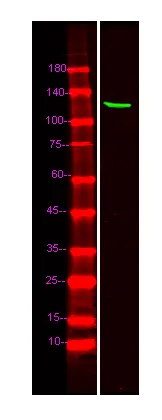
Nuclear receptor interacting protein 1 (NRIP1) is a nuclear protein that specifically interacts with the hormone-dependent activation domain AF2 of nuclear receptors. Also known as RIP140, this protein modulates transcriptional activity of the estrogen receptor. [provided by RefSeq, Jul 2008],disease:Genetic variation in NRIP1 may act as predisposing factor for endometriosis.,domain:Contains 9 Leu-Xaa-Xaa-Leu-Leu (LXXLL) motifs, which have different affinities for nuclear receptors. The C-terminal LTKTNPILYYMLQK motif is required for ligand-dependent interaction with RAAR and RXRB homo- and heterodimers, for the corepressor activity, and for the formation of an HDAC3 complex with RARA/RXRB (By similarity). Contains at least four autonomous repression domains (RD1-4). RD1 functions via a histone deacetylase (HDAC)-independent mechanism, whereas RD2, RD3 and RD4 can function by HDAC-dependent or independent mechanisms, depending on cell type. RD2 is dependent on CTBP binding.,function:Modulates transcriptional activation by steroid receptors such as NR3C1, NR3C2 and ESR1. Also modulates transcriptional repression by nuclear hormone receptors.,PTM:Acetylation regulates its nuclear translocation and corepressive activity (By similarity). Acetylation abolishes interaction with CTBP1. Phosphorylation enhances interaction with YWHAH.,subcellular location:Localized to discrete foci and redistributes to larger nuclear domains upon binding to ligand-bound NR3C1.,subunit:Interacts with the ligand binding domain (LBD) of NR2C1 in the absence of ligand. Interacts with RARA and RXRB homodimers and RARA/RXRB heterodimers in the presence of ligand. Interacts with HDAC1 and HDAC3 via its N-terminal domain (By similarity). Interacts with CTBP1, CTBP2, ESR1, HDAC1, HDAC2, HDAC5, HDAC6, NR3C1, NR3C2, YWHAH, JUN and FOS. Found in a complex with both NR3C1 and YWHAH.,
研究领域