Recombinant Mouse EFNA5 (C-6His)
Alternative NamesEphrin-A5; AL-1; EPH-related receptor tyrosine kinase ligand 7; Epl7; Eplg7; Lerk7; Efna5
规格参数 Specifications
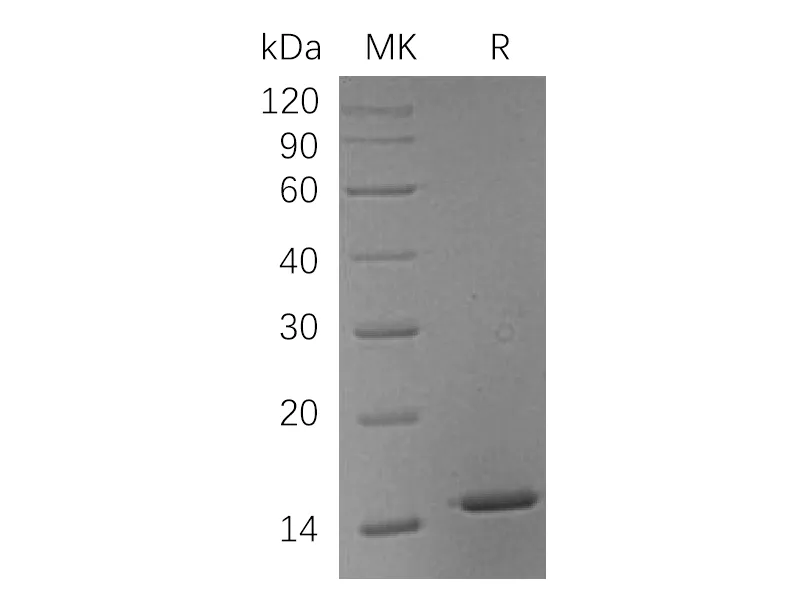
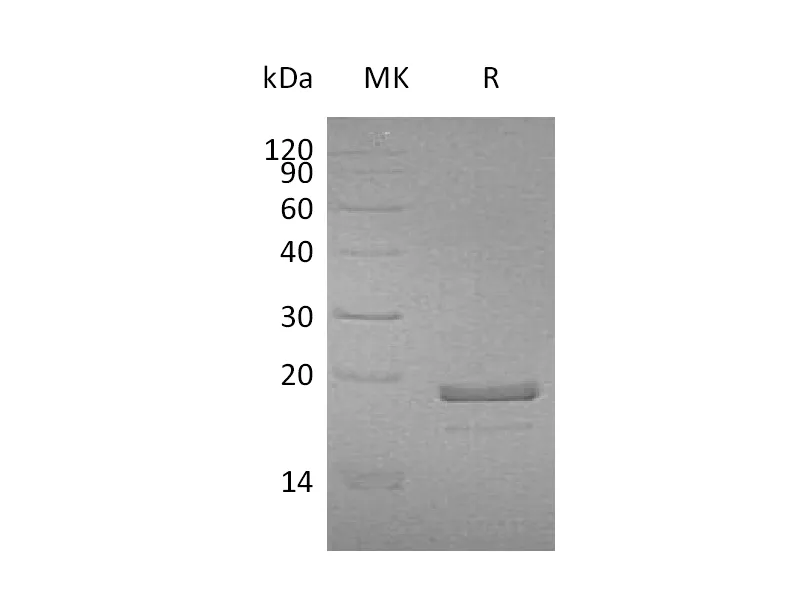
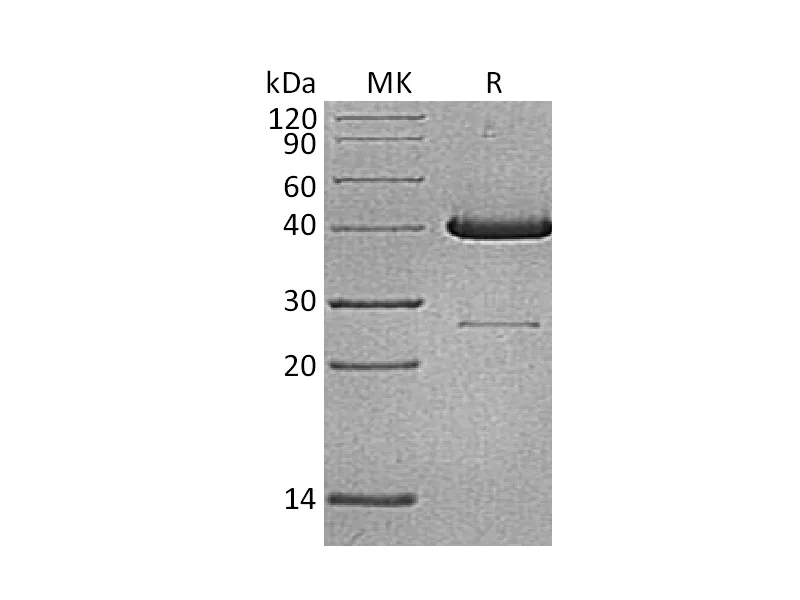
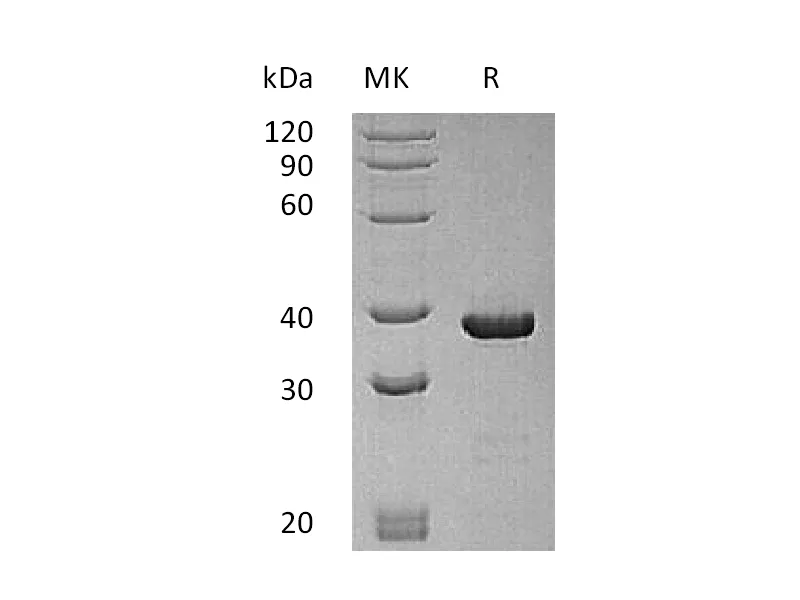
| 纯度Purity | Greater than 95% as determined by reducing SDS-PAGE |
|---|---|
| 内毒素Endotoxin | <1 EU/µg as determined by LAL test. |
| 蛋白构建Protein Construction |
【Gln21-Gln206】序列区间-6HisC 端标签
|
| Accession | O08543 |
| 表达宿主Expression Host | HEK293 |
| 种属Species | Mouse |
| 预测分子量Predicted MW | 22.5 kDa |
| 制剂Formulation | Lyophilized from a 0.2 μm filtered solution of PBS, pH 7.4. |
| 运输方式Shipping | The product is shipped with ice bag. Upon receipt, store it immediately at the temperature listed below. |
| 稳定性&储存Stability & Storage | 12 months at -20°C to -80°C in lyophilized state.6 months at -20°C to -80°C under sterile conditions after reconstitution.7-10 days at 2°C to 8°C under sterile conditions after reconstitution.Please minimize freeze-thaw cycles. |
| 复溶Reconstitution | Always centrifuge tubes before opening. Do not mix by vortex or pipetting. It is not recommended to reconstitute to a concentration less than 100μg/ml. Dissolve the lyophilized protein in distilled water. Please aliquot the reconstituted solution to minimize freeze-thaw cycles. |
!
本司产品仅用于科研,不用于临床诊断和治疗。
产品图片 Product Images点击图片可查看原图
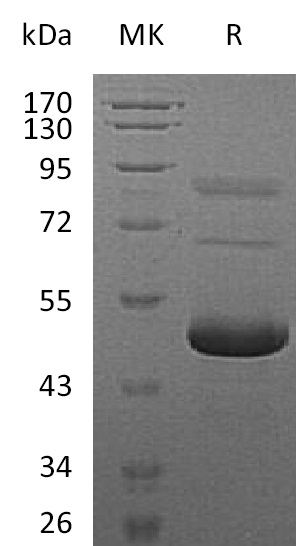 |
Greater than 90% as determined by reducing SDS-PAGE. |
靶点信息 Target Information
| 分子别名Alternative Names | Ephrin-A5AL-1EPH-related receptor tyrosine kinase ligand 7Epl7Eplg7Lerk7Efna5 |
|---|---|
| 功能Function | Cell surface GPI-bound ligand for Eph receptors, a family of receptor tyrosine kinases which are crucial for migration, repulsion and adhesion during neuronal, vascular and epithelial development. Binds promiscuously Eph receptors residing on adjacent cells, leading to contact-dependent bidirectional signaling into neighboring cells. The signaling pathway downstream of the receptor is referred to as forward signaling while the signaling pathway downstream of the ephrin ligand is referred to as reverse signaling. Induces compartmentalized signaling within a caveolae-like membrane microdomain when bound to the extracellular domain of its cognate receptor. This signaling event requires the activity of the Fyn tyrosine kinase. Activates the EPHA3 receptor to regulate cell-cell adhesion and cytoskeletal organization. With the receptor EPHA2 may regulate lens fiber cells shape and interactions and be important for lens transparency maintenance. May function actively to stimulate axon fasciculation. The interaction of EFNA5 with EPHA5 also mediates communication between pancreatic islet cells to regulate glucose-stimulated insulin secretion. Cognate/functional ligand for EPHA7, their interaction regulates brain development modulating cell-cell adhesion and repulsion. |
| 亚细胞定位Subcellular Location | Cell membrane; Lipid-anchor, GPI-anchor. Membrane, caveola; Lipid-anchor, GPI-anchor. |
| 数据库链接Databases |
基因功能参考文献39 条
- that Epha2 and Efna5 participate in the complex, global patterning of lens fiber cells that is necessary for maximal optical quality PMID: 29800803 : 29800803
- This study demonstrated for a role of ephrinA signaling for the selective targeting of serotonergic raphe nuclei. We show that EphA5 is differentially expressed across the different hindbrain raphe nuclei, and that this correlates with a different repulsive action of ephrinA on 5-HT axon growth. PMID: 28197551 : 28197551
- these results suggest that the basic helix-loop-helix transcription factorsbinding site in ECR1 is involved in the positive regulation of ephrin-A5 gene expression during the development of the mesencephalon. PMID: 28614915 : 28614915
- During urogenital development, different modes of Eph/Ephrin signaling occur at several sites with EphrinB2 and EphrinA5 acting in concert. PMID: 27344203 : 27344203
- dissociations of N-cadherin and adherens junctions in the associated interlocking domains may result in the formation of isolated globules and nuclear opacities in the ephrin-A5(-/-) mice. PMID: 26643403 : 26643403
- Overexpression of Ephrin-A5 in mice results in decreasing the size of progenitor pool through inducing apoptosis. PMID: 26674965 : 26674965
- Ephrin-A5 interacts with Ephrin-A4 to modulate neurogenesis and angiogenesis in a model of temporal lobe epilepsy. PMID: 25502292 : 25502292
- Data show the effects of genetic loss of ephrin-A5, Eph receptors EphA4, and EphA7 on the development of medulloblastoma tumors in the smoothened (Smo) transgenic mouse model. PMID: 26345456 : 26345456
- the unique cross-subclass interaction of EphB2 with ephrin A5 has evolved to function upstream of JNK signaling for the purpose of maintaining an adequate pool of progenitor cells to ensure proper closure of the optic fissure. PMID: 26839344 : 26839344
- Female mice lacking EFNA5 are subfertile, exhibit a compromised response to LH, and display abnormal ovarian histology after superovulation. PMID: 26672804 : 26672804
- NF-kappaB in NG2(+) cells promotes myoblast migration to the tips of myofibers through cell-cell contact through expression of ephrinA5 from NG2(+) cells PMID: 26777211 : 26777211
- The reduced nuclear size and diminished gene expression mirrors subtle changes in ephrin A5 expression evident in P1 and P4 enucleated neocortex, 11 and 8 days prior to natural eye opening, respectively. PMID: 26452243 : 26452243
- These data support the hypothesis that the retinocollicular projection is a superimposition of a number of individual two-dimensional topographic maps that originate from specific types of RGCs, require ephrin-A signaling. PMID: 25649160 : 25649160
- Ephrin A2 and Ephrin-A5 are important for the functional development of cutaneous innervation. PMID: 25243788 : 25243788
- ephrin A5 ligands imported by invading thalamic axons interact with EphA4-expressing radial glial cells. PMID: 25480914 : 25480914
- data show that ephrinA5 drives repellent interactions between temporal and nasal axons within the superior colliculus, and demonstrates for the first time that target-independent mechanisms play an essential role in retinocollicular map formation in vivo. PMID: 25451192 : 25451192
- multi-protein complex comprising ephrinA5, EphA7, and TNFR1 may constitute a platform for inducing caspase-dependent apoptotic cell death PMID: 23657875 : 23657875
- Ephrin-A5 has a critical role in postnatal lens fiber organization to maintain lens transparency PMID: 23401654 : 23401654
- Complementary expression of ephrin-A5 in hair cells and EphA4 receptor among spiral ganglion neuron populations controls the targeting of type I and type II afferent fibres to inner and outer hair cells, respectively. PMID: 23385583 : 23385583
- ephrin-A5 expression appears to be critical for proper development of central monoaminergic pathways and that its loss results in a number of neurodevelopmental abnormalities PMID: 22954718 : 22954718
- Ephrin-A5 is induced in reactive astrocytes in periinfarct cortex and is an inhibitor of axonal sprouting and motor recovery in stroke. PMID: 22837401 : 22837401
- In a growth cone collapse assay, mouse embryonic stem cell-derived spinal motor neurons respond to ephrin-A5, semaphorin(Sema)3f, and Sema3a in a concentration-dependent manner. PMID: 22279234 : 22279234
- Results demonstrated that the ephrinA5-EphA4/EphA5 system plays an important role in the direct pathway-dependent regulation of the SNr in cocaine responses and would provide valuable therapeutic targets of cocaine addiction. PMID: 21628570 : 21628570
- Our work shows that ephrinA5 protein is expressed in restrictive regions of the developing mouse brain PMID: 20738842 : 20738842
- EphA/ephrin-A signaling plays crucial roles in the establishment and/or maintenance of the brain vascular system, as an essential constituent of the adult neurogenic niche. PMID: 20474079 : 20474079
- Results indicate that on postnatal day 8 (P8), the dendrites in mutant animals exhibit more filopodia and are more branched than dendrites of wildtype cells; on P23, dendrites are still more branched, but possess fewer spines than wildtype cells. PMID: 19827157 : 19827157
- Optic nerve section in adult rat regulates the expression of EphA5 in the retina.EphA5 was expressed as an increasing naso-temporal gradient. By 1 month, expression was decreased resulting in a uniform expression across the naso-temporal axis. PMID: 11860487 : 11860487
- Involved in embryonic axon guidance of limbic thalamocortical projections; gene knockout results in "miswiring" of these pathways PMID: 12417660 : 12417660
- Ephrin A5 receptor in the thalamus and ephrin A5 in the cerebral cortex control intra-areal topographic mapping of thalamocortical axons. PMID: 12895420 : 12895420
- positional differences in axon terminal areas are eliminated with ephrin-A5 overexpression PMID: 15527895 : 15527895
- We conclude that ectopic expression of ephrin A5 in murine fibroblasts elevates oncogenic potential, including increased invasive behaviour, anchorage-independent growth, and morphological transformation. PMID: 17022942 : 17022942
- Ephrin-A5 enhances the motility of cortical neurons that is dependent on the activity of Src-family kinases; Ephrin-A5 further changes the adhesive properties of neurons by inducing the formation of cell aggregates. PMID: 17522309 : 17522309
- ephrin-A5 specifically regulates branch formation of thalamic axons, but does not affect target layer selection PMID: 18463505 : 18463505
- Results compare gene expression patterns in the somatosensory cortex of wild type and ephrinA5 deficient mice, which exhibit subtle, but highly reproducible alterations of thalamocortical projections and intrinsic cortical circuits. PMID: 18619851 : 18619851
- Results suggest that ephrin-A5 acts as an inhibitory flank that contributes to define the pathway of migrating interneurons. PMID: 18662335 : 18662335
- Ephrin-A5 and B1 localization and signaling in murine fibroblasts and tissues were examined. PMID: 18694724 : 18694724
- Analysis of the striatal patterning in ephrin A5/EphA4 mutant mice revealed the requirement of EphA4 signalling for the proper sorting of matrix and striosome neuronal populations in vivo. PMID: 18755772 : 18755772
- ephrin-A5 interacts with the EphA2 receptor to regulate the adherens junction complex, a key role in lens fiber cell shape and cell-cell interactions PMID: 18948590 : 18948590
- ephrinAs and more specifically ephrinA5, may be actors in the guidance of dopaminergic projections PMID: 19576892 : 19576892
蛋白复溶体积计算器缓冲液体积 = 蛋白质量 ÷ 蛋白浓度
输入任意两项,第三项自动计算 |
蛋白浓度稀释计算器初浓度 × 初体积 = 终浓度 × 终体积
输入任意三项,第四项自动计算 |