


Recombinant Mouse CADM1 (C-6His)
Alternative NamesCell adhesion molecule 1;Immunoglobulin superfamily member 4;IgSF4;Nectin-like protein 2;NECL-2;Synaptic cell adhesion molecule;SynCAM;Tumor suppressor in lung cancer 1;TSLC-1
规格参数 Specifications
| 纯度Purity | Greater than 95% as determined by reducing SDS-PAGE |
|---|---|
| 内毒素Endotoxin | <1 EU/µg as determined by LAL test. |
| 蛋白构建Protein Construction |
【Gln48-His388】序列区间-6HisC 端标签
|
| Accession | Q8R5M8 |
| 表达宿主Expression Host | HEK293 |
| 种属Species | Mouse |
| 预测分子量Predicted MW | 39.2 kDa |
| 制剂Formulation | Lyophilized from a 0.2 μm filtered solution of PBS, pH 7.4. |
| 运输方式Shipping | The product is shipped with ice bag. Upon receipt, store it immediately at the temperature listed below. |
| 稳定性&储存Stability & Storage | 12 months at -20°C to -80°C in lyophilized state.6 months at -20°C to -80°C under sterile conditions after reconstitution.7-10 days at 2°C to 8°C under sterile conditions after reconstitution.Please minimize freeze-thaw cycles. |
| 复溶Reconstitution | Always centrifuge tubes before opening. Do not mix by vortex or pipetting. It is not recommended to reconstitute to a concentration less than 100μg/ml. Dissolve the lyophilized protein in distilled water. Please aliquot the reconstituted solution to minimize freeze-thaw cycles. |
!
本司产品仅用于科研,不用于临床诊断和治疗。
产品图片 Product Images点击图片可查看原图
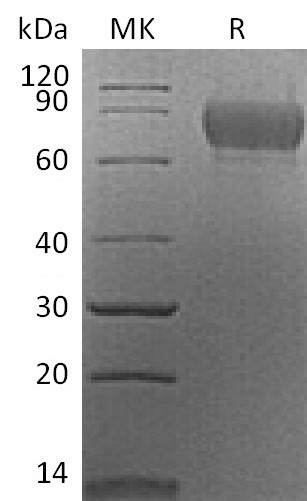 |
Greater than 95% as determined by reducing SDS-PAGE. |
靶点信息 Target Information
| 分子别名Alternative Names | Cell adhesion molecule 1Immunoglobulin superfamily member 4IgSF4Nectin-like protein 2NECL-2Synaptic cell adhesion moleculeSynCAMTumor suppressor in lung cancer 1TSLC-1 |
|---|---|
| 功能Function | Mediates homophilic cell-cell adhesion in a Ca(2+)-independent manner. Also mediates heterophilic cell-cell adhesion with CADM3 and NECTIN3 in a Ca(2+)-independent manner. Interaction with CRTAM promotes natural killer (NK) cell cytotoxicity and interferon-gamma (IFN-gamma) secretion by CD8+ T-cells in vitro as well as NK cell-mediated rejection of tumors expressing CADM1 in vivo. In mast cells, may mediate attachment to and promote communication with nerves. CADM1, together with MITF, is essential for development and survival of mast cells in vivo. By interacting with CRTAM and thus promoting the adhesion between CD8+ T-cells and CD8+ dendritic cells, regulates the retention of activated CD8+ T-cell within the draining lymph node. Required for the intestinal retention of intraepithelial CD4+ CD8+ T-cells and, to a lesser extent, intraepithelial and lamina propria CD8+ T-cells and CD4+ T-cells. Interaction with CRTAM promotes the adhesion to gut-associated CD103+ dendritic cells, which may facilitate the expression of gut-homing and adhesion molecules on T-cells and the conversion of CD4+ T-cells into CD4+ CD8+ T-cells. Acts as a synaptic cell adhesion molecule and plays a role in the formation of dendritic spines and in synapse assembly. May be involved in neuronal migration, axon growth, pathfinding, and fasciculation on the axons of differentiating neurons. May play diverse roles in the spermatogenesis including in the adhesion of spermatocytes and spermatids to Sertoli cells and for their normal differentiation into mature spermatozoa. |
| 亚细胞定位Subcellular Location | Cell membrane; Single-pass type I membrane protein. Cell junction, synapse, synaptic cell membrane; Single-pass type I membrane protein. |
| 数据库链接Databases |
基因功能参考文献50 条
- alternative splicing can give rise to both shedding-susceptible and shedding-resistant CADM1 (cell adhesion molecule 1) variant proteins. PMID: 28393893 : 28393893
- SynCAM1, Neuroligin-1B and Neuroligin-2A were overexpressed in newborn neurons in the dentate gyrus of 7- to 9-week-old mice. SynCAM1 increased the morphological maturation of dendritic spines and mossy fiber terminals while Neuroligin-1B increased spine density. In contrast, Neuroligin-2A increased both spine density and size as well as GABAergic innervation and resulted in a drastic increase of neuronal survival. PMID: 27473321 : 27473321
- The results of this study demonstrate that the synapse-organizing adhesion molecule SynCAM 1 has pronounced effects on neuronal connectivity in the hippocampal CA3 area. PMID: 27413156 : 27413156
- Cadm1 is a direct target of NFATc1, which is induced by RANKL through epigenetic modification, and regulates osteoclastic bone resorption in a negative feedback manner. PMID: 28414795 : 28414795
- Data show that cell adhesion molecule 1 (SynCAM 1) generally prolongs the lifetime of spines. PMID: 27053173 : 27053173
- This experiments show that the survival rate of adult-generated neurons is increased by overexpressing SynCAM 1 PMID: 26332750 : 26332750
- Our study reveals a novel mechanism of chronic NF-kappaB activation by CADM1 in HTLV-1 infected cells PMID: 25774694 : 25774694
- Study demonstrates that polysialic acid-SynCAM 1 defines a subpopulation of NG2 cells and identifies the presence of polysialic acid-NRP2 in microglia PMID: 25752299 : 25752299
- CADM1 appeared to sustain gap junctional intercellular communication among alpha-cells via homophilic binding and, based on this action, CADM1 appears to prevent excessive secretion of glucagon from alpha-cells. PMID: 22513384 : 22513384
- This study demonistrated that SynCAM 1 in the synaptic organization of the rod visual pathway and provide evidence for novel roles of synaptic adhesion in the structural and functional integrity of ribbon synapses. PMID: 23982969 : 23982969
- Necl-2 co-localizes with ErbB4 in hippocampus and and regulates ErbB4 signaling in cultured neurons. PMID: 23769722 : 23769722
- Loss of SynCAM1 modulates cocaine effects on spine structures in the nucleus accumbens. PMID: 23169347 : 23169347
- The bone volume fraction did not differ between the CADM1 knockout mice and the wild type mice for both 8-week old and 11-week old mice. PMID: 23541110 : 23541110
- Cadm1 is indeed a bona fide tumor suppressor gene and provide new insights into genetic partners that co-operate in tumorigenesis when Cadm1-expression is lost. PMID: 22553910 : 22553910
- These results indicated that CADM1 was a novel osteoblastic adhesion molecule that is expressed transiently during osteoblastic maturation, and a useful diagnostic marker for osteosarcoma cells. PMID: 23142238 : 23142238
- Cadm1 specifically interacts with Mupp1, and may form a ternary complex with Mupp1-GABBR2 in the cerebellum. PMID: 22994563 : 22994563
- Epigenetic silencing complexity in the promoter region of Cadm1 is not only defined by DNA hypermethylation, but high nucleosome occupancy, altered nucleosome positioning and 'bivalent' histone modifications. PMID: 22701659 : 22701659
- disruption of SynCAM1-dependent astroglial function results in behavioral abnormalities similar to those described in animals model of attention-deficit hyperactive disorder PMID: 22558465 : 22558465
- Cadm1 expression in the hair follicle plays a role in autoimmune alopecia. PMID: 22210910 : 22210910
- Results suggest that although the Foxp2 transcription factor does not target Cadm1, Cadm1 at the synapses of Purkinje cells and parallel fibers is necessary for ultrasonic vocalization (USV) function. PMID: 22272290 : 22272290
- These results clarify the detailed mechanism of membrane-proximal cleavage of CADM1, suggesting the possibility of RIP-mediated CADM1 signaling. PMID: 22172944 : 22172944
- Synaptic cell adhesion molecule SynCAM 1 self-assembles laterally via its extracellular, membrane-proximal immunoglobulin domains 2 and 3, generating SynCAM oligomers and instructing interactions of SynCAM 1 across the nascent and mature synaptic cleft. PMID: 21926970 : 21926970
- IGSF4 plays a central role in T cell functioning by dual independent mechanisms, control of T cell receptor signaling and control of T cell-antigen-presenting cell interaction. PMID: 22084409 : 22084409
- SynCAM1 mediates astrocyte-to-astrocyte and astrocyte-to-GnRH neuron adhesiveness in the hypothalamus. PMID: 21486931 : 21486931
- SynCAM1 is expressed in astrocytes and contributes to erbB4 receptor-mediated control of female sexual development. PMID: 21486934 : 21486934
- From pachytene spermatocytes at stage VI to step 4 spermatids, RA175 was not detected by the enzyme-labelled antibody method and was faintly detected by the indirect immunofluorescence method. PMID: 21486398 : 21486398
- results indicate that CADM1d is a specific neuronal isoform that enhances nerve-mast cell interaction, and they suggest that nerve-mast cell interaction may be reinforced as the brain grows mature because CADM1d becomes predominant PMID: 21482734 : 21482734
- The mutated CADM1 showed morphological abnormalities, including shorter dendrites, and impaired synaptogenesis in neurons. PMID: 21364653 : 21364653
- Overexpression of SynCAM 1 in transgenic mice promotes excitatory synapse number, while loss of SynCAM 1 results in fewer excitatory synapses. SynCAM 1 also functions at mature synapses to alter their plasticity by regulating long-term depression. PMID: 21145003 : 21145003
- this study demonstrates that CADM1 plays roles in regulating emotional behaviors, social behaviors and motor performances, and that CADM1 has important implications for psychiatric disorders with disruptions in social behavior, such as autism. PMID: 20450890 : 20450890
- Analysis of serial sections of perinatal Ncam(-/-) brain revealed that polySia-SynCAM 1 is expressed exclusively by NG2 cells, a multifunctional glia population that can receive glutamatergic input via unique neuron-NG2 cell synapses. PMID: 20479255 : 20479255
- SynCAM 1 acts in developing neurons to shape migrating growth cones and contributes to the adhesive differentiation of their axo-dendritic contacts PMID: 20368431 : 20368431
- Cell adhesion molecules between spermatogenic and Sertoli cells play essential roles in spermatogenesis. PMID: 19337787 : 19337787
- The Tslc1 gene is mapped on mouse chromosome 9, a synteny of human chromosome 11q, and is composed of ten exons, the exon-intron junctions being highly conserved between human and mouse. PMID: 12242005 : 12242005
- results showing that SgIGSF mediates the adhesion of mast cells to fibroblasts and that the transcription of SgIGSF is critically regulated by MITF. PMID: 12456501 : 12456501
- SgIGSF on the surface of spermatogenic cells binds to some membrane molecules on Sertoli cells in a heterophilic manner and thereby may play diverse roles in the spermatogenesis PMID: 12606335 : 12606335
- Possibly involved in localization of a transmembrane protein(s) through Pals2. PMID: 12826663 : 12826663
- SgIGSF has a role in survival of cultured mast cells PMID: 15158462 : 15158462
- SgIGSF and KIT independently play significant roles in cell migration PMID: 15474495 : 15474495
- the tscl1 protein was localized in the brain neuroepithelium at embryonic day 9.5, neural crest at E10.5, motor neurons at E10.5, and olfactory epithelium at E16.5. PMID: 15707673 : 15707673
- The spatiotemporal patterns of the expression suggest that IGSF4 plays crucial roles in the development of both telencephalon and cerebellum. PMID: 15862624 : 15862624
- RA175-based cell junction is necessary for retaining elongating spermatids in the invagination of Sertoli cells for their maturation and translocation to the adluminal surface for timely release. PMID: 16382161 : 16382161
- Results suggest that MITF and SgIGSF appear essential for the development and survival of mast cells in tissues of adult WBB6F1-KitW/KitW-v mice. PMID: 16605125 : 16605125
- Tslc1 is essential for normal spermatogenesis in mice. PMID: 16611999 : 16611999
- TSLC1/IGSF4 expression is indispensable for the adhesion of spermatocytes and spermatids to Sertoli cells and for their normal differentiation into mature spermatozoa. PMID: 16612000 : 16612000
- results establish an essential role for Tslc1 in spermatozoal maturation & motility, distinct from other members of the nectin family PMID: 16837733 : 16837733
- These results indicate that TSLC1 is a novel interameloblast adhesion molecule that may be downregulated during ameloblastic tumorigenesis. PMID: 17300670 : 17300670
- We propose that SgIGSF is a novel and functional biliary epithelial cell adhesion molecule that is expressed for a limited time during active bile duct/ductule formation. PMID: 17326163 : 17326163
- The retrograde response to axotomy of spinal motoneurons involves a rapid down-regulation of SynCAM1 mRNA, indicating that down-regulation of synaptic adhesion molecules plays a role in postinjury synapse elimination PMID: 17492651 : 17492651
- In the Ra175(-/-) elongating spermatid, Par-3 was absent, and Jam-C was absent or abnormally localized. PMID: 18055550 : 18055550
蛋白复溶体积计算器缓冲液体积 = 蛋白质量 ÷ 蛋白浓度
输入任意两项,第三项自动计算 |
蛋白浓度稀释计算器初浓度 × 初体积 = 终浓度 × 终体积
输入任意三项,第四项自动计算 |



