


| 纯度Purity | Greater than 95% as determined by reducing SDS-PAGE |
|---|---|
| 内毒素Endotoxin | <1 EU/µg as determined by LAL test. |
| 蛋白构建Protein Construction |
【Gln24-Thr266】序列区间-FcC 端标签
|
| Accession | Q99JW5 |
| 表达宿主Expression Host | HEK293 |
| 种属Species | Mouse |
| 预测分子量Predicted MW | 54.8 kDa |
| 制剂Formulation | Lyophilized from a 0.2 μm filtered solution of PBS, pH 7.4. |
| 运输方式Shipping | The product is shipped with ice bag. Upon receipt, store it immediately at the temperature listed below. |
| 稳定性&储存Stability & Storage | 12 months at -20°C to -80°C in lyophilized state.6 months at -20°C to -80°C under sterile conditions after reconstitution.7-10 days at 2°C to 8°C under sterile conditions after reconstitution.Please minimize freeze-thaw cycles. |
| 复溶Reconstitution | Always centrifuge tubes before opening. Do not mix by vortex or pipetting. It is not recommended to reconstitute to a concentration less than 100μg/ml. Dissolve the lyophilized protein in distilled water. Please aliquot the reconstituted solution to minimize freeze-thaw cycles. |
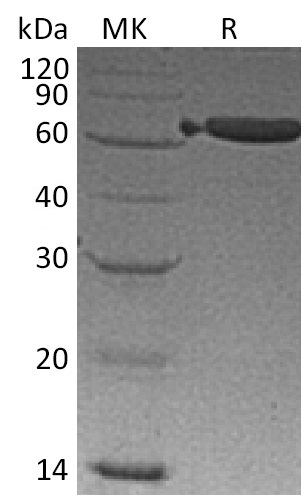 |
Greater than 95% as determined by reducing SDS-PAGE. |
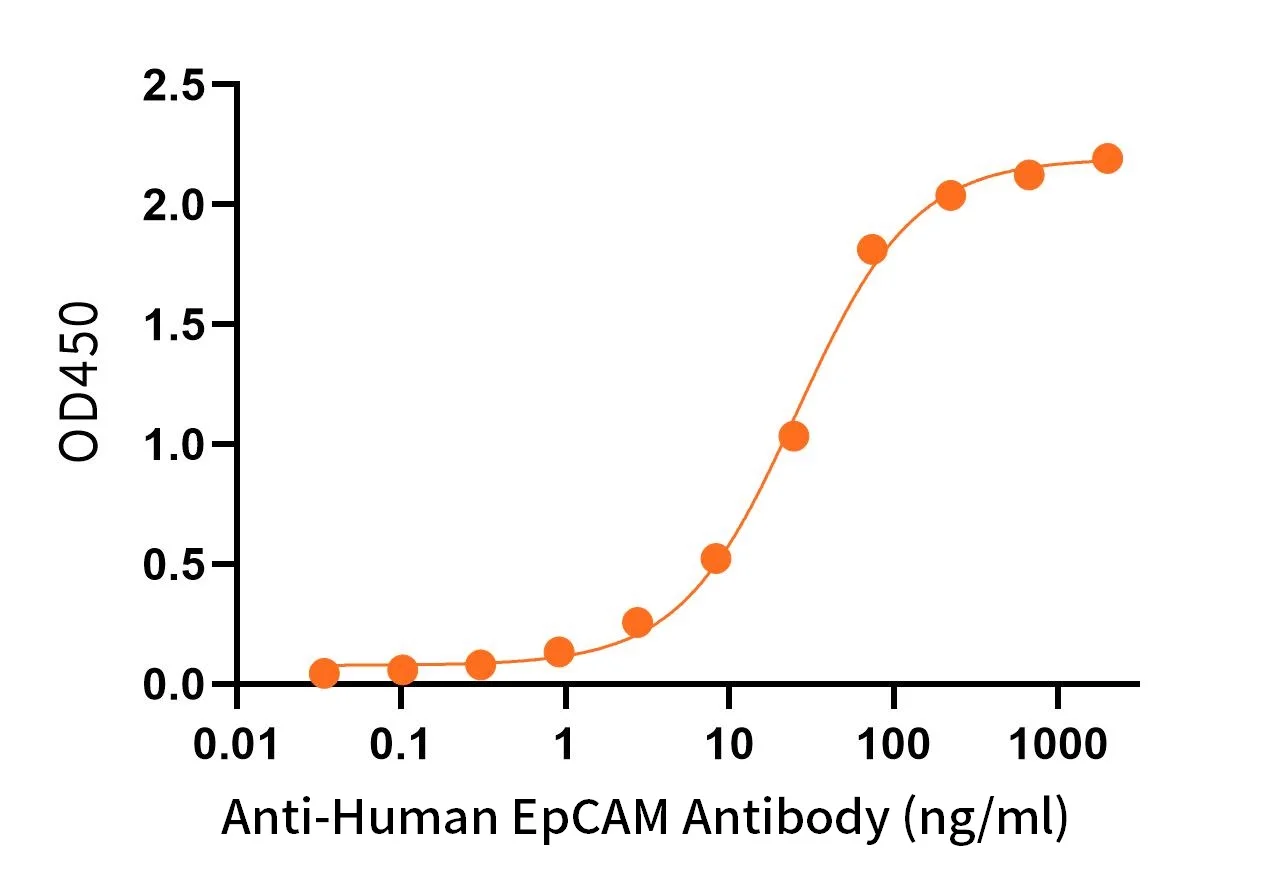 |
Immobilized Recombinant Mouse EpCAM (C-Fc) at 1μg/ml (100 μl/well) can bind Anti-Human EpCAM Antibody(Human IgG4)*. *: Biotinylated by NHS-biotin prior to testing.The ED50 of Anti-Human EpCAM Antibody is 25.73ng/ml.(Regularly tested). |
| 分子别名Alternative Names | 17-1A323/A3ACSTD1CD326EGP-2EGP314EGP40EpCAMMOC31TACST-1TACSTD1TROP1 |
|---|---|
| 功能Function | May act as a physical homophilic interaction molecule between intestinal epithelial cells (IECs) and intraepithelial lymphocytes (IELs) at the mucosal epithelium for providing immunological barrier as a first line of defense against mucosal infection. Plays a role in embryonic stem cells proliferation and differentiation. Up-regulates the expression of FABP5, MYC and cyclins A and E. |
| 亚细胞定位Subcellular Location | Lateral cell membrane; Single-pass type I membrane protein. Cell junction, tight junction. |
| 数据库链接Databases |
基因功能参考文献22 条
- The expression of Epcam mRNA, which is a functional marker of potential hepatic stem-like cells, was controlled by LEF1, which was regulated by CLOCK. PMID: 29958886 : 29958886
- EpEX/EpCAM are sufficient to reprogram fibroblasts into iPSCs with only Oct4 or Klf4. PMID: 28157205 : 28157205
- extracellular vesicles tend to localize in the intestinal tract associated with epithelial cell adhesion molecule PMID: 27721471 : 27721471
- Data show that EpCAM-expressing proliferating ductal cells (PDC) could be a cellular origin of hepatocellular carcinoma (HCC), suggesting the existence of stem/progenitor-derived hepatocarcinogenesis. PMID: 28951464 : 28951464
- activation of hepatic H19RNA promoted cholestatic liver fibrosis through the ZEB1/EpCAM signaling pathway PMID: 28407375 : 28407375
- These results identify EpCAM as a substrate of matriptase and link HAI-2, matriptase, EpCAM, and claudin-7 in a functionally important pathway that causes disease when it is dysregulated. PMID: 28094766 : 28094766
- EpCAM appears to differentially regulate Langerhans cell mobility/migration in the setting of limited inflammation as compared with the intense inflammation triggered by contact sensitizers PMID: 27106675 : 27106675
- Knock-down EpCAM cell model of congenital tufting enteropathy was developed. In vivo inducible mouse model was developed resulting in mutant EpCAM protein. PMID: 25482158 : 25482158
- in addition to converting to cholangiocyte-like cells, Sox9(+)EpCAM(-) cells provide luminal space near expanded ductular structures to prevent deterioration of the injuries and potentially supply new hepatocytes to repair damaged tissues PMID: 24482234 : 24482234
- EpCAM is a highly conserved protein present in fishes, amphibians, reptiles, birds, marsupials, and placental mammals, and is subject to shedding, gamma-secretase-dependent regulated intramembrane proteolysis, and proteasome-mediated degradation. PMID: 24009667 : 24009667
- Suggest pivotal role of EpCAM in intestinal epithelial structure and integrity, with mutations resulting in congenital tufting enteropathy. PMID: 24337010 : 24337010
- mTrop1/Epcam knockout mice develop congenital tufting enteropathy through dysregulation of intestinal E-cadherin/beta-catenin. PMID: 23209569 : 23209569
- EpCAM contributes to formation of intestinal barrier by recruiting claudins to cell-cell junctions. PMID: 22819673 : 22819673
- These results conclusively link EpCAM expression to Langerhan cell (LC) motility/migration and LC migration to immune regulation. PMID: 22411813 : 22411813
- Results show that SSCs are the most concentrated in CD9(+)EPCAM(low/-) population and also suggest that EPCAM plays an important role in progenitor cell amplification in the mouse spermatogenic system. PMID: 21858196 : 21858196
- EpCAM could contribute substantially to the pathogenesis of lung cancer. PMID: 21535318 : 21535318
- EpCAM was required for differentiation or survival of parietal trophoblast giant cells, normal development of the placental labyrinth and establishment of a competent maternal-fetal circulation. PMID: 20046825 : 20046825
- analysis of EpCAM expression in normal, non-pathological tissues PMID: 17981779 : 17981779
- The spatiotemporal expression pattern of EpCAM changes during nephrogenesis PMID: 18025791 : 18025791
- These data suggest that EpCAM is involved in signal transduction triggering several intracellular signalling pathways using tumor cell lines in colorectal and lung cancer. PMID: 19002182 : 19002182
- EpCAM(+) cells isolated from injured liver proliferate to form colonies in vitro, and the clonally expanded cells differentiate into hepatocytes and cholangiocytes, suggesting that the oval cell fraction contains potential HSCs. PMID: 19429791 : 19429791
- expression of EpCAM and DLK1 suggests the developmental pathways of mouse liver progenitors PMID: 19527784 : 19527784
蛋白复溶体积计算器缓冲液体积 = 蛋白质量 ÷ 蛋白浓度
输入任意两项,第三项自动计算 |
蛋白浓度稀释计算器初浓度 × 初体积 = 终浓度 × 终体积
输入任意三项,第四项自动计算 |



