


Recombinant Mouse TF (C-6His)
Alternative NamesTissue factor; TF; Coagulation factor III
规格参数 Specifications
| 纯度Purity | Greater than 95% as determined by reducing SDS-PAGE |
|---|---|
| 内毒素Endotoxin | <1 EU/µg as determined by LAL test. |
| 蛋白构建Protein Construction |
【Ala29-Glu251】序列区间-6HisC 端标签
|
| Accession | P20352 |
| 表达宿主Expression Host | HEK293 |
| 种属Species | Mouse |
| 预测分子量Predicted MW | 26.2 kDa |
| 制剂Formulation | Lyophilized from a 0.2 μm filtered solution of 20mM Tris-HCl, 150mM NaCl, 0.05% Brij35, pH 7.5. |
| 运输方式Shipping | The product is shipped with ice bag. Upon receipt, store it immediately at the temperature listed below. |
| 稳定性&储存Stability & Storage | 12 months at -20°C to -80°C in lyophilized state.6 months at -20°C to -80°C under sterile conditions after reconstitution.7-10 days at 2°C to 8°C under sterile conditions after reconstitution.Please minimize freeze-thaw cycles. |
| 复溶Reconstitution | Always centrifuge tubes before opening. Do not mix by vortex or pipetting. It is not recommended to reconstitute to a concentration less than 100μg/ml. Dissolve the lyophilized protein in distilled water. Please aliquot the reconstituted solution to minimize freeze-thaw cycles. |
!
本司产品仅用于科研,不用于临床诊断和治疗。
产品图片 Product Images点击图片可查看原图
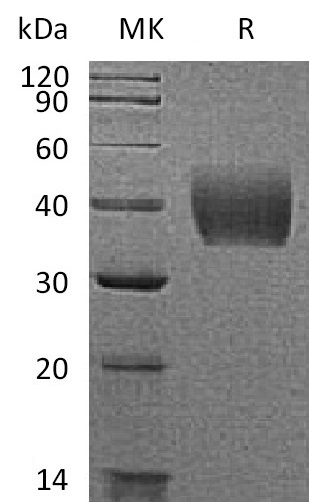 |
Greater than 95% as determined by reducing SDS-PAGE. |
靶点信息 Target Information
| 分子别名Alternative Names | Tissue factorTFCoagulation factor III |
|---|---|
| 功能Function | Initiates blood coagulation by forming a complex with circulating factor VII or VIIa. The [TF:VIIa] complex activates factors IX or X by specific limited proteolysis. TF plays a role in normal hemostasis by initiating the cell-surface assembly and propagation of the coagulation protease cascade. |
| 亚细胞定位Subcellular Location | Membrane; Single-pass type I membrane protein. |
| 数据库链接Databases |
基因功能参考文献50 条
- Tissue factor cytoplasmic domain is involved in TF-PAR-2 signalling initiating hepatic fibrosis and is a potential therapeutic target, as its deletion would not impact coagulation. PMID: 28883694 : 28883694
- Myeloid cell derived tissue factor dampens inflammation in acid-induced acute lung injury. PMID: 28509332 : 28509332
- Ticagrelor, but not clopidogrel, reduces arterial thrombosis via endothelial tissue factor suppression. Ticagrelor reduced TNF-alpha-induced TF expression via proteasomal degradation. PMID: 28028070 : 28028070
- Evening primrose oil and forskolin decreased the prothrombotic effect of celecoxib initiated by a LPS challenge in mice, and this effect was, at least partly, mediated by mitigating TF expression and activity. PMID: 28124089 : 28124089
- There was no significant contribution of TF on myeloid cells in multiple models of experimental ALI, leading to the conclusion that TF in myeloid cells is not a major contributor to experimental ALI. PMID: 26924425 : 26924425
- Hepatocyte TF activates coagulation in a mouse model of chronic liver injury PMID: 26325534 : 26325534
- Thrombin-independent contribution of tissue factor to inflammation and cardiac hypertrophy in a mouse model of sickle cell disease. PMID: 26817955 : 26817955
- expression by myeloid cells affects macrophage differentiation, and regulate Mycobacterium tuberculosis growth PMID: 26471500 : 26471500
- TF expressed on tumor microparticles contributes to the increased incidence of cancer-associated venous thrombosis in mice in vivo. PMID: 25955268 : 25955268
- These findings reveal a novel biological function and mechanism of the protein C pathway in which protein S and the aPC-cleaved form of fV are cofactors for anti-inflammatory cell signaling by aPC in the context of endotoxemia and infection PMID: 26341257 : 26341257
- Lung epithelial tissue factor regulates alveolar procoagulant activity and permeability in acute lung injury. PMID: 25884207 : 25884207
- PGE2 increases both TF expression and activity through the regulation of the EP1/SIRT1 pathway. PMID: 26065856 : 26065856
- Fas-initiated, caspase-3-dependent hepatocyte apoptosis increases tissue factor procoagulant activity through a mechanism involving phosphatidylserine externalization. PMID: 25015658 : 25015658
- Heme promotes tissue factor-dependent coagulation activation and induces tissue factor expression on leukocytes in vivo. PMID: 25596265 : 25596265
- TF is essential for the development of pericyte coverage of tumor microvessels and aPL-induced tumor cell expression of chemokine ligand 2, a mediator of pericyte recruitment PMID: 25451155 : 25451155
- Alternatively spliced tissue factor promotes plaque angiogenesis through the activation of hypoxia-inducible factor-1alpha and vascular endothelial growth factor signaling. PMID: 25116956 : 25116956
- Klkb1(-/-) mice have a novel mechanism for thrombosis protection in addition to reduced contact activation. This pathway arises when bradykinin delivery to vasculature is compromised and mediated by increased receptor Mas, prostacyclin, Sirt1, and KLF4 PMID: 25339356 : 25339356
- study provides a novel mechanism for the posttranscriptional regulation of TF expression, indicating that this is selectively regulated by PARP-14. PMID: 25293769 : 25293769
- Mice in which TF gene is disrupted in the neuroectodermal lineage exhibit delayed progression of spontaneous brain tumors driven by oncogenic N-ras and SV40 large T antigen (SV40LT) expressed under the control of sleeping beauty transposase. PMID: 25450387 : 25450387
- Alternatively spliced tissue factor is not sufficient for embryonic development PMID: 24879059 : 24879059
- demonstrate that TLR-4 contributes to arterial thrombosis formation in vivo and causes increased TF expression and activity in vitro PMID: 25275013 : 25275013
- New insights into the spatiotemporal localization of prothrombinase in vivo. PMID: 24869936 : 24869936
- FVIIa binding to EPCR on the endothelium facilitates the transport of FVIIa from circulation to extravascular tissues where TF resides PMID: 22950420 : 22950420
- TF expression is regulated by JAK2-STAT3 signaling. PMID: 23238822 : 23238822
- TF expression plays a pivotal role in the pathogenesis of MPE generation via regulating of tumor metastasis and vascular permeability in lung adenocarcinoma bearing activated Stat3. PMID: 24086497 : 24086497
- Tissue factor expression provokes escape from tumor dormancy and leads to genomic alterations. PMID: 24520174 : 24520174
- endosomal signalling may represent a central coordinating point in the process of induction of TF expression PMID: 23328933 : 23328933
- Data indicate that hfVII-LC and hIgG1-Fc can effectively inhibit tumor growth and metastases in SCID mice with tissue factor (TF) over-expressing colon cancer. PMID: 23494077 : 23494077
- Tanshinone IIA inhibits cell proliferation and TF and MMP-12 expressions in RAW264.7 cells stimulated by ox-LDL. PMID: 19620042 : 19620042
- vascular Gas6 contributes to thrombus formation in vivo and can be explained by the ability of Gas6 to promote tissue factor expression and activity. PMID: 23149844 : 23149844
- PAK1 negatively regulates the expression of TFPI and additionally contributes to increased TF activity. PMID: 23038262 : 23038262
- TF expression by myeloid cells does not significantly contribute to venous thrombogenesis in an electrolytic injury model. PMID: 22192154 : 22192154
- Cyclooxygenase-2-derived prostacyclin regulates arterial thrombus formation by suppressing tissue factor in a sirtuin-1-dependent-manner. PMID: 22865892 : 22865892
- Authors propose that murine alternatively spliced tissue factor is a functional homolog of murine alternatively spliced tissue factor, exerting some of its key effects via beta3 integrins. PMID: 22481268 : 22481268
- Findings suggest a gene therapy for hemophilia A treatment using factor VIII (FVIII)-dual vectors. PMID: 22744182 : 22744182
- Our data indicate that different cellular sources of TF contribute to activation of coagulation, vascular inflammation, and endothelial cell injury in sickle cell disease. PMID: 22661702 : 22661702
- Only TF-positive cell lines activated coagulation in nude mice, and this activation was abolished by an anti-human TF Ab. PMID: 22547577 : 22547577
- alternatively spliced tissue factor (TF) and full-length TF protect cardiomyocytes against TNF-alpha-induced apoptosis via activation of specific signaling pathways, and up-regulation of anti-apoptotic members of the Bcl-2 protein family. PMID: 22326437 : 22326437
- Results suggest that the prothrombotic state associated with hypercholesterolemia is caused by oxLDL-mediated induction of tissue factor expression in monocytes via engagement of a TLR4/TLR6 complex. PMID: 22214850 : 22214850
- Data show that tissue factor plays a detrimental role in experimental colitis by signal transduction-dependent keratinocyte-derived chemokine production in colon, thereby provoking granulocyte influx with subsequent inflammation and organ damage. PMID: 21717035 : 21717035
- Findings implicate role for cAMP in regulation of the gene expression of tissue factor and plasminogen activator inhibitor-1 in adipocytes. PMID: 21496886 : 21496886
- soluble alternatively spliced (as)TF may serve as a migration- and angiogenesis-promoting factor PMID: 21389637 : 21389637
- RAR-a, RXR-a and TF may emerge as important regulatory molecules and play important role in liver injury. PMID: 21658367 : 21658367
- Smooth muscle cells may be the major source of TF in atherosclerosis without plaque rupture. PMID: 19662362 : 19662362
- TF gene and protein expression was significantly elevated in mice treated by allogenic hematopoietic stem cell transplantation. PMID: 19954621 : 19954621
- Upregulated tissue factor(TF) expression may be associated with age-related macular degeneration(AMD), and inflammatory and oxidative stress may contribute to TF expression in AMD eyes. PMID: 21042291 : 21042291
- This study identified tissue factor (TF) as a crucial mediator of fetal and placental damage in mouse models of recurrent miscarriages and preeclampsia. PMID: 21262438 : 21262438
- Sirt1 inhibition induces tissue factor expression and arterial thrombus formation in vivo. PMID: 20978007 : 20978007
- the TWEAK-Fn14 axis can regulate activation of TF and PAI-1 expression in vascular cells PMID: 20810696 : 20810696
- tissue factor expression contributes to exacerbated diabetic nephropathy in mice lacking eNOS fed a high fat diet PMID: 20626618 : 20626618
蛋白复溶体积计算器缓冲液体积 = 蛋白质量 ÷ 蛋白浓度
输入任意两项,第三项自动计算 |
蛋白浓度稀释计算器初浓度 × 初体积 = 终浓度 × 终体积
输入任意三项,第四项自动计算 |



