


Recombinant Mouse SP-D (C-6His)
Alternative NamesCOLEC7; Collectin 7; Lung surfactant protein D; PSPD; pulmonary surfactant-associated protein D; SFTPD; SPD; SP-D; SP-Dpulmonary surfactant apoprotein; surfactant protein D; surfactant, pulmonary-associated protein D
规格参数 Specifications
| 纯度Purity | Greater than 95% as determined by reducing SDS-PAGE |
|---|---|
| 内毒素Endotoxin | <1 EU/µg as determined by LAL test. |
| 蛋白构建Protein Construction |
【Ala20-Phe374】序列区间-6HisC 端标签
|
| Accession | P50404 |
| 表达宿主Expression Host | HEK293 |
| 种属Species | Mouse |
| 预测分子量Predicted MW | 36.7 kDa |
| 制剂Formulation | Lyophilized from a 0.2 μm filtered solution of 20mM MES, 150mM NaCl, pH 7.4. |
| 运输方式Shipping | The product is shipped with ice bag. Upon receipt, store it immediately at the temperature listed below. |
| 稳定性&储存Stability & Storage | 12 months at -20°C to -80°C in lyophilized state.6 months at -20°C to -80°C under sterile conditions after reconstitution.7-10 days at 2°C to 8°C under sterile conditions after reconstitution.Please minimize freeze-thaw cycles. |
| 复溶Reconstitution | Always centrifuge tubes before opening. Do not mix by vortex or pipetting. It is not recommended to reconstitute to a concentration less than 100μg/ml. Dissolve the lyophilized protein in distilled water. Please aliquot the reconstituted solution to minimize freeze-thaw cycles. |
!
本司产品仅用于科研,不用于临床诊断和治疗。
产品图片 Product Images点击图片可查看原图
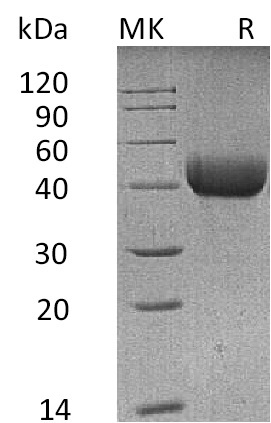 |
Greater than 95% as determined by reducing SDS-PAGE. |
靶点信息 Target Information
| 分子别名Alternative Names | COLEC7Collectin 7Lung surfactant protein DPSPDpulmonary surfactant-associated protein DSFTPDSPDSP-DSP-Dpulmonary surfactant apoproteinsurfactant protein Dsurfactant, pulmonary-associated protein D |
|---|---|
| 功能Function | Contributes to the lung's defense against inhaled microorganisms, organic antigens and toxins. Interacts with compounds such as bacterial lipopolysaccharides, oligosaccharides and fatty acids and modulates leukocyte action in immune response. May participate in the extracellular reorganization or turnover of pulmonary surfactant. Binds strongly maltose residues and to a lesser extent other alpha-glucosyl moieties. |
| 亚细胞定位Subcellular Location | Secreted, extracellular space, extracellular matrix. Secreted, extracellular space, surface film. |
| 数据库链接Databases |
基因功能参考文献50 条
- Colitis caused a notable increase in Sftpd gene expression in the gallbladder, but not in the lung, via the activity of glucocorticoids produced in the liver. PMID: 28878025 : 28878025
- SP-D deficiency reduces atherosclerosis in ApoE-knockout mice by decreasing the accumulation and proliferation of macrophages and by reducing IL-6 levels systemically. PMID: 28472244 : 28472244
- Our data may promote further studies on the morphological development of the aging lung and the role of SP-D in this process. PMID: 28185902 : 28185902
- The experimentally induced alterations were more severe in the SP-D(-/-) than in the WT mice, particularly with respect to the surfactant-storing lamellar bodies which were sometimes extremely enlarged in SP-D(-/-) mice. PMID: 27565967 : 27565967
- these results demonstrate SP-D plays protective roles by inhibiting apoptosis and modulating NF-kappaB-mediated inflammation in CLP-induced acute pancreatic injury . PMID: 26634656 : 26634656
- our results demonstrate that SFTPD deficiency affects female fertility, highlighting roles for SFTPD in ovarian and uterine physiology PMID: 26874827 : 26874827
- the collectin Surfactant Protein D is an essential component of host innate immunity to helminths PMID: 26900854 : 26900854
- SP-D protects the ocular surface from S. aureus infection. PMID: 26398197 : 26398197
- Estrogen positively regulates expression of SP-D in the mouse uterus. Progesterone, along with estrogen synergizes SP-D expression, however, when administered alone results in negative regulation. PMID: 25693975 : 25693975
- NOS2 mediates remodeling of septal walls, resulting in deposition of interstitial tissue in Sftpd(-/-). PMID: 26320150 : 26320150
- Suggest a protective role for SP-D in the pathogenesis of sub-epithelial fibrosis in a mouse model of allergic inflammation through regulation of eosinophil-derived TGF-beta1. PMID: 25472740 : 25472740
- Data indicate that although iNOS is involved in radiation-induced injury and altered SP-D structure, in the absence of SP-D, it functions to promote proinflammatory signaling. PMID: 25552309 : 25552309
- No effect of ablation of surfactant protein-D on acute cerebral infarction in mice. PMID: 25038795 : 25038795
- These results establish that DPPI is a major determinant of survival following Klebsiella pneumoniae lung infection and suggest that the survival disadvantage in DPPI(+/+) mice is in part due to processing of surfactant protein D by DPPI. PMID: 24955853 : 24955853
- Together, these studies support the conclusion that surfactant protein D increases susceptibility to Cryptococcus neoformans infection by promoting Cryptococcus neoformans-driven pulmonary IL-5 and eosinophil infiltration. PMID: 24478083 : 24478083
- Sp-D was identified as the ligand of Ig-Hepta/GPR116. PMID: 23922714 : 23922714
- Surfactant protein D contributes to ocular defense against Pseudomonas aeruginosa in a murine model of dry eye disease. PMID: 23762428 : 23762428
- Serum levels of SP-D increase during lung injury, with a sustained increment during chronic inflammation compared with acute inflammation. PMID: 23435873 : 23435873
- SP-D participates in host defense against the vaccinia virus infection by interaction with the viral surface protein A27. PMID: 23518578 : 23518578
- SP-D can protect the bladder urothelium against UPEC infection and suggest a possible function of SP-D in urinary tract. PMID: 23012359 : 23012359
- Mice lacking SP-D were partially protected during Cryptococcus neoformans infection; they displayed a longer mean time to death and decreased fungal burden at several time points postinfection than wild-type mice. PMID: 22547543 : 22547543
- The data suggest SP-D as a regulator of energy intake and body composition and an inhibitor of metabolic endotoxemia. SP-D may play a causal role at the crossroads of inflammation, obesity, and insulin resistance. PMID: 22509382 : 22509382
- Inflammation is initiated from abnormal alveolar epithelial cells in Hermansky-Pudlak syndrome, and S-nitrosylated SP-D plays significant role in amplifying pulmonary inflammation. PMID: 21616998 : 21616998
- a unique biological relevance for SP-D-DNA interactions and places SP-D as an important innate immune protein that promotes bacterial trapping by NETs during neutrophil-mediated host defense. PMID: 21724991 : 21724991
- SP-D inhibits pulmonary inflammation and migration of peripheral monocyte/macrophages into the lung through GM-CSF-dependent pathways during indirect lung injury PMID: 20639460 : 20639460
- Viruses expressing the hemagglutinin of pandemic influenza A viruses were associated with significant pathology in the lower respiratory tract, including acute inflammation, and showed low binding activity for lung surfactant protein D. PMID: 21334038 : 21334038
- SP-D decreases allergen responses, an effect that may be mediated by increase of CTLA4 in T cells. PMID: 20435925 : 20435925
- Complementation of pulmonary abnormalities in SP-D(-/-) mice with an SP-D/conglutinin fusion protein PMID: 11956209 : 11956209
- Results suggest that SP-D-dependent processes regulating surfactant lipid homeostasis were disassociated from those mediating emphysema. PMID: 12163500 : 12163500
- SP-D-deficient mice have an up to 10-fold increase in the number of apoptotic and necrotic alveolar macrophages with excess surfactant phospholipid accumulation that is reversible by intrapulmonary administration of a fragment of recombinant SP-D. PMID: 12218102 : 12218102
- SP-D binds to apoptotic cells in a localized, patchy pattern, drives apoptotic cell ingestion by phagocytes through a mechanism dependent on calreticulin and CD91, and alters apoptotic cell clearance from the naive lung. PMID: 12244199 : 12244199
- CRP-ductin binds gram-positive and gram-negative bacteria and interacts with lung surfactant protein D. PMID: 12884308 : 12884308
- Surfactant-associated protein D plays a role in host defense against Pneumocystis carinii in vivo by modulating clearance of organisms, lung inflammation, and metabolism of NO. PMID: 15073692 : 15073692
- surfactant protein D gene transcription is regulated by NFAT and thyroid transcription factor-1 PMID: 15173172 : 15173172
- local cytokine release is regulated by SP-D when the (IAV) Influenza A virus is glycosylated at a specific site (N165) suggesting a role in protection from IAV infection. PMID: 15280465 : 15280465
- GM-CSF-dependent macrophage activity is not necessary for emphysema development in SP-D-deficient mice PMID: 15310555 : 15310555
- SP-D regulates uptake and catabolism by type II cells and influences the ultrastructure of surfactant in the alveolus. PMID: 15579631 : 15579631
- SP-D influences innate host defense, in part, by regulating sCD14 in a process mediated by MMP-9 and MMP-12. PMID: 15814723 : 15814723
- Sp-D has an important role in the regulation of cytokine milieu and eosinophilia in the lungs, and its absence highlights its essential role in host defense against pulmonary allergenic challenge. PMID: 15905537 : 15905537
- SP-D can bind free DNA and DNA present on apoptotic and necrotic cells, enhance their phagocytosis, and minimize autoantibody generation. PMID: 15905582 : 15905582
- serum SP-D can serve as a biomarker of lung inflammation in both acute and chronic lung injury in mice PMID: 15967375 : 15967375
- Our data provides evidence that SP-D has a significant role to play in the clearance of pneumococci during the early stages of infection in both pulmonary sites and blood. PMID: 16255775 : 16255775
- The ligand binding of homologous human, rat, and mouse trimeric trimeric neck plus carbohydrate recognition domain (neck+CRD) fusion proteins, each with identical N-terminal tags remote from the ligand-binding surface, was compared. PMID: 16514117 : 16514117
- allergen exposure induces elevation in SP-D protein levels in an interleukin-4/interleukin-13-dependent manner, which in turn, prevents further activation of sensitized T cells PMID: 16517724 : 16517724
- collagen domain of SP-D is required for the regulation of pulmonary macrophage activation, airspace remodeling, and surfactant lipid homeostasis PMID: 16787926 : 16787926
- Our data suggest that SP-D in BALF binds beta-glucan on Blastomyces dermatitidis, blocking alveolar macropahges access to beta-glucan, thereby inhibiting TNF-alpha production. PMID: 16861641 : 16861641
- SP-D regulates surface CD11b and CD11c levels on the alveolar macrophage by modulating receptor trafficking, providing a mechanism by which SP-D mediates phagocytic activity in the alveolar macrophage. PMID: 17056703 : 17056703
- The in vitro expression of SP-D gene in A549 cells prolonged cell survival following exposure to cigarette smoke condensate. PMID: 17298450 : 17298450
- Data are suggestive that SP-D may play a role in innate immunity in the female reproductive tract in vivo. PMID: 17954522 : 17954522
- Important in ocular host defense. Interference with the action of or a deficiency in SPD, even transiently, could predispose the eye to Pseudomonas keratitis. PMID: 17972221 : 17972221
蛋白复溶体积计算器缓冲液体积 = 蛋白质量 ÷ 蛋白浓度
输入任意两项,第三项自动计算 |
蛋白浓度稀释计算器初浓度 × 初体积 = 终浓度 × 终体积
输入任意三项,第四项自动计算 |



