


Recombinant Mouse PD-1 (C-Fc)
Alternative NamesProgrammed cell death protein 1;PD-1;CD279;Pdcd1;mPD-1
规格参数 Specifications
| 纯度Purity | Greater than 95% as determined by reducing SDS-PAGE |
|---|---|
| 内毒素Endotoxin | <1 EU/µg as determined by LAL test. |
| 蛋白构建Protein Construction |
【Leu25-Gln167】序列区间-FcC 端标签
|
| Accession | Q02242 |
| 表达宿主Expression Host | HEK293 |
| 种属Species | Mouse |
| 预测分子量Predicted MW | 43.3 kDa |
| 制剂Formulation | Lyophilized from a 0.2 μm filtered solution of 20mM Tris-HCl, 150mM NaCl, pH 8.0. |
| 运输方式Shipping | The product is shipped with ice bag. Upon receipt, store it immediately at the temperature listed below. |
| 稳定性&储存Stability & Storage | 12 months at -20°C to -80°C in lyophilized state.6 months at -20°C to -80°C under sterile conditions after reconstitution.7-10 days at 2°C to 8°C under sterile conditions after reconstitution.Please minimize freeze-thaw cycles. |
| 复溶Reconstitution | Always centrifuge tubes before opening. Do not mix by vortex or pipetting. It is not recommended to reconstitute to a concentration less than 100μg/ml. Dissolve the lyophilized protein in distilled water. Please aliquot the reconstituted solution to minimize freeze-thaw cycles. |
!
本司产品仅用于科研,不用于临床诊断和治疗。
产品图片 Product Images点击图片可查看原图
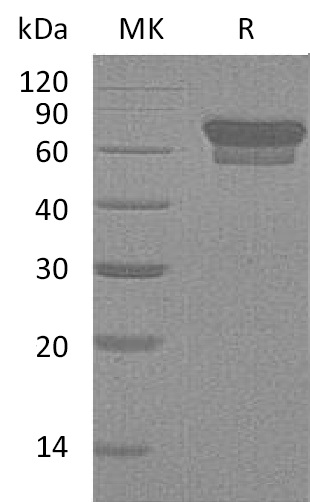 |
Greater than 95% as determined by reducing SDS-PAGE. |
靶点信息 Target Information
| 分子别名Alternative Names | Programmed cell death protein 1PD-1CD279Pdcd1mPD-1 |
|---|---|
| 功能Function | Inhibitory receptor on antigen activated T-cells that plays a critical role in induction and maintenance of immune tolerance to self. Delivers inhibitory signals upon binding to ligands, such as CD274/PDCD1L1 and CD273/PDCD1LG2. Following T-cell receptor (TCR) engagement, PDCD1 associates with CD3-TCR in the immunological synapse and directly inhibits T-cell activation. Suppresses T-cell activation through the recruitment of PTPN11/SHP-2: following ligand-binding, PDCD1 is phosphorylated within the ITSM motif, leading to the recruitment of the protein tyrosine phosphatase PTPN11/SHP-2 that mediates dephosphorylation of key TCR proximal signaling molecules, such as ZAP70, PRKCQ/PKCtheta and CD247/CD3zeta. The PDCD1-mediated inhibitory pathway is exploited by tumors to attenuate anti-tumor immunity and facilitate tumor survival. |
| 亚细胞定位Subcellular Location | Cell membrane; Single-pass type I membrane protein. |
| 数据库链接Databases |
基因功能参考文献50 条
- Oncolytic herpes virotherapy and PD-1 blockade in a murine rhabdomyosarcoma model is an efficient treatment strategy. PMID: 28539588 : 28539588
- These results show that PD-1 plays an inhibitory role during the naive-to-effector CD8 T cell transition and that the PD-1 pathway can also be modulated at this stage of T cell differentiation. PMID: 29654146 : 29654146
- Blockade of CCR5-mediated myeloid derived suppressor cell accumulation enhances anti-PD1 efficacy in gastric cancer PMID: 29303012 : 29303012
- T-cell activation mediates the immunopreventive effects of anti-PD-1; PD-1 on T cells interacts with the PD-1 ligand PD-L1 on cancer cells PMID: 29018057 : 29018057
- these data show that PD-1 expression is an intrinsic property of brain-resident memory CD8 T cells in a persistent CNS viral infection PMID: 28829048 : 28829048
- Our results demonstrate that entinostat enhances the antitumor effect of PD-1 targeting through functional inhibition of MDSCs and a transition away from an immune-suppressive tumor microenvironment. These data provide a mechanistic rationale for the clinical testing and potential markers of response of this novel combination in solid tumor patients. PMID: 28698201 : 28698201
- synergism in cell death by Caspase-1- and RipK3 resulted in restriction of PD-1 and TIM3 expression on primed CD8(+) T cells, which promoted the survival of activated CD8(+) T cells. PMID: 28686578 : 28686578
- Tim-3 and PD-1 pathways play critical roles in regulating CD8(+) T cell function and maintaining normal pregnancy. PMID: 28331165 : 28331165
- Anti-PD-1/PD-L1 therapy inhibited CMT167 orthotopic lung tumors by 95%. .Silencing PD-L1 expression in CMT167 cells resulted in smaller orthotopic tumors that remained sensitive to anti-PD-L1 therapy, whereas implantation of CMT167 cells into PD-L1(-) mice blocked orthotopic tumor growth, indicating a role for PD-L1 in both the cancer cell and the microenvironment. PMID: 28819064 : 28819064
- Combination therapies that depend on checkpoint inhibitor antibodies (Abs) such as for PD-1 or its ligand (PD-L1) together with immune stimulatory agonist Abs like anti-OX40 are being tested in the clinic to achieve improved antitumor effects PMID: 28848055 : 28848055
- Inhibition of Fut8, a core fucosyltransferase, by genetic ablation or pharmacologic inhibition reduced cell-surface expression of PD-1 and enhanced T cell activation, leading to more efficient tumor eradication. PMID: 28768188 : 28768188
- An examination of the mechanisms of immunity behind this long-term protection in PD-1 knockout mice showed a key role for parasite-specific CD8(+) T cells even when CD4(+) T cells and B cells responded to re-infection. PMID: 27217330 : 27217330
- To test the in vivo activity of REGN2810, which does not cross-react with murine PD-1, knock-in mice were generated to express a hybrid protein containing the extracellular domain of human PD-1, and transmembrane and intracellular domains of mouse PD-1 PMID: 28265006 : 28265006
- The combination of tumor vaccination to induce high avidity tumor specific T cell responses and PD-1 blockade synergises to provide tumor therapy and 85% survival in the aggressive B16 melanoma model. PMID: 27825115 : 27825115
- Blockade of PD-1 with monoclonal antibody may be an effective treatment during the postoperative period for restoring surgery-induced immunosuppression. PMID: 28320090 : 28320090
- Data suggest that genetic or environmental factors that even moderately affect the expression of both PD-1 and FoxP3 can cause life-threatening autoimmune diseases by disrupting the T-cell homeostasis. PMID: 27410049 : 27410049
- Data (including data from studies in transgenic/knockout mice) suggest that T-cell expression of Mirn155 is required to limit melanoma growth; miR-155, Pdcd1, Pdcd1l1, and Ctla4 appear to regulate overlapping pathways promoting antitumor immunity. [Mirn155 = microRNA 155; Pdcd1 = programmed cell death 1 protein; Pdcd1l1 = programmed cell death 1 ligand 1 protein; Ctla4 = cytotoxic T-lymphocyte-associated protein 4] PMID: 28912267 : 28912267
- PD-1 plays a vital role in brain inflammation via regulation of Fgl-2 after ICH, and that manipulation of PD-1 might be a promising therapeutical target in ICH. PMID: 27717876 : 27717876
- The identification of the role for PD-1 in regulating B cell-dependent antitumor immunity to Tn antigen highlights an opportunity to develop new therapeutic strategies targeting tumor-associated carbohydrate antigens PMID: 27856425 : 27856425
- These findings suggest that PD-1 pathway blockade may reverse adaptive immune resistance following cyclic dinucleotide treatment, enhancing both local and systemic antitumor immunity. PMID: 27821498 : 27821498
- data suggest that increased expression of checkpoint blockade molecules PD-1 and CTLA-4 on donor T cells is not sufficient to prevent GvHD, and that cooperation between checkpoint blockade signaling by host cells and donor Tregs is necessary to limit GvHD in allo-HSCT recipients PMID: 28953925 : 28953925
- PD-1 Blockade Promotes Epitope Spreading in Anticancer CD8(+) T Cell Responses by Preventing Fratricidal Death of Subdominant Clones To Relieve Immunodomination PMID: 28939757 : 28939757
- Adoptive transfer of murine T cells expressing a chimeric-PD1-Dap10 receptor may induce a preferential cytokine profile and T-cell differentiation phenotype for anti-lymphoma therapies. PMID: 28670716 : 28670716
- soluble PD-1 is elevated in critical illness and may represent a potential biomarker for Acute respiratory distress syndrome. PMID: 27835962 : 27835962
- Together, our results suggest an important role of PD-1 in glioma-induced immune escape, and provide translational evidence for the use of PD-1 blocking antibodies in human malignant gliomas. PMID: 28681455 : 28681455
- study found that Bcl6 positively regulates PD-1 expression by inhibiting the ability of T-bet/Tbx21 to repress Pdcd1 transcription. PMID: 28586108 : 28586108
- PD-L1 selectively enhances T cell-mediated immune responses, driving graft-versus-host disease lethality and suggesting a context-dependent function of the PD-1/PD-L1 axis PMID: 27294527 : 27294527
- PD-1 is required for maintaining the number, and hence function, of KLRG1(+) Group 2 innate lymphoid cells. PMID: 28490441 : 28490441
- this study shows that PD-1 regulates early glycolytic and mitochondrial alterations in virus-specific CD8+ T cells generated during infection, and represses transcriptional coactivator PGC-1alpha PMID: 27496729 : 27496729
- Our results suggest that anti-PD-1 antibody treatment has little effect on afatinib-induced lung injury. PMID: 28756224 : 28756224
- both mouse and human tumour-associated macrophages (TAM) express PD-1; TAM PD-1 expression increases over time in mouse models of cancer and with increasing disease stage in primary human cancers PMID: 28514441 : 28514441
- These data implicate a critical role for conserved region C (CR-C), a promoter proximal cis-regulatory element that is critical to PD-1 expression in vitro, in governing PD-1 expression, and a subsequent role in guiding CD8 T cell differentiation PMID: 27895178 : 27895178
- we provide evidence that indicates that the PD-1(+) fraction of DN T cells represents self-reactive cells. PMID: 27060346 : 27060346
- PD-1 receptor has a role in interacting with programmed cell death ligands and B7-1 PMID: 28270509 : 28270509
- PD-1 is upregulated in CD4+ T cells in Schistosoma japonicum (S. japonicum)-infected mice. PMID: 27792733 : 27792733
- Findings indicated that METH induced the upregulation of PD-1 expression which altered the cytokine production as well as cytotoxic functions in mouse model of lymphocytic choriomeningitis virus infection. PMID: 27760221 : 27760221
- Taken together, our data demonstrate the importance of CD40 signaling in the conversion of CTL exhaustion and its ability to enhance PD-1 antagonist action in rescuing exhausted CTLs in chronic infection. PMID: 28153727 : 28153727
- Our proteogenomic analysis demonstrates a role of Smad4 loss in the PD-L1 immune evasion, as well as Il1rl1's role in CSC-like properties of NCC-S1M. PMID: 28153736 : 28153736
- These studies indicate that PD-1 is a critical homeostatic regulator for Tregs by modulating proliferation and apoptosis during IL-2 therapy. PMID: 28151427 : 28151427
- data defined PD-1(hi)IL-25R(hi) as an early checkpoint in Innate lymphoid cell development; results provide a perspective for exploring PD-1 and its ligand (PD-L1) in immunotherapy, and allow effective manipulation of the immune system for disease prevention and therapy PMID: 27749818 : 27749818
- Authors demonstrate that inactivation of the PD-1 gene in melanoma-reactive CD8(+) T cells and in fibrosarcoma-reactive polyclonal T cells enhanced the persistence of PD-1 gene-modified T cells at the tumor site and increased tumor control. PMID: 27197251 : 27197251
- PD-1/PD-L1 plays a crucial role in maintaining immune tolerance induced by UVB-iDCs, as well as in actively controlling effector T cells specific to alloantigens. PMID: 27556047 : 27556047
- PD-1 dampens antigen-specific Th17 response, thus inhibiting autoimmune arthritis PMID: 27197661 : 27197661
- Tim-3(+) PD-1(+) CD8(+) T cells showed more evident properties associated with exhaustion than Tim-3(-) PD-1(+) CD8(+) T cells. PMID: 26750587 : 26750587
- that porcine islet-specific tolerance is dependent on PD-1, which could not be extended to skin grafts PMID: 26109574 : 26109574
- Programmed cell death-1 engagement followed by zymosan stimulation might primarily attenuate the phosphorylation of tyrosine residue in Programmed cell death-1 receptor/ligand. PMID: 26913605 : 26913605
- these data suggest a scenario in which microglia are involved in the regulation of experimental autoimmune encephalomyelitis by suppressing Th1-cell differentiation via the PD-L1-nitric oxide pathway. PMID: 26769487 : 26769487
- Blockade of TGFbeta downregulated PD-1 and PD-L1 expression and precipitated graft rejection. PMID: 26824266 : 26824266
- PD-1 regulates peripheral T-cell responses in both human and murine rheumatoid arthritis PMID: 26608464 : 26608464
- Decidual NK, NKT and gamma/delta T cells showed increased PD-1 expression and reduced cytotoxic potential when compared to the periphery. PMID: 26278059 : 26278059
蛋白复溶体积计算器缓冲液体积 = 蛋白质量 ÷ 蛋白浓度
输入任意两项,第三项自动计算 |
蛋白浓度稀释计算器初浓度 × 初体积 = 终浓度 × 终体积
输入任意三项,第四项自动计算 |



