


| 纯度Purity | Greater than 95% as determined by reducing SDS-PAGE |
|---|---|
| 内毒素Endotoxin | <1 EU/µg as determined by LAL test. |
| 蛋白构建Protein Construction |
【Gln35-Gln155&Ser156-Gln694】序列区间-6HisC 端标签
|
| Accession | Q80W65 |
| 表达宿主Expression Host | HEK293 |
| 种属Species | Mouse |
| 预测分子量Predicted MW | 1458.2 kDa |
| 制剂Formulation | Lyophilized From a 0.2 μm filtered solution of 50mM HEPES, 150mM NaCl, 20% Glycerol, pH 7.4. |
| 运输方式Shipping | The product is shipped with ice bag. Upon receipt, store it immediately at the temperature listed below. |
| 稳定性&储存Stability & Storage | 12 months at -20°C to -80°C in lyophilized state.6 months at -20°C to -80°C under sterile conditions after reconstitution.7-10 days at 2°C to 8°C under sterile conditions after reconstitution.Please minimize freeze-thaw cycles. |
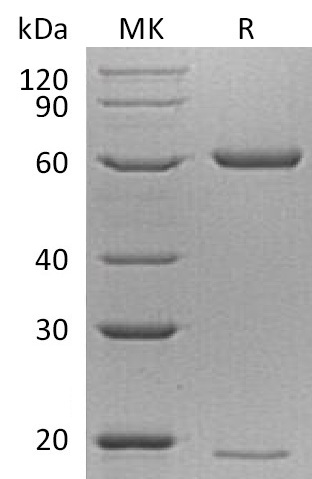 |
Greater than 95% as determined by reducing SDS-PAGE. |
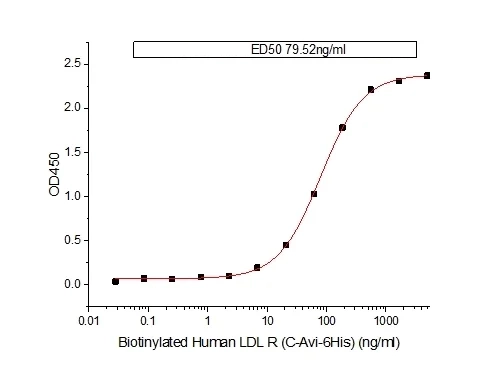 |
Immobilized Recombinant Mouse PCSK9-His at 5 μg/ml (100 μl/well) can bind Biotinylated Human LDL R-His-Avi. The ED50 of Biotinylated Human LDL R-His-Avi is 79.52 ng/ml. (QC verified). |
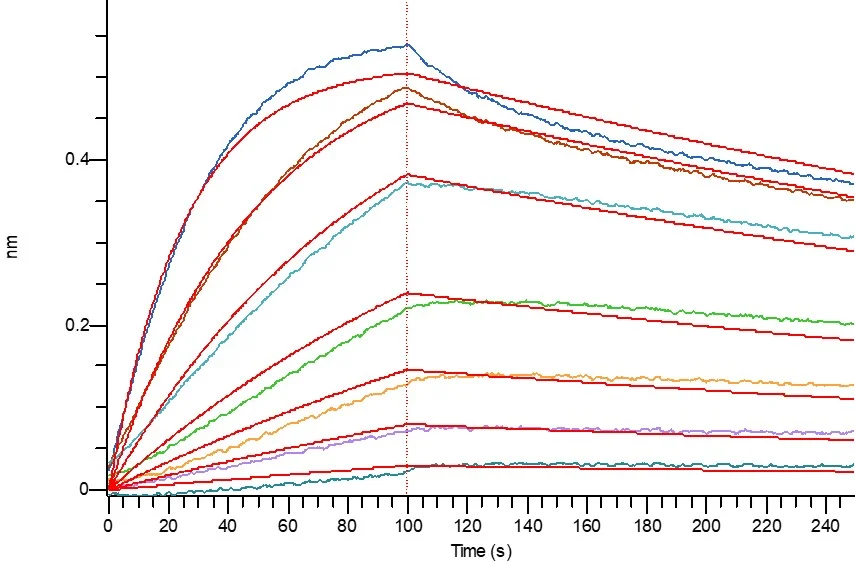 |
Loaded Biotinylated Human LDL R-Avi-His on SA Biosensor, can bind Mouse PCSK9-His with an affinity constant of 4.97 nM as determined in BLI assay. (Regularly tested) |
| 分子别名Alternative Names | Proprotein Convertase Subtilisin/Kexin Type 9Neural Apoptosis-Regulated Convertase 1NARC-1Proprotein Convertase 9PC9Subtilisin/Kexin-Like Protease PC9Pcsk9Narc1 |
|---|---|
| 功能Function | Crucial player in the regulation of plasma cholesterol homeostasis. Binds to low-density lipid receptor family members: low density lipoprotein receptor (LDLR), very low density lipoprotein receptor (VLDLR), apolipoprotein E receptor (LRP1/APOER) and apolipoprotein receptor 2 (LRP8/APOER2), and promotes their degradation in intracellular acidic compartments. Acts via a non-proteolytic mechanism to enhance the degradation of the hepatic LDLR through a clathrin LDLRAP1/ARH-mediated pathway. May prevent the recycling of LDLR from endosomes to the cell surface or direct it to lysosomes for degradation. Can induce ubiquitination of LDLR leading to its subsequent degradation. Inhibits intracellular degradation of APOB via the autophagosome/lysosome pathway in a LDLR-independent manner. Involved in the disposal of non-acetylated intermediates of BACE1 in the early secretory pathway. Inhibits epithelial Na(+) channel (ENaC)-mediated Na(+) absorption by reducing ENaC surface expression primarily by increasing its proteasomal degradation. Regulates neuronal apoptosis via modulation of LRP8/APOER2 levels and related anti-apoptotic signaling pathways. |
| 亚细胞定位Subcellular Location | Cytoplasm. Secreted. Endosome. Lysosome. Cell surface. Endoplasmic reticulum. Golgi apparatus. |
| 数据库链接Databases |
基因功能参考文献50 条
- The data of the present study demonstrated that the PCSK9 shRNAmediated antiapoptotic effect induced by MCAO in hyperlipidemic mice is associated with ApoER2 downregulation, which may be a potential new therapy for stroke treatment in patients with hyperlipidemia. PMID: 30066942 : 30066942
- It was concluded that quercetin inhibits oxLDLinduced lipid droplets in RAW264.7 cells by upregulation of ABCAl, ABCG1, LXRalpha and downregulation of PCSK9, p53, p21 and p16. PMID: 29845234 : 29845234
- PCSK9 overexpression in the aorta may promote acute aortic dissection. PMID: 29197601 : 29197601
- Genetically determined PCSK9 deficiency might be associated with ectopic fat accumulation. PMID: 28758421 : 28758421
- The present study aimed to explore the direct toxicity of proprotein convertase subtilisin/kexin type 9 (PCSK9) to atherosclerosis (AS) and its association with apoptotic endothelial cells. PMID: 28656218 : 28656218
- present anti-PCSK9 vaccine induced long-lasting anti-PCSK9 antibody production and improved lipoprotein profiles. Thus, anti-PCSK9 vaccine could become a new option for the treatment of dyslipidemia as a long-acting therapy in future PMID: 29438441 : 29438441
- PCSK9 may act as an inflammatory mediator in the pathogenesis of atherosclerosis via TLR4/NF-kappaB signaling pathway. PMID: 28535426 : 28535426
- PCSK9, by sustaining smooth muscle cell synthetic phenotype, proliferation, and migration, may play a pro-atherogenic role in the arterial wall PMID: 27477186 : 27477186
- PCSK9 inhibits lipoprotein(a) clearance through the LDLR. PMID: 28750079 : 28750079
- Use Crispr-Cas system to introduce nonsense variants into PCSK9 to lower blood cholesterol levels. PMID: 28751571 : 28751571
- Studied the combination model of a single AAV-PCSK9 injection, high-fat diet, and partial carotid ligation which induces robust atherosclerosis in the flow-disturbed carotid artery within 3 weeks in C57 mice, and results suggest this is a quick and convenient model to study atherosclerosis and mechanisms using any knockout or transgenic mice without having to generate double knockouts. PMID: 28504688 : 28504688
- These observations suggest positive feedback interplay between SMC-derived PCSK9 and mtDNA damage in the proinflammatory milieu involving mtROS. This interaction results in cellular injury, characterized by apoptosis-a hallmark of atherosclerosis. PMID: 27197615 : 27197615
- AdipoR activation by agonists regulated PCSK9 expression and inhibits atherosclerosis in apoE(-/-) mice. PMID: 28546220 : 28546220
- Adeno-associated virus mediated infection with a mouse PCSK9 gain-of-function mutation is a rapid, easy, and efficient approach for inducing hypercholesterolemia and promoting abdominal aortic aneurysms in C57BL/6 mice infused with angiotensin II. PMID: 27470509 : 27470509
- conditions that cause ER stress regardless of their ability to dysregulate ER Ca(2+) inhibit PCSK9 secretion, thereby reducing PCSK9-mediated LDLR degradation and promoting LDLR-dependent hepatic cholesterol uptake. PMID: 27909053 : 27909053
- Proprotein Convertase Subtilisin/Kexin Type 9 (PCSK9) Single Domain Antibodies Are Potent Inhibitors of Low Density Lipoprotein Receptor Degradation. PMID: 27284008 : 27284008
- PCSK9 increases hepatic lipid and lipoprotein production via apoE- and LDLR-dependent mechanisms PMID: 26980204 : 26980204
- Podocyte damage triggers marked inductions in plasma PCSK9, and knockout of Pcsk9 ameliorates dyslipidemia in a mouse model of nephrotic syndrome. PMID: 27358438 : 27358438
- polydatin ameliorates lipid and glucose metabolism in type 2 diabetes mellitus by downregulating PCSK9. PMID: 26833058 : 26833058
- binding of PCSK9 to GRP94 protects LDLR from degradation likely by preventing early binding of PCSK9 to LDLR PMID: 26628375 : 26628375
- The absence of PCSK9 results in a sex- and tissue-specific subcellular distribution of the LDLR and VLDLR, which is determined by estradiol levels. PMID: 26323289 : 26323289
- that ox-LDL receptor-1 and PCSK9 positively influence each other's expression, especially during an inflammatory reaction PMID: 26092101 : 26092101
- Data show that leptin treatment suppresses proprotein convertase subtilisin/kexin type 9 (PCSK9) in male, but fails to suppress PCSK9 in female. PMID: 26824363 : 26824363
- The Liver Clock Controls Cholesterol Homeostasis through Trib1 Protein-mediated Regulation of PCSK9/Low Density Lipoprotein Receptor (LDLR) Axis. PMID: 26547624 : 26547624
- PCSK9(-/-) mice display normal sodium balance and blood pressure regulation despite an increase of cleaved alphaENaC under basal condition PMID: 25621930 : 25621930
- PCSK9-mediated CD36 degradation may serve to limit fatty acid uptake and triglyceride accumulation in tissues, such as the liver and adipose tissue. PMID: 26494228 : 26494228
- HNF1alpha, but not HNF1beta, is the primary positive regulator of PCSK9 transcription in mouse liver PMID: 25652089 : 25652089
- high fructose consumption inversely modulates LDL-C and PCSK9 serum levels in mice without a significant impact on liver LDLR protein levels PMID: 25682035 : 25682035
- PCSK9-reactive oxygen species interaction may be important in the development of atherosclerosis in arterial channels with low shear stress. PMID: 25490141 : 25490141
- reduced PCSK9 function is associated with increased pathogen lipid clearance. PMID: 25320235 : 25320235
- Genome editing with the CRISPR-CRISPR-associated 9 system disrupts the Pcsk9 gene in vivo with high efficiency and reduces blood cholesterol levels in mice. PMID: 24916110 : 24916110
- MMP-2 overexpression may protect the LDLR from PCSK-9-induced degradation. PMID: 25613181 : 25613181
- PCSK9 markedly increases intestinal triglyceride-rich apoB production through mechanisms mediated in part by transcriptional effects on apoB. PMID: 25070550 : 25070550
- data revealed a plausible new role of AnxA2 in the reduction of PCSK9 protein levels via a translational mechanism. PMID: 24808179 : 24808179
- A vicious cycle in LDLR degradation might be generated by PCSK9 induced by hepatic Idol overexpression via dual mechanisms: sterol regulatory element-binding protein 2/LDLR. PMID: 24675665 : 24675665
- Pcsk9 inactivation decreases the HDL cholesterol concentration and cholesterol efflux capacity in serum, but does not increase atherosclerotic fatty streak volume. PMID: 23883163 : 23883163
- Low-density lipoprotein receptor (LDLR) is the main route of elimination of proprotein convertase subtilisin/kexin type 9 (PCSK9) and reciprocal regulation between these 2 proteins controls serum PCSK9 levels, hepatic LDLR expression, and serum LDL level. PMID: 23690465 : 23690465
- Data indicate that FoxO3 and Sirt6 suppress the PCSK9 gene expression and reduce LDL-cholesterol. PMID: 23974119 : 23974119
- Studies indicate that PCSK9 knockout (KO) (Pcsk9-/-) mice exhibit higher levels of LDLR protein in the liver and less circulating total cholesterol. PMID: 23775089 : 23775089
- PCSK9 deficiency caused a decrease in several cholesteryl esters (CE) and short fatty acid chain containing sphingolipid species. PMID: 23623011 : 23623011
- Transintestinal cholesterol excretion is regulated by PCSK9/ABCB1/statins. PMID: 23559630 : 23559630
- Furin-cleaved proprotein convertase subtilisin/kexin type 9 (PCSK9) is active and modulates low density lipoprotein receptor and serum cholesterol levels. PMID: 23135270 : 23135270
- AnxA2 acts as an endogenous regulator of PCSK9-induced LDLR degradation PMID: 22848640 : 22848640
- immunization with human-PCSK9 in mice is able to raise antibodies that cross-react and neutralize circulating mouse-PCSK9 protein thus resulting in increased liver LDL receptor levels and plasma cholesterol uptake PMID: 22611251 : 22611251
- Results indicate that although PPARgamma activation increased PCSK9 expression, PPARgamma activation induced LDLR and CYP7A1 expression that enhanced LDL cholesterol metabolism. PMID: 22593575 : 22593575
- propose a new role for PCSK9 that involves shuttling between apoB and low-density lipoprotein receptor PMID: 22580899 : 22580899
- PCSK9 potentiates neuronal apoptosis via modulation of ApoER2 levels and related anti-apoptotic signaling pathways. PMID: 22481440 : 22481440
- Increased PCSK9 might be responsible for the reduction in LDLR that results from decreased insulin signaling. The mTORC1 inhibitor rapamycin caused increased expression of PCSK9. PMID: 22426206 : 22426206
- PCSK9 overexpression is proatherogenic. PMID: 22261195 : 22261195
- PCSK9 downregulates LDLR levels during brain development and following transient ischemic stroke in adult mice PMID: 21518694 : 21518694
蛋白复溶体积计算器缓冲液体积 = 蛋白质量 ÷ 蛋白浓度
输入任意两项,第三项自动计算 |
蛋白浓度稀释计算器初浓度 × 初体积 = 终浓度 × 终体积
输入任意三项,第四项自动计算 |



