


Recombinant Mouse LAG-3 (C-6His)
Alternative NamesLymphocyte activation gene 3 protein;CD223;Lag3
规格参数 Specifications
| 纯度Purity | Greater than 95% as determined by reducing SDS-PAGE |
|---|---|
| 内毒素Endotoxin | <1 EU/µg as determined by LAL test. |
| 蛋白构建Protein Construction |
【Ser23-Leu442】序列区间-6HisC 端标签
|
| Accession | Q61790 |
| 表达宿主Expression Host | HEK293 |
| 种属Species | Mouse |
| 预测分子量Predicted MW | 46.2 kDa |
| 制剂Formulation | Lyophilized from a 0.2 μm filtered solution of PBS, pH 7.4. |
| 运输方式Shipping | The product is shipped with ice bag. Upon receipt, store it immediately at the temperature listed below. |
| 稳定性&储存Stability & Storage | 12 months at -20°C to -80°C in lyophilized state.6 months at -20°C to -80°C under sterile conditions after reconstitution.7-10 days at 2°C to 8°C under sterile conditions after reconstitution.Please minimize freeze-thaw cycles. |
| 复溶Reconstitution | Always centrifuge tubes before opening. Do not mix by vortex or pipetting. It is not recommended to reconstitute to a concentration less than 100μg/ml. Dissolve the lyophilized protein in distilled water. Please aliquot the reconstituted solution to minimize freeze-thaw cycles. |
!
本司产品仅用于科研,不用于临床诊断和治疗。
产品图片 Product Images点击图片可查看原图
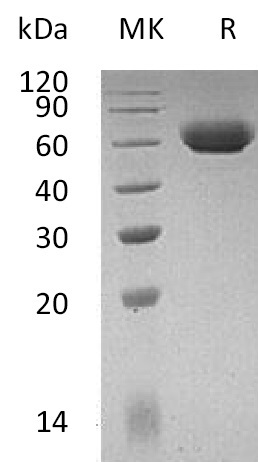 |
Greater than 95% as determined by reducing SDS-PAGE. |
靶点信息 Target Information
| 分子别名Alternative Names | Lymphocyte activation gene 3 proteinCD223Lag3 |
|---|---|
| 功能Function | Lymphocyte activation gene 3 protein: Inhibitory receptor on antigen activated T-cells. Delivers inhibitory signals upon binding to ligands, such as FGL1. FGL1 constitutes a major ligand of LAG3 and is responsible for LAG3 T-cell inhibitory function. Following TCR engagement, LAG3 associates with CD3-TCR in the immunological synapse and directly inhibits T-cell activation. May inhibit antigen-specific T-cell activation in synergy with PDCD1/PD-1, possibly by acting as a coreceptor for PDCD1/PD-1. Negatively regulates the proliferation, activation, effector function and homeostasis of both CD8(+) and CD4(+) T-cells. Also mediates immune tolerance: constitutively expressed on a subset of regulatory T-cells (Tregs) and contributes to their suppressive function. Also acts as a negative regulator of plasmacytoid dendritic cell (pDCs) activation. Binds MHC class II (MHC-II); the precise role of MHC-II-binding is however unclear.; May function as a ligand for MHC class II (MHC-II) on antigen-presenting cells (APC), promoting APC activation/maturation and driving Th1 immune response. |
| 亚细胞定位Subcellular Location | [Lymphocyte activation gene 3 protein]: Cell membrane; Single-pass type I membrane protein.; [Secreted lymphocyte activation gene 3 protein]: Secreted. |
| 数据库链接Databases |
基因功能参考文献29 条
- upregulated in the central nervous system by intraepithelial lymphocytes from the gut epithelium of myelin oligodendrocyte glycoprotein(35-55)-specific T-cell receptor transgenic mice PMID: 27198196 : 27198196
- thi study shows that LAG-3 directly modulates the size of the T cell response and support the use of LAG-3 blockade regimens to enhance CD8+ T cell responses PMID: 27206765 : 27206765
- Study suggests that expression of the inhibitory receptors PD-1 and LAG-3 on CD4(+) T cells and their reduced IL-2 production are common characteristic features of Plasmodium infection. PMID: 26696540 : 26696540
- An IL-27/Lag3 axis enhances Foxp3+ regulatory T cell-suppressive function and therapeutic efficacy. PMID: 26013006 : 26013006
- LAG3 and PD1 co-inhibitory molecules have roles in collaborating to limit CD8+ T cell signaling and dampen antitumor immunity in a murine ovarian cancer model PMID: 26318293 : 26318293
- Poxvirus-Based Active Immunotherapy with PD-1 and LAG-3 Dual Immune Checkpoint Inhibition Overcomes Compensatory Immune Regulation, Yielding Complete Tumor Regression in Mice. PMID: 26910562 : 26910562
- Lymphatic endothelial cells (LECs) serve as an antigen reservoir for CD4 T-cell tolerance, and MHC-II molecules on LECs are used to induce CD8 T-cell tolerance via LAG-3. PMID: 25857745 : 25857745
- LAG-3 expression on Tconv cells makes them more susceptible to Treg based suppression, and also regulates the development of a TH1 T-cell response. PMID: 25372844 : 25372844
- LAG-3 exerts an important regulatory effect on autoimmunity. PMID: 25122007 : 25122007
- Lag-3 is an important regulatory molecule involved in alloreactive T cell proliferation and activation after bone marrow transplantation. PMID: 24475140 : 24475140
- these results define a strong synergy between the PD-1 and LAG-3 inhibitory pathways in tolerance to both self and tumor antigens. PMID: 22186141 : 22186141
- We conclude that LAG-3 is necessary for regulating CD4(+) and CD8(+) T cell function during autoimmune diabetes PMID: 21873518 : 21873518
- LAG-3 is required for long-term peripheral CD8 but not CD4 T-cell tolerance and this requirement is CD8 cell-extrinsic. PMID: 21422469 : 21422469
- LAG-3 acts synergistically with PD-1 and/or other immunoregulatory genes to prevent autoimmunity in mice. PMID: 21300912 : 21300912
- This significant intracellular storage of LAG-3 appears to facilitate its rapid translocation to the cell surface following T-cell activation, which was much faster for LAG-3 than CD4 PMID: 20391435 : 20391435
- blockade of LAG-3 did not rescue cytokine production by virus-specific CD8 T cells and did not alter the virus titer in various organs PMID: 19880580 : 19880580
- Lag3 inhibits CD4-dependent, but not CD4-independent, T cell function via its cytoplasmic domain. PMID: 12421911 : 12421911
- LAG-3 regulates the expansion of activated T cells. PMID: 12672063 : 12672063
- LAG-3 activates antigen-presenting cells through MHC class II signalling, leading to increased antigen-specific T-cell responses in vivo. PMID: 14644131 : 14644131
- data suggest that LAG-3 negatively regulates T cell expansion and controls the size of the memory T cell pool PMID: 15100286 : 15100286
- LAG-3 marks regulatory T cell populations and contributes to their suppressor activity PMID: 15485628 : 15485628
- LAG-3 is cleaved within the D4 transmembrane domain connecting peptide into two fragments that remain membrane associated. Modulation of LAG-3 cleavage may contribute to the function of this key regulatory T cell protein. PMID: 15557174 : 15557174
- LAG-3 negatively regulates T cell homeostasis by regulatory T cell-dependent and independent mechanisms. PMID: 15634887 : 15634887
- LAG-3 is a new marker of T cell induced B cell activation. PMID: 15971272 : 15971272
- Metalloprotease-mediated cleavage of LAG-3 controls T-cell proliferation and immune response. PMID: 17245433 : 17245433
- Data demonstrate a direct role for LAG-3 on CD8+ T cells and suggest that LAG-3 blockade may be a potential cancer treatment. PMID: 17932562 : 17932562
- a novel ITAM-mediated inhibitory signaling pathway in DCs triggered by MHC II engagement of LAG-3, providing a molecular mechanism in which regulatory T cells may suppress via modulating DC function. PMID: 18424711 : 18424711
- LAG-3 plays an important but selective cell intrinsic and cell extrinsic role in plasmacytoid dendritic cells biology PMID: 19201841 : 19201841
- signaling through the PD-1 and LAG-3 pathways have distinct functional consequences to CD8 T cells under tolerizing conditions PMID: 19454660 : 19454660
蛋白复溶体积计算器缓冲液体积 = 蛋白质量 ÷ 蛋白浓度
输入任意两项,第三项自动计算 |
蛋白浓度稀释计算器初浓度 × 初体积 = 终浓度 × 终体积
输入任意三项,第四项自动计算 |



