


Recombinant Mouse Clusterin (C-6His)
Alternative NamesClusterin; Apolipoprotein J; Clustrin; Sulfated glycoprotein 2
规格参数 Specifications
| 纯度Purity | Greater than 95% as determined by reducing SDS-PAGE |
|---|---|
| 内毒素Endotoxin | <1 EU/µg as determined by LAL test. |
| 蛋白构建Protein Construction |
【Glu22-Glu448】序列区间-6HisC 端标签
|
| Accession | Q06890 |
| 表达宿主Expression Host | HEK293 |
| 种属Species | Mouse |
| 预测分子量Predicted MW | 50.4 kDa |
| 制剂Formulation | Lyophilized from a 0.2 μm filtered solution of 20mM PB, 150mM NaCl, pH 7.4. |
| 运输方式Shipping | The product is shipped with ice bag. Upon receipt, store it immediately at the temperature listed below. |
| 稳定性&储存Stability & Storage | 12 months at -20°C to -80°C in lyophilized state.6 months at -20°C to -80°C under sterile conditions after reconstitution.7-10 days at 2°C to 8°C under sterile conditions after reconstitution.Please minimize freeze-thaw cycles. |
| 复溶Reconstitution | Always centrifuge tubes before opening. Do not mix by vortex or pipetting. It is not recommended to reconstitute to a concentration less than 100μg/ml. Dissolve the lyophilized protein in distilled water. Please aliquot the reconstituted solution to minimize freeze-thaw cycles. |
!
本司产品仅用于科研,不用于临床诊断和治疗。
产品图片 Product Images点击图片可查看原图
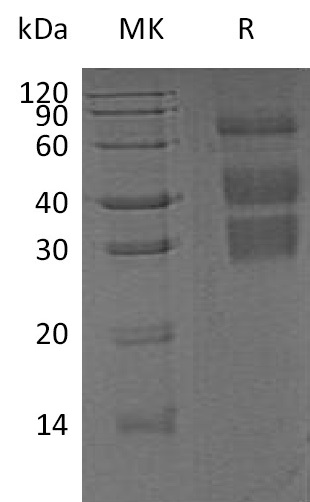 |
Greater than 95% as determined by reducing SDS-PAGE. |
靶点信息 Target Information
| 分子别名Alternative Names | ClusterinApolipoprotein JClustrinSulfated glycoprotein 2 |
|---|---|
| 功能Function | Functions as extracellular chaperone that prevents aggregation of non native proteins. Prevents stress-induced aggregation of blood plasma proteins. Inhibits formation of amyloid fibrils by APP, APOC2, B2M, CALCA, CSN3, SNCA and aggregation-prone LYZ variants (in vitro). Does not require ATP. Maintains partially unfolded proteins in a state appropriate for subsequent refolding by other chaperones, such as HSPA8/HSC70. Does not refold proteins by itself. Binding to cell surface receptors triggers internalization of the chaperone-client complex and subsequent lysosomal or proteasomal degradation. When secreted, protects cells against apoptosis and against cytolysis by complement. Intracellular forms interact with ubiquitin and SCF (SKP1-CUL1-F-box protein) E3 ubiquitin-protein ligase complexes and promote the ubiquitination and subsequent proteasomal degradation of target proteins. Promotes proteasomal degradation of COMMD1 and IKBKB. Modulates NF-kappa-B transcriptional activity. Following stress, promotes apoptosis. Inhibits apoptosis when associated with the mitochondrial membrane by interference with BAX-dependent release of cytochrome c into the cytoplasm. Plays a role in the regulation of cell proliferation. Following ER stress, suppresses stress-induced apoptosis by stabilizing mitochondrial membrane integrity through interaction with HSPA5. When secreted, does not affect caspase or BAX-mediated intrinsic apoptosis and TNF-induced NF-kappa-B-activity. When secreted, acts as an important modulator during neuronal differentiation through interaction with STMN3. Plays a role in the clearance of immune complexes that arise during cell injury. |
| 亚细胞定位Subcellular Location | Secreted. Nucleus. Cytoplasm. Mitochondrion membrane; Peripheral membrane protein; Cytoplasmic side. Cytoplasm, cytosol. Microsome. Endoplasmic reticulum. Mitochondrion. Mitochondrion membrane. Cytoplasm, perinuclear region. Cytoplasmic vesicle, secretory vesicle, chromaffin granule. |
| 数据库链接Databases |
基因功能参考文献50 条
- Data identified sCLU as a regulator of mBMSCs lineage commitment to osteoblasts versus adipocytes through a mechanism mediated by ERK1/2 signaling. Inhibiting sCLU is a possible therapeutic approach for enhancing osteoblast differentiation and consequently bone formation. PMID: 29476977 : 29476977
- Results of quantitative real-time polymerase chain reaction analysis showed that Clu mRNA levels in the inner ear were increased during embryogenesis and were constantly expressed in the adult. PMID: 28687930 : 28687930
- Exposure of primary hippocampal neurons to Abeta42 induced an overexpression of intracellular clusterin, but the level of clusterin in supernatants did not change. Moreover, in APP/PSEN1 mice, there was a significant increase in intracellular clusterin in cortex and hippocampus, compared to age-matched wild-type (WT) mice, while serum clusterin level in APP/PSEN1 mice and in WT mice has no significant difference. PMID: 28558636 : 28558636
- These findings suggest that in the absence of CLU, Abeta clearance shifts to perivascular drainage pathways, resulting in fewer parenchymal plaques but more CAA because of loss of CLU chaperone activity, complicating the potential therapeutic targeting of CLU for AD. PMID: 28701379 : 28701379
- Sustained expression of clusterin in liver functioned as a preconditioning stimulus and prevented methionine and choline deficient (MCD) diet-induced severe steatohepatitis injury via Nrf2 activation. PMID: 29229391 : 29229391
- Clusterin deficiency worsens renal inflammation and tissue fibrosis after ischemia-reperfusion injury in the kidney. PMID: 27649757 : 27649757
- The results identify Clusterin as a new molecular partner involved in apoptotic cell efferocytosis and suggest a protective role for Clusterin in inflammation and autoimmune diseases. PMID: 27148688 : 27148688
- Both CLU and PLXNA4 have been genetically associated with Alzheimer disease (AD) risk and our data thus provide a direct relationship between two AD risk genes. Our data suggest that increasing the levels of PLXNA4 or targeting CLU-PLXNA4 interactions may have therapeutic value in AD. PMID: 27378688 : 27378688
- clusterin-induced TNF-alpha and MMP-9 up-regulation is most likely mediated via TLR4 recruitment into lipid rafts; clusterin has a role as an endogenous regulator for TLR4 signaling PMID: 27965092 : 27965092
- susceptibility to experimental pancreatitis is determined by strain and model differences with Clusterin and Pycr1 alterations PMID: 27939882 : 27939882
- the antioxidant property of clusterin is suggested to regulate the expression of CCL20 in bronchial epithelial cells and the subsequent recruitment of inflammatory dendritic cells in the airway. PMID: 26826245 : 26826245
- these data suggest that activation of prosurvival autophagy by hypoxia in kidney cells requires CLU expression and may be a key cytoprotective mechanism of CLU in the protection of the kidney from hypoxia/ischemia-mediated injury. PMID: 26561650 : 26561650
- Taken together, our results suggest that an NCE-box within the clusterin promoter is necessary for insulin-stimulated hepatic expression of clusterin via SREBP-1c. PMID: 26282207 : 26282207
- Overexpression of clusterin in proximal tubular epithelial cells decreased the levels of Ang II-stimulated fibrotic markers and AT1R. PMID: 25148511 : 25148511
- Clusterin facilitates stress-induced lipidation of LC3 and autophagosome biogenesis to enhance cancer cell survival. PMID: 25503391 : 25503391
- Results suggest that regulation of clusterin expression by the lymphotoxin beta signaling pathway and its protein dynamics during immune response suggest a specific role of in the immune system. PMID: 24865838 : 24865838
- we have identified hypothalamic clusterin as a novel anorexigenic molecule that can potentiate central leptin activity. PMID: 24825475 : 24825475
- This study provides the first evidence that sCLU reduces OC formation by inhibiting the actions of M-CSF, thereby suggesting its protective role in bone erosion. PMID: 24866235 : 24866235
- results suggest that clusterin plays a protective role against high-fat diet-induced insulin resistance through the suppression of oxidative stress and inflammation. PMID: 24684302 : 24684302
- These results showed that clusterin expression is modulated dynamically during development and by sensory activity. PMID: 23831077 : 23831077
- Suggest Clu is required for renal tissue regeneration in the kidney repair phase after ischemia-reperfusion injury, which is associated with promotion of tubular cell proliferation. PMID: 24477687 : 24477687
- Clusterin induces the chemotactic directional migration of J774A.1 macrophages. PMID: 24569077 : 24569077
- no difference in the circulating levels of Clusterin in late-stage prion disease when animals will show behavioral decline, accumulation of misfolded protein, and dramatic synaptic and neuronal loss. PMID: 24366862 : 24366862
- Clusterin is a ligand for apolipoprotein E receptor 2 (ApoER2) and very low density lipoprotein receptor (VLDLR) and signals via the Reelin-signaling pathway. PMID: 24381170 : 24381170
- Clusterin level was slightly increased in lumbar spinal cord of SOD1G93A transgenic mice, but only during the period of neuronal death, reactive gliosis, and overt symptomatology, and clusterin was a constituent of mutant SOD1 inclusions. PMID: 23595219 : 23595219
- These studies suggest unique roles for SC-derived OPN and CLU in regeneration of peripheral motor and sensory axons. PMID: 24478351 : 24478351
- The hypothalamic clusterin-low-density lipoprotein receptor-related protein-2 axis is a novel anorexigenic signalling pathway. PMID: 23673647 : 23673647
- CLU protects hepatocellular carcinoma cells from endoplasmic reticulum stress induced apoptosis at least partially through interacting with GRP78. PMID: 23457489 : 23457489
- Nuclear clusterin signals cell death via an interaction with Bcl-xL in the hippocampus after seizures. PMID: 22197644 : 22197644
- these findings describe a novel function for clusterin as an inducer of TNF-alpha in macrophages and their chemotactic migration, and suggest that clusterin has a tumor-promoting effect. PMID: 22575505 : 22575505
- attenuates renal fibrosis in obstructive nephropathy PMID: 22052058 : 22052058
- Loss of clusterin limits atherosclerosis in apolipoprotein E-deficient mice via reduced expression of Egr-1 and TNF-alpha. PMID: 21099169 : 21099169
- Data suggest that clusterin plays a critical role to promote both exocrine and endocrine regeneration following pancreas injury, as well as for in vitro beta-cell regeneration. PMID: 21290478 : 21290478
- these results suggest that clusterin expression is increased by glucose stimulation, and SREBP-1c plays a crucial role in the metabolic regulation of clusterin. PMID: 21549685 : 21549685
- the Rarb region of Mmu14 and Stmn2, but not Cr1 or Clu or Picalm have roles in prion disease PMID: 21151910 : 21151910
- The chaperone clusterin mediates systemic clearance of extracellular misfolded proteins PMID: 21505792 : 21505792
- Clusterin has a chaperone action like that of the small heat shock proteins PMID: 10694874 : 10694874
- The chaperone action of clusterin is ATP-independent PMID: 11123922 : 11123922
- The extracellular chaperone clusterin appears in the cytosol during endoplasmic reticulum stress PMID: 17451556 : 17451556
- The chaperone action of clusterin is important in quality control of extracellular protein folding PMID: 19878774 : 19878774
- Clusterin is an extracellular holdase-type chaperone PMID: 10066740 : 10066740
- Cellular RNA released from necrotic cells can act as an endogenous TLR3 ligand to induce clusterin expression in vitro in vascular smooth muscle cells and in vivo. PMID: 20692254 : 20692254
- Reduction of inducible expression of clusterin results in an increase in tubular cell apoptosis and renders mice prone to ischemia reperfusion injury, implying a protective role of clusterin in kidney injury. PMID: 20007348 : 20007348
- Clusterin is acting in a dual role in that cells can be protected from apoptosis and dead cells can be more easily removed PMID: 11906924 : 11906924
- clusterin promotes amyloid plaque formation and is critical for neuritic toxicity in a mouse model of Alzheimer's disease PMID: 12145324 : 12145324
- over expression of this protein is responsible for the anti-apoptosis effect in a mouse neuroblastoma cell line, B103. PMID: 12622243 : 12622243
- apolipoprotein J has a role in inhibiting NF-kappaB signaling through stabilization of IkappaBs; this activity may result in suppression of tumor cell motility PMID: 12882985 : 12882985
- additive effects of apoE and clusterin on influencing amyloid-beta deposition PMID: 14741101 : 14741101
- Our findings show increased clusterin expression in the aged S100B mice compared to their CD-1 controls, a finding we have interpreted as further evidence of pathological brain aging. PMID: 15126113 : 15126113
- Clusterin alters the extracellular deposition of prion protein (PrP) associated with bovine spongiform encephalopathy (BSE) and accelerates BSE pathogenesis in the mouse model. PMID: 15257138 : 15257138
蛋白复溶体积计算器缓冲液体积 = 蛋白质量 ÷ 蛋白浓度
输入任意两项,第三项自动计算 |
蛋白浓度稀释计算器初浓度 × 初体积 = 终浓度 × 终体积
输入任意三项,第四项自动计算 |



