


Recombinant Mouse S100B (C-6His)
Alternative NamesProtein S100-B; S-100 protein beta chain; S-100 protein subunit beta; S100 calcium-binding protein B; S100b; S100 beta; S100 calcium binding protein B
规格参数 Specifications
| 纯度Purity | Greater than 95% as determined by reducing SDS-PAGE |
|---|---|
| 内毒素Endotoxin | <1 EU/µg as determined by LAL test. |
| 蛋白构建Protein Construction |
【Met1-Glu92】序列区间-6HisC 端标签
|
| Accession | P50114 |
| 表达宿主Expression Host | E. coli |
| 种属Species | Mouse |
| 预测分子量Predicted MW | 11.8 kDa |
| 制剂Formulation | Lyophilized from a 0.2 μm filtered solution of 20mM PB, 150mM NaCl, pH 7.4. |
| 运输方式Shipping | The product is shipped with ice bag. Upon receipt, store it immediately at the temperature listed below. |
| 稳定性&储存Stability & Storage | 12 months at -20°C to -80°C in lyophilized state.6 months at -20°C to -80°C under sterile conditions after reconstitution.7-10 days at 2°C to 8°C under sterile conditions after reconstitution.Please minimize freeze-thaw cycles. |
| 复溶Reconstitution | Always centrifuge tubes before opening. Do not mix by vortex or pipetting. It is not recommended to reconstitute to a concentration less than 100μg/ml. Dissolve the lyophilized protein in distilled water. Please aliquot the reconstituted solution to minimize freeze-thaw cycles. |
!
本司产品仅用于科研,不用于临床诊断和治疗。
产品图片 Product Images点击图片可查看原图
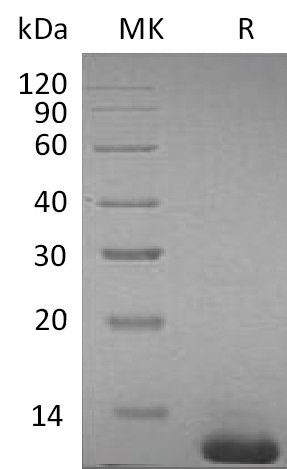 |
Greater than 95% as determined by reducing SDS-PAGE. |
靶点信息 Target Information
| 分子别名Alternative Names | Protein S100-BS-100 protein beta chainS-100 protein subunit betaS100 calcium-binding protein BS100bS100 betaS100 calcium binding protein B |
|---|---|
| 功能Function | Weakly binds calcium but binds zinc very tightly-distinct binding sites with different affinities exist for both ions on each monomer. Physiological concentrations of potassium ion antagonize the binding of both divalent cations, especially affecting high-affinity calcium-binding sites. Binds to and initiates the activation of STK38 by releasing autoinhibitory intramolecular interactions within the kinase. Interaction with AGER after myocardial infarction may play a role in myocyte apoptosis by activating ERK1/2 and p53/TP53 signaling. Could assist ATAD3A cytoplasmic processing, preventing aggregation and favoring mitochondrial localization. May mediate calcium-dependent regulation on many physiological processes by interacting with other proteins, such as TPR-containing proteins, and modulating their activity. |
| 亚细胞定位Subcellular Location | Cytoplasm. Nucleus. |
| 数据库链接Databases |
基因功能参考文献39 条
- Data (including data from studies in knockout mice) suggest that S100b acting as a humoral factor impairs glycolysis in muscle (myoblasts, myotubes, and skeletal muscles) independent of insulin action; this effect appears to be due to inhibition of Gapdh activity from enhanced poly(ADP-ribosyl)ation of Gapdh. (S100B = S100 protein, beta polypeptide, neural; Gapdh = glyceraldehyde-3-phosphate dehydrogenase) PMID: 28174179 : 28174179
- S100B inhibits C3H/10T1/2 murine embryonic mesenchyma.l cells into osteoblasts. S100B stimulates C3H/10T1/2 cell differentiation into adipocytes. PMID: 27601207 : 27601207
- The results of this study showed that S100B affects behavioral despair in female mice through functional interaction with the 5-HT7 receptor. PMID: 26499172 : 26499172
- Data show that S100B has direct effects on macrophages, enhancing particularly CCL22 and IL-1beta expression and modulates the inflammatory response in uveoretinitis and this is likely to be, at least in part, via a direct effect on macrophages. PMID: 26204512 : 26204512
- Data show that high glucose increased protein-protein interaction between Steap4 and S100B in mesangial (MES13) cells. PMID: 25817898 : 25817898
- high glucoseinduced profibrotic genes (TGFbeta, type IV collagen and fibronectin) and cell hypertrophyrelated p21WAF1 are dependent on S100B. PMID: 25482070 : 25482070
- Data suggest up-regulation of S100b/RAGE (advanced glycosylation end-product receptor) signaling plays role in inflammatory interaction between adipocytes/macrophages; adipocyte secretion of S100b is up-regulated by Tnf (tumor necrosis factor-alpha). PMID: 23804363 : 23804363
- Gioma production of S100B enhancestumor growth through CCL2 upregulation and tumor-associated macrophages chemoattraction. PMID: 23719262 : 23719262
- HMGB1, S100B, and RAGE signaling modulate the hippocampal inflammatory response and might play key roles in surgery-induced cognitive decline. PMID: 23899512 : 23899512
- S100B is a proinflammatory cytokine bridging RAGE and CD166/ALCAM downstream effector mechanisms, both being compensatory upregulated after genetic deletion of its counterpart. PMID: 23729438 : 23729438
- S100B expression may serve to modulate cardiac metabolism and adverse consequences of AGE in diabetic post-MI remodeling and function PMID: 23000886 : 23000886
- S100B is expressed in mouse photoreceptor cone outer segments but not in rods. PMID: 22508049 : 22508049
- The RAGE pathway may play an important role in STAT3 induction in glioma-associated macrophages and microglia, a process that may be mediated through S100B. PMID: 21264954 : 21264954
- S100B and APP levels are simultaneously increased within Down syndrome neural progenitors, their secretions are synergistically enhanced in a paracrine fashion, and their overexpressions disrupt mitochondrial membrane potentials and redox states. PMID: 21779383 : 21779383
- Unlike in the hippocampus-dependent tasks, S100B-KO mice were indistinguishable from wild-type mice in both cerebellum-dependent motor coordination and delay eyeblink conditioning. PMID: 21146588 : 21146588
- Data support S100B inhibition as a novel strategy for reducing cortical plaque load, gliosis and neuronal dysfunction in Alzheimer disease (AD) and suggest that both extracellular as well as intracellular S100B contribute to AD histopathology. PMID: 21080947 : 21080947
- These results suggest that S100beta is important for brain development and establishment of proper brain functions. PMID: 20099023 : 20099023
- Given the crucial roles of COX-2, IL-1beta and TNF-alpha in the inflammatory response, we propose that, by engaging RAGE, S100B might play an important role in microglia activation in the course of brain damage. PMID: 18599158 : 18599158
- attenuates the hemodynamic response to catecholamines PMID: 19713945 : 19713945
- constitutive overexpression of S100beta in transgenic mice does not modify serotonin levels during development, nor does it protect the serotonergic neurons from selective neurotoxicity or modify the serotonergic sprouting induced by partial lesion. PMID: 11835317 : 11835317
- The distribution of serotonergic fibers in the brains of S100B-knockout mice was normal. S100B may not influence neurite extension of serotonergic neurons PMID: 11872254 : 11872254
- Glial protein S100B modulates long-term neuronal synaptic plasticity PMID: 11891290 : 11891290
- the major cytoplasmic S100B target protein in different glial cell lines in the presence of Zn(2+) and Ca(2+) is IQGAP1 PMID: 12377780 : 12377780
- These results implicate normal levels of S100B in the attenuation of epileptogenesis. PMID: 12393261 : 12393261
- the -1,669/+3,106 sequence of the S100B gene is a useful reagent for driving expression of transgenes in most S100B-expressing cells of mouse brain. PMID: 12561079 : 12561079
- S-100b-containing cells and GFAP-containing cells increased in the striatum and substantia nigra at 3 days after MPTP treatment. S-100 immunoreactivity was observed only in GFAP-positive astrocytes. PMID: 12673835 : 12673835
- S-100 beta overexpressing animals were more active than the CD-1 control animals and showed significantly less social sniffing. PMID: 12742260 : 12742260
- Our findings show increased clusterin expression in the aged S100B mice compared to their CD-1 controls, a finding we have interpreted as further evidence of pathological brain aging. PMID: 15126113 : 15126113
- results support the idea that elevated levels of S100B in the brain are associated with increased vulnerability to neurological injury PMID: 15236402 : 15236402
- Mice lacking S100B show an apparent delay in OPC maturation in response to demyelinating insult. Nuclear S100B participates in the regulation of oligodendroglial cell maturation. PMID: 15555923 : 15555923
- 5-HT may modulate glial morphology by inducing a release of intracellular S-100B, and this pathway is inoperable in the S-100B knockout (-/-). PMID: 15621007 : 15621007
- These results argue against the current view that S100B expression is restricted to the astrocytic lineage in the CNS, and indicate that the use of S100B in combination with other molecular markers will help discriminate oligodendrocytes from astrocytes. PMID: 15782413 : 15782413
- Our data are consistent with a model in which S-100B overexpression in AD enhances glial activation and leads to an augmented neuroinflammatory process that increases the severity of neuropathologic sequelae. PMID: 15810011 : 15810011
- Altogether, our results indicate that the S100B expression defines a late developmental stage after which GFAP-expressing cells lose their NSC potential and suggest that S100B expression is repressed by adult SVZ microenvironment. PMID: 17078026 : 17078026
- possible interaction between FGF-2 and S100Beta in activated satellite cells of the dorsal root ganglia, which might trigger paracrine actions in the axotomized sensory neurons PMID: 17729158 : 17729158
- S100B has a role in exacerbating brain damage and periinfarct reactive gliosis (astrocytosis and microgliosis) during the subacute phase of middle cerebral artery occlusion PMID: 18451356 : 18451356
- There was a significant increase of hippocampal BDNF (+53%) and a decrease of hippocampal (-12%) and residual neocortical (-15%) NA in 10-month-old S100B KO mice compared to wildtype mice. PMID: 18638525 : 18638525
- Our findings suggest further investigation into the potential role of vitamin E in reducing the oxidation state of the S100B protein and its influence on neuroinflammatory processes marked by microglial activation in vivo. PMID: 18649404 : 18649404
- The data of this study indicated that genetic differences in S100B gene expression may predispose individual differences in the responsivity to repeated intake of MDMA. PMID: 18812013 : 18812013
蛋白复溶体积计算器缓冲液体积 = 蛋白质量 ÷ 蛋白浓度
输入任意两项,第三项自动计算 |
蛋白浓度稀释计算器初浓度 × 初体积 = 终浓度 × 终体积
输入任意三项,第四项自动计算 |



