
Hedgehog信号通路
Many of the genes that encode hedgehog pathway components have subsequently been associated with a range of inherited human developmental disorders and other pathologies.
Fanconi anemia (FA) is an autosomal recessive genetic disorder resulting in symptoms that include chromosomal breakage, bone marrow failure, hypersensitivity to DNA cross-linking agents (such as mitomycin C), and a predisposition to cancer (1). In response to DNA damage, the FA nuclear complex (FANCA, FANCB, FANCC, FANCE, FANCF, FANCG, FANCM) induces mono-ubiquitination of FANCD2 and FANCI (2). Monoubiquitination of FANCD2 induces localization of FANCD2 to sites of DNA damage, where it interacts with BRCA1. FANCJ/BRIP1, FANCD1/BRCA2, and FANCN/PALB2 are also recruited to sites of DNA damage (3).
This document focuses on gluconeogenesis and its associated key enzymes, along with relevant antibodies and research references. It elaborates on the functions of multiple enzymes involved in gluconeogenesis and glycolysis, such as enolase isoforms (ENO1/2/3), fructose-1,6-bisphosphatase 1 (FBP1), glucose-6-phosphate isomerase (GPI), phosphoenolpyruvate carboxykinase (PCK1/2), phosphoglycerate mutase 1 (PGAM1), phosphoglycerate kinase 1 (PGK1), and pyruvate carboxylase (PC). These enzymes play pivotal roles in metabolic processes, with abnormal expression linked to tumor progression (e.g., breast cancer, lung cancer, clear cell renal cell carcinoma) and other diseases. Additionally, the document presents a regulatory diagram of glucose metabolism (encompassing glycolysis, gluconeogenesis, and the tricarboxylic acid cycle) and provides detailed information on specific antibodies targeting the aforementioned enzymes, including their catalog numbers, reactivities, and applications. Relevant research references are also included to support the discussed findings.
GATA proteins comprise a group of transcription factors that are related by the presence of conserved zinc finger DNA-binding domains, which bind directly to the nucleotide sequence core element GATA. There are six vertebrate GATA proteins, designated GATA-1 to GATA-6. Although they are commonly divided as hematopoietic (GATA-1-3) or cardiac (GATA-4-6) factors, GATA proteins are expressed in a wide variety of tissue and play critical roles in embryonic development and organ differentiation.
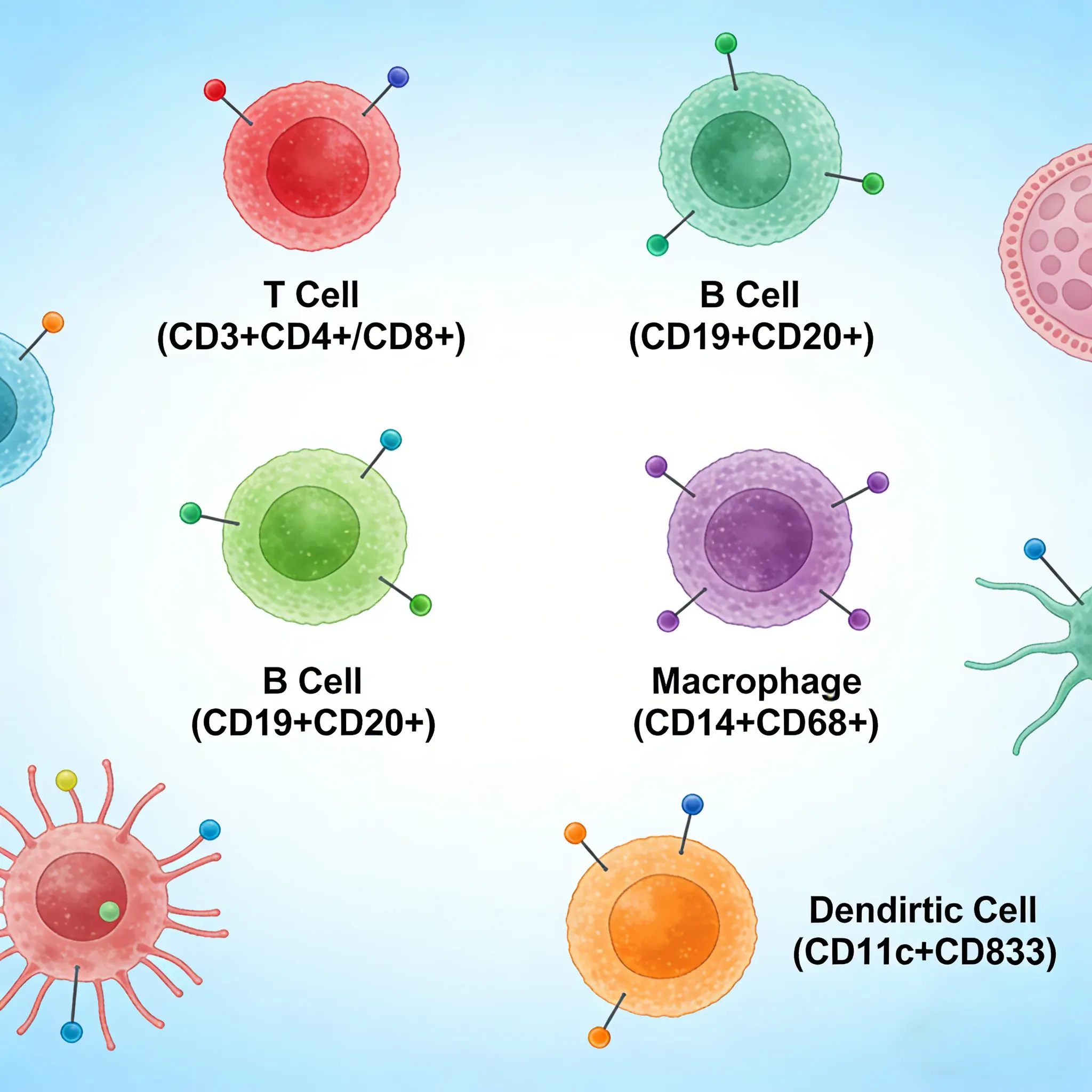
The interaction between cancer and the host immune system mainly occurs in the reactive tissue stroma surrounding tumors, an area known as the Tumor Immune Microenvironment (TIME). The breakthrough clinical application of immune checkpoint inhibitors, particularly targeted therapies against Programmed Death Protein 1 (PD-1, a T-cell co-inhibitory receptor) and Programmed Death Ligand 1 (PD-L1, also known as B7-H1/CD274), has not only propelled cancer immunotherapy into a new era but also made functional analysis of TIME a core focus in both research and clinical settings. Precise characterization of TIME's cellular composition, functional states, and molecular interaction networks is a crucial prerequisite for screening predictive biomarkers for immunotherapy response. Furthermore, deeply clarifying the dual pro-cancer/anti-cancer mechanisms of various immune cells in TIME and their dynamic associations with tumor cells can provide core support for developing novel immunotherapeutic strategies. However, the high heterogeneity of TIME and the challenge of detecting low-abundance immune molecules pose severe challenges to traditional analytical techniques, urgently requiring highly sensitive, multiplex-targeted in situ detection tools to overcome this dilemma.
The Forkhead signaling pathway is a conserved, evolutionarily ancient molecular network centered on Forkhead box (FOX) transcription factors—a family of proteins characterized by a highly conserved "Forkhead" DNA-binding domain (≈100 amino acids) that mediates sequence-specific binding to target gene promoters.