


| 纯度Purity | Greater than 97% as determined by reducing SDS-PAGE. |
|---|---|
| 内毒素Endotoxin | Please contact with the lab for this information |
| 蛋白构建Protein Construction |
【Ala331-Ser442】序列区间
|
| Accession | Q07257 |
| 表达宿主Expression Host | - |
| 种属Species | Rattus norvegicus (Rat) |
| 预测分子量Predicted MW | 13.9 kDa |
| 制剂Formulation | Lyophilized from a 0.2 μm filtered solution of 20mM Tris, 150mM NaCl, pH8.0, containing 1mM EDTA, 1mM DTT, 0.01% SKL, 5% Trehalose and Proclin300. |
| 运输方式Shipping | The product is shipped with ice bag. Upon receipt, store it immediately at the temperature listed below. |
| 稳定性&储存Stability & Storage | 12 months at -20°C to -80°C in lyophilized state.6 months at -20°C to -80°C under sterile conditions after reconstitution.7-10 days at 2°C to 8°C under sterile conditions after reconstitution.Please minimize freeze-thaw cycles. |
| 复溶Reconstitution | Reconstitute in 20mM Tris, 150mM NaCl (pH8.0) to a concentration of 0.1-1.0 mg/mL. Do not vortex. |
 |
Greater than 97% as determined by reducing SDS-PAGE. |
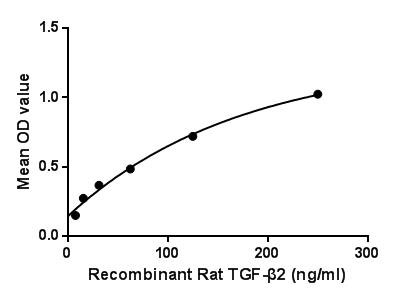 |
Transforming growth factor-beta 2 (TGF-β2) is a secreted protein known as a cytokine that performs many cellular functions and has a vital role during embryonic development (alternative names: Glioblastoma-derived T-cell suppressor factor, G-TSF, BSC-1 cell growth inhibitor, Polyergin, Cetermin). It is an extracellular glycosylated protein. It is known to suppress the effects of interleukin dependent T-cell tumors. Besides, Vitronectin (VTN) has been identified as an interactor of TGF-β2, thus a binding ELISA assay was conducted to detect the interaction of recombinant rat TGF-β2 and recombinant rat VTN. Briefly, TGF-β2 were diluted serially in PBS, with 0.01% BSA (pH 7.4). Duplicate samples of 100μL were then transferred to VTN-coated microtiter wells and incubated for 2h at 37℃. Wells were washed with PBST and incubated for 1h with anti-TGF-β2 pAb, then aspirated and washed 3 times. After incubation with HRP labelled secondary antibody, wells were aspirated and washed 3 times. With the addition of substrate solution, wells were incubated 15-25 minutes at 37℃. Finally, add 50µL stop solution to the wells and read at 450nm immediately. The binding activity of TGF-β2 and VTN was shown in Figure 1, and this effect was in a dose dependent manner. Figure. The binding activity of TGF-β2 with VTN. |
| 分子别名Alternative Names | TGF-B2TGF-Beta2G-TSFLAPCeterminPolyerginLatency-associated peptideBSC-1 cell growth inhibitorGlioblastoma-derived T-cell suppressor factor |
|---|---|
| 背景介绍Background | Transforming growth factor beta-2 proprotein: Precursor of the Latency-associated peptide (LAP) and Transforming growth factor beta-2 (TGF-beta-2) chains, which constitute the regulatory and active subunit of TGF-beta-2, respectively.; Required to maintain the Transforming growth factor beta-2 (TGF-beta-2) chain in a latent state during storage in extracellular matrix. Associates non-covalently with TGF-beta-2 and regulates its activation via interaction with 'milieu molecules', such as LTBP1 and LRRC32/GARP, that control activation of TGF-beta-2.; Transforming growth factor beta-2: Multifunctional protein that regulates various processes such as angiogenesis and heart development. Activation into mature form follows different steps: following cleavage of the proprotein in the Golgi apparatus, Latency-associated peptide (LAP) and Transforming growth factor beta-2 (TGF-beta-2) chains remain non-covalently linked rendering TGF-beta-2 inactive during storage in extracellular matrix. At the same time, LAP chain interacts with 'milieu molecules', such as LTBP1 and LRRC32/GARP, that control activation of TGF-beta-2 and maintain it in a latent state during storage in extracellular milieus. Once activated following release of LAP, TGF-beta-2 acts by binding to TGF-beta receptors (TGFBR1 and TGFBR2), which transduce signal. |
| 功能Function | Transforming growth factor beta-2 proprotein: Precursor of the Latency-associated peptide (LAP) and Transforming growth factor beta-2 (TGF-beta-2) chains, which constitute the regulatory and active subunit of TGF-beta-2, respectively.; Required to maintain the Transforming growth factor beta-2 (TGF-beta-2) chain in a latent state during storage in extracellular matrix. Associates non-covalently with TGF-beta-2 and regulates its activation via interaction with 'milieu molecules', such as LTBP1 and LRRC32/GARP, that control activation of TGF-beta-2.; Transforming growth factor beta-2: Multifunctional protein that regulates various processes such as angiogenesis and heart development. Activation into mature form follows different steps: following cleavage of the proprotein in the Golgi apparatus, Latency-associated peptide (LAP) and Transforming growth factor beta-2 (TGF-beta-2) chains remain non-covalently linked rendering TGF-beta-2 inactive during storage in extracellular matrix. At the same time, LAP chain interacts with 'milieu molecules', such as LTBP1 and LRRC32/GARP, that control activation of TGF-beta-2 and maintain it in a latent state during storage in extracellular milieus. Once activated following release of LAP, TGF-beta-2 acts by binding to TGF-beta receptors (TGFBR1 and TGFBR2), which transduce signal. |
| 亚细胞定位Subcellular Location | [Latency-associated peptide]: Secreted, extracellular space, extracellular matrix.; [Transforming growth factor beta-2]: Secreted. |
| 数据库链接Databases |
基因功能参考文献24 条
- VEGF and TGFB2 are upregulated in femoral bone during fracture healing following implantation with coated titanium screws. PMID: 28361415 : 28361415
- Diminished collagen synthesis in folliculostellate cell-deficient cell aggregates was partially recovered by TGFbeta2. TGFbeta2-mediated folliculostellate cell-pericyte interaction appears to be essential for collagen synthesis in anterior pituitary. PMID: 26957638 : 26957638
- miR-378a expression is associated with its methylation status in TGF-beta1-treated cells, and epigenetically-regulated miR-378a inhibits TGF-beta1-induced hepatic stellate cells activation, at least in part, via TGF-beta2. PMID: 27855367 : 27855367
- Hepatic TGFB2 gene expression was up-regulated in liver of bile duct ligation model of liver fibrosis. PMID: 27049496 : 27049496
- These study results suggest that HR controls Tgf-b2 expression via regulation of miR-31, thus causing abnormal hair cycle in Hr(Hp)/Hr(Hp) mice. PMID: 25639665 : 25639665
- Data suggest that Muller cells release TGF-beta2, inhibiting the proliferation of retinal endothelial cells via activation of Smad2/Smad3 and attenuation of ERK signaling PMID: 24838936 : 24838936
- level of TGFbeta2 in rat colonic neoplasms PMID: 12209600 : 12209600
- Tgfb2 exhibited dynamic changes in expression in experimental glomerulonephritis. PMID: 12545247 : 12545247
- colocalizes with the trans-Golgi network marker TGN38 and a marker molecule for secretory granules, chromogranin B in PC12 cells and hippocampal neurons; a substantial portion of TGF-beta2 is secreted by the regulated secretory pathway in these cells PMID: 12595240 : 12595240
- TGF-beta 2 may play a physiological role in germ cell proliferation/differentiation and Sertoli cell function. PMID: 12646048 : 12646048
- role in cranial suture fusion PMID: 12733949 : 12733949
- Tgfb2 exrpession increased in infarcted myocardium after propranolol treatment. PMID: 14575314 : 14575314
- Analysis of Tgf-beta2 expression patterns in acute and progressive glomerulonephritis models. PMID: 15122060 : 15122060
- TGF-beta2 mRNA and protein expressions in the cerebral cortex of the H-Tx rat, a model of congenital hydrocephalus. PMID: 15375625 : 15375625
- TGF-beta2 plays important role in pancreatic morphogenesis and administration of excess all-trans retinoic acid before neurulation inhibit TGF-beta2 expression disrupted pancreatic morphogenesis particularly Langerhans islets. PMID: 16479313 : 16479313
- differential processing of TGF-beta1 and -beta 2 may be part of the mechanism that generates isoform-specific functions of the TGF-betas PMID: 17516499 : 17516499
- expression and signaling of TGFbeta2 and distribution of extracellular matrix proteins: laminin, fibronectin, collagens in the parotid gland of control and diabetic rats. PMID: 17574405 : 17574405
- novel role for TGF-beta2 in protection from unloading-induced apoptosis in vivo PMID: 18378961 : 18378961
- TGF-beta1 and TGF-beta 2 mRNA, but not TGF-beta3, is increased at 4 and 12 weeks in experimental diabetic peripheral neuropathy. PMID: 18406405 : 18406405
- immunolocalization of transforming growth factor beta (TGF-beta2) in rat thymic stromal cells and thymocytes: TGF-beta2 may play an important role in the organization or development of thymocytes in the late stages of thymopoiesis PMID: 18554691 : 18554691
- These results show that elevated expression of TSP-1 and TGF-beta can be detected in the injured segment of the spinal cord 12 and 24 h after injury. Thus, TSP-1 and TGF-beta may have a role in SCI. PMID: 19342245 : 19342245
- The renoprotective effect of AM might be related to inhibition of myofibroblast activation, inducing of HGF and reducing of TGF-beta1 expression. PMID: 19434765 : 19434765
- TGF-beta2 is an essential neuroprotective factor released by microglia in its culture medium that, to be fully effective, requires the concomitant presence of other factor(s) of low molecular weight. PMID: 19457129 : 19457129
- TGF-beta2 and TGF-beta3 induced a dose-dependant increase of apoptosis in cultured stromal cells. PMID: 19656380 : 19656380
蛋白复溶体积计算器缓冲液体积 = 蛋白质量 ÷ 蛋白浓度
输入任意两项,第三项自动计算 |
蛋白浓度稀释计算器初浓度 × 初体积 = 终浓度 × 终体积
输入任意三项,第四项自动计算 |



