


| 纯度Purity | Greater than 95% as determined by reducing SDS-PAGE. |
|---|---|
| 内毒素Endotoxin | Please contact with the lab for this information |
| 蛋白构建Protein Construction |
【Glu21-Ser99】序列区间
|
| Accession | P33622 |
| 表达宿主Expression Host | - |
| 种属Species | Mus musculus (Mouse) |
| 预测分子量Predicted MW | 10.4 kDa |
| 制剂Formulation | Lyophilized from a 0.2 μm filtered solution of 20mM Tris, 150mM NaCl, pH8.0, containing 1mM EDTA, 1mM DTT, 0.01% SKL, 5% Trehalose and Proclin300. |
| 运输方式Shipping | The product is shipped with ice bag. Upon receipt, store it immediately at the temperature listed below. |
| 稳定性&储存Stability & Storage | 12 months at -20°C to -80°C in lyophilized state.6 months at -20°C to -80°C under sterile conditions after reconstitution.7-10 days at 2°C to 8°C under sterile conditions after reconstitution.Please minimize freeze-thaw cycles. |
| 复溶Reconstitution | Reconstitute in 20mM Tris, 150mM NaCl (pH8.0) to a concentration of 0.1-1.0 mg/mL. Do not vortex. |
 |
Greater than 95% as determined by reducing SDS-PAGE. |
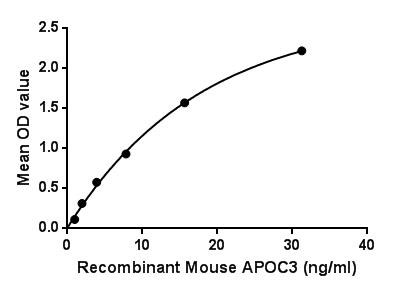 |
Figure. The binding activity of APOC3 with PCYOX1. Apolipoprotein C3 (APOC3) also known as apo-CIII is a component of very low density lipoprotein (VLDL). APOC3 inhibits lipoprotein lipase and hepatic lipase; it is thought to inhibit hepatic uptake of triglyceride-rich particles. An increase in apoC-III levels induces the development of hypertriglyceridemia. Some evidences suggest an intracellular role for Apo-CIII in promoting the assembly and secretion of triglyceride-rich VLDL particles from hepatic cells under lipid-rich conditions. Besides, Prenylcysteine Oxidase 1 (PCYOX1) has been identified as an interactor of APOC3, thus a binding ELISA assay was conducted to detect the interaction of recombinant mouse APOC3 and recombinant mouse PCYOX1. Briefly, APOC3 were diluted serially in PBS, with 0.01% BSA (pH 7.4). Duplicate samples of 100μL were then transferred to PCYOX1-coated microtiter wells and incubated for 2h at 37℃. Wells were washed with PBST and incubated for 1h with anti-APOC3 pAb, then aspirated and washed 3 times. After incubation with HRP labelled secondary antibody, wells were aspirated and washed 3 times. With the addition of substrate solution, wells were incubated 15-25 minutes at 37℃. Finally, add 50µL stop solution to the wells and read at 450nm immediately. The binding activity of APOC3 and PCYOX1 was shown in Figure 1, and this effect was in a dose dependent manner. |
| 分子别名Alternative Names | Apo-C3APOCIIIAPOC-III |
|---|---|
| 背景介绍Background | Component of triglyceride-rich very low density lipoproteins (VLDL) and high density lipoproteins (HDL) in plasma. Plays a multifaceted role in triglyceride homeostasis. Intracellularly, promotes hepatic very low density lipoprotein 1 (VLDL1) assembly and secretion; extracellularly, attenuates hydrolysis and clearance of triglyceride-rich lipoproteins (TRLs). Impairs the lipolysis of TRLs by inhibiting lipoprotein lipase and the hepatic uptake of TRLs by remnant receptors. Formed of several curved helices connected via semiflexible hinges, so that it can wrap tightly around the curved micelle surface and easily adapt to the different diameters of its natural binding partners. |
| 功能Function | Component of triglyceride-rich very low density lipoproteins (VLDL) and high density lipoproteins (HDL) in plasma. Plays a multifaceted role in triglyceride homeostasis. Intracellularly, promotes hepatic very low density lipoprotein 1 (VLDL1) assembly and secretion; extracellularly, attenuates hydrolysis and clearance of triglyceride-rich lipoproteins (TRLs). Impairs the lipolysis of TRLs by inhibiting lipoprotein lipase and the hepatic uptake of TRLs by remnant receptors. Formed of several curved helices connected via semiflexible hinges, so that it can wrap tightly around the curved micelle surface and easily adapt to the different diameters of its natural binding partners. |
| 亚细胞定位Subcellular Location | Secreted. |
| 数据库链接Databases |
基因功能参考文献19 条
- Both triglyceride-rich lipoproteins (TRLs) and ApoCIII contribute to the progression of atherosclerosis, and the modulation of TRLs and ApoCIII may represent a novel therapeutic approach against hypertriglyceridemia induced atherosclerosis. PMID: 30223835 : 30223835
- C3(QK) variant is a gain-of-function mutation that can stimulate VLDL1 production, through enhanced DNL PMID: 28887372 : 28887372
- intestinal apoC-III overexpression results in the secretion of smaller, less dense chylomicron particles along with reduced triacylglycerol secretion from the intestine PMID: 28159868 : 28159868
- ApoC-III inhibits turnover of TG-rich lipoproteins primarily through a hepatic clearance mechanism mediated by the LDLR/LRP1 axis PMID: 27400128 : 27400128
- These data strongly suggest that intestinal apoC-III is not a FoxO1 target and support the idea that apoC-III is not regulated coordinately with hepatic apoC-III, and establishes another key aspect of apoC-III that is unique in the intestine from the liver. PMID: 28739253 : 28739253
- APOC3, whose dysregulation is liable for hypertriglyceridemia, is not a predisposing factor for linking overnutrition to NAFLD in obesity PMID: 28115523 : 28115523
- Severe hypertriglyceridaemia resulting from ApoCIII overexpression promotes restenosis and atherosclerosis PMID: 26160324 : 26160324
- Under conditions of islet insulin resistance, locally produced apoCIII is an important diabetogenic factor involved in impairment of beta-cell function. PMID: 25941406 : 25941406
- decreased ApoAI synthesis might be accounted for the lower plasma HDL level in ApoCIII transgenic mice PMID: 25969427 : 25969427
- ApoCIII hyperactivates beta cell CaV1 channels through SR-BI/beta1 integrin-dependent coactivation of PKA and Src. PMID: 23949443 : 23949443
- Increased plasma APOC3 concentrations predispose mice to diet-induced nonalcoholic fatty liver and hepatic insulin resistance. PMID: 21793029 : 21793029
- Glucose induces apoCIII transcription, which may represent a mechanism linking hyperglycemia, hypertriglyceridemia, and cardiovascular disease in type 2 diabetes. PMID: 21183731 : 21183731
- PGC-1beta regulates plasma triglyceride metabolism through stimulating apolipoprotein C3 (APOC3) expression and elevating APOC3 levels in circulation PMID: 20889132 : 20889132
- The apoC-III metabolism may contribute to dyslipidemia in CKD, and this requires further investigation. PMID: 19542564 : 19542564
- Association between SstI polymorphism of the gene, glucose intolerance and cardiovascular risk in renal transplant recipients PMID: 11959336 : 11959336
- ApoB lipoproteins that contain apoCIII increase THP-1 cell adhesion to ECs via PKCalpha and RhoA-mediated beta1-integrin activation. PMID: 16461842 : 16461842
- oxidized fatty acids may act through an APOA5/APOClll mechanism that contributes to lowering of TG levels other than PPAR* induction PMID: 18243209 : 18243209
- the apoCIII enhancer contributes to the maintenance of an active chromatin subdomain of the apoAI/CIII/AIV genes, but not apoAV PMID: 18678879 : 18678879
- These results suggest that apoC-III may play a specific role in lipid storage and mobilization in adipocytes, non-lipoprotein-secreting cells, and indicate the functional role of RXRalpha during adipocyte differentiation. PMID: 19121312 : 19121312
蛋白复溶体积计算器缓冲液体积 = 蛋白质量 ÷ 蛋白浓度
输入任意两项,第三项自动计算 |
蛋白浓度稀释计算器初浓度 × 初体积 = 终浓度 × 终体积
输入任意三项,第四项自动计算 |



