


| 纯度Purity | Greater than 95% as determined by reducing SDS-PAGE. |
|---|---|
| 内毒素Endotoxin | Please contact with the lab for this information |
| 蛋白构建Protein Construction |
【Asp268-Ser376】序列区间
|
| Accession | O08689 |
| 表达宿主Expression Host | - |
| 种属Species | Mus musculus (Mouse) |
| 预测分子量Predicted MW | 13.9 kDa |
| 制剂Formulation | Lyophilized from a 0.2 μm filtered solution of 20mM Tris, 150mM NaCl, pH8.0, containing 1mM EDTA, 1mM DTT, 0.01% SKL, 5% Trehalose and Proclin300. |
| 运输方式Shipping | The product is shipped with ice bag. Upon receipt, store it immediately at the temperature listed below. |
| 稳定性&储存Stability & Storage | 12 months at -20°C to -80°C in lyophilized state.6 months at -20°C to -80°C under sterile conditions after reconstitution.7-10 days at 2°C to 8°C under sterile conditions after reconstitution.Please minimize freeze-thaw cycles. |
| 复溶Reconstitution | Reconstitute in 20mM Tris, 150mM NaCl (pH8.0) to a concentration of 0.1-1.0 mg/mL. Do not vortex. |
 |
Greater than 95% as determined by reducing SDS-PAGE. |
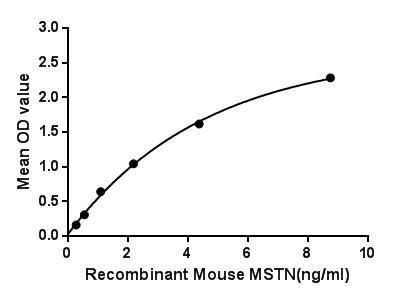 |
Figure. The binding activity of MSTN with FSTL3. Myostatin (MSTN) also known as growth differentiation factor 8 (GDF-8) a myokine, a protein produced and released by myocytes. It inhibit myogenesis including muscle cell growth and differentiation. Myostatin is a secreted growth differentiation factor that is a member of the TGF beta protein family. Besides, Follistatin Like Protein 3 (FSTL3) has been identified as an interactor of MSTN, thus a binding ELISA assay was conducted to detect the interaction of recombinant mouse MSTN and recombinant mouse FSTL3. Briefly, MSTN were diluted serially in PBS, with 0.01% BSA (pH 7.4). Duplicate samples of 100uL were then transferred to FSTL3-coated microtiter wells and incubated for 2h at 37℃. Wells were washed with PBST and incubated for 1h with anti-MSTN pAb, then aspirated and washed 3 times. After incubation with HRP labelled secondary antibody, wells were aspirated and washed 3 times. With the addition of substrate solution, wells were incubated 15-25 minutes at 37℃. Finally, add 50µL stop solution to the wells and read at 450nm immediately. The binding activity of MSTN and FSTL3 was shown in Figure 1, and this effect was in a dose dependent manner. |
| 分子别名Alternative Names | GDF8Growth Differentiation Factor 8 |
|---|---|
| 背景介绍Background | Acts specifically as a negative regulator of skeletal muscle growth. |
| 功能Function | Acts specifically as a negative regulator of skeletal muscle growth. |
| 亚细胞定位Subcellular Location | Secreted. |
| 数据库链接Databases |
基因功能参考文献50 条
- the prodomain:GDF8 complex can exist in a fully latent state and an activated or "triggered" state where the prodomain remains in complex with the mature domain PMID: 29348202 : 29348202
- Myostatin deletion increases lean muscle mass and results in muscle-specific increases in endothelium-dependent vasodilation. PMID: 29192067 : 29192067
- Indoxyl sulfate enhanced the production of myostatin by enhancing oxidative stress in skeletal muscle, leading to muscle atrophy. PMID: 27549031 : 27549031
- Myostatin inhibition therapy for insulin-deficient type 1 diabetes has been proposed in an experimental model. PMID: 27581061 : 27581061
- maternal myostatin deficiency altered fetal growth and calvarial collagen content of newborn mice and conferred a lasting impact on bone geometry and biomechanical integrity of offspring at 4 mo of age. PMID: 27821779 : 27821779
- Mstn regulates Fndc5/Irisin expression and secretion through a novel miR-34a-dependent post-transcriptional mechanism; loss of Mstn in mice leads to the increased Fndc5/Irisin expression, which contributes to the browning of white adipocytes PMID: 27297797 : 27297797
- Axon diameter and myelin thickness were increased in motor axons of myostatin deficient animals. PMID: 28073155 : 28073155
- These data illustrate the importance of lipids as a link by which MSTN deficiency can impact mitochondrial bioenergetics in skeletal muscle. PMID: 28676454 : 28676454
- Myostatin inhibits eEF2K-eEF2 by regulating AMPK to suppress protein synthesis. PMID: 29024627 : 29024627
- These results demonstrate that a greater than additive effect is observed on the growth of skeletal muscle and in the reduction of body fat when myostatin is absent and IGF1 is in excess, and that myostatin and IGF1 regulate skeletal muscle size, myofibre type and gonadal fat through distinct mechanisms. PMID: 28533420 : 28533420
- Mstn deficiency but not anti-myostatin blockade induces marked proteomic changes in mouse skeletal muscle. PMID: 27214824 : 27214824
- GDF8 plays a significant regulatory role in bone formation and bone resorption PMID: 28074479 : 28074479
- Genetic inactivation of myostatin increases maximal force and power, but in return it reduces muscle quality, particularly in male mice. PMID: 27312354 : 27312354
- findings indicate that myostatin directly influences osteocyte function and thereby inhibits osteoblastic differentiation, at least in part, through the suppression of osteocyte-derived exosomal miR-218, suggesting a novel mechanism in muscle-bone communication. PMID: 28465350 : 28465350
- The 12-bp Mstn(Cmpt-dl1Abc) deletion decreases adiposity and improves whole body glucose uptake, insulin sensitivity, and (18)FDG uptake of skeletal muscle and white adipose tissue. PMID: 27965203 : 27965203
- In this model, increased LTBP4 led to greater muscle mass with proportionally increased strength, and decreased fibrosis. The increase in muscle mass and reduction in fibrosis were similar to what occurs when myostatin, a related TGFbeta family member and negative regulator of muscle mass, was deleted in mdx mice PMID: 27148972 : 27148972
- myostatin dysfunction impairs adaptation of the soleus muscle to high functional demands. PMID: 26304113 : 26304113
- Evidences indicate that the suppression of MSTN cause to increase the regenerative potential of injured soleus muscle via the increase in the population of muscle satellite cells regardless of unloading conditions. PMID: 27647997 : 27647997
- A role for Nfix in postnatal skeletal muscle development and regeneration and Myostatin gene expression regulation. PMID: 26923583 : 26923583
- Myostatin deletion specifically affects skeletal muscle mitochondrial function and redox status. Decreased mitochondrial function and oxidative markers persisted in aged mstn KO mice. However, muscle hypertrophy and the redox status related to this genotype appeared as beneficial side effects attenuating the age effect, as metabolic changes become less pronounced in comparison with WT mice. PMID: 26944368 : 26944368
- A synthetic peptide corresponding to this decorin region dose-dependently inhibited the response to myostatin in cardiomyocytes PMID: 27559042 : 27559042
- myostatin may play an important role in maintaining ankle and wrist joint health. PMID: 26549246 : 26549246
- Agouti-related peptide (AgRP) neuron activation acutely reprograms gene expression in BAT toward a myogenic signature, including increased expression of myostatin. Interference with myostatin activity improves insulin sensitivity that was impaired by AgRP neurons activation. PMID: 27015310 : 27015310
- Increased expression of myostatin in heart muscle cells caused interstitial fibrosis via activation of the TAK-1-MKK3/6-p38 signaling pathway PMID: 25725788 : 25725788
- study is the first to report an in vivo association between vitamin D, myostatin, and the regulation of muscle mass PMID: 26340892 : 26340892
- Report myostatin expression in early postnatal mouse masseter and rectus femoris muscles. PMID: 25982068 : 25982068
- An age-dependent decline in serum Gdf8 levels was identified. PMID: 26489925 : 26489925
- Mstn may negatively regulate Igf2 expression to control postnatal skeletal muscle growth, however differences in growth between male and female mice are not readily explained by changes in expression of Igf family members. PMID: 26198127 : 26198127
- the phenotypic and physiologic impact of postnatal myostatin inhibition on bite mechanics, were examined. PMID: 26252892 : 26252892
- Data (including data from studies in knockout mice) suggest that myostatin attenuation stimulates adipogenesis in vivo; reduced adiposity in mstn-/- knockout mice results from nutrient partitioning away from fat and in support of muscle. PMID: 26580671 : 26580671
- analysis of dual exon skipping of dystrophin and myostatin pre-mRNAs using phosphorodiamidate morpholino oligomers conjugated with an arginine-rich peptide PMID: 25959011 : 25959011
- Data show that circulating myostatin levels decreased with age and estimates of growth differentiation factor 11 (GDF11) levels using myostatin null mice indicate that they were almost 500 times lower than those for myostatin. PMID: 26372181 : 26372181
- MSTN haploinsufficiency protects against aging-related declines in muscle function and enhances the longevity of mice. PMID: 25808276 : 25808276
- results reveal that there is a novel pathway in skeletal muscle development in which miR-128 regulates myostatin at CDS region to inhibit proliferation but promote differentiation of myoblast cells. PMID: 25958325 : 25958325
- Myostatin modulates the expression and secretion of adipokines in fully differentiated 3T3-L1 adipocytes. PMID: 25878062 : 25878062
- Myostatin deficiency or antibody-mediated inhibition leads to an amelioration of arthritis severity in hTNFtg mice PMID: 26236992 : 26236992
- Established the myostatin mutated-mouse model in order to study myostatin, which is expressed primarily in skeletal muscle, and negatively regulates skeletal muscle mass. PMID: 25695746 : 25695746
- novel insights into myostatin regulation at three different mouse developmental timepoints PMID: 25695797 : 25695797
- FST, SMAD3, TGFBR1, and AcvR1a genes play a vital role in skeletal muscle hypertrophy in the myostatin propeptide transgenic mice. PMID: 25147795 : 25147795
- Myostatin/activin blocking combined with exercise reconditions skeletal muscle expression profile of mdx mice. PMID: 25304272 : 25304272
- Myostatin acted through the Ras-Mek-Erk signaling pathway to transcriptionally regulate miR-431 expression C2C12 cells. PMID: 25869071 : 25869071
- present the First low resolution solution structure of myostatin-free and myostatin-bound states of GASP-1 and GASP-2 PMID: 25657005 : 25657005
- The susceptibility of skeletal muscles of Mstn(-/-) mice to atrophy during hindlimb suspension is due to an up- and downregulation, respectively, of the mechanisms regulating atrophy of myofibres and translation of mRNA. PMID: 24718581 : 24718581
- Gasp-1 overexpression resulted in increased myostatin expression. PMID: 25277978 : 25277978
- Cardiac MTSN activation occurs rapidly after cardiac ischemia. PMID: 25528587 : 25528587
- reduced sarcoplasmic reticulum calcium release underlies the reduced muscle force in mutant Cmpt animals PMID: 24445322 : 24445322
- our results reveal an essential role for myostatin in the pathogenesis of cancer cachexia and link this condition to tumor growth, with implications for furthering understanding of cancer as a systemic disease. PMID: 25336187 : 25336187
- role of myostatin in cardiovascular disease and cachexia PMID: 24680839 : 24680839
- MyoD expression was detected to identify impact of IGF-1 on myoblasts differentiation when exposed to myostatin. PMID: 24575400 : 24575400
- mechanical vibration strongly down-regulates atrophy genes myostatin and atrogin-1 both in vivo and in vitro. PMID: 22711460 : 22711460
蛋白复溶体积计算器缓冲液体积 = 蛋白质量 ÷ 蛋白浓度
输入任意两项,第三项自动计算 |
蛋白浓度稀释计算器初浓度 × 初体积 = 终浓度 × 终体积
输入任意三项,第四项自动计算 |



