


| 纯度Purity | Greater than 95% as determined by reducing SDS-PAGE. |
|---|---|
| 内毒素Endotoxin | Please contact with the lab for this information |
| 蛋白构建Protein Construction |
【Ile602-Ala821】序列区间
|
| Accession | P20807 |
| 表达宿主Expression Host | - |
| 种属Species | Homo sapiens (Human) |
| 预测分子量Predicted MW | 29.1 kDa |
| 制剂Formulation | Lyophilized from a 0.2 μm filtered solution of PBS, pH7.4, containing 0.01% SKL, 1mM DTT, 5% Trehalose and Proclin300. |
| 运输方式Shipping | The product is shipped with ice bag. Upon receipt, store it immediately at the temperature listed below. |
| 稳定性&储存Stability & Storage | 12 months at -20°C to -80°C in lyophilized state.6 months at -20°C to -80°C under sterile conditions after reconstitution.7-10 days at 2°C to 8°C under sterile conditions after reconstitution.Please minimize freeze-thaw cycles. |
| 复溶Reconstitution | Reconstitute in 10mM PBS (pH7.4) to a concentration of 0.1-1.0 mg/mL. Do not vortex. |
 |
Greater than 95% as determined by reducing SDS-PAGE. |
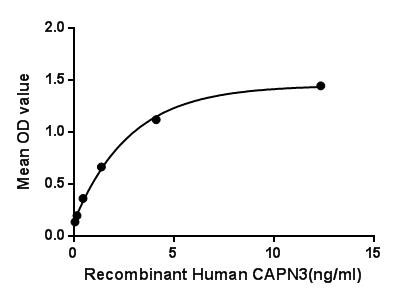 |
Figure. The binding activity of CAPN3 with TTN. Calpain 3 is a calcium-dependent cysteine protease mainly expressed in skeletal muscle. In humans, calpain 3 is encoded by the CAPN3 gene. This gene encodes a muscle-specific member of the calpain large subunit family that specifically binds to titin. Mutations in this gene are associated with limb-girdle muscular dystrophies type 2A. Alternate promoters and alternative splicing result in multiple transcript variants encoding different isoforms and some variants are ubiquitously expressed. Besides, Titin (TTN) has been identified as an interactor of CAPN3, thus a binding ELISA assay was conducted to detect the interaction of recombinant human CAPN3 and recombinant human TTN. Briefly, CAPN3 were diluted serially in PBS with 0.01% BSA (pH 7.4). Duplicate samples of 100uL were then transferred to TTN-coated microtiter wells and incubated for 2h at 37℃. Wells were washed with PBST and incubated for 1h with anti-CAPN3 pAb, then aspirated and washed 3 times. After incubation with HRP labelled secondary antibody, wells were aspirated and washed 3 times. With the addition of substrate solution, wells were incubated 15-25 minutes at 37℃. Finally, add 50µL stop solution to the wells and read at 450nm immediately. The binding activity of CAPN3 and TTN was shown in Figure 1, and this effect was in a dose dependent manner. |
| 分子别名Alternative Names | CANPL3p94LGMD2LGMD2AnCL1Calcium-activated neutral proteinase 3Muscle-specific calcium-activated neutral protease 3New calpain 1 |
|---|---|
| 背景介绍Background | Calcium-regulated non-lysosomal thiol-protease. Proteolytically cleaves CTBP1 at 'His-409'. Mediates, with UTP25, the proteasome-independent degradation of p53/TP53. |
| 功能Function | Calcium-regulated non-lysosomal thiol-protease. Proteolytically cleaves CTBP1 at 'His-409'. Mediates, with UTP25, the proteasome-independent degradation of p53/TP53. |
| 亚细胞定位Subcellular Location | Cytoplasm. Nucleus, nucleolus. |
| 数据库链接Databases |
基因功能参考文献50 条
- We conclude that integrative variants, haplotypes and diplotypes of the CAPN3 rs4344713 and FRMD5 rs524908, as well as DBP and BMI are associated with serum lipid variables in the Jing and Han populations. PMID: 28332615 : 28332615
- This study demonstrates that a cluster of patients with Limb-Girdle Muscular Dystrophy Type 2A in a small Mexican village arises from a novel CAPN3 founder mutation. PMID: 28103310 : 28103310
- Heterozygosity for c.643_663del21 in CAPN3 results in a myopathy resembling the recessive form. PMID: 27259757 : 27259757
- Unrelated families with limb girdle muscular dystrophy shared common haplotypes with homozygote patterns in two families, and a compound heterozygote pattern in the third family. PMID: 27262448 : 27262448
- Here, for the first time, we report a new variant in the CAPN3 gene that can be considered as a robust genetics factor causing limb-girdle muscular dystrophy type 2A disease. PMID: 27861222 : 27861222
- Genetic analysis of CAPN3 gene by whole exome sequencing revealed five causative variants which had not been reported in the Iranian population before including a novel 6 bp deletion (c.795_800delCATTGA) and four previously reported mutations (c.1939G > T, c.2243G > A, c.2257delGinsAA, and c.2380 + 2T > G) PMID: 27020652 : 27020652
- The allele frequency of CAPN3 gene mutation in limb-girdle muscular dystrophy patients was different in patients from Latvia and Lithuania. PMID: 27142102 : 27142102
- Studies indicate that gene mutations causing muscle-specific calcium-activated neutral protease 3 protein (CAPN3) defects are responsible for limb-girdle muscular dystrophy type 2A (LGMD2A). PMID: 26363099 : 26363099
- We analyzed 76 families affected with LGMD and identified 62 probands with mutations in the CANP3 gene. C.550delA was the most common mutation identified, being found in 78% of the LGMD2A families PMID: 26484845 : 26484845
- We identified four novel CAPN3 mutations and demonstrated clinical and pathological heterogeneity in Korean patients with calpainopathy. PMID: 26632398 : 26632398
- Cleavage of C-terminal titin by CAPN3 is associated with limb-girdle muscular dystrophy 2A and tibial muscular dystrophy. PMID: 25877298 : 25877298
- Calpain-3 over-expression induces p53 activation and redox imbalance in melanoma A375 cells. PMID: 25658320 : 25658320
- Phosphorylated CAPN3 is involved in the pathology of limb-girdle muscular dystrophy type 2A through defects in myofibril integrity and/or signaling pathways. PMID: 25252031 : 25252031
- results provide evidence that WT CAPN3 can be formed by the iMOC of two different complementary CAPN3 mutants PMID: 25512505 : 25512505
- In LGMD2A muscles the activation of the atrophy programme appeared to depend mainly upon induction of the ubiquitin-proteasome system PMID: 23414389 : 23414389
- a heterozygous deletion of the entire CAPN3 gene was found in a patients with Limb-girdle muscular dystrophy type 2A PMID: 24715573 : 24715573
- The results indicate that PDGF-C upregulation and calpain-3 downregulation are involved in the aggressiveness of malignant melanoma and suggest that modulators of these proteins PMID: 24126726 : 24126726
- Suppression of transgenic CAPN3 expression in cardiac tissue prevents cardiac toxicity in a model of limb-girdle muscular dystrophy. PMID: 23908349 : 23908349
- Authors found that PLEIAD also interacts with CTBP1 (C-terminal binding protein 1), a transcriptional co-regulator, and CTBP1 is proteolyzed in COS7 cells expressing CAPN3. PMID: 23707407 : 23707407
- Lobulated fibers were often encountered in the muscle biopsies of LGMD2A patients. Such fibers were more frequent in patients with 550delA mutation PMID: 23821418 : 23821418
- The findings further confirm mutations in CAPN3 as a genetic cause of eosinophilic myositis and highlight eosinophilic infiltration as an early component (or event) of primary calpainopathy. PMID: 21204801 : 21204801
- Researchers identified 2 founder mutations in CAPN3, a missense (c.2338G>C; p.D780H) and a splice-site (c.2099-1G>T) mutation, on 2 different haplotype backgrounds in unrelated limb-girdle muscular dystrophy in the Indian Agarwal community. PMID: 23666804 : 23666804
- An intronic mutation in CAPN3 causes severe Limb girdle muscular dystrophy 2A in a large inbred family belonging to a genetic isolate in the Italian Alps. PMID: 22486197 : 22486197
- All 18 mutations of Chinese LGMD2A patients are distributed along the entire CAPN3 gene; 11 of the mutations are novel, including 4 missense mutations, 5 deletions, and 2 splicing mutations. PMID: 22926650 : 22926650
- Alterations in CAPN3 and nuclear factor-kappaB signaling contribute to muscle mass loss in congenital muscular dystrophy. PMID: 22975586 : 22975586
- Evidence from patients with limb girdle muscular dystrophies suggests that calpain 3 is needed for the regenerative process. PMID: 22443334 : 22443334
- This is the first report on a potential pathogenic CAPN3 gene mutation resulting from an Alu insertion. PMID: 22158424 : 22158424
- In resting human skeletal muscle, the majority (87%) of calpain-3 was present in myofibrillar fractions. PMID: 21836041 : 21836041
- In our series of patients, six out of the 13 patients (P9-P14) carried mutations in genes not related to facioscapulohumeral muscular dystrophy, that is, CAPN3 and VCP PMID: 21984748 : 21984748
- A homozygous transversion mutation in the CAPN3 gene confirms limb-girdle muscular dystrophy type 2A. PMID: 21386772 : 21386772
- The benign phenotype observed in association with combined pG222R and pR748Q mutations suggests that limb-girdle muscular dystrophy type 2A may result from a compensatory effect of compound heterozygosity rather than the LGMD2A mutations themselves. PMID: 22006685 : 22006685
- Data show that direct sequencing of CAPN3, encoding calpain-3, identified a homozygous deletion c.483delG (p.Ile162SerfsX17). PMID: 21172462 : 21172462
- Limb-girdle muscular dystrophy patients carried a new splicing site mutation (c.1536+1G>T) in the CAPN3 gene, which leads to complete retention of intron 12 of the CAPN3 gene and total calpain3 deficiency. PMID: 20477750 : 20477750
- 5 different intronic variants (one novel) in CAPN3 that bioinformatic tools predicted would affect RNA splicing, underwent comprehensive studies which were designed to prove they are disease-causing. PMID: 20635405 : 20635405
- CARP and its regulator calpain 3 appear to occupy a central position in the important cell fate-governing NF-kappaB pathway in skeletal muscle PMID: 20860623 : 20860623
- The major c.550delA mutation in the CAPN3 gene was identified in 70% of Russian patients. PMID: 20517216 : 20517216
- Interactions with M-band titin and calpain 3 link myospryn (CMYA5) to tibial and limb-girdle muscular dystrophies. PMID: 20634290 : 20634290
- The findings suggest that mutation analysis of the CAPN3 cDNA should use skeletal muscle tissue as materials instead of peripheral blood. PMID: 20533264 : 20533264
- calpain 3 participates in the establishment of the pool of reserve cells by decreasing the transcriptional activity of the key myogenic regulator MyoD via proteolysis independently of the ubiquitin-proteasome degradation pathway. PMID: 20139084 : 20139084
- reduced expression of calpain 3 was associated with phenotypes related to obesity and insulin resistance PMID: 12075569 : 12075569
- effects of type of mutation, amount of calpain in the muscle, gender and ethnicity of affected patients on clinical course (age of onset and ascertainment) were analysed PMID: 12461690 : 12461690
- reaction analysis of calpain p94 autolysis and domains PMID: 12482600 : 12482600
- The enzyme is preferentially expressed in B- and T-lymphocytes, whereas it is poorly expressed in natural killer cells and almost undetectable in polymorphonuclear cells. PMID: 12882647 : 12882647
- The 550delA mutation was present on 76% of CAPN3 (calpain 3) chromosomes that led us to screen general population for this mutation PMID: 14981715 : 14981715
- Insertion sequence 1 of p94 acts as internal autoinhibitory propeptide, blocking the active site of p94 from substrates and inhibitors. PMID: 15073171 : 15073171
- Ten novel CAPN3 mutations found in concentrated in several exons in Muscular Dystrophies patients PMID: 15221789 : 15221789
- This study found that three novel mutations of calpain 3 gene in limb girdle muscular dystrophy type 2A (LGMD2A, calpainopathy). PMID: 15351423 : 15351423
- Efficient and stable CAPN3 transgene expression in mouse muscle restores enzyme proteolytic activity without evident toxicity in a calpain 3-deficient mouse model of limb-girdle muscular dystrophy type 2A. PMID: 16290124 : 16290124
- Thus, the proteolytic activity of the core of p94 and its deletion mutant lacking NS and IS1 was shown to be strictly Ca(2+)-dependent. We propose a two-stage model of activation of the proteolytic core of p94. PMID: 16533054 : 16533054
- the importance of p94-connectin interaction in the control of p94 functions by regulating autolytic decay of p94 PMID: 16627476 : 16627476
蛋白复溶体积计算器缓冲液体积 = 蛋白质量 ÷ 蛋白浓度
输入任意两项,第三项自动计算 |
蛋白浓度稀释计算器初浓度 × 初体积 = 终浓度 × 终体积
输入任意三项,第四项自动计算 |



