


| 纯度Purity | Greater than 95% as determined by reducing SDS-PAGE. |
|---|---|
| 内毒素Endotoxin | Please contact with the lab for this information |
| 蛋白构建Protein Construction |
【Asn27-Val481】序列区间
|
| Accession | P18428 |
| 表达宿主Expression Host | - |
| 种属Species | Homo sapiens (Human) |
| 预测分子量Predicted MW | 52.1 kDa |
| 制剂Formulation | Lyophilized from a 0.2 μm filtered solution of 20mM Tris, 150mM NaCl, pH8.0, containing 1mM EDTA, 1mM DTT, 0.01% SKL, 5% Trehalose and Proclin300. |
| 运输方式Shipping | The product is shipped with ice bag. Upon receipt, store it immediately at the temperature listed below. |
| 稳定性&储存Stability & Storage | 12 months at -20°C to -80°C in lyophilized state.6 months at -20°C to -80°C under sterile conditions after reconstitution.7-10 days at 2°C to 8°C under sterile conditions after reconstitution.Please minimize freeze-thaw cycles. |
| 复溶Reconstitution | Reconstitute in 20mM Tris, 150mM NaCl (pH8.0) to a concentration of 0.1-1.0 mg/mL. Do not vortex. |
 |
Greater than 95% as determined by reducing SDS-PAGE. |
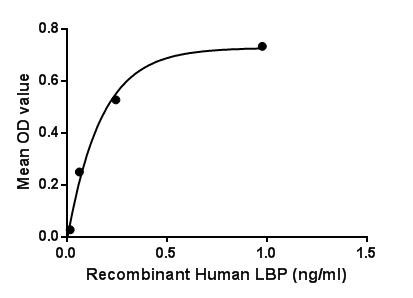 |
Figure. The binding activity of LBP with CD14. Lipopolysaccharide Binding Protein (LBP) is a soluble acute-phase protein that binds to bacterial lipopolysaccharide (or LPS) to elicit immune responses by presenting the LPS to important cell surface pattern recognition receptors called CD14 and TLR4. The protein encoded by this gene is involved in the acute-phase immunologic response to gram-negative bacterial infections. This protein is part of a family of structurally and functionally related proteins, including BPI, plasma cholesteryl ester transfer protein (CETP), and phospholipid transfer protein (PLTP). Besides, Cluster Of Differentiation 14 (CD14) has been identified as an interactor of LBP, thus a binding ELISA assay was conducted to detect the interaction of recombinant human LBP and recombinant human CD14. Briefly, LBP were diluted serially in PBS, with 0.01% BSA (pH 7.4). Duplicate samples of 100µL were then transferred to CD14-coated microtiter wells and incubated for 2h at 37℃. Wells were washed with PBST and incubated for 1h with anti-LBP pAb, then aspirated and washed 3 times. After incubation with HRP labelled secondary antibody, wells were aspirated and washed 3 times. With the addition of substrate solution, wells were incubated 15-25 minutes at 37℃. Finally, add 50µL stop solution to the wells and read at 450nm immediately. The binding activity of LBP and CD14 was shown in Figure 1, and this effect was in a dose dependent manner. |
| 分子别名Alternative Names | LPS-Binding Protein |
|---|---|
| 背景介绍Background | Plays a role in the innate immune response. Binds to the lipid A moiety of bacterial lipopolysaccharides (LPS), a glycolipid present in the outer membrane of all Gram-negative bacteria. Acts as an affinity enhancer for CD14, facilitating its association with LPS. Promotes the release of cytokines in response to bacterial lipopolysaccharide. |
| 功能Function | Plays a role in the innate immune response. Binds to the lipid A moiety of bacterial lipopolysaccharides (LPS), a glycolipid present in the outer membrane of all Gram-negative bacteria. Acts as an affinity enhancer for CD14, facilitating its association with LPS. Promotes the release of cytokines in response to bacterial lipopolysaccharide. |
| 亚细胞定位Subcellular Location | Secreted. Cytoplasmic granule membrane. |
| 数据库链接Databases |
基因功能参考文献50 条
- This study shows a remarkable reversal of amyloid fibrin formation by LBP addition to the plasma of Parkinson's Disease patients . PMID: 29494603 : 29494603
- Serum LBP levels are associated with arterial stiffness, independent of obesity and traditional cardiovascular risk factors, especially in men with type 2 diabetes. PMID: 28486964 : 28486964
- novel observation that sCD14 compared with lipopolysaccharide binding protein, offers a preferred target to ameliorate TLR especially TLR4-induced inflammation and insulin resistance in human obesity and metabolic syndrome PMID: 26880233 : 26880233
- LBP, an endotoxemia associated protein might be used as an inflammatory biomarker of both infectious and non-infectious origins in HCV-infected subjects PMID: 28107471 : 28107471
- Data show that after matching for gender, age, and body mass index (BMI), serum lipopolysaccharide-binding protein (LBP) does not improve prediction of the development of type 2 diabetes mellitus (T2DM) independently. PMID: 25753130 : 25753130
- The main findings of this study are that, in acute stroke patients, levels of LBP, IL-10, IL-6 and CRP show a different time course in patients with and without post-stroke infection. PMID: 25613713 : 25613713
- Serum LBP level is significantly elevated in polycystic ovary syndrome women and is associated with insulin resistance. PMID: 26799617 : 26799617
- LBP serves not only as an extracellular LPS shuttle but in addition facilitates intracellular transport of LPS. PMID: 26804480 : 26804480
- LBP level was not significantly different in neutropenic systemic inflammatory response syndrome patients and sepsis patients. PMID: 26046926 : 26046926
- Report increased secretion of Fetuin A, LBP and HMGB-1 from subcutaneous adipose tissue in metabolic syndrome. PMID: 25978344 : 25978344
- Low levels of microbial translocation marker LBP are associated with sustained viral response after anti-HCV treatment in HIV-1/HCV co-infected patients PMID: 25785448 : 25785448
- serum level elevated in late-onset neonatal sepsis in very low birth weight infants PMID: 25014514 : 25014514
- Adjusting for body mass index and waist circumference, LBP levels remained significantly increased in metabolic syndrome and increased with increasing numbers of MetS risk factors. PMID: 25063948 : 25063948
- study suggested that elevated plasma LBP was associated with an increased risk of developing MetS among middle-aged and older Chinese, especially in normal-weight individuals. PMID: 24906952 : 24906952
- In preterm neonates born to asymptomatic women with PPROM, LBP in cord blood at delivery is an excellent diagnostic biomarker of Fetal inflammatory response syndrome/funisitis with prognostic potential. PMID: 24335151 : 24335151
- report pre-ART IL-6 and LBP levels as well as IL-6, LBP and I-FABP levels during IRIS-event as potential biomarkers in TB-IRIS PMID: 24312369 : 24312369
- In childnre, LBP was independently associated with BMI and with measures of obstructive sleep apnea severity as well as with metabolic dysfunction, particularly insulin resistance as indicated by the homeostasis model assessment of insulin resistance. PMID: 24276451 : 24276451
- Suggest that the serum LBP concentration constitutes a reliable biologic marker for the diagnosis of a febrile urinary tract infection in children. PMID: 23463341 : 23463341
- Mutations in the lipopolysaccharide binding protein impair innate immunity. PMID: 24120359 : 24120359
- Serum LBP concentrations increased with age. Overweight, obesity, and having metabolic syndrome (particularly, low HDL cholesterol levels) were associated with higher LBP concentrations PMID: 23349936 : 23349936
- expression in oral keratinocytes is stimulated by Porphyromonas gingivalis LPS PMID: 22736337 : 22736337
- Human lipopolysaccharide-binding protein (LBP) and CD14 independently deliver triacylated lipoproteins to Toll-like receptor 1 (TLR1) and TLR2 and enhance formation of the ternary signaling complex PMID: 23430250 : 23430250
- LBP is a surrogate marker of microbial translocation in association with physical functioning of older adults. PMID: 22960476 : 22960476
- Association of lipopolysaccharide-binding protein gene polymorphisms with cerebral infarction in a Chinese population PMID: 22476641 : 22476641
- our study demonstrated that an elevated LBP level of >15000 ng/ml may serve as a biomarker for the prediction and monitoring of aGVHD. PMID: 22552880 : 22552880
- During the first 14 days of postoperative sepsis, LBP plasma concentrations showed a time course that was very similar to CRP with a high concordance in the pattern of day-to-day changes PMID: 21901123 : 21901123
- The availability of commercial methods for the automated measurement of the soluble CD14 subtype presepsin and lipopolysaccharide binding protein represent a challenge for the evaluation in clinical practice of reliable markers of neonatal sepsis. PMID: 21740312 : 21740312
- Aseptic trauma primes the innate immune system for the posttraumatic release of lipopolysaccharide binding protein and sCD14 PMID: 21722015 : 21722015
- Cytokine concentrations in amniotic fluid during the mid-trimester did not differ with parity or fetal gender. IL-6, IL-8, and LBP levels appeared stable with gestational week (GW), whereas GW significantly influenced TNF-alpha concentrations. PMID: 21702700 : 21702700
- LBP measurements performed shortly after preterm premature rupture of membranes, are not of value either in the prediction of newborn's infection, or in the prognosis of latency period duration. PMID: 21353369 : 21353369
- This study highlights the LBP rs2232596 and CD14 rs4914 polymorphisms as biomarkers for elevated colorectal carcinoma susceptibility in the Chinese Han population PMID: 21633598 : 21633598
- High LBP is associated with Crohn's disease. PMID: 20865702 : 20865702
- Elevated circulating LBP was associated with obesity, metabolic syndrome, and type 2 diabetes in apparently healthy Chinese. PMID: 20530747 : 20530747
- The association of the polymorphisms c.291C>T and c.613A>G suggest a role of LBP in the disease manifestation of infective endocarditis. PMID: 19560454 : 19560454
- Serial LBP serum measurements may offer a clinically useful biomarker for identification of patients with severe sepsis having the worst outcomes and the highest probability of developing sepsis-induced ARDS PMID: 19718443 : 19718443
- carboxyl-terminal domain of these closely related endotoxin-binding proteins dictates the route and host responses to complexes they form with endotoxin. PMID: 11773072 : 11773072
- a new and reliable infection marker after kidney transplantation PMID: 11976738 : 11976738
- Identification of single amino acid residues essential for the binding of lipopolysaccharide (LPS) to LPS binding protein (LBP) residues 86-99 by using an Ala-scanning library PMID: 11991204 : 11991204
- plasma factor LBP and cell surface receptor CD14 were necessary for LPS activation of p38, which was tightly associated with LPS priming of the PMN respiratory burst PMID: 12117913 : 12117913
- Besides a role in the detoxification of bacterial toxin present in the circulation, LBP-chylomicron complexes may be part of a local defense mechanism of the intestine against translocated bacterial toxin. PMID: 12538700 : 12538700
- innate immune recognition of LTA via LBP, CD14, and TLR-2 represents an important mechanism in the pathogenesis of systemic complications in the course of infectious diseases brought about by Gram-positive pathogens. while TLR-4 and MD-2 are not involved. PMID: 12594207 : 12594207
- Single nucleotide polymorphism of the LBP gene is not assciated with complicated sepsis after trauma. PMID: 12615620 : 12615620
- data support the hypothesis that lipopolysaccharide binding protein can inhibit cell responses to lipopolysaccharide(LPS) by inhibiting LPS transfer from membrane CD14 to the Toll-like receptor 4-MD-2 signaling receptor PMID: 12754215 : 12754215
- plays an essential role in the innate immune response to Gram-positive pneumococci PMID: 12932360 : 12932360
- In critically ill neonates aged over 48 h and children lipopolysaccharide binding protein is a better marker than procalcitonin, interleukin-6 and C-reactive protein. PMID: 15127192 : 15127192
- Dual role of LBP and CD14 in initiation of proinflammatory signaling and clearance or neutralization of LPS. PMID: 15618154 : 15618154
- studies suggest that SP-A could contribute to modulate Re-LPS responses by altering the competence of the LBP-CD14 receptor complex PMID: 15932345 : 15932345
- LBP mediates the fusion of lipid membranes and LPS aggregates. PMID: 16303759 : 16303759
- Human pulmonary LBP acts as an important modulator of the LPS response in the respiratory tract in vivo. PMID: 16493079 : 16493079
- Significantly elevated serum concentrations of LBP and sCD14 are found in severe sepsis patients. PMID: 16512634 : 16512634
蛋白复溶体积计算器缓冲液体积 = 蛋白质量 ÷ 蛋白浓度
输入任意两项,第三项自动计算 |
蛋白浓度稀释计算器初浓度 × 初体积 = 终浓度 × 终体积
输入任意三项,第四项自动计算 |



