


| 纯度Purity | Greater than 95% as determined by reducing SDS-PAGE. |
|---|---|
| 内毒素Endotoxin | Please contact with the lab for this information |
| 蛋白构建Protein Construction |
【Leu317-Pro532】序列区间
|
| Accession | Q13219 |
| 表达宿主Expression Host | - |
| 种属Species | Homo sapiens (Human) |
| 预测分子量Predicted MW | 25.9 kDa |
| 制剂Formulation | Lyophilized from a 0.2 μm filtered solution of PBS, pH7.4, containing 0.01% SKL, 1mM DTT, 5% Trehalose and Proclin300. |
| 运输方式Shipping | The product is shipped with ice bag. Upon receipt, store it immediately at the temperature listed below. |
| 稳定性&储存Stability & Storage | 12 months at -20°C to -80°C in lyophilized state.6 months at -20°C to -80°C under sterile conditions after reconstitution.7-10 days at 2°C to 8°C under sterile conditions after reconstitution.Please minimize freeze-thaw cycles. |
| 复溶Reconstitution | Reconstitute in 10mM PBS (pH7.4) to a concentration of 0.1-1.0 mg/mL. Do not vortex. |
 |
Greater than 95% as determined by reducing SDS-PAGE. |
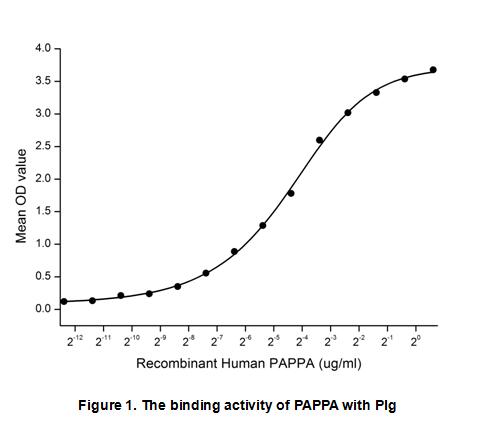 |
Pregnancy-associated plasma protein A(PAPPA), also known as pappalysin-1, is a secreted protease whose main substrate is insulin-like growth factor binding proteins. PAPPA's proteolytic function is activated upon collagen binding. It is thought to be involved in local proliferative processes such as wound healing and bone remodeling. Low plasma level of this protein has been suggested as a biochemical marker for pregnancies with aneuploid fetuses (fetuses with an abnormal number of chromosomes). Besides, Plasminogen (Plg) has been identified as an interactor of PAPPA, thus a binding ELISA assay was conducted to detect the interaction of recombinant human PAPPA and recombinant human Plg. Briefly, biotinylated PAPPA were diluted serially in PBS with 0.01% BSA (pH 7.4). Duplicate samples of 100μl were then transferred to Plg-coated microtiter wells and incubated for 1 h at 37℃. Wells were washed 3 times with PBST and incubated for 0.5 h at 37℃ with SA labelled HRP. After incubation with SA labelled HRP, wells were aspirated and washed 5 times. With the addition of substrate solution, wells were incubated 15-25 minutes at 37℃. Finally, add 50µL stop solution to the wells and read at 450/630 nm immediately. The binding activity of PAPPA and Plg was shown in Figure 1, and the ED50 for this effect is 0.04936 ug/ml. |
| 分子别名Alternative Names | PAPP-APAPAASBABP2DIPLA1IGFBP-4asePAPPA1Pappalysin 1Insulin-Like Growth Factor Binding Protein-4 ProteaseDifferentially Placenta 1 Expressed Protein |
|---|---|
| 背景介绍Background | Metalloproteinase which specifically cleaves IGFBP-4 and IGFBP-5, resulting in release of bound IGF. Cleavage of IGFBP-4 is dramatically enhanced by the presence of IGF, whereas cleavage of IGFBP-5 is slightly inhibited by the presence of IGF. |
| 功能Function | Metalloproteinase which specifically cleaves IGFBP-4 and IGFBP-5, resulting in release of bound IGF. Cleavage of IGFBP-4 is dramatically enhanced by the presence of IGF, whereas cleavage of IGFBP-5 is slightly inhibited by the presence of IGF. |
| 亚细胞定位Subcellular Location | Secreted. |
| 数据库链接Databases |
基因功能参考文献50 条
- Serum PAPP-A at third trimester of pregnancy was not associated with late-onset pre-eclampsia and intrauterine growth retardation after 34weeks of pregnancy. PMID: 29674192 : 29674192
- Elevated PROK1 in the first pregnancy trimester is a more effective marker than PAPP-A in the prediction of pre-eclampsia and fetal growth restriction. PMID: 28675948 : 28675948
- The findings suggest a possible pathophysiological link between the development of Fetal growth restriction and the expression of PAPPA, PAPPA2 and PLAC-1. PMID: 29532882 : 29532882
- Data suggest that PGF and PAPPA serve as serum biomarkers for early diagnosis of gestational hypertension. These studies were conducted at antenatal clinics in Ghana using blood from women between 8 and 13 weeks gestation. (PGF = placental growth factor; PAPPA = pregnancy-associated plasma protein-A) PMID: 29587776 : 29587776
- Pregnancy associated plasma protein-A (PAPP-A) appears to be a potentially useful biomarker for short-term risk stratification of patients presenting with chest pain of ischemic origin (Review). PMID: 29144175 : 29144175
- These data suggested that hsa_circ_0004904 and hsa_circ_0001855 combined with PAPP-A might be promising biomarkers for the detection of Preeclampsia. Bioinformatics analysis predicted that hsa_circ_0004904 and hsa_circ_0001855 miRNA sponges directly target PAPP-A. PMID: 29758559 : 29758559
- higher first trimester serum values seem to be associated with placenta accreta in women with placenta previa PMID: 28027672 : 28027672
- Studied the role of pregnancy-associated plasma protein A (PAPP-A) in the outcome of ischemic cerebrovascular disease. PMID: 27809366 : 27809366
- maternal serum levels associated with small for gestational age neonates, preterm birth, and pre-eclampsia PMID: 28514830 : 28514830
- PAPP-A and ProMBP are associated with increased risk of death in heart failure patients. PMID: 28537443 : 28537443
- low levels not associated with high serum estradiol at controlled ovarian stimulation PMID: 28606451 : 28606451
- PAPP-A C/C genotypes were more frequent among mothers with gestational diabetes than in control. PMID: 28655969 : 28655969
- Elevated PAPP-A compared to other risk factors was a stronger predictor for future CV events 2 years post ACS in patients with type 2 diabetes mellitus. PMID: 28381225 : 28381225
- PAPP-A, like CCS and CIMT, is a parameter that can be used to detect subclinical atherosclerosis. PMID: 28791822 : 28791822
- Results suggest that links between PAPP-A concentrations in early pregnancy and subsequent glucose concentrations and blood pressures may be mediated by changes in insulin sensitivity (and secretion). PMID: 28323969 : 28323969
- Collectively, these results identify PAPP-A as a pregnancy-dependent oncogene while also showing that extended lactation is protective against PAPP-A-mediated carcinogenesis. PMID: 26951623 : 26951623
- Lower PlGF and higher PAPP-A and free beta-hCG levels were found in the fetal circulation of near-term severe preeclamptic pregnancies PMID: 27809614 : 27809614
- PAPP-A 1224 SNP has a significant effect on the level and activity of PAPP-A in human follicles, suggesting that the follicular fluid level of bioactive insulin-like growth factor depends on the genotype. PMID: 27793387 : 27793387
- This study demonstrated no association between PAPP-A gene rs7020782 polymorphism and Preeclampsia (PE) and intrauterine growth restriction. PMID: 26520690 : 26520690
- data indicate that PAPP-A promotes TF expression in human endothelial cells and support the hypothesis that this proteinase, besides being involved in progression of atherosclerosis, does not represent an independent risk factor for adverse cardiovascular events, but it rather might play an "active" role in the pathophysiology of ACS as an effector molecule able to induce a pro-thrombotic phenotype in endothelial cells PMID: 27007282 : 27007282
- assessed serum PAPP-A levels in COPD and the associations with disease severity; elevated levels of PAPP-A were observed in patients with COPD PMID: 27090654 : 27090654
- STC2 is involved in regulating PAPP-A activity during the development of atherosclerosis PMID: 26983002 : 26983002
- Data suggest that stanniocalcin 1 and 2 (STC1, STC2) participate in inhibition of proteolytic activity of pregnancy-associated plasma protein-A (PAPP-A) during folliculogenesis. PMID: 26874357 : 26874357
- measurements of maternal serum PAPP-A concentration in the first trimester predict severe fetal growth restriction more effectively than they predict a birth weight below the 10th percentile among a Chinese population PMID: 25845987 : 25845987
- Women with PAPP-A /=90th percentile is protective against small for gestational age, and is associated with an increased risk of large for gestational age for infants born after 32 weeks gestation. PMID: 26773241 : 26773241
- Data suggest that incidences of intrauterine growth restriction, pre-eclampsia, preterm birth, and fetal death are significantly greater in pregnant women with low serum levels of PAPP-A in first trimester (9-13 weeks of pregnancy) as compared to control pregnant women; study was conducted in India. PMID: 25773764 : 25773764
- The first trimester maternal PAPP-A levels were decreased in the ICSI group compared with those in the controls, but not in IVF and embryo transfer groups. PMID: 26697810 : 26697810
- miR-141 may play important roles in ox-LDL-induced abnormal proliferation of the vascular smooth muscle cells by targeting PAPPA. PMID: 26823756 : 26823756
- Combined analysis of PAPP-A and free beta-hCG appears to be a potential candidate to predict early fetal loss. PMID: 25159705 : 25159705
- PAPP-A in ascites and tissue-associated PAPP-A serve to increase IGF bioactivity and, thereby, to stimulate IGF-IR-mediated ovarian tumor growth. PMID: 26336825 : 26336825
- PAPP-A determination during the first trimester of pregnancy in women at risk for IUGR makes possible the prophylactic treatment and monitoring of pregnancy. PMID: 27125092 : 27125092
- Data indicate that rising pregnancy-associated plasma protein-A (PAPP-A) levels are prognostic in patients with coronary artery disease (CAD). PMID: 26223809 : 26223809
- PAPP-A serum concentrations differed significantly between Asian and European women during the first trimester of pregnancy. PMID: 25858516 : 25858516
- The study findings showed that plasma sCD40L, fetuin-A, and PAPP-A levels are associated with carotid plaque formation and instability. PMID: 26214492 : 26214492
- For Down syndrome affected pregnancies, the median MoM of first trimester PAPP-A, PlGF, and AFP were significantly reduced, and free-beta-hCG were significantly elevated. PMID: 25846403 : 25846403
- Increased PAPP-A in the first trimester is associated with placenta accreta. PMID: 24226752 : 24226752
- Maternal serum PAPP-A was not associated with fetal open spina bifida. PMID: 24226839 : 24226839
- The A>C variation of rs7020782 of PAPPA might be an independent risk factor for carotid plaque development and calcification. PMID: 26122709 : 26122709
- Elevated PAPP-A was associated with fetal macrosomia. PMID: 24155168 : 24155168
- Suggest that PAPP-A is specifically involved in the regulation of steroidogenesis in human antral follicles. PMID: 26297643 : 26297643
- The performance of screening for GDM by maternal factors was not improved by the addition of PAPP-A and/or PLGF. First trimester maternal serum PAPP-A and PLGF are not useful in screening for GDM. PMID: 26362726 : 26362726
- serum variations during the first trimester cannot be used as a marker of excessive fetal growth PMID: 24940710 : 24940710
- Data suggest both serum PAPP-A and serum CRP (high-sensitivity C-reactive protein) are up-regulated during first trimester in women who will undergo early pregnancy failure. PMID: 25596909 : 25596909
- PAPPA was similar between pregnant women with chronic kidney disease and controls. PMID: 25395363 : 25395363
- Median PAPP-A MoM was 1.01 in the control group and 1.05 (P = 0.83) in praevia, compared with 1.22 in abnormally invasive placentation cases (0.16). PMID: 25639820 : 25639820
- A PAPP-A value, expressed in MoM, of 1.25 is a predictive factor of fetal birth weight >4000 g PMID: 24743523 : 24743523
- first trimester PAPP-A levels were measured to see if they were associated with negative pregnancy outcome. Groups with high and low PAPP-A significantly differed only in miscarriages. PMID: 25139218 : 25139218
- inadequate sensitivity as first trimester serum marker for pre-eclampsia PMID: 24786703 : 24786703
- Serum PAPP-A levels were closely associated with the coronary no-reflow phenomenon during percutaneous coronary intervention. PMID: 24227626 : 24227626
- High PAPP-A expression is associated with breast cancer. PMID: 25468445 : 25468445
蛋白复溶体积计算器缓冲液体积 = 蛋白质量 ÷ 蛋白浓度
输入任意两项,第三项自动计算 |
蛋白浓度稀释计算器初浓度 × 初体积 = 终浓度 × 终体积
输入任意三项,第四项自动计算 |



