


Active Prokineticin 2 (PK2)
Alternative NamesPK-2; Bv8; MIT1; KAL4; Protein Bv8 Homolog
规格参数 Specifications
| 纯度Purity | Greater than 95% as determined by reducing SDS-PAGE. |
|---|---|
| 内毒素Endotoxin | Please contact with the lab for this information |
| 蛋白构建Protein Construction |
【Ile30-Gln128】序列区间
|
| Accession | Q9HC23 |
| 表达宿主Expression Host | - |
| 种属Species | Homo sapiens (Human) |
| 预测分子量Predicted MW | 41.2 kDa |
| 制剂Formulation | Lyophilized from a 0.2 μm filtered solution of 20mM Tris, 150mM NaCl, pH8.0, containing 1mM EDTA, 1mM DTT, 0.01% SKL, 5% Trehalose and Proclin300. |
| 运输方式Shipping | The product is shipped with ice bag. Upon receipt, store it immediately at the temperature listed below. |
| 稳定性&储存Stability & Storage | 12 months at -20°C to -80°C in lyophilized state.6 months at -20°C to -80°C under sterile conditions after reconstitution.7-10 days at 2°C to 8°C under sterile conditions after reconstitution.Please minimize freeze-thaw cycles. |
| 复溶Reconstitution | Reconstitute in 20mM Tris, 150mM NaCl (pH8.0) to a concentration of 0.1-1.0 mg/mL. Do not vortex. |
!
本司产品仅用于科研,不用于临床诊断和治疗。
产品图片 Product Images点击图片可查看原图
 |
Greater than 95% as determined by reducing SDS-PAGE. |
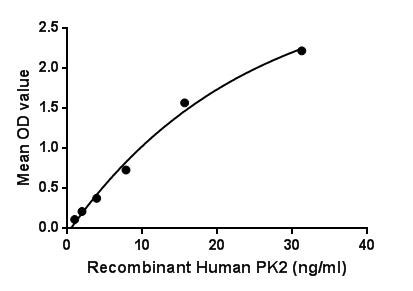 |
Figure. The binding activity of PK2 with PKR1 |
靶点信息 Target Information
| 分子别名Alternative Names | PK-2Bv8MIT1KAL4Protein Bv8 Homolog |
|---|---|
| 背景介绍Background | May function as an output molecule from the suprachiasmatic nucleus (SCN) that transmits behavioral circadian rhythm. May also function locally within the SCN to synchronize output. Potently contracts gastrointestinal (GI) smooth muscle. |
| 功能Function | May function as an output molecule from the suprachiasmatic nucleus (SCN) that transmits behavioral circadian rhythm. May also function locally within the SCN to synchronize output. Potently contracts gastrointestinal (GI) smooth muscle. |
| 亚细胞定位Subcellular Location | Secreted. |
| 数据库链接Databases |
基因功能参考文献30 条
- The results indicate that PK2 over-production perpetuates psoriatic symptoms by creating PK-2-IL-1 vicious loop. PK2 is a central player in psoriasis and a promising psoriasis-specific target. PMID: 27887936 : 27887936
- Prokineticin-2 is correlated with various cardiometabolic risk factors. PMID: 26728949 : 26728949
- Data suggest that prokineticins (PROK1 and PROK2) and prokineticin receptors (PROKR1 and PROKR2) act as main regulators of physiological functions of ovary, uterus, placenta, and testis. [REVIEW] PMID: 26574895 : 26574895
- Suggest PROK2 as an angiogenic growth factor in colorectal cancer. PMID: 26317645 : 26317645
- study found a novel mutation in PROK2 in two male siblings presenting normosmic congenital hypogonadotropic hypogonadism, in whom a mutation in the GNRHR gene had been previously described, suggesting the possibility of a digenic inheritance PMID: 25531638 : 25531638
- PROK2 significantly increased in human fetal ovary across gestation. PMID: 26192875 : 26192875
- EG-VEGF, BV8, and PROKR2 gene expression is approximately five, four, and two times higher in cystic fibrosis lungs compared with controls. PMID: 26047640 : 26047640
- No abnormalities were found in the patient group for the PROKR2 and GNRH1genes. In addition, no genomic rearrangements were identified in the healthy control individuals for the described genes PMID: 24002956 : 24002956
- PROK2 signaling in humans is not required for central circadian pacemaker function. PMID: 24423319 : 24423319
- A novel role of BV8 in promoting oncogenesis intrinsic to malignant cells of myeloid origin. PMID: 23548897 : 23548897
- We could not implicate the ligand PROK2 in congenital hypopituitarism and septo-optic dysplasia. PMID: 23386640 : 23386640
- Three PROKR2 mutations previously described in Kallmann syndrome and one new PROK2 mutation were found in patients with isolated congenital anosmia. PMID: 23082007 : 23082007
- Induction of Bv8 expression by granulocyte colony-stimulating factor in CD11b+Gr1+ cells: key role of Stat3 signaling. PMID: 22528488 : 22528488
- Data suggest that elevated prokineticin 2 levels, as a consequence of gastrointestinal tract inflammation, induce visceral pain via prokineticin receptors. PMID: 22050240 : 22050240
- Patients with this genetic form of Kallmann syndrome have been reported to have a possible increased prevalence of obesity and sleep disorders, which may be related to the role of PROK2 in food intake and circadian rhythms (Review) PMID: 20389090 : 20389090
- Review. Role of prokineticins in inflammatory and contractile pathways at parturition in humans. PMID: 20172976 : 20172976
- Male patients carrying biallelic mutations in PROK2 or PROKR2 have a less variable and on average a more severe reproductive phenotype than patients carrying monoallelic mutations in these genes. PMID: 20022991 : 20022991
- Prokineticin 2 transmits the behavioural circadian rhythm of the suprachiasmatic nucleus. PMID: 12024206 : 12024206
- Bv8 and EG-VEGF, along with other factors such as VEGF-A, may maintain the integrity and also regulate proliferation of the blood vessels in the testis PMID: 12604792 : 12604792
- Paracrine role for the PKs and their receptors in endometrial vascular function. PMID: 15126578 : 15126578
- potentially modulates growth, survival, and function of cells of the innate and adaptive immune systems, possibly through autocrine or paracrine signaling mechanisms PMID: 15548611 : 15548611
- study demonstrated that prokineticin 1 and 2 and their receptors are expressed in human prostate and that their levels increased with prostate malignancy PMID: 16763065 : 16763065
- These findings reveal that insufficient prokineticin-signaling through PROKR2 leads to abnormal development of the olfactory system and reproductive axis in man. PMID: 17054399 : 17054399
- Homozygous loss-of-function PROK2 mutations cause both Kallmann syndrome and normosmic idiopathic hypogonadotropic hypogonadism PMID: 17959774 : 17959774
- The identification of PROK2 biallelic mutations, that is, a missense mutation, p.R73C, and a frameshift mutation, c.163delA, in two out of 273 patients presenting as sporadic cases, is reported. PMID: 18285834 : 18285834
- PK2/Bv8 expression decreases as the liver evolves towards cancer and does not correlate with HCC angiogenesis PMID: 18300343 : 18300343
- Loss-of-function mutations in PROK2 and PROKR2 underlie both Kallmann syndrome (KS) and normosmic idiopathic hypogonadotropic hypogonadism (IHH). PMID: 18559922 : 18559922
- Loss-of-function mutations in the genes encoding prokineticin-2 or prokineticin receptor-2 cause autosomal recessive Kallmann syndrome. PMID: 18682503 : 18682503
- no mutations found in Kallmann syndrome PMID: 18723471 : 18723471
- Bv8 expression is regulated by several cytokines in a cell type-specific fashion PMID: 19336519 : 19336519
蛋白复溶体积计算器缓冲液体积 = 蛋白质量 ÷ 蛋白浓度
输入任意两项,第三项自动计算 |
蛋白浓度稀释计算器初浓度 × 初体积 = 终浓度 × 终体积
输入任意三项,第四项自动计算 |



