


| 纯度Purity | Greater than 97% as determined by reducing SDS-PAGE. |
|---|---|
| 内毒素Endotoxin | Please contact with the lab for this information |
| 蛋白构建Protein Construction |
【Ala35-Asn107】序列区间
|
| Accession | P09341 |
| 表达宿主Expression Host | - |
| 种属Species | Homo sapiens (Human) |
| 预测分子量Predicted MW | 38.0 kDa |
| 制剂Formulation | Lyophilized from a 0.2 μm filtered solution of 20mM Tris, 150mM NaCl, pH8.0, containing 1mM EDTA, 1mM DTT, 0.01% SKL, 5% Trehalose and Proclin300. |
| 运输方式Shipping | The product is shipped with ice bag. Upon receipt, store it immediately at the temperature listed below. |
| 稳定性&储存Stability & Storage | 12 months at -20°C to -80°C in lyophilized state.6 months at -20°C to -80°C under sterile conditions after reconstitution.7-10 days at 2°C to 8°C under sterile conditions after reconstitution.Please minimize freeze-thaw cycles. |
| 复溶Reconstitution | Reconstitute in 20mM Tris, 150mM NaCl (PH8.0) to a concentration of 0.1-1.0 mg/mL. Do not vortex. |
 |
Greater than 97% as determined by reducing SDS-PAGE. |
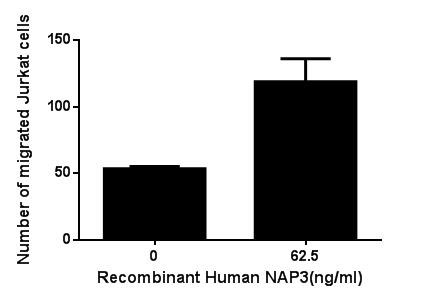 |
Figure. The chemotactic effect of NAP3 on THP-1 cells. Neutrophil-activating protein 3 (NAP3) also known as chemokine (C-X-C motif) ligand 1 (CXCL1) is a small cytokine belonging to the CXC chemokine family. NAP3 is expressed by macrophages, neutrophils and epithelial cells,and has neutrophil chemoattractant activity. Thus, chemotaxis assay used 24-well microchemotaxis system was undertaken to detect the chemotactic effect of NAP3 on the human monocytic cell line THP-1. Briefly, THP-1 cells were seeded into the upper chambers (100uL cell suspension, 106 cells/mL in RPMI 1640 with FBS free) and SLC (31.25ng/mL, 62.5ng/mL ,125ng/mL and 250ng/mL diluted separately in serum free RPMI 1640) was added in lower chamber with a polycarbonate filter (8µm pore size) used to separate the two compartments. After incubation at 37℃ with 5% CO2 for 1h, the filter was removed, then cells in low chamber were observed by inverted microscope at low magnification (×100) and the number of migrated cells were counted at high magnification (×400) randomly (five fields for each filter). Result shows NAP3 is able to induce migration of THP-1 cells. The migrated THP-1 cells in low chamber at low magnification (×100) were shown in Figure 1. Five fields of each chamber were randomly chosen, and the migrated cells were counted at high magnification (×400). Statistical results were shown in Figure 2. The optimum chemotaxis of NAP3 occurs at 31.25-250ng/mL. (A) THP-1 cells were seeded into the upper chambers and serum free RPMI 1640 with 62.5ng/mL NAP3 was added in lower chamber, then cells in lower chamber were observed at low magnification (×100) after incubation for 1h; (B) THP-1 cells were seeded into the upper chambers and serum free RPMI 1640 without NAP3 was added in lower chamber, then cells in lower chamber were observed at low magnification (×100) after incubation for 1h. Figure.The chemotactic effect of NAP3 on THP-1 cells. |
| 分子别名Alternative Names | NAP3GRO1GROaGRO-AMGSA-ANAP3SCYB1Chemokine C-X-C-Motif Ligand 1Melanoma Growth Stimulating Activity AlphaFibroblast Secretory Protein |
|---|---|
| 背景介绍Background | Has chemotactic activity for neutrophils. May play a role in inflammation and exerts its effects on endothelial cells in an autocrine fashion. In vitro, the processed forms GRO-alpha(4-73), GRO-alpha(5-73) and GRO-alpha(6-73) show a 30-fold higher chemotactic activity. |
| 功能Function | Has chemotactic activity for neutrophils. May play a role in inflammation and exerts its effects on endothelial cells in an autocrine fashion. In vitro, the processed forms GRO-alpha(4-73), GRO-alpha(5-73) and GRO-alpha(6-73) show a 30-fold higher chemotactic activity. |
| 亚细胞定位Subcellular Location | Secreted. |
| 数据库链接Databases |
基因功能参考文献50 条
- The chemokine Gro1 induced in response to inflammation triggers senescence and arrests development of new neurons in the hippocampus and that the magnitude of this response is sex-dependent. PMID: 30201019 : 30201019
- CXCL1 displays a specific microRNA (miR) upregulated by the prototypical colon cancer onco-miR miR-105. PMID: 30115896 : 30115896
- These results show that AKIP1 is crucial in cervical cancer angiogenesis and growth by elevating the levels of the NF-kappaB-dependent chemokines CXCL1, CXCL2, and CXCL8. PMID: 29520695 : 29520695
- Adipose stromal cells recruitment to tumours, driven by CXCL1 and CXCL8, promotes prostate cancer progression. PMID: 27241286 : 27241286
- CXCL1, which is produced by breast cancer cells, can promote cancer growth and development PMID: 29438938 : 29438938
- miR-204 inhibits cell proliferation in gastric cancer by targeting CKS1B, CXCL1 and GPRC5A. PMID: 29283424 : 29283424
- Thrombocytosis was more prevalent in patients with inflammatory breast cancer (IBC)than in those with non-IBC and it was associated with poor prognosis. GRO and TGF-beta were associated with thrombocytosis in IBC PMID: 28831670 : 28831670
- the plasma concentrations of CXCL1 indicated the disease activity and prognosis in interstitial pneumonia with autoimmune features (IPAF). Thus, the CXCL1/CXCR2 axis appears to be involved in the progression of IPAF. PMID: 27958346 : 27958346
- CXCL1/8 secreted by adipose-derived mesenchymal stem cells could promote breast cancer angiogenesis. PMID: 28514506 : 28514506
- GROA overexpression is associated with invasion in triple negative breast cancer. PMID: 28560447 : 28560447
- The results of the transwell chemotaxis assay also supported the above results. Our data suggest that APN can promote h-JBMMSC chemotaxis by up-regulating CXCL1 and CXCL8 PMID: 28176455 : 28176455
- This study highlighted CAF-secreted CXCL1 as an attractive target to reverse tumor radioresistance. PMID: 28518141 : 28518141
- we identified the microRNA miR-200a as a putative post-transcriptional regulator of CXCL1 in hepatocellular carcinoma PMID: 27542259 : 27542259
- study demonstrates that CXCL1 can transform NOFs into senescent CAFs via an autocrine mechanism PMID: 29360827 : 29360827
- Association of polymorphic markers of chemokine genes, their receptors, and CD14 gene with coronary atherosclerosis PMID: 29369549 : 29369549
- GROalpha high in the tumor microenvironment can be used as potential indicators for the progression of non-small cell lung cancer PMID: 28375674 : 28375674
- IL-8, but not the CXCL1 circuit, is critical for the regulation of thyroid cancer stem cells. PMID: 27577959 : 27577959
- this study shows that CXCL1 is expressed in epithelium of the endometrium with adenomyosis and demonstrate that VEGF is capable of inducing CXCL1 expression PMID: 27665197 : 27665197
- Taken together, the present study indicates that IL-33 localized in the human atherosclerotic plaque increases GRO-alpha mRNA expression and protein secretion via activation of ERK1/2, JNK, and NF-kappaB in HUVECs, suggesting that IL-33 plays an important role in the pathophysiology and development of atherosclerosis. PMID: 28637660 : 28637660
- Study provides the first evidence that primary malignant cell-secreted VEGFA stimulates tumor-associated macrophages to produce CXCL1, which recruits CXCR2-positive MDSCs to form a premetastatic niche to promote liver metastases. PMID: 28455419 : 28455419
- the presence of elevated circulating levels of VEGF and CXCL1 are predictive of liver and lung metastasis, respectively of colorectal cancer. PMID: 28870907 : 28870907
- This study describe elevated levels of CXCL1 and it receptor in the Solid Component and Cyst Fluid of Human Adamantinomatous Craniopharyngioma, relative to other pediatric brain tumors and normal cerebral tissue. PMID: 28859336 : 28859336
- The expressions of CXCL1 in cancer cells and CXCR2 in stromal cells are useful prognostic factors for gastric cancer patients PMID: 28575019 : 28575019
- CXCL1 secreted by tumor-associated lymphatic endothelial cells promotes lymph node metastasis of gastric cancer through integrin beta1/FAK/AKT signaling pathway. PMID: 27832972 : 27832972
- S100A9 and S100A12 may have a role in the pathogenesis of pneumonia: S100A9 and CXCL1 may contribute solely in mild pneumonia, and CCL5 and CXCL11 may contribute in severe pneumonia. PMID: 28381820 : 28381820
- These findings support a role for CXCL1 and IL-8 in cystic fibrosis lung disease severity and identify STAT3 as a modulating pathway. PMID: 27799352 : 27799352
- Results suggest that CXCL1 is a key molecular link between senescence of stromal fibroblasts and tumor growth. PMID: 27092462 : 27092462
- Increased IL-8 and CXCL1 transcription in T84 and THP-1 cells compared to that in wild-type EPEC. PMID: 27297392 : 27297392
- CXCL1 signaling in the tumor microenvironment is highly responsible for repeated intravesical recurrence, disease progression, and drug resistance through enhanced invasion ability. In conclusion, disrupting CXCL1 signaling to dysregulate this chemokine is a promising therapeutic approach for human UCB. PMID: 27690238 : 27690238
- Silencing of the CXCL1 gene inhibits HGC803 cell migration and invasion. The positive expression of CXCL1 is correlated with poor survival of gastric cancer patients and CXCL1 is an independent prognostic factor for gastric cancer. PMID: 27748927 : 27748927
- These results demonstrate that tumor-derived CXCL1 contributes to TANs infiltration in lung cancer which promotes tumor growth. PMID: 27446967 : 27446967
- the serum levels of the soluble factors sCD40L and CXCL1 are not associated with endometriosis and are not suitable as biomarkers for disease diagnosis. PMID: 27190986 : 27190986
- Elevated expression of GRO-alpha in cytoplasm of cancer cells (hazard ratio [HR] = 5.730, P = 0.007) and stroma (HR = 3.120, P = 0.022) were independent prognostic factors of pancreatic cancer. T classification (HR = 2.130, P = 0.023), lymphatic metastasis (HR = 4.211, P = 0.009) and TNM classification (HR = 0.481, P = 0.031) were also prognostic predictors in PC patients. PMID: 27472713 : 27472713
- The novel findings reveal the critical role of NLRP12-IL-17A-CXCL1 axis in host defense by modulating neutrophil recruitment against Klebsiella pneumoniae. PMID: 26349659 : 26349659
- increased amounts released by neutrophils from fibromyalgia patients PMID: 26341115 : 26341115
- these findings suggest that CXCL1 plays critical roles in the growth and apoptosis of hepatocellular carcinoma PMID: 26499374 : 26499374
- BBP also stimulated the production of CXCL1/GROalpha by TADCs, which increased the angiogenesis of breast cancer in a mouse model PMID: 26397389 : 26397389
- Intense glomerular CXCL1 expression was observed in biopsy specimens from patients with lupus nephritis PMID: 25471749 : 25471749
- hCXCL1-GAG interactions provide stringent control over regulating chemokine levels and receptor accessibility and activation, and that chemotactic gradients mediate cellular trafficking to the target site. PMID: 26721883 : 26721883
- Urine CXCL1 is a promising, non-invasive molecular marker for tumor detection and outcome prediction in patients with bladder cancer . PMID: 26406865 : 26406865
- CXCR2-CXCL1 axis is correlated with neutrophil infiltration and predicts a poor prognosis in hepatocellular carcinoma PMID: 26503598 : 26503598
- Polymorphisms in the promoter regions of the CXCL1 and CXCL2 genes contribute to increased risk of alopecia areata in the Korean population PMID: 26345899 : 26345899
- VEGF markedly induces CXCL1 release in A549 lung epithelial cells. PMID: 23665907 : 23665907
- TGF-beta negatively regulates CXCL1 expression in CAFs through Smad2/3 binding to the promoter, and through suppression of HGF/c-Met autocrine signaling PMID: 26252654 : 26252654
- work shows parallel networks of necroptosis-induced CXCL1 and Mincle signalling that promote macrophage-induced adaptive immune suppression and thereby enable pancreatic ductal adenocarcinoma progression PMID: 27049944 : 27049944
- High CXCL1 expression is a poor prognostic biomarker in metastatic colorectal cancer. PMID: 26104296 : 26104296
- urinary CXCL1 as a new non-invasive predictor of IgAN progression PMID: 25816025 : 25816025
- CXCL1 expression was a negative prognostic factor. PMID: 25175281 : 25175281
- There was a significant positive correlation between CXCL-1 levels in the vitreous and the extent of the retinal detachment. PMID: 25766782 : 25766782
- CXCL1 expression was highly upregulated in patients with alcoholic hepatitis. PMID: 25930080 : 25930080
蛋白复溶体积计算器缓冲液体积 = 蛋白质量 ÷ 蛋白浓度
输入任意两项,第三项自动计算 |
蛋白浓度稀释计算器初浓度 × 初体积 = 终浓度 × 终体积
输入任意三项,第四项自动计算 |



