


| 纯度Purity | Greater than 95% as determined by reducing SDS-PAGE. |
|---|---|
| 内毒素Endotoxin | Please contact with the lab for this information |
| 蛋白构建Protein Construction |
【Phe17-Thr98】序列区间
|
| Accession | Q99616 |
| 表达宿主Expression Host | Yeast |
| 种属Species | Homo sapiens (Human) |
| 预测分子量Predicted MW | 10.7 kDa |
| 制剂Formulation | Lyophilized from a 0.2 μm filtered solution of 20mM Tris, 150mM NaCl, pH8.0, containing 1mM EDTA, 1mM DTT, 0.01% SKL, 5% Trehalose and Proclin300. |
| 运输方式Shipping | The product is shipped with ice bag. Upon receipt, store it immediately at the temperature listed below. |
| 稳定性&储存Stability & Storage | 12 months at -20°C to -80°C in lyophilized state.6 months at -20°C to -80°C under sterile conditions after reconstitution.7-10 days at 2°C to 8°C under sterile conditions after reconstitution.Please minimize freeze-thaw cycles. |
| 复溶Reconstitution | Reconstitute in 20mM Tris, 150mM NaCl (PH8.0) to a concentration of 0.1-1.0 mg/mL. Do not vortex. |
 |
Greater than 95% as determined by reducing SDS-PAGE. |
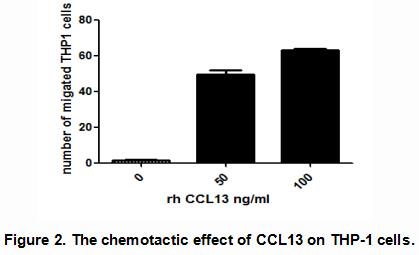 |
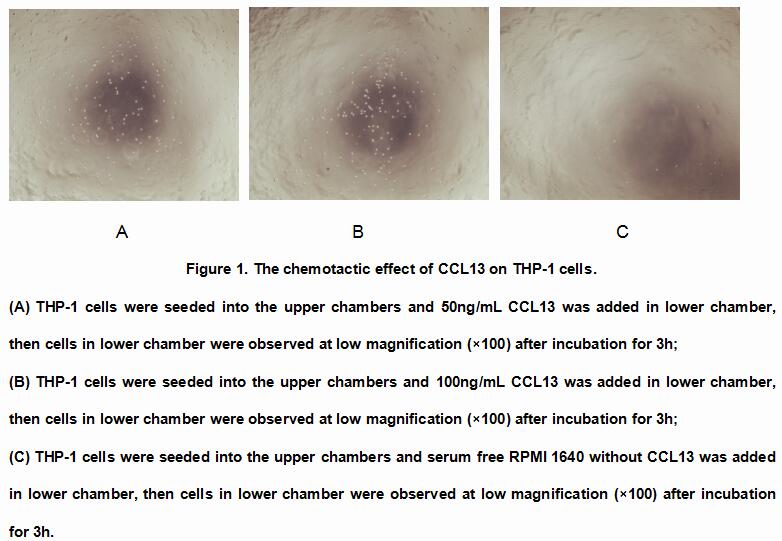
CCL13 (C-C motif chemokine 13) is a chemotactic factor that attracts monocytes, lymphocytes, basophils and eosinophils, which belongs to the CC chemokine subfamily. It has been reported that CCL13 can induce chemotactic migration of THP-1 cells. Therefore, chemotaxis assay used 24-well microchemotaxis system was undertaken to detect the chemotactic effect of CCL13 on the human monocytic cell line THP-1. Briefly, THP-1 cells were seeded into the upper chambers (100µL cell suspension, 106 cells/mL in RPMI 1640 with 0.5% FBS) and CCL13 (50ng/mL and 100ng/mL diluted separately in serum free RPMI 1640) was added in lower chamber with a polycarbonate filter (8µm pore size) used to separate the two compartments. After incubation at 37oC with 5% CO2 for 3h, the filter was removed, then cells in low chamber were observed by inverted microscope at low magnification (×100) and the number of migrated cells were counted at high magnification (×400) randomly (five fields for each filter). Result: CCL13 is able to induce migration of THP-1 cells. The migrated THP-1 cells in low chamber at low magnification (×100) were shown in Figure 1. Five fields of each chamber were randomly chosen to count the migrated cells at high magnification (×400) and the statistical data was shown in Figure 2. |
 |
| 分子别名Alternative Names | CCL13SCYA13NCC1SCYL1CKb10Chemokine C-C-Motif Ligand 13Small Inducible Cytokine Subfamily A(Cys-Cys)Member 13CK-beta-10Monocyte chemoattractant 4 |
|---|---|
| 背景介绍Background | Chemotactic factor that attracts monocytes, lymphocytes, basophils and eosinophils, but not neutrophils. Signals through CCR2B and CCR3 receptors. Plays a role in the accumulation of leukocytes at both sides of allergic and non-allergic inflammation. May be involved in the recruitment of monocytes into the arterial wall during the disease process of atherosclerosis. May play a role in the monocyte attraction in tissues chronically exposed to exogenous pathogens. |
| 功能Function | Chemotactic factor that attracts monocytes, lymphocytes, basophils and eosinophils, but not neutrophils. Signals through CCR2B and CCR3 receptors. Plays a role in the accumulation of leukocytes at both sides of allergic and non-allergic inflammation. May be involved in the recruitment of monocytes into the arterial wall during the disease process of atherosclerosis. May play a role in the monocyte attraction in tissues chronically exposed to exogenous pathogens. |
| 亚细胞定位Subcellular Location | Secreted. |
| 数据库链接Databases |
基因功能参考文献15 条
- CCL13 expression is significantly upregulated in human masticatory mucosa during wound healing PMID: 28005267 : 28005267
- CCL13 levels in serum and synovial fluid may serve as a biomarker for the progression of osteoarthritis. PMID: 25654294 : 25654294
- CCL13 is an antimicrobial protein with bacteriocidal activity against E. coli. PMID: 12949249 : 12949249
- Data suggest that CCL13 binds to several chemokine receptors (CCR1, CCR2, and CCR3), allowing CCL13 to elicit different effects on target cells of immune system. CCL13 is involved in pathology of chronic inflammatory/autoimmune diseases. [REVIEW] PMID: 23846739 : 23846739
- MCP-4 and hsCRP may be the markers linking chronic inflammation in obesity and periodontal disease. PMID: 23375121 : 23375121
- E(2) has adverse effects on the pathogenesis of RA as a result of unregulated cell death, increased TNF-alpha-induced MMP-3 production, and CCL13 overproduction, subsequently resulting in the disease progression of RA. PMID: 22393877 : 22393877
- Findings suggest that the pro-atherogenic effects of CCR2 may not be restricted to interaction with MCP-1, but could also involve activation by MCP-4, being an inflammatory link between platelet and monocyte activation. PMID: 20139115 : 20139115
- Data suggest that the monocyte chemoattractant protein-4 core promoter YY-1 binding motif is functional, and modulates the transcriptional regulation of the MCP-4 gene. PMID: 12805085 : 12805085
- The study was undertaken to understand the relationship between the functional proteomics of receptor-Ck and developmental stages of human atherosclerotic aortic wall. PMID: 14560935 : 14560935
- MCP-4 may be a critical molecule that links obesity and chronic inflammation. PMID: 16855189 : 16855189
- The Th2 cytokine IL-4 preferentially stimulated MCP-4 expression. PMID: 17541284 : 17541284
- interferon-gamma with IL-1beta/TNF-alpha activates the production of CCL13 from chondrocytes in RA joints; secreted CCL13 enhances fibroblast-like synoviocyte proliferation by activating the extracellular signal-regulated MAP kinases cascade PMID: 17824960 : 17824960
- TLR2, 3, 4 and 5 ligands, but not TLR7/8 or 9 ligands, synergized with IL-4 to induce the production of MCP-4 in nasal polyp fibroblasts. PMID: 17851891 : 17851891
- CCL13 and HSPC159 mRNA expressions in PBMC are up-regulated specifically in MCNS patients during the nephrosis phase. PMID: 18219197 : 18219197
- Oncostatin M can strongly up-regulate the expression of CCL13, a chemokine recently identified in the synovial fluid of patients with rheumatoid arthritis. PMID: 19565514 : 19565514
蛋白复溶体积计算器缓冲液体积 = 蛋白质量 ÷ 蛋白浓度
输入任意两项,第三项自动计算 |
蛋白浓度稀释计算器初浓度 × 初体积 = 终浓度 × 终体积
输入任意三项,第四项自动计算 |



