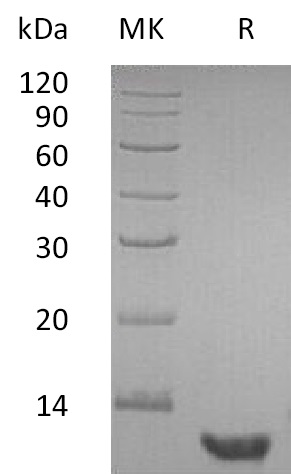
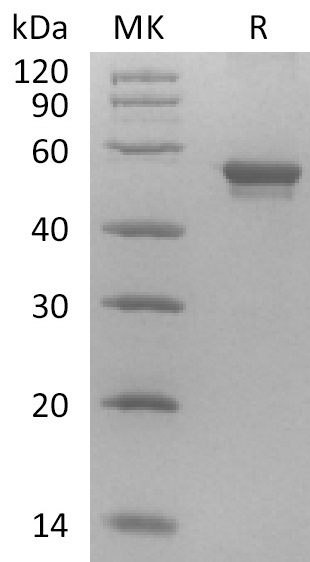
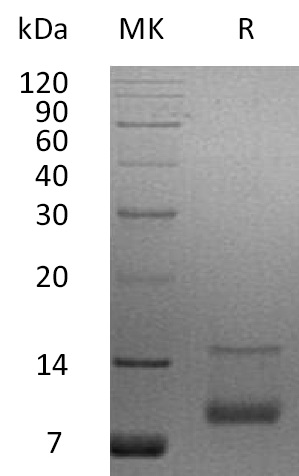
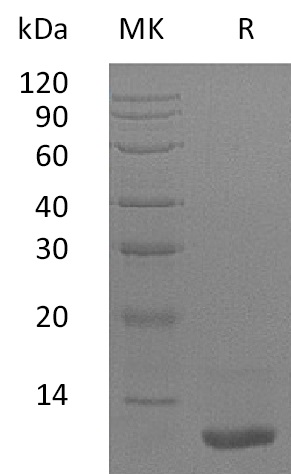
| 纯度Purity | Greater than 95% as determined by reducing SDS-PAGE |
|---|---|
| 内毒素Endotoxin | <0.01 EU/µg as determined by LAL test. |
| 蛋白构建Protein Construction |
【Ala301-Ser412 (Tyr340Phe)】序列区间
|
| Accession | P10600 |
| 表达宿主Expression Host | HEK293 |
| 种属Species | Human/Mouse/Rat |
| 预测分子量Predicted MW | 12.7 kDa |
| 制剂Formulation | Lyophilized from a 0.2 μm filtered solution of 50mM Glycine-HCl, 150mM NaCl, pH 2.5. |
| 运输方式Shipping | The product is shipped with ice bag. Upon receipt, store it immediately at the temperature listed below. |
| 稳定性&储存Stability & Storage | 12 months at -20°C to -80°C in lyophilized state.6 months at -20°C to -80°C under sterile conditions after reconstitution.7-10 days at 2°C to 8°C under sterile conditions after reconstitution.Please minimize freeze-thaw cycles. |
| 复溶Reconstitution | Always centrifuge tubes before opening. Do not mix by vortex or pipetting. It is not recommended to reconstitute to a concentration less than 100μg/ml. Dissolve the lyophilized protein in distilled water. Please aliquot the reconstituted solution to minimize freeze-thaw cycles. |
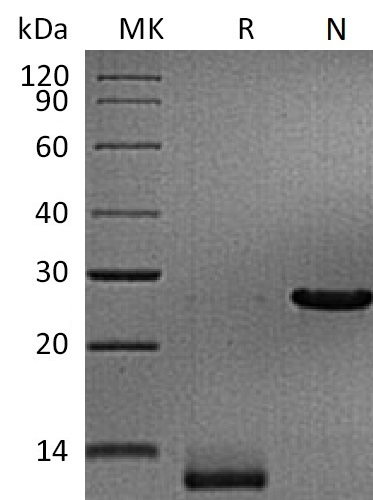 |
Greater than 95% as determined by reducing SDS-PAGE. |
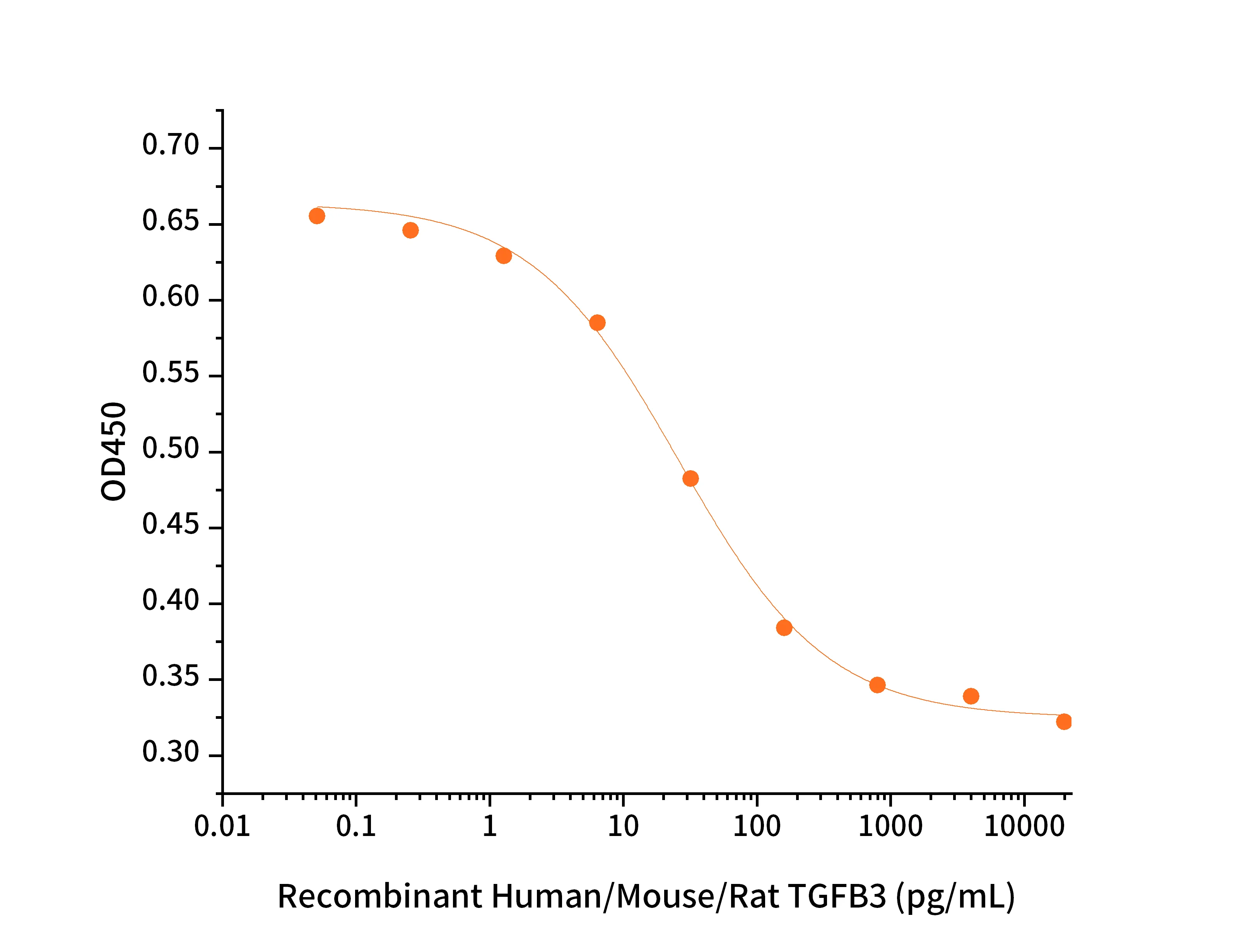 |
Measured by its ability to inhibit the IL-4-dependent proliferation of TF-1 human erythroleukemic cells. The ED50 for this effect is 10-80 pg/ml. (QC verified) |
| 分子别名Alternative Names | Transforming growth factor beta-3TGFB3TGF-beta-3Latency-associated peptideLAP |
|---|---|
| 功能Function | Transforming growth factor beta-3 proprotein: Precursor of the Latency-associated peptide (LAP) and Transforming growth factor beta-3 (TGF-beta-3) chains, which constitute the regulatory and active subunit of TGF-beta-3, respectively.; Required to maintain the Transforming growth factor beta-3 (TGF-beta-3) chain in a latent state during storage in extracellular matrix. Associates non-covalently with TGF-beta-3 and regulates its activation via interaction with 'milieu molecules', such as LTBP1 and LRRC32/GARP, that control activation of TGF-beta-3. Interaction with integrins results in distortion of the Latency-associated peptide chain and subsequent release of the active TGF-beta-3.; Transforming growth factor beta-3: Multifunctional protein that regulates embryogenesis and cell differentiation and is required in various processes such as secondary palate development. Activation into mature form follows different steps: following cleavage of the proprotein in the Golgi apparatus, Latency-associated peptide (LAP) and Transforming growth factor beta-3 (TGF-beta-3) chains remain non-covalently linked rendering TGF-beta-3 inactive during storage in extracellular matrix. At the same time, LAP chain interacts with 'milieu molecules', such as LTBP1 and LRRC32/GARP that control activation of TGF-beta-3 and maintain it in a latent state during storage in extracellular milieus. TGF-beta-3 is released from LAP by integrins: integrin-binding results in distortion of the LAP chain and subsequent release of the active TGF-beta-3. Once activated following release of LAP, TGF-beta-3 acts by binding to TGF-beta receptors (TGFBR1 and TGFBR2), which transduce signal. |
| 亚细胞定位Subcellular Location | [Latency-associated peptide]: Secreted, extracellular space, extracellular matrix.; [Transforming growth factor beta-3]: Secreted. |
| 数据库链接Databases |
基因功能参考文献50 条
- Elevations of TGF-beta3, SMAD2 and SMAD4 in hypertrophic scars and increase of IGF-1R in immature stages may give some clues for acne hypertrophic scar formation. PMID: 30167815 : 30167815
- This review highlights advances in the understanding of the cellular sources, activation processes, contextual determinants, and immunological roles of TGF-beta3 with comparisons to other TGF-beta isoforms. PMID: 30071700 : 30071700
- This study showed that YOD1 overexpression enhances cell migration by promoting TGF-beta3 signaling which may play an important role in lip and palate formation. PMID: 30145984 : 30145984
- We suggest that increased TGFbeta3 levels are responsible for development of aggressive prostate cancer in African American patients as a consequence of development of resistance to inhibitory effects of TGFbeta on cell proliferation and induction of invasive metastatic behavior PMID: 29474521 : 29474521
- data implies that miR-140 is a potent chondrogenic differentiation inducer for iPSCs and also, we have showed increasing chondrogenic differentiation by using overexpression of miR-140 and TGFbeta3. PMID: 29456027 : 29456027
- The increase in TGF-beta3 found in inflammatory wound healing (WF) highlights its negative effect on wound healing, while the increased levels of sEng in granulating WF affects the leukocyte adhesion/transmigration through the endothelium, reducing the inflammatory response and favoring the wound healing. PMID: 29065449 : 29065449
- In nonsyndromic CL+/-P Malay patients,the prevalence of the mutations in the TGFbeta3 gene was 17.7%. For the TGFbeta3 gene, there was no mutation in the coding region in either of the groups. PMID: 26151095 : 26151095
- Human dental apical papilla-derived Mesenchymal stem cells (hSCAPs) can produce and secrete TGFbeta3 in response to micro-environmental cues. PMID: 25690385 : 25690385
- Higher TGF-beta3 serum concentrations are a risk factor for uterine fibroids. PMID: 27743697 : 27743697
- High expression of TGF-beta3 in preeclampsia decidua stimulates miR-494 in decidual mesenchymal stem cells (MSC) and attenuates the regulation of MSC switching the macrophage toward M2 type, contributing to an immune imbalance at maternal-fetal interface. PMID: 27149081 : 27149081
- The frequency GA genotype of transforming growth factor beta 3 (TGFbeta3) gene was associated with increased risk of non-syndromic cleft palate only (NS CPO). PMID: 28364787 : 28364787
- combining TGF-beta3 with BMP-2 was able to promote the process of bone formation more markedly in vitro, providing a promising clinical strategy in the field of skeletal regeneration and in fracture healing. PMID: 27878265 : 27878265
- No significant association was observed in MMP13, TIMP2 and TGFB3 genes with CP or PI. CP is a risk factor to develop PI, however, there is no association of both diseases with polymorphisms in the MMP13, TIMP2 and TGFB3 genes PMID: 27058373 : 27058373
- Our study showed that TGFA/TGFB3/MSX1 gene polymorphisms were associated with congenital NSHI. CCGTAC and TTACGT haplotypes might be protective factors, while TTGCGC haplotype might be a risk factor for congenital NSHI. TGFA/TGFB3/MSX1 gene rs3771494, rs1058213, rs3917201, rs2268626, rs3821949, and rs62636562 haplotype analysis showed that haplotype CCGTAC and TTACGT might be protective factors (both P<0.001) PMID: 27356075 : 27356075
- increased stromal POSTN induced by TGF-beta3 directly accelerated the growth, migration and invasion of cancer cells PMID: 26857387 : 26857387
- Taken together, these results demonstrate that insulin and TGF-beta3 present antagonistic effects during the chondrogenesis of human bone marrow-derived stem/progenitor cells. PMID: 26866713 : 26866713
- CCN4 has a positive influence on chondrogenic differentiation by modulating the effects of TGF-beta3. PMID: 26555637 : 26555637
- TGFB3 polymorphism is associated with male infertility. PMID: 26612435 : 26612435
- Results identified a novel human TGFB3 mutation, which contributes to the clinical delineation of the emerging connective tissue disorder tentatively called Rienhoff syndrome, a disorder overlapping with Marfan and Loeys-Dietz syndrome. PMID: 26184463 : 26184463
- Fluocinolone Acetonide enhances TGF-beta3-associated chondrogenesis of bone marrow derived mesenchymal stem cells PMID: 25753754 : 25753754
- TGF-beta3-expressing CD4+CD25(-)LAG3+ regulatory T cells have a role in controlling humoral immune responses PMID: 25695838 : 25695838
- TGF-beta3 mediates the attenuating effect of MSCs on both the proliferation and extracellular matrix production of human keloid fibroblasts and decreases skin fibrosis PMID: 25858630 : 25858630
- TGF-beta3 existed in synovium and LBs of SC, and was responsible for the pathogenesis of SC. PMID: 25742744 : 25742744
- TGFB3 polymorphism, significant differences were observed for allele and genotype frequencies between caries free and caries affected individuals in oral cleft group (p = 0.013 and 0.006 for allele and genotype frequencies respectively). PMID: 25307808 : 25307808
- TGF-beta3 may contribute to the persistent intestinal dysfunction seen in gastroschisis-related intestinal dysfunction. PMID: 25431043 : 25431043
- Data indicate greater staining for transforming growth factor beta 3 (TGF-beta3) in healthier tissue compared with diseased menisci. PMID: 25418724 : 25418724
- The results show an intricate interplay between p53 and TGF-beta3 whereby p53 inhibits the TGF-beta3-induced expression of genes, e.g., EPHB2, to impede tumor cell invasion and migration PMID: 25257729 : 25257729
- findings emphasize the broad clinical variability associated with TGFB3 mutations and highlight the importance of early recognition of the disease because of high cardiovascular risk PMID: 25835445 : 25835445
- It was found that the majority of TGF-beta3 that was loaded onto the scaffold was released in a controlled manner over the first 10days of culture, with comparable long-term chondrogenesis PMID: 24907658 : 24907658
- We identified genetic variants in TGFB3 and ARHGAP29 associated with suboptimal healing outcome. PMID: 24635173 : 24635173
- These results unequivocally demonstrate that human TGF-beta3 elicits bone induction by up-regulation of endogenous BMP-2 and is blocked by hNoggin. PMID: 24438909 : 24438909
- TGF-beta3 could be stably expressed in pcDNA3.1(+)-hTGF-beta3-transfected PSCs. PMID: 21823016 : 21823016
- Liarozole decreased TGF-beta3 and TGF-beta3-mediated extracellular matrix expression in a 3D uterine leiomyoma culture system. PMID: 24825427 : 24825427
- meta-analysis suggests that TGF-beta3 gene polymorphisms may contribute to NSCLP susceptibility, especially among Asian populations. PMID: 24053560 : 24053560
- Allelic and haplotypic associations implicate a possible role of TGFB3 in nonsyndromic cleft lip with or without cleft palate in the Chilean population. PMID: 20170386 : 20170386
- This study provides a comprehensive list of genes differentially expressed in the healing corneal epithelial cells of diabetic corneas and suggests the therapeutic potential of TGF-beta3 for treating corneal and skin wounds in diabetic patients. PMID: 24306208 : 24306208
- The GG genotype and G allele of TGF-beta 3 were significantly different in the patient group compared with the control. PMID: 23023602 : 23023602
- Shear stress of vascular endothelial cells induces TGF-beta3 signaling and subsequent activation of Kruppel-like factor 2 and NO, and represents a novel role for TGF-beta3 in the maintenance of homeostasis in a hemodynamic environment. PMID: 23968981 : 23968981
- Mutation in TGFB3 is associated with a syndrome of low muscle mass, growth retardation, distal arthrogryposis and clinical features overlapping with Marfan and Loeys-Dietz syndrome. PMID: 23824657 : 23824657
- These findings suggest human serum, FGF-2 and TGF-beta3 as possible candidates to support biological treatment strategies of AF defects. PMID: 23122986 : 23122986
- These results highlight TGFbeta/5-HT signaling as a potent mechanism for control of biomechanical remodeling of atrioventricular cushions during development. PMID: 22880017 : 22880017
- Hypoxia may inhibit the invasion of human extravillous trophoblast cells through inducing the integrin switch from alpha1 integrin to alpha5 integrin and promoting TGFB3 expression. PMID: 22674391 : 22674391
- IL-1B & TGFB3 synergistically activated MMP)-1, MMP-3,& MMP-10 gene expression in NSCLC cells via MAPK-dependent pathways. PMID: 22796605 : 22796605
- Significant statistical differences were found for genotype frequencies between tooth agenesis and TGFB3 control samples, as well as for allele and genotype frequencies between unilateral tooth agenesis and TGFB3 control samples. PMID: 22191848 : 22191848
- TGF-beta3 isoform is a key agent in seminal plasma that signals induction of proinflammatory cytokine synthesis in cervical cells. PMID: 22706080 : 22706080
- analysis of genetic variants hints at the contribution of TGFB3 and MN1 in the aetiology of submucous cleft palate PMID: 22409215 : 22409215
- involved in the modulation of epithelial barrier function by regulating assembly of tight junctions PMID: 22369552 : 22369552
- This study confirms the crucial role of TGF-beta3 in the fusion of palatal shelves during development and further, provides novel evidence of TGF-beta3 gene polymorphism in the etiology of nonsyndromic cleft lip and palate in Indian subpopulation PMID: 22143699 : 22143699
- We observed significant downregulation of Transforming Growth Factor beta 3 in women with recurrent miscarriage compared with controls. PMID: 22266274 : 22266274
- study suggests that both combination medium, but better with the addition of TGF-ss3 could enhance BMSCs chondrogenesis in vivo, and promotes themaintenance of the chondrocyte phenotype PMID: 21666950 : 21666950
蛋白复溶体积计算器缓冲液体积 = 蛋白质量 ÷ 蛋白浓度
输入任意两项,第三项自动计算 |
蛋白浓度稀释计算器初浓度 × 初体积 = 终浓度 × 终体积
输入任意三项,第四项自动计算 |