


| 纯度Purity | Greater than 95% as determined by reducing SDS-PAGE. |
|---|---|
| 内毒素Endotoxin | Please contact with the lab for this information |
| 蛋白构建Protein Construction |
【Leu22-Lys175】序列区间
|
| Accession | Q6A2H4 |
| 表达宿主Expression Host | 293F |
| 种属Species | Chicken (Gallus) |
| 预测分子量Predicted MW | 19.9 kDa |
| 制剂Formulation | Lyophilized from a 0.2 μm filtered solution of PBS, pH7.4, containing 0.01% SKL, 1mM DTT, 5% Trehalose and Proclin300. |
| 运输方式Shipping | The product is shipped with ice bag. Upon receipt, store it immediately at the temperature listed below. |
| 稳定性&储存Stability & Storage | 12 months at -20°C to -80°C in lyophilized state.6 months at -20°C to -80°C under sterile conditions after reconstitution.7-10 days at 2°C to 8°C under sterile conditions after reconstitution.Please minimize freeze-thaw cycles. |
| 复溶Reconstitution | Reconstitute in 10mM PBS (pH7.4) to a concentration of 0.1-1.0 mg/mL. Do not vortex. |
 |
Greater than 95% as determined by reducing SDS-PAGE. |
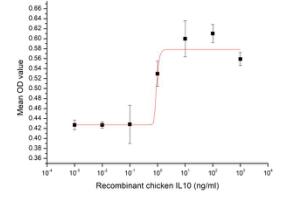 |
Interleukin 10, also known as cytokine synthesis inhibitory factor (CSIF), is the charter member of the IL 10 family of alpha helical cytokines that also includes IL 19, IL 20, IL 22, IL 24, and IL 26/AK155. Mature human IL 10 shares 72%-86% amino acid sequence identity with bovine, canine, equine, feline, mouse, ovine, porcine, and rat IL 10. Whereas human IL 10 is active on mouse cells, mouse IL 10 does not act on human cells. IL 10 is a critical molecule in the control of viral infections and allergic and autoimmune inflammation. It promotes phagocytic uptake and Th2 responses but suppresses antigen presentation and Th1 proinflammatory responses. The activity of IL10 is usually measured by a cell proliferation assay using MC/9 mouse mast cells. MC/9 cells were seeded into triplicate wells of 96-well plates at a density of 8,000 cells/well with 2% serum standard DMEM which contains various concentrations of recombinant chicken IL4. After incubated for 3 days, cells were observed by inverted microscope and cell proliferation was measured by Cell Counting Kit-8 (CCK-8). Briefly, 10 µl of CCK-8 solution was added to each well of the plate, then the absorbance at 450 nm was measured using a microplate reader after incubating the plate for 2-4 hours at 37 ℃. Proliferation of MC/9 cells after incubation with IL10 for 3 days observed by inverted microscope was shown in Figure 1. Cell viability was assessed by CCK-8 (Cell Counting Kit-8 ) assay after incubation with recombinant chicken IL10 for 3 days. The result was shown in Figure 2. It was obvious that IL10 significantly increased cell viability of MC/9 cells. The ED50 is 0.92 -9.2 ng/ml. Figure 2. Cell proliferation of MC/9 cells after stimulated with IL10. |
| 分子别名Alternative Names | CSIFIL10ATGIFCytokine Synthesis Inhibitory Factor |
|---|---|
| 背景介绍Background | Major immune regulatory cytokine that acts on many cells of the immune system where it has profound anti-inflammatory functions, limiting excessive tissue disruption caused by inflammation. Mechanistically, IL10 binds to its heterotetrameric receptor comprising IL10RA and IL10RB leading to JAK1 and STAT2-mediated phosphorylation of STAT3. In turn, STAT3 translocates to the nucleus where it drives expression of anti-inflammatory mediators. Targets antigen-presenting cells (APCs) such as macrophages and monocytes and inhibits their release of pro-inflammatory cytokines including granulocyte-macrophage colony-stimulating factor /GM-CSF, granulocyte colony-stimulating factor/G-CSF, IL-1 alpha, IL-1 beta, IL-6, IL-8 and TNF-alpha. Interferes also with antigen presentation by reducing the expression of MHC-class II and co-stimulatory molecules, thereby inhibiting their ability to induce T cell activation. In addition, controls the inflammatory response of macrophages by reprogramming essential metabolic pathways including mTOR signaling. |
| 功能Function | Major immune regulatory cytokine that acts on many cells of the immune system where it has profound anti-inflammatory functions, limiting excessive tissue disruption caused by inflammation. Mechanistically, IL10 binds to its heterotetrameric receptor comprising IL10RA and IL10RB leading to JAK1 and STAT2-mediated phosphorylation of STAT3. In turn, STAT3 translocates to the nucleus where it drives expression of anti-inflammatory mediators. Targets antigen-presenting cells (APCs) such as macrophages and monocytes and inhibits their release of pro-inflammatory cytokines including granulocyte-macrophage colony-stimulating factor /GM-CSF, granulocyte colony-stimulating factor/G-CSF, IL-1 alpha, IL-1 beta, IL-6, IL-8 and TNF-alpha. Interferes also with antigen presentation by reducing the expression of MHC-class II and co-stimulatory molecules, thereby inhibiting their ability to induce T cell activation. In addition, controls the inflammatory response of macrophages by reprogramming essential metabolic pathways including mTOR signaling. |
| 亚细胞定位Subcellular Location | Secreted. |
| 数据库链接Databases |
蛋白复溶体积计算器缓冲液体积 = 蛋白质量 ÷ 蛋白浓度
输入任意两项,第三项自动计算 |
蛋白浓度稀释计算器初浓度 × 初体积 = 终浓度 × 终体积
输入任意三项,第四项自动计算 |



