


| 纯度Purity | Greater than 90% as determined by reducing SDS-PAGE. |
|---|---|
| 内毒素Endotoxin | Please contact with the lab for this information |
| 蛋白构建Protein Construction |
【Ala20-Phe374】序列区间
|
| Accession | P35248 |
| 表达宿主Expression Host | 293F |
| 种属Species | Rattus norvegicus (Rat) |
| 预测分子量Predicted MW | 37.1 kDa |
| 制剂Formulation | Lyophilized from a 0.2 μm filtered solution of PBS, pH7.4, containing 0.01% SKL, 1mM DTT, 5% Trehalose and Proclin300. |
| 运输方式Shipping | The product is shipped with ice bag. Upon receipt, store it immediately at the temperature listed below. |
| 稳定性&储存Stability & Storage | 12 months at -20°C to -80°C in lyophilized state.6 months at -20°C to -80°C under sterile conditions after reconstitution.7-10 days at 2°C to 8°C under sterile conditions after reconstitution.Please minimize freeze-thaw cycles. |
| 复溶Reconstitution | Reconstitute in 10mM PBS (pH7.4) to a concentration of 0.1-1.0 mg/mL. Do not vortex. |
 |
Greater than 90% as determined by reducing SDS-PAGE. |
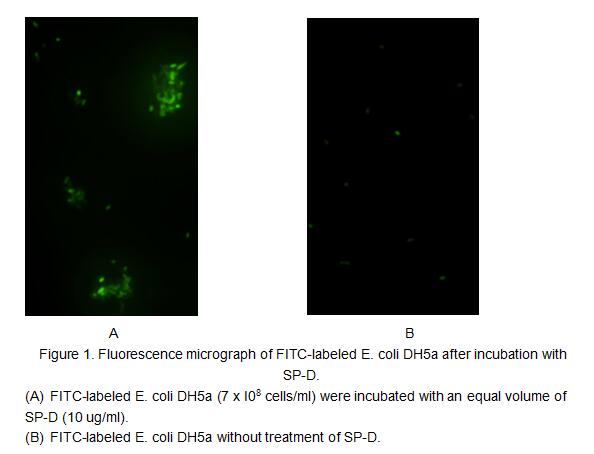 |
SP-D (surfactant protein-D) is a 43 kDa member of the collectin family of innate immune modulators. It is constitutively secreted by alveolar lining cells and epithelium associated with tubular structures. Its principal components consist of a collagen-like region and a C-terminal carbohydrate recognition domain (CRD), a structure that further places it in a subset of an expanded group of proteins termed defense collagens. SP-D is known to bind both SIRP alpha and the calreticulin/CD91 complex on macrophages. When the ratio of antigen/pathogen to available CRDs is low, antigen can be bound without occupying all available CRDs. The free CRDs will bind to SIRP alpha, generating a signal that downmodulates the inflammatory response. When virtually all CRDs are occupied by ligand, however, free CRDs are not available for SIRP alpha binding. The activity of the recombinant rat SPD was measured by its ability to bind fluorescein-conjugated E. coli bioparticles. The rrSPD was diluted to 10 ug/ml in assay buffer of 20 mM Tris, 137 mM NaCl, 1 mM CaC12, pH7.4 and fluorescein-conjugated E. coli was diluted to 7*108 cells/ml. Equal volume of 10 ug/ml rrSPD and fluorescein-conjugated E. coli were mixed and incubated at room temperature for 1h. 10 ul mixture was took onto the slide and observed under the fluorescence microscopy. The result was shown in figure 1, the rrSPD could bind fluorescein-conjugated E. coli bioparticles. |
| 分子别名Alternative Names | SFTPDCOLEC7PSP-DSFTP4SP-DPulmonary Surfactant Protein DCollectin-7Lung surfactant protein D |
|---|---|
| 背景介绍Background | Contributes to the lung's defense against inhaled microorganisms, organic antigens and toxins. Interacts with compounds such as bacterial lipopolysaccharides, oligosaccharides and fatty acids and modulates leukocyte action in immune response. May participate in the extracellular reorganization or turnover of pulmonary surfactant. Binds strongly maltose residues and to a lesser extent other alpha-glucosyl moieties. |
| 功能Function | Contributes to the lung's defense against inhaled microorganisms, organic antigens and toxins. Interacts with compounds such as bacterial lipopolysaccharides, oligosaccharides and fatty acids and modulates leukocyte action in immune response. May participate in the extracellular reorganization or turnover of pulmonary surfactant. Binds strongly maltose residues and to a lesser extent other alpha-glucosyl moieties. |
| 亚细胞定位Subcellular Location | Secreted, extracellular space, extracellular matrix. Secreted, extracellular space, surface film. |
| 数据库链接Databases | KEGGrno:25350UniGeneRn.11348 |
基因功能参考文献23 条
- in acute lung injury, serum level increased from day 5, peaked on day 10, and then gradually decreased until day 28 PMID: 27541374 : 27541374
- SPA binds dipalmitoyl-phosphatidylcholine, the major surfactant lipid component, but not phosphatidylinositol; SPD exhibits the opposite preference. Data suggest flexibility in a key surface loop supports distinctive lipid binding of SPA; quadruple mutant SPA (E171D/P175E/R197N/K203D) that introduces SPD-like loop-stabilizing Ca2+ binding site in carbohydrate recognition domain exhibits ligand-binding preferences of SPD. PMID: 28719181 : 28719181
- In rat SP-D overexpressed mice, the lipopolysaccharide-induced levels of TNF-alpha and IL-10 in amniotic fluid and fetal serum and the expression of IL-10 in placenta and fetal membranes were significantly different from wild-type mice. PMID: 22892325 : 22892325
- Surfactant protein D modulated subpollen particle uptake in a cell type specific way (e.g. greater number of macrophages and epithelial cells, which participated in allergen particle uptake) and led to a decreased secretion of pro-inflammatory cytokines. PMID: 22296755 : 22296755
- Silica exposure causes dynamic changes of SP-D and CC16 protein expression in lung tissue and bronchoalveolar lavage fluid. PMID: 19080379 : 19080379
- An extended binding site for influenza A virus; calcium-dependent antiviral activity involves residues flanking the primary carbohydrate binding site as well as more remote residues displayed on the carbohydrate recognition domain surface. PMID: 20601494 : 20601494
- SP-D promotes attachment of allergen-containing subpollen particles to epithelial cells and may thus be involved in the inflammatory response to inhaled allergen. PMID: 20569420 : 20569420
- analysis of myeloperoxidase-dependent inactivation of surfactant protein D in vitro and in vivo PMID: 20228064 : 20228064
- Results suggest that SP-D-dependent processes regulating surfactant lipid homeostasis were disassociated from those mediating emphysema. PMID: 12163500 : 12163500
- Heterogeneous allele expression of SP-D mRNA in large intestine and other tissues. PMID: 12464693 : 12464693
- SP-A and SP-D are antimicrobial proteins that directly inhibit the proliferation of Gram-negative bacteria in a macrophage- and aggregation-independent manner by increasing the permeability of the microbial cell membrane PMID: 12750409 : 12750409
- SP-A and SP-D are antimicrobial proteins that directly inhibit the growth of Histoplasma capsulatum by increasing permeability of the organism PMID: 12857753 : 12857753
- SP-D interacts with chlamydial pathogens and enhance their phagocytosis into macrophages PMID: 15075250 : 15075250
- Degradation of pulmonary surfactant protein D by Pseudomonas aeruginosa elastase abrogates innate immune function PMID: 15123664 : 15123664
- SP-A and SP-D enhance mannose receptor-mediated phagocytosis of M. avium by macrophages PMID: 15187139 : 15187139
- results indicated SP-A & SP-D have distinct functions in lung homeostasis & the function of the neck domain & carbohydrate recognition domain of SP-D is dependent on its own NH2-terminal & collagenous domains that cannot be complemented by those of SP-A PMID: 16500946 : 16500946
- The ligand binding of homologous human, rat, and mouse trimeric trimeric neck plus carbohydrate recognition domain (neck+CRD) fusion proteins, each with identical N-terminal tags remote from the ligand-binding surface, was compared. PMID: 16514117 : 16514117
- VEGF increased expression of SP-D mRNA in preterm rat lung. PMID: 17267143 : 17267143
- Interactions with the side chain of inner core heptoses provide a potential mechanism for the recognition of diverse types of lipopolysaccharides by SP-D. PMID: 18092821 : 18092821
- These results show that antiviral activities of surfactant protein-D can be reproduced without the N-terminal and collagen domains and that cross-linking of these domains is essential for anti-influenza A virus activity. PMID: 18302538 : 18302538
- After OVA challenge alveolar epithelial cells Type II (AEII) show a significantly higher expression of SP-A and SP-D leading also to higher amounts of both SPs in BALF, and macrophages gather predominantly SP-A. PMID: 18802356 : 18802356
- S-nitrosylation of SP-D causes quaternary structural alterations and a swtich to its inflammatory signaling role. PMID: 19007302 : 19007302
- Multimerization of surfactant protein D, but not its collagen domain, is required for antiviral and opsonic activities related to influenza virus. PMID: 19017984 : 19017984
蛋白复溶体积计算器缓冲液体积 = 蛋白质量 ÷ 蛋白浓度
输入任意两项,第三项自动计算 |
蛋白浓度稀释计算器初浓度 × 初体积 = 终浓度 × 终体积
输入任意三项,第四项自动计算 |



