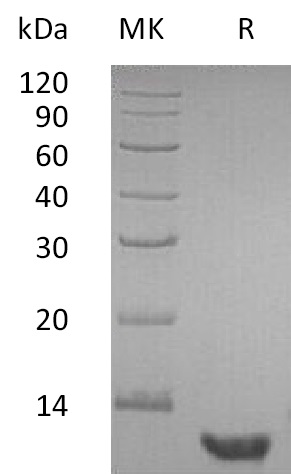
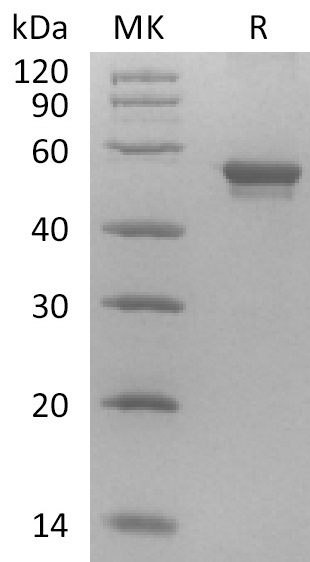
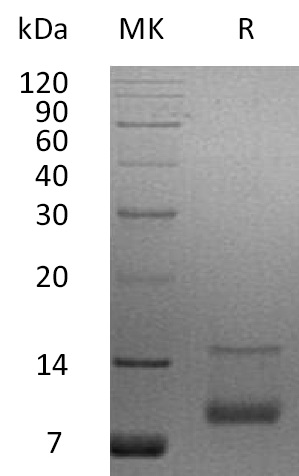
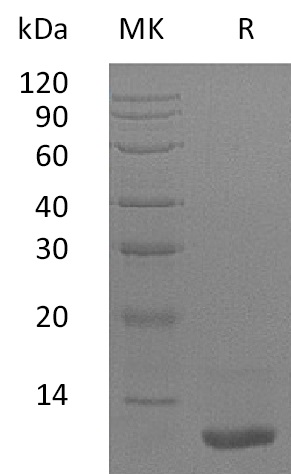
| 纯度Purity | Greater than 95% as determined by reducing SDS-PAGE |
|---|---|
| 内毒素Endotoxin | <1 EU/µg as determined by LAL test. |
| 蛋白构建Protein Construction |
FlagN 端标签-8HisN 端标签-【Ser189-Ala303】序列区间
|
| Accession | Q9Z0J7 |
| 表达宿主Expression Host | HEK293 |
| 种属Species | Mouse |
| 预测分子量Predicted MW | 16.9 kDa |
| 制剂Formulation | Lyophilized from a 0.2 μm filtered solution of 4mM HCl. |
| 运输方式Shipping | The product is shipped with ice bag. Upon receipt, store it immediately at the temperature listed below. |
| 稳定性&储存Stability & Storage | 12 months at -20°C to -80°C in lyophilized state.6 months at -20°C to -80°C under sterile conditions after reconstitution.7-10 days at 2°C to 8°C under sterile conditions after reconstitution.Please minimize freeze-thaw cycles. |
| 复溶Reconstitution | Always centrifuge tubes before opening. Do not mix by vortex or pipetting. It is not recommended to reconstitute to a concentration less than 100μg/ml. Dissolve the lyophilized protein in 4mM HCl. Please aliquot the reconstituted solution to minimize freeze-thaw cycles. |
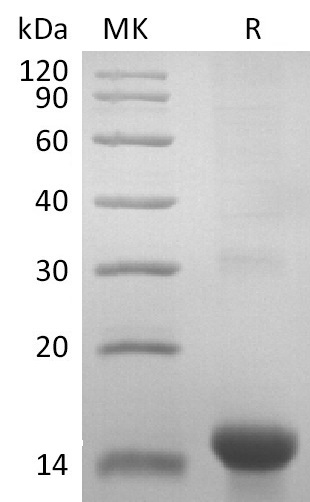 |
Greater than 95% as determined by reducing SDS-PAGE. |
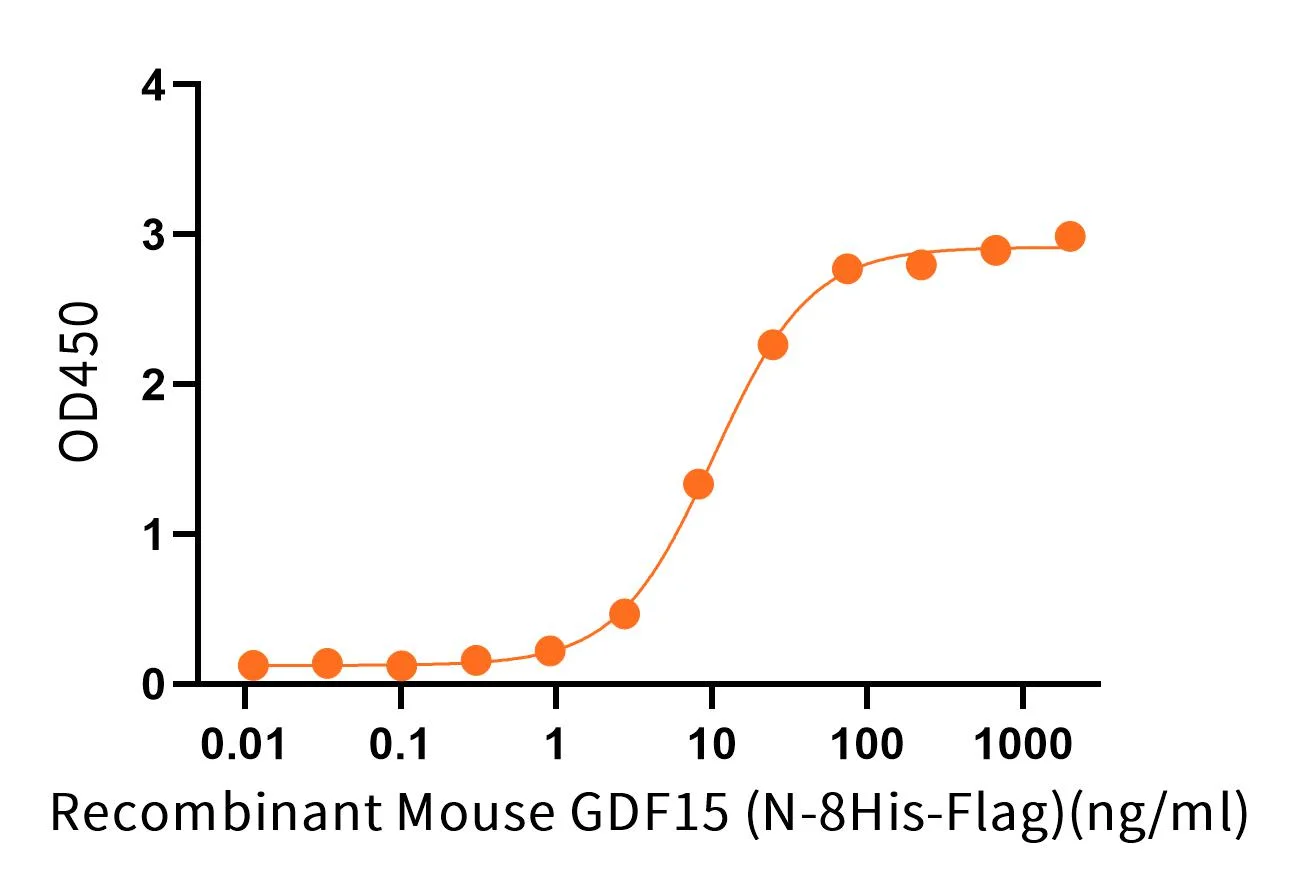 |
Immobilized Recombinant Mouse GFRAL at 1μg/ml (100 μL/well) can bind Recombinant Mouse GDF15*.The ED50 of Recombinant Mouse GDF15* is 10.47 ng/ml.(Regularly tested) |
| 分子别名Alternative Names | Growth Differentiation Factor/xa015, Macrophage inhibitory cytokine 1, GDF-15, MIC-1, NAG-1, PLAB, PTGFB |
|---|---|
| 功能Function | Regulates food intake, energy expenditure and body weight in response to metabolic and toxin-induced stresses. Binds to its receptor, GFRAL, and activates GFRAL-expressing neurons localized in the area postrema and nucleus tractus solitarius of the brainstem. It then triggers the activation of neurons localized within the parabrachial nucleus and central amygdala, which constitutes part of the 'emergency circuit' that shapes feeding responses to stressful conditions. On hepatocytes, inhibits growth hormone signaling. |
| 亚细胞定位Subcellular Location | Secreted. |
| 数据库链接Databases |
基因功能参考文献49 条
- GDF15 is a myokine secreted by aging-related stress and may control aging phenotype PMID: 29491220 : 29491220
- Membrane-protein extraction and use of an intracellular protein-transport inhibitor showed that GDF-15 promoted CaV3.1 and CaV3.3 alpha-subunit expression by trafficking to the membrane. PMID: 27353765 : 27353765
- CHOP activates Gdf15 transcription via binding to its promoter upon endoplasmic reticulum stress. PMID: 28847729 : 28847729
- The ANT1-deficient muscle mitochondria produce excess reactive oxygen species (ROS) and are partially uncoupled. Hence, the muscle respiration under nonphosphorylating conditions is increased. Muscle transcriptome analysis revealed the induction of mitochondrial biogenesis, down-regulation of diabetes-related genes, and increased expression of the genes encoding the myokines FGF21 and GDF15. PMID: 28223503 : 28223503
- isolating GFRAL as the receptor for GDF15-induced anorexia and weight loss, the identification of a mechanistic basis for the non-homeostatic regulation of neural circuitry by a peripheral signal associated with tissue damage and stress; findings provide opportunities to develop therapeutic agents for the treatment of disorders with altered energy demand PMID: 28953886 : 28953886
- These data suggest that GDF15 is required for IL-13-induced improvement of glucose intolerance in mice fed an HFD. PMID: 28874416 : 28874416
- HIF-1alpha and GDF15 expression are inversely related under normoxia and hyperoxia. PMID: 28734801 : 28734801
- This is the first study defining the role of Mic-1/Gdf15 in a number of behavioural domains. PMID: 28081177 : 28081177
- epithelial restitution was promoted by enhanced NAG-1 expression and subsequent enterocyte locomotion during the early wound-healing process PMID: 27421482 : 27421482
- GDF15 is a potent mitohormetic signal that safeguards against the onset of obesity and insulin resistance. PMID: 27986797 : 27986797
- The aim of this study was to identify the role of endogenous Gdf-15 in the MPTP (1-methyl-4-phenyl-1,2,3,6-tetrahydropyridine) mouse model of Parkinson's disease (PD) by comparing Gdf-15 (+/+) and Gdf-15 (-/-) mice. PMID: 27115420 : 27115420
- The results of this study indicated the importance of Gdf-15 in promoting survival of DAergic neurons and regulating the inflammatory response post 6-OHDA lesion. PMID: 26733415 : 26733415
- endogenous Growth/differentiation factor-15 is beneficial for axon regeneration following sciatic nerve crush PMID: 26077927 : 26077927
- repeated cisterna magna administration of human umbilical cord blood-derived mesenchymal stem cells enhanced endogenous adult hippocampal neurogenesis and synaptic activity through a paracrine factor of GDF-15 PMID: 26154268 : 26154268
- Levels of GDF-15 mRNA increased 2 h after induction of ventilator-induced lung injury in WT lungs. Non-hematopoietic cells are the main source of GDF-15. GDF-15 is required for platelet-leukocyte interactions during ventilator-induced lung injury. PMID: 25948320 : 25948320
- hNAG-1 appears to be a novel therapeutic target in preventing and treating obesity and insulin resistance. PMID: 24531647 : 24531647
- Collectively, hNAG-1 is an important regulator of mammalian longevity and may act as a survival factor. PMID: 25239873 : 25239873
- Counterbalance between MIC-1 and ATF3 is critical for deciding the fate of enterocytes under the food chemical stress. PMID: 25180886 : 25180886
- Growth differentiation factor 15, a marker of lung involvement in systemic sclerosis, is involved in fibrosis development but is not indispensable for fibrosis development. PMID: 24504814 : 24504814
- Growth/differentiation factor 15 promotes EGFR signalling, and regulates proliferation and migration in the hippocampus of neonatal and young adult mice. PMID: 24496615 : 24496615
- GDF-15 is therefore prominently upregulated in the retina after optic nerve crush but does not directly interfere with the magnitude and temporal progression of retinal ganglion cell death. PMID: 23640134 : 23640134
- GDF15 protects the renal interstitium and tubular compartment in experimental type 1 and 2 diabetes without affecting glomerular damage PMID: 23986522 : 23986522
- Enteropathogenic Escherichia coli enhances MIC-1 gene expression in the human intestinal cancer cells PMID: 23503457 : 23503457
- knockdown of MIC-1 can decrease RNPC1-induced cell growth suppression. PMID: 23836903 : 23836903
- This is the first study that demonstrates a protective role of GDF-15 in advanced atherosclerosis and macrophage accumulation, possibly due to the reduced expression of adhesion molecules. PMID: 23800095 : 23800095
- MIC-1/GDF15 is involved in the physiological regulation of appetite and energy storage. PMID: 23468844 : 23468844
- GDF-15 specifically inhibits platelet integrin activation, preventing thrombus formation. PMID: 23231375 : 23231375
- GDF-15 is involved in orchestrating atherosclerotic lesion progression by regulating apoptotic cell death and IL-6-dependent inflammatory responses to vascular injury. PMID: 23316317 : 23316317
- Increased expression of the TGF-b superfamily cytokine MIC-1/GDF15 protects ApoE(-/-) mice from the development of atherosclerosis. PMID: 22386250 : 22386250
- GDF15 impairs aortic contractile and relaxing function through an endothelium-dependent mechanism involving altered caveolar endothelial NO synthase signaling. PMID: 23262134 : 23262134
- MIC-1/GDF15 has complex actions on tumor behavior PMID: 22952779 : 22952779
- identified the secreted protein follistatin-like 1 (FSTL1) as an inducer of GDF15 production. PMID: 22675198 : 22675198
- The work shows that the molecule MIC-1/GDF15 might be beneficial for the treatment of obesity as well as perturbations in glucose homeostasis. PMID: 22514681 : 22514681
- These findings suggest that GDF15 could play a pivotal role in the pathogenesis of bone loss relevant to hypoxia. PMID: 22190281 : 22190281
- coronary artery ligation in Gdf15-deficient mice led to enhanced recruitment of polymorphonuclear leukocytes into the infarcted myocardium and an increased incidence of cardiac rupture PMID: 21516086 : 21516086
- Regulation of GDF-15, a distant TGF-beta superfamily member, in a mouse model of cerebral ischemia. PMID: 21128084 : 21128084
- GDF-15 deletion has a beneficial effect both in early and later atherosclerosis by inhibition of CCR2-mediated chemotaxis and by modulating cell death. PMID: 21242297 : 21242297
- GDF-15 at endogenous levels contributes to proliferation and immune escape of malignant gliomas in an immunocompetent host. PMID: 20534737 : 20534737
- Data show that MIC-1 is secreted from melanoma cells together with VEGF to promote vascular development mediated by (V600E)B-Raf signaling. PMID: 20431030 : 20431030
- GDF-15 prevents apoptosis in cerebellar granule neurons by activating Akt and inhibiting endogenously active ERK PMID: 12514175 : 12514175
- GDF-15/MIC-1 is an early mediator of the injury response in kidney and lung PMID: 15897808 : 15897808
- GDF-15 induction is an immediate early response to liver injury that can occur through TNF and p53 independent pathways PMID: 16154591 : 16154591
- GDF15 is a novel autocrine/endocrine factor that antagonizes the hypertrophic response and loss of ventricular performance. PMID: 16397142 : 16397142
- gdf15 is a growth factor with dual function either promoting proliferation or growth arrest and differentiation due most likely to differences in cellular differentiation PMID: 17286605 : 17286605
- GDF-15 has no apparent effect on hepatocellular carcinoma (HCC) tumor formation rate, growth rate or invasiveness in diethylnitrosamine-induced HCC in vivo. PMID: 18210153 : 18210153
- Data conclude that MIC-1 is expressed in adipose tissue and secreted from adipocytes and is therefore a new adipokine. MIC-1 may have a paracrine role in the modulation of adipose tissue function and body fat mass. PMID: 19074584 : 19074584
- a possible inverse relationship exists between the expression of NAG-1 and COX-2 in tumor formation of colon tissue. PMID: 19375854 : 19375854
- the NAG-1 protein inhibits urethane-induced tumor formation PMID: 19401523 : 19401523
- Despite striking similarities in the GDF-15 and CNTF knock-out phenotypes, expression levels of CNTF and other neurotrophic factors in the sciatic nerve were unaltered suggesting that GDF-15 is a genuine novel trophic factor for motor and sensory neurons. PMID: 19864576 : 19864576
蛋白复溶体积计算器缓冲液体积 = 蛋白质量 ÷ 蛋白浓度
输入任意两项,第三项自动计算 |
蛋白浓度稀释计算器初浓度 × 初体积 = 终浓度 × 终体积
输入任意三项,第四项自动计算 |