Recombinant Mouse CXCL9 (C-6His)
Alternative NamesC-X-C motif chemokine 9; Gamma-interferon-induced monokine; Monokine induced by interferon-gamma; MIG; MuMIG; Protein m119; Small-inducible cytokine B9; Cxcl9; Mig; Scyb9
规格参数 Specifications
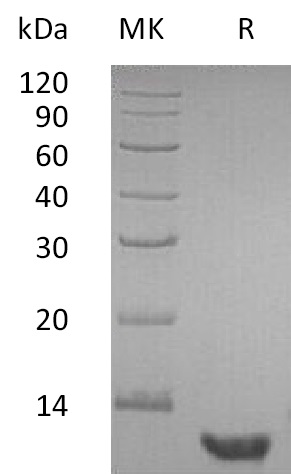
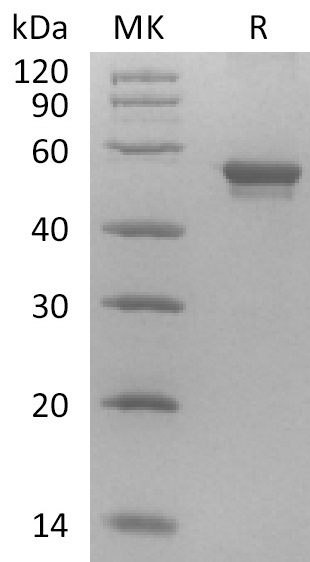
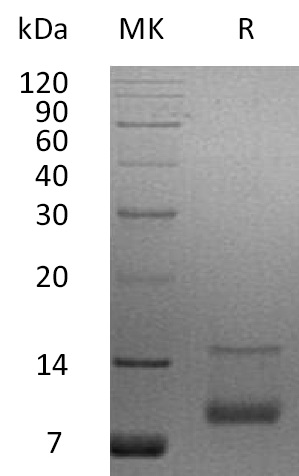
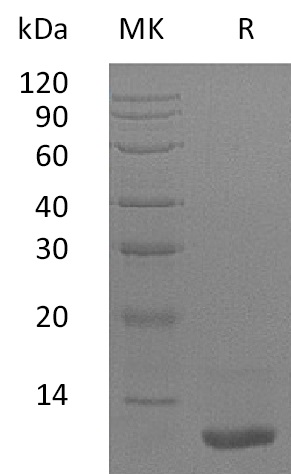
| 纯度Purity | Greater than 95% as determined by reducing SDS-PAGE |
|---|---|
| 内毒素Endotoxin | <1 EU/µg as determined by LAL test. |
| 蛋白构建Protein Construction |
【Thr22-Thr126】序列区间-6HisC 端标签
|
| Accession | P18340 |
| 表达宿主Expression Host | HEK293 |
| 种属Species | Mouse |
| 预测分子量Predicted MW | 13 kDa |
| 制剂Formulation | Lyophilized from a 0.2 μm filtered solution of PBS, pH 7.4. |
| 运输方式Shipping | The product is shipped with ice bag. Upon receipt, store it immediately at the temperature listed below. |
| 稳定性&储存Stability & Storage | 12 months at -20°C to -80°C in lyophilized state.6 months at -20°C to -80°C under sterile conditions after reconstitution.7-10 days at 2°C to 8°C under sterile conditions after reconstitution.Please minimize freeze-thaw cycles. |
| 复溶Reconstitution | Always centrifuge tubes before opening. Do not mix by vortex or pipetting. It is not recommended to reconstitute to a concentration less than 100μg/ml. Dissolve the lyophilized protein in distilled water. Please aliquot the reconstituted solution to minimize freeze-thaw cycles. |
!
本司产品仅用于科研,不用于临床诊断和治疗。
产品图片 Product Images点击图片可查看原图
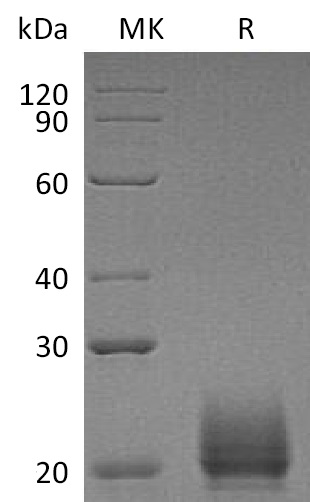 |
Greater than 95% as determined by reducing SDS-PAGE. |
靶点信息 Target Information
| 分子别名Alternative Names | C-X-C motif chemokine 9Gamma-interferon-induced monokineMonokine induced by interferon-gammaMIGMuMIGProtein m119Small-inducible cytokine B9Cxcl9MigScyb9 |
|---|---|
| 功能Function | May be a cytokine that affects the growth, movement, or activation state of cells that participate in immune and inflammatory response. |
| 亚细胞定位Subcellular Location | Secreted. |
| 数据库链接Databases |
基因功能参考文献50 条
- although the expression of CXCL9 and CXCL11 are increased after spinal nerve ligation, they may not contribute to the maintenance of neuropathic pain. PMID: 29712506 : 29712506
- Cxcl9 has a role in angiogenesis and osteogenesis in bone. PMID: 27966526 : 27966526
- Data suggest that the CXCL9-CXCR3 axis plays a pivotal role in the liver-specific distribution of TRAIL+ NK cells in mice. PMID: 29088306 : 29088306
- IFNalphaR1 signaling promoted CXCL9 and CXCL10 synthesis, suggesting that these chemokines might be involved in the LPS and CD134 costimulation response. PMID: 28432083 : 28432083
- CXCL10 plays in the pathogenesis of recurrent Herpetic stromal keratitis, and that CXCL9 displays its importance when CXCL10 is absent. PMID: 28282568 : 28282568
- CXCL9 expression is strongly upregulated in PGRN KO mice and its level is correlated with severity of inflammation in a dermatitis model. PMID: 26892362 : 26892362
- hepatic expression of the inflammatory CXC chemokine ligands (CXCL)9 and CXCL10 strongly increased whereas homeostatic CXCL12 significantly decreased. PMID: 26052942 : 26052942
- Here, we report the evidence for the production of MIG, a second CXCR3 ligand, during the primary immune response to HSV-1 corneal infection. PMID: 25207638 : 25207638
- These findings identify a novel role for the immune cell-derived CXCL9 chemokine in directing a protective antimicrobial response in the intestinal mucosa. PMID: 25643352 : 25643352
- These results indicate that CXCL9 is crucial for recruiting immune T cells into the brain and inducing an accumulation of the T cells into the areas where tachyzoites proliferate to prevent reactivation of chronic T. gondii infection. PMID: 25432064 : 25432064
- tumours are characterized by expression of inflammatory chemokines (CCL2, CCL5, CCL7, CCL8, CCL12, CXCL9, CXCL10 and CX3CL1), reflected by an enrichment of activated Foxp3(-) and Foxp3(+) T cells PMID: 25495686 : 25495686
- Aged mice had similar levels of IL-1beta, TNF, IFN-gamma, IL-17, and granulocyte colony-stimulating factor following S. pneumoniae infection, compared with young mice, but increased levels of the chemokines CXCL9, CXCL12, CCL3, CCL4, CCL5, CCL11, and CCL17. PMID: 25595646 : 25595646
- Data indicate that a feed-forward CXCL9-dependent circuit provided additional chemotactic cues that further increase local memory cell density. PMID: 23352234 : 23352234
- IFN-gamma-mediated loss of Mig expression in cutaneous tumors as a potent mechanism of immunoediting that results in increased tumor resistance to T cell-mediated immunity. PMID: 23241877 : 23241877
- CXCL9/10 have antifibrotic roles on liver non-parenchymal cells PMID: 22905138 : 22905138
- findings show that effector T cells cannot accumulate within the decidua, the specialized stromal tissue encapsulating the fetus and placenta; impaired accumulation was in part attributable to the epigenetic silencing of key T cell-attracting inflammatory chemokine genes in decidual stromal cells PMID: 22679098 : 22679098
- Mig contributes to the acute lethal toxicity arising from 5-FU administration. PMID: 22474250 : 22474250
- Cxcr3, Cxcl9 and Cxcl10 are increased in alopecia areata. PMID: 22358057 : 22358057
- The results identify direct angiostatic and antifibrotic effects of the Cxcr3 ligand Cxcl9 in a model of experimental liver fibrosis. PMID: 22237831 : 22237831
- MIG/CXCL9 is expressed in the lungs upon pneumococcal infection in a MyD88-dependent manner PMID: 20381636 : 20381636
- Expression of the chemokine Mig (CXCL9) was increased 2.8-fold in tumors from Egr-1 knockout mice. PMID: 19200397 : 19200397
- CXCL9 promotes the development of IFN-gamma-producing CD8 T cells, and CXCL10 antagonizes this skewing during allograft rejection. PMID: 20194716 : 20194716
- CCL2, CXCL9 and CXCL2 mRNA are up-regulated after oral Salmonella infection in Peyer's patches and lymph nodes coincident with the first arrival of monocytes and neutrophils PMID: 19839009 : 19839009
- MIG (CXCL9) chemokine gene therapy combines with antibody-cytokine fusion protein to suppress growth and dissemination of murine colon carcinoma. PMID: 11731434 : 11731434
- in study of relevance of chemokine expression to selective migration of t-cells and the disease localization in murine graft-versus-host disease, Mig was found to be predominantly expressed in spleen, liver, and not skin, and not heart. PMID: 12098066 : 12098066
- NF-kappaB has a critical role in mediating IFN-gamma-induced MIG (monokine induced by IFN-gamma) expression independent of hyaluronan PMID: 12226082 : 12226082
- involved in T cell cardiac allograft vasculopathy PMID: 12368204 : 12368204
- Data show that the transcriptional coactivator CREB-binding protein (CBP) mediated the STAT1/NF-kappaB synergy for transcription of the gene for CXC ligand 9 an interferon-gamma (IFN-gamma)-inducible chemokine. PMID: 12403783 : 12403783
- full potency of SLC/CCL21-mediated anti-tumor responses require in part the induction of IFNgamma, MIG/CXCL9 and IP-10/CXCL10 PMID: 12740040 : 12740040
- Peak of expression of CXCL9 and CXCL10 occurred 4 days before CD8+ T cells infiltrated infected tissues. CXCL9 and CXCL10 may play role early during immune response against rickettsial infections. PMID: 14507644 : 14507644
- Mig functions as a negative regulator of murine eosinophils PMID: 14769916 : 14769916
- exogenous CXCL9 stimulated CD4 lymphocyte proliferation in a MHC class II-mismatched MLR and increased the number of IFN-gamma-producing CD4 lymphocytes PMID: 15187119 : 15187119
- Interactions involving CXCR3 and its primary ligands Mig and IP-10 significantly contribute to donor T cell recruitment to the lung after allogeneic stem cell transplantation. PMID: 15265940 : 15265940
- RANKL stimulates the serine phosphorylation of STAT1, causing MIG gene transcription and secretion, which may have a role in recruiting CXCR3-positive osteoclast precursors and osteoclasts to bone remodeling or inflammatory sites. PMID: 15585657 : 15585657
- IFN-gamma knockout mice, which manifested depressed ear-swelling following delayed hypersensitsivity challenge, made no Mig. PMID: 15629884 : 15629884
- Results suggest that in the sensitized host, CXCR3, IP-10, and Mig are required for optimal delayed hypersensitivity responsiveness but are not essential for containing HSV-1 replication. PMID: 15708587 : 15708587
- results suggest that MUM1 plays roles in the progression of B-cell lymphoma/leukemia by regulating the expression of various genes including MIG. PMID: 15959530 : 15959530
- CXCL9 has a role in graft rejection in the absence of CCL19 and CCL21 PMID: 16095489 : 16095489
- MIG mRNA expression in the lungs of Klebsiella-infected mice requires the endogenous production of IFN-gamma. PMID: 16299319 : 16299319
- CXCL9 signaling enhances immune responses following Trypanosoma cruzi infection; transcripts for CXCL9 remain elevated during chronic infection PMID: 16368965 : 16368965
- CXCL9 is up-regulated in unique patterns following tracheal transplantation in mice. Deletion of CXCL9 does not affect airway obliteration. PMID: 16709871 : 16709871
- These results suggest that the more aggressive rejection of xenografts compared with allografts is due to the earlier expression of CXC-chemokines, IP-10 and MIG, and subsequent adjuvant effects of proinflammatory cytokines. PMID: 16768726 : 16768726
- Collectively, the results suggest a non-redundant role for CXCL9 and CXCL10 in response to ocular HSV-1 infection in terms of controlling virus replication and recruitment of CD4(+) T cells into the cornea. PMID: 17296171 : 17296171
- Acute ethanol intoxication impairs lung expression of Cxcl9, interfering with pulmonary response to bacterial challenge. PMID: 17889309 : 17889309
- IFN-gamma is mediator of Cxcl10 and Cxcl9 gene expression in experimental autoimmune encephalomyelitis(EAE). It differentially regulates expression of these genes by astrocytes and microglia. Differential glial localization of these chemokines in EAE. PMID: 17902170 : 17902170
- The absence of CXCL9 or CXCL10 expression significantly alters the ability of the host to control genital HSV-2 infection through the mobilization of effector cells to sites of infection. PMID: 18178850 : 18178850
- These data demonstrate that CXCR3 on CD8(+) T cells is required for T cell recruitment into the brain and the development of murine cerebral malaria. PMID: 18347328 : 18347328
- Liver sinusoidal endothelial cells present chemokines (CXCL12 and CXCL9) to circulating lymphocytes. PMID: 18697212 : 18697212
- CXCR3 ligands, IP10 and MIG, contribute to Th1-induced inflammation but not to homing of Th1 cells into the lung. PMID: 18716926 : 18716926
- CXCL9 promotes protection from coronavirus-induced neurological and liver disease. PMID: 18973912 : 18973912
蛋白复溶体积计算器缓冲液体积 = 蛋白质量 ÷ 蛋白浓度
输入任意两项,第三项自动计算 |
蛋白浓度稀释计算器初浓度 × 初体积 = 终浓度 × 终体积
输入任意三项,第四项自动计算 |