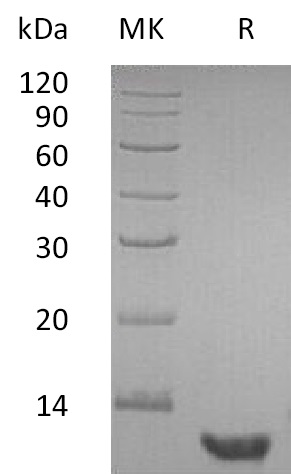
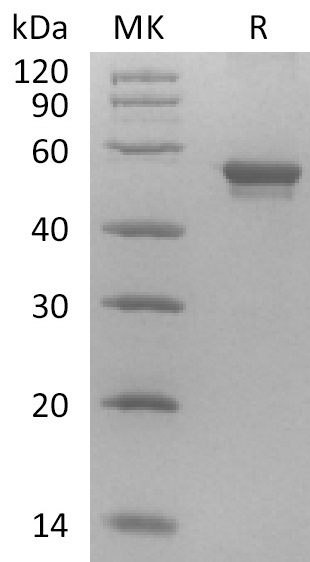
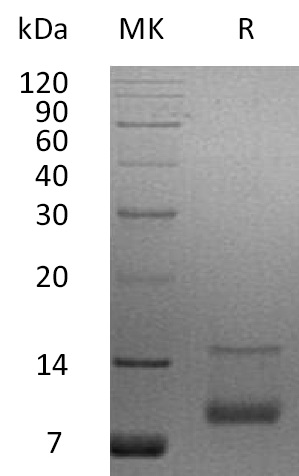
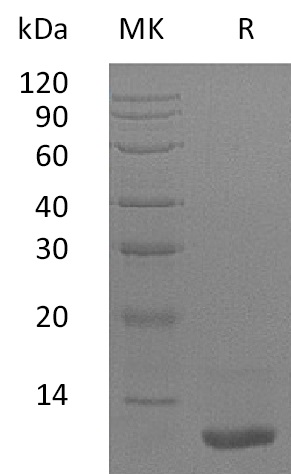
| 纯度Purity | Greater than 95% as determined by reducing SDS-PAGE |
|---|---|
| 内毒素Endotoxin | <1 EU/µg as determined by LAL test. |
| 蛋白构建Protein Construction |
【Ile24-Asp159】序列区间-6HisC 端标签
|
| Accession | Q62312-2 |
| 表达宿主Expression Host | HEK293 |
| 种属Species | Mouse |
| 预测分子量Predicted MW | 16.2 kDa |
| 制剂Formulation | Lyophilized from a 0.2 μm filtered solution of PBS, pH 7.4. |
| 运输方式Shipping | The product is shipped with ice bag. Upon receipt, store it immediately at the temperature listed below. |
| 稳定性&储存Stability & Storage | 12 months at -20°C to -80°C in lyophilized state.6 months at -20°C to -80°C under sterile conditions after reconstitution.7-10 days at 2°C to 8°C under sterile conditions after reconstitution.Please minimize freeze-thaw cycles. |
| 复溶Reconstitution | Always centrifuge tubes before opening. Do not mix by vortex or pipetting. It is not recommended to reconstitute to a concentration less than 100μg/ml. Dissolve the lyophilized protein in distilled water. Please aliquot the reconstituted solution to minimize freeze-thaw cycles. |
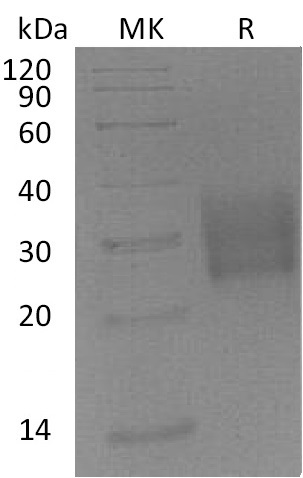 |
Greater than 95% as determined by reducing SDS-PAGE. |
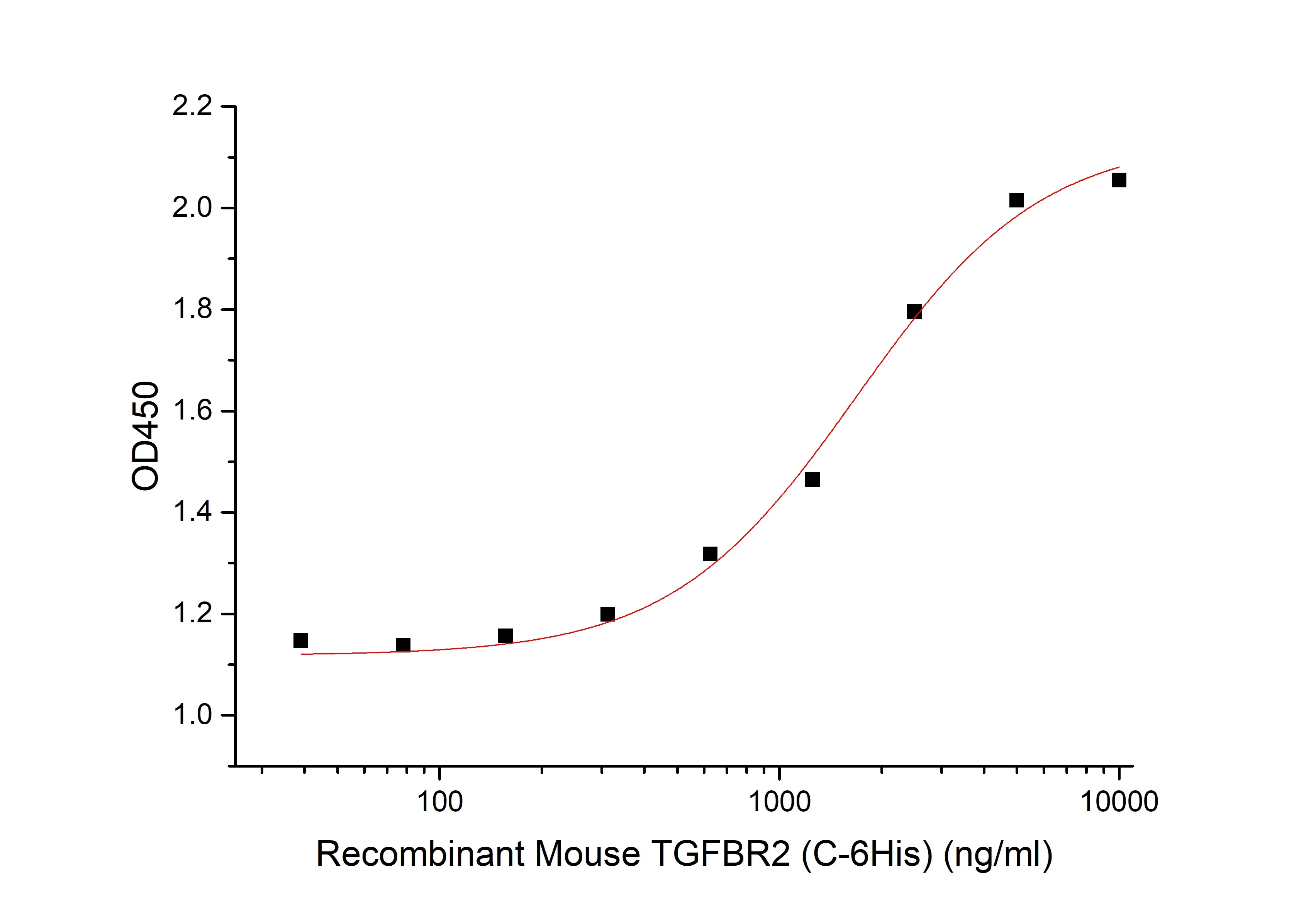 |
Measured by its ability to inhibit TGF-beta 1 activity on TF‑1 human erythroleukemic cells.The ED50 for this effect is 1680.39ng/ml in the presence of 1ng/ml of recombinant human TGF-beta 1. |
| 分子别名Alternative Names | TGF-beta receptor type-2TGFR-2TGF-beta type II receptorTransforming growth factor-beta receptor type IITGF-beta receptor type IITbetaR-IITgfbr2 |
|---|---|
| 功能Function | Transmembrane serine/threonine kinase forming with the TGF-beta type I serine/threonine kinase receptor, TGFBR1, the non-promiscuous receptor for the TGF-beta cytokines TGFB1, TGFB2 and TGFB3. Transduces the TGFB1, TGFB2 and TGFB3 signal from the cell surface to the cytoplasm and is thus regulating a plethora of physiological and pathological processes including cell cycle arrest in epithelial and hematopoietic cells, control of mesenchymal cell proliferation and differentiation, wound healing, extracellular matrix production, immunosuppression and carcinogenesis. The formation of the receptor complex composed of 2 TGFBR1 and 2 TGFBR2 molecules symmetrically bound to the cytokine dimer results in the phosphorylation and the activation of TGFRB1 by the constitutively active TGFBR2. Activated TGFBR1 phosphorylates SMAD2 which dissociates from the receptor and interacts with SMAD4. The SMAD2-SMAD4 complex is subsequently translocated to the nucleus where it modulates the transcription of the TGF-beta-regulated genes. This constitutes the canonical SMAD-dependent TGF-beta signaling cascade. Also involved in non-canonical, SMAD-independent TGF-beta signaling pathways. |
| 亚细胞定位Subcellular Location | Cell membrane; Single-pass type I membrane protein. Membrane raft. |
| 数据库链接Databases |
基因功能参考文献50 条
- the molecular actions of TGFBR2 result in both SMAD4-dependent constraint of proliferation and SMAD4-independent activation of apoptosis PMID: 29352019 : 29352019
- altered Tgfbeta signaling in cultured mouse and human enteroids supports further the in vivo data and reveals a critical role for Tgfbeta signaling in generating precursor secretory cells. Overall, our data reveal a key role for Tgfbeta signaling in regulating ISCs clonal dynamics and differentiation, with implications for cancer, tissue regeneration, and inflammation. PMID: 27791005 : 27791005
- In young Fbn1(C1039G/+) mice, aortopathy develops in the absence of detectable alterations in smooth muscle cell (SMC) TGF-beta signaling. Loss of physiologic SMC TGF-beta signaling exacerbates MFS-associated aortopathy. Our data support a protective role for SMC TGF-beta signaling during early development of MFS-associated aortopathy. PMID: 28119285 : 28119285
- The present study demonstrates that TGFbeta responsiveness in the myeloid compartment is critical in controlling autoimmune encephalomyelitis, and that its specific deletion in monocyte-derived dendritic cells causes severe experimental autoimmune encephalomyelitis without remission. PMID: 27479807 : 27479807
- These results suggest proliferation and maturation of immature osteoblasts requires Tgfbr2 signaling and that decreased bone volume in Osx-Cre;Tgfbr2(fl/fl) mice is likely due to fewer mature osteoblasts. PMID: 28043895 : 28043895
- The authors identify ELMO1 as a novel target of TGFbeta signaling and show that restoration of Tgfbr2 results in a complete block of ELMO1 in vivo. Knocking down Elmo1 impairs metastasis of carcinoma cells to the lung, thereby providing insights into the mechanisms of progression of Tgfbr2-deficient invasive transition zone squamous cell carcinoma. PMID: 28219480 : 28219480
- Cell-intrinsic TGFbeta-RII signaling limits CD4 T cell proliferation but not prototypical T helper subset differentiation early after chronic lymphocytic choriomeningitis virus infection. PMID: 27599295 : 27599295
- Knockout of the TGFbeta receptor in proopiomelanocortin neurons counteracts the hypertensive effect of not only TGFbeta but also mtDNA excess, while the hypertensive action of central mtDNA can be blocked pharmacologically by a TGFbeta receptor antagonist or genetically by TGFbeta receptor knockout. PMID: 27894066 : 27894066
- Postnatal disruption of Tgfbr2 gene compromises extracellular matrix properties and promotes aortic dissection, which can be prevented by rapamycin treatment. PMID: 26988590 : 26988590
- Gasdermin C is upregulated by inactivation of Tgfbr2 in the presence of mutated Apc, promoting colorectal cancer cell proliferation. PMID: 27835699 : 27835699
- Epithelial TGFbeta signaling via TGFBR2 does not contribute to the development of liver fibrosis or formation of hepatocellular carcinomas in mice, but restricts cholangiocyte proliferation to prevent cholangiocarcinoma development. PMID: 26627606 : 26627606
- The removal of Tgfbr2 and treatment with losartan both delayed the progression of articular cartilage degeneration induced by medial meniscus (DMM) compared with control littermates. PMID: 26355014 : 26355014
- Data (including data from studies in transgenic mice) suggest intraislet pancreatic duct cells are capable of giving rise to insulin-secreting beta-cells; Tgfbr2/transforming growth factor-beta type II receptor appears to be involved in this process. PMID: 26505114 : 26505114
- Elimination of TGF-betaIIR is not sufficient to completely prevent liver fibrosis. TGF-beta-independent mechanism of type I collagen production and suggest connective tissue growth factor as its potent mediator. PMID: 25108224 : 25108224
- Overexpression of TGFbeta1 promotes pulmonary inflammation, apoptosis and mortality via TGFbetaR2 in the developing mouse lung. PMID: 25591994 : 25591994
- Loss of smooth muscle cells Tgfbr2 disrupts TGF-beta signaling, acutely alters SMC gene expression, and rapidly results in severe and durable aortopathy. PMID: 26494233 : 26494233
- Increased Tgfbr2 expression is associated with pulmonary fibrosis. PMID: 26216407 : 26216407
- Suggest that miR-370 acting via TbetaRII might play a potential role in hepatic IR injury, and inhibition of miR-370 efficiently attenuated the damage to the liver. PMID: 24351048 : 24351048
- skeletal phenotype of mice carrying a mutation in the TGF-beta type 2 receptor associated with severe Loeys-Dietz syndrome in humans: Cortical bone showed significantly reduced tissue area, bone area, and cortical thickness with increased eccentricity PMID: 26173585 : 26173585
- Expression of microRNA-211 is regulated by the key melanocyte transcription factor MITF and regulates pigmentation by targeting the TGF-beta receptor 2. PMID: 25444235 : 25444235
- TGFBR2-dependent molecular crosstalk between neural and endothelial cells during brain vessel development was discovered. PMID: 24990151 : 24990151
- TGF-beta signaling plays an important role in dentin formation and pulp protection. Furthermore, our findings may provide new insight into possible mechanisms underlying human hereditary dentin disorders and reparative dentin formation. PMID: 25818583 : 25818583
- taken together, indicate that a simple genetic alteration in the TGFbeta signaling pathway in the inflamed and regenerating intestinal mucosa can cause invasive intestinal tumors. PMID: 25687406 : 25687406
- phosphorylation of tyrosines within the TbetaRII tail was essential for SMAD-dependent fibrotic signaling within cells of the kidney collecting duct PMID: 24983314 : 24983314
- Conditional deletion of Tgfbr2 in keratin 14-positive stratified epithelia causes ocular surface epithelial hyperplasia and conjunctival goblet cell expansion that invaginates into the subconjunctival stroma in the mouse eye. PMID: 25377551 : 25377551
- The TGFbetaRII-mediated signaling in thymic epithelial cells inhibits their development into Hassall's corpuscles in mice PMID: 23929912 : 23929912
- CD4Foxp3 thymocytes from mice with the Tgfbr2 deletion expressed high levels of CXCR3. PMID: 24165986 : 24165986
- basal TGF-beta signaling in smooth muscle promotes postnatal aortic wall homeostasis and impedes disease progression PMID: 24401272 : 24401272
- TGFbeta regulates epithelial-mesenchymal interactions through WNT signaling activity to control muscle development in the soft palate. PMID: 24496627 : 24496627
- Inhibition of TGFbeta signaling (deletion of the Tgfbr2 gene in chondrocytes) resulted in up-regulation of Runx2, Mmp13, and Adamts5 expression in articular cartilage tissue and progressive osteoarthritis development in TGFbetaRII(Col2ER) mice. PMID: 23982761 : 23982761
- Data indicate thate TGFbeta activates the ABL1 pathway in the absnce of TGFbeta receptor type II (TbetaRII) during tongue development. PMID: 23950180 : 23950180
- Osx-Cre;Tgfbr2(fl/fl) mice were generated (Tgfbr2(cko)) and post-natal tooth development was compared in Tgfbr2(cko) and control littermates. PMID: 23933490 : 23933490
- Spatial and temporal expression of Tgfbr2 is regulated during mouse forelimb development. PMID: 23231014 : 23231014
- TbetaRII-deficient mice showed a lower level of developmental apoptosis of retinal neurons. PMID: 23986258 : 23986258
- Reduced cholesterol synthesis is observed in Tgfbr2 mutant palatal tissue. PMID: 23060211 : 23060211
- This study uncovers a previously unrecognized dominant function of the dnTGFbetaRII in CD8(+) T cell proliferation and cellular transformation PMID: 23686479 : 23686479
- Increased copy number of dnTGFbetaRII is critical for development of lymphoma-like T cell infiltration. PMID: 23145171 : 23145171
- gross alterations in dorsal vertebrae were apparent by E16.5days in Tgfbr2 mutants PMID: 22369999 : 22369999
- Loss of Tgfbr2 in hypertrophic chondrocytes using Col10a1-Cre mice resulted in delays in both the hypertrophic conversion of proliferating chondrocytes and terminal chondrocyte differentiation PMID: 22885149 : 22885149
- IRF6 and SMAD4 synergistically regulate the fate of the medial edge epithelium(MEE), and TGFbeta-mediated Irf6 activity is responsible for MEE degeneration during palatal fusion in mice. PMID: 23406900 : 23406900
- c-Cbl conjugates neural precursor cell-expressed, developmentally downregulated 8 (NEDD8), a ubiquitin-like protein, to TbetaRII at Lys556 and Lys567. PMID: 23290524 : 23290524
- Deficiency of the TGF-beta type II receptor protected proximal tubule epithelial cells from apoptosis. PMID: 23160515 : 23160515
- TGFbetaR2 signaling in dendritic cells is critical to control autoimmunity through both regulatory T (Treg) cell-dependent and -independent mechanisms. PMID: 22972928 : 22972928
- TGFbeta signalling is essential in vascular endothelial cells for maintaining vascular integrity at the angiogenic front as it migrates into developing neural tissues in early postnatal life. PMID: 22745736 : 22745736
- Results establish a novel role for TGFbeta signaling in expression of genes for alternatively activated macrophages. Lack of TbetaRII signaling may reduce the anti-inflammatory M2 phenotype of macrophages because of reduced expression of these products. PMID: 22703233 : 22703233
- Treatment of PyMT/Tgfbr2(KO) mice with anti-IL-17 Ab decreased carcinoma growth and metastatic burden. PMID: 22408746 : 22408746
- We conclude that Tgfbr2 in myeloid cells has a negative role in the regulation of anti-tumorigenic functions of these cells PMID: 22685318 : 22685318
- The TbetaRII/monocyte-chemoattractant protein (MCP)-5 axis is an essential crossroad for joint development and endochondral growth. PMID: 22814601 : 22814601
- TbetaRII may determine the distinct roles of TGF-beta1 in inflammation and fibrogenesis in a mouse model of ureteral obstruction induced nephropathy. PMID: 22190171 : 22190171
- Data show that dual Dicer-deficient and TGFbetaRII-deficient mice show defects in both TGFbeta-mediated tolerance and miR production. PMID: 22225602 : 22225602
蛋白复溶体积计算器缓冲液体积 = 蛋白质量 ÷ 蛋白浓度
输入任意两项,第三项自动计算 |
蛋白浓度稀释计算器初浓度 × 初体积 = 终浓度 × 终体积
输入任意三项,第四项自动计算 |