Recombinant Mouse PLGF (C-6His)
Alternative NamesPlacenta growth factor; PlGF; Plgf; D12S1900; PGFL; PGF; PlGF-2; SHGC-10760
规格参数 Specifications
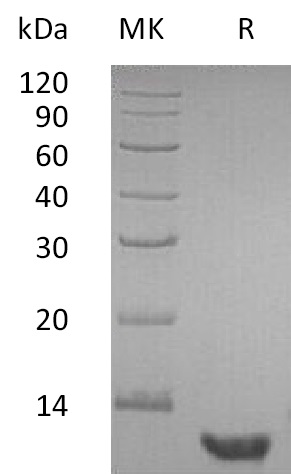
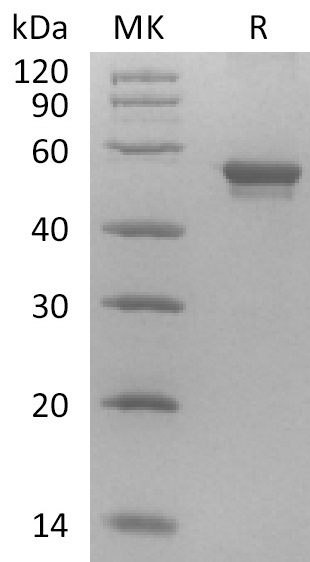
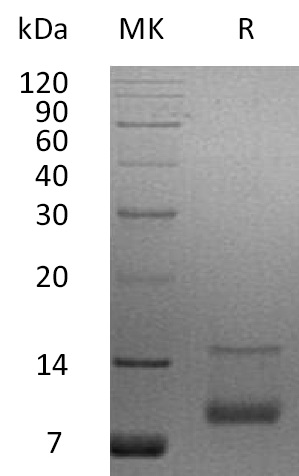
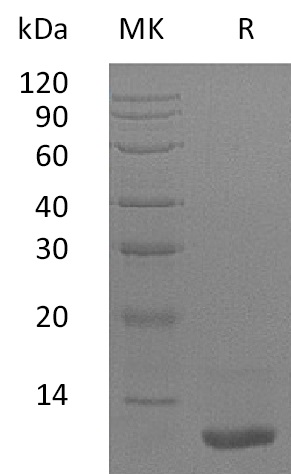
| 纯度Purity | Greater than 95% as determined by reducing SDS-PAGE |
|---|---|
| 内毒素Endotoxin | <1 EU/µg as determined by LAL test. |
| 蛋白构建Protein Construction |
【Val19-Pro158】序列区间-6HisC 端标签
|
| Accession | P49764 |
| 表达宿主Expression Host | HEK293 |
| 种属Species | Mouse |
| 预测分子量Predicted MW | 16.9 kDa |
| 制剂Formulation | Lyophilized from a 0.2 μm filtered solution of 20mM PB, 150mM NaCl, pH 7.4. |
| 运输方式Shipping | The product is shipped with ice bag. Upon receipt, store it immediately at the temperature listed below. |
| 稳定性&储存Stability & Storage | 12 months at -20°C to -80°C in lyophilized state.6 months at -20°C to -80°C under sterile conditions after reconstitution.7-10 days at 2°C to 8°C under sterile conditions after reconstitution.Please minimize freeze-thaw cycles. |
| 复溶Reconstitution | Always centrifuge tubes before opening. Do not mix by vortex or pipetting. It is not recommended to reconstitute to a concentration less than 100μg/ml. Dissolve the lyophilized protein in distilled water. Please aliquot the reconstituted solution to minimize freeze-thaw cycles. |
!
本司产品仅用于科研,不用于临床诊断和治疗。
产品图片 Product Images点击图片可查看原图
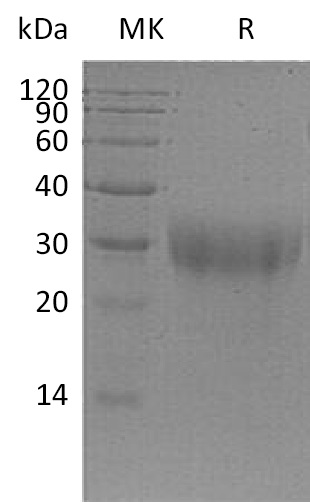 |
Greater than 95% as determined by reducing SDS-PAGE. |
靶点信息 Target Information
| 分子别名Alternative Names | Placenta growth factorPlGFPlgfD12S1900PGFLPGFPlGF-2SHGC-10760 |
|---|---|
| 功能Function | Growth factor active in angiogenesis and endothelial cell growth, stimulating their proliferation and migration. It binds to the receptor FLT1/VEGFR-1. Also promotes cell tumor growth. |
| 亚细胞定位Subcellular Location | Secreted. |
| 数据库链接Databases |
基因功能参考文献50 条
- elevated PlGF levels may contribute to recruitment and activation of leukocytes. This can subsequently lead to increased pathology of affected organs in addition to mediating acute hypoxia/reoxygenation-triggered vaso-occlusion under sickle cell disease conditions. PMID: 29337222 : 29337222
- Data indicate that VEGF-B is a high-affinity VEGFR-1 ligand that, unlike PIGF, cannot efficiently induce signaling downstream of VEGFR-1. PMID: 23821770 : 23821770
- the lack of PIGF may have contributed to the delayed angiogenic response and the prothrombotic phenotype observed in the PIGF(-/-)animals. PMID: 22126916 : 22126916
- Overexpression of VEGF but not PIGF exacerbated the lipopolysaccharide-mediated toxic effects, supporting a pathophysiological role for VEGF in mediating the sepsis phenotype. PMID: 16702604 : 16702604
- Findings indicate that placental growth factor (PlGF) plays an important role in liver fibrosis-associated angiogenesis and that blockage of PlGF could be an effective strategy for chronic liver disease. PMID: 28378526 : 28378526
- Data demonstrate that PlGF is expressed in vivo and that its expression is restricted to the areas of the tumors where the highest levels of hypoxia occur. Also, hypoxia activates PlGF expression in cultured lymphatic endothelial cells. PMID: 28427198 : 28427198
- Study provides mechanistic and clinical evidence that decreased PLGF levels in the placenta after in utero alcohol exposure are associated to brain angiogenesis defects. Measurement of PLGF levels at birth in the placenta or the fetal blood may serve as a predictive marker for subsequent neurodevelopmental outcomes of exposed fetuses. PMID: 28587682 : 28587682
- PGF deficiency is associated with impaired cerebral vascular development in mice. PMID: 26646502 : 26646502
- PlGF inhibition attenuates PERK activation, likely by tempering hypoxia in HCC via vessel normalisation. The UPR is able to regulate PlGF expression, suggesting the existence of a feedback mechanism for hypoxia-mediated UPR PMID: 26753564 : 26753564
- Data indicate that placental growth factor (PlGF) is needed in the spleen to allow the activation of T cells and blood pressure raising. PMID: 26285836 : 26285836
- Placental growth factor promotes differentiation of bone marrow-derived macrophages and enhanced vascular endothelial cell proliferation. PMID: 26089019 : 26089019
- PLGF in LC cells induced macrophage polarization in vivo, and significantly promoted the growth of LC. PMID: 25961789 : 25961789
- PLGF is upregulated in vascular cells in response to fluid shear stress. PMID: 26408539 : 26408539
- Data suggests that PLGF may target islet endothelia to release growth factors activating PI3k signalling in beta cells to increase their proliferation. In Pre-Eclampsia, PLGF reduction impairs these processes resulting in gestational diabetes mellitus. PMID: 25924650 : 25924650
- The neutrophil elastase-PlGF-JNK/PKCdelta pathway contributes to the pathogenesis of lung epithelial cell apoptosis and emphysema. PMID: 25186164 : 25186164
- E2F1 limits cardiac neovascularization and functional recovery after myocardial infarction by suppressing VEGF and PlGF up-regulation through p53-dependent and -independent mechanisms, respectively. PMID: 25341896 : 25341896
- Pgf knockout mice had higher systolic blood pressure in early and late pregnancy but an extended, abnormal midpregnancy interval of depressed systolic pressure. Knockout kidneys were hypertrophic and had glomerular pathology. PMID: 25537372 : 25537372
- PLGF triggers focal adhesion disassembly in alveolar type II cells via inhibiting the activation of focal adhesion kinase. PMID: 25515701 : 25515701
- Fine branching angiogenesis of anti-mesometrial vessels required both conceptus and maternal PGF. PMID: 25106880 : 25106880
- PlGF mediates the neuroimmune interaction in the spleen, organizing a unique and nonredundant response that allows the onset of hypertension. PMID: 25517614 : 25517614
- These results suggest that PlGF is critical for the development of diabetic retinopathy, and its genetic deletion protects the retina from diabetic damage. PMID: 25187372 : 25187372
- PlGF overexpression prevents angiogenesis by inhibiting Braf, extracellular signal-regulated kinase activation, and downregulation of HIF-1alpha in the mouse placenta. PMID: 25147341 : 25147341
- These results render PlGF an appealing target for ocular wound healing and point to potential therapeutic benefits of PlGF inhibition for the prevention of surgical failure. PMID: 24118824 : 24118824
- The increase in PlGF and PlGF-induced JNK and p38 MAPK pathways contribute to porcine pancreatic elastase-induced lung epithelial cell apoptosis and emphysema. PMID: 24008737 : 24008737
- PlGF positively and negatively modulate tumor growth, angiogenesis, and vascular remodeling through a VEGF-dependent mechanism. PMID: 23918367 : 23918367
- Aldosterone increases early atherosclerosis in regions of turbulent blood flow and promotes an inflammatory plaque phenotype that is associated with PlGF signaling. PMID: 23525413 : 23525413
- Tumor-derived PlGF negatively modulates tumor angiogenesis and tumor growth and may potentially serve as a predictive marker of anti-VEGF cancer therapy. PMID: 23267058 : 23267058
- Plgf1-de gene is a new therapeutic tool for the inhibition of VEGFs driven ocular neovascularization. PMID: 23139276 : 23139276
- The decrease in PlGF and VEGF coupled with the increase in sFlt-1 suggests that Ang-(1-7) may serve as a novel anti-angiogenic therapy for prostate cancer. PMID: 22644934 : 22644934
- PlGF repairs myocardial ischemia through mechanisms of angiogenesis, cardioprotection and recruitment of myo-angiogenic competent marrow progenitors PMID: 21969865 : 21969865
- Placental growth factor is a novel member of the cytokine network of Wallerian degeneration. PMID: 21264946 : 21264946
- Placental growth factor finely tunes a balanced regulation of the tissue inhibitor of metalloproteinases-3/tumor necrosis factor-alpha-converting enzyme axis and the consequent TNF-alpha activation in response to transverse aortic constriction. PMID: 21900081 : 21900081
- PGF is a secreted factor that supports hypertrophy and cardiac function during pressure overload by affecting endothelial cells and fibroblasts that in turn stimulate and support the myocytes through additional paracrine factors. PMID: 21636802 : 21636802
- keratin-positive trophoblast secretion of prolactin-like protein a (Prlpa) and placental growth factor (PlGF) during decidualization are altered in the absence of keratins PMID: 21435445 : 21435445
- Data identify the pro-proliferative VEGF family member placental growth factor (PGF) as an aldosterone-regulated vascular mineralocorticoid receptors target gene in mice and humans. PMID: 20921624 : 20921624
- Placenta growth factor (PlGF) is a novel inducer of plasminogen activator inhibitor-1 (PAI-1) in sickle cell disease PMID: 20351105 : 20351105
- in a knockout mouse model, the absence of PlGF strongly inhibits mucosal intestinal angiogenesis in acute colitis, which is associated with an early increase in intestinal epithelial hypoxia and aggravation of the course of the disease PMID: 20142801 : 20142801
- Neutralization of PlGF using four novel blocking antibodies had no significant effect on tumor angiogenesis in 15 models; data argue against an important role of PlGF during primary tumor growth in most models. PMID: 20371352 : 20371352
- PlGF deficiency delays carcinogen-induced Hepatocellular carcinoma (HCC) and papilloma formation, and that PlGF silencing retards transgenic HCC. PMID: 20371353 : 20371353
- Findings link PIGF to cancer-associated retinopathy, reveal the molecular mechanisms of VEGFR1 ligand-mediated retinopathy. PMID: 20080765 : 20080765
- Placental growth factor is a survival factor for tumor endothelial cells and macrophages. PMID: 12019148 : 12019148
- PlGF overexpression results in an increase in the number, branching and size of dermal blood vessels as well as in enhanced vascular permeability. Injected recombinant PlGF was able to induce vessel permeability in wild-type mice. PMID: 12045226 : 12045226
- stimulated angiogenesis in ischemic heart and limb PMID: 12091877 : 12091877
- demonstrate that absence of PlGF reduces vascular leakage induced by skin wounding, allergens, and neurogenic inflammation PMID: 12150967 : 12150967
- PlGF is an important promoter of arteriogenesis. PMID: 12606258 : 12606258
- results indicated that skin tumor development occurred in a strong angiogenesis-prone scenario in which PlGF and Ang-2 acted cooperatively with VEGF, whereas the negative or stabilizing effect of Ang-1 was abrogated PMID: 12766907 : 12766907
- inducible expression of BF-2, combined with microarray analysis, to identify Placental Growth Factor (PlGF), a Vascular Endothelial Growth Factor (VEGF) family member previously implicated in angiogenesis, as a downstream target of BF-2 PMID: 13678594 : 13678594
- Placental growth factor plays as role in basal adhesion formation and in carbon dioxide pneumoperitoneum-enhanced adhesion formation after laparoscopic surgery in transgenic mice. PMID: 14505757 : 14505757
- PlGF is required for macrophage infiltration in early atherosclerotic lesions in apoE(-/-) mice PMID: 15911697 : 15911697
- PlGF is required for mediating and coordinating the key aspects of fracture repair PMID: 16614757 : 16614757
蛋白复溶体积计算器缓冲液体积 = 蛋白质量 ÷ 蛋白浓度
输入任意两项,第三项自动计算 |
蛋白浓度稀释计算器初浓度 × 初体积 = 终浓度 × 终体积
输入任意三项,第四项自动计算 |