


| 纯度Purity | Greater than 90% as determined by reducing SDS-PAGE. |
|---|---|
| 内毒素Endotoxin | Please contact with the lab for this information |
| 蛋白构建Protein Construction |
【Met1-Glu89】序列区间
|
| Accession | P27005 |
| 表达宿主Expression Host | 293F |
| 种属Species | Mus musculus (Mouse) |
| 预测分子量Predicted MW | 11.9 kDa |
| 制剂Formulation | Lyophilized from a 0.2 μm filtered solution of PBS, pH7.4, containing 0.01% SKL, 1mM DTT, 5% Trehalose and Proclin300. |
| 运输方式Shipping | The product is shipped with ice bag. Upon receipt, store it immediately at the temperature listed below. |
| 稳定性&储存Stability & Storage | 12 months at -20°C to -80°C in lyophilized state.6 months at -20°C to -80°C under sterile conditions after reconstitution.7-10 days at 2°C to 8°C under sterile conditions after reconstitution.Please minimize freeze-thaw cycles. |
| 复溶Reconstitution | Reconstitute in 10mM PBS (pH7.4) to a concentration of 0.1-1.0 mg/mL. Do not vortex. |
 |
Greater than 90% as determined by reducing SDS-PAGE. |
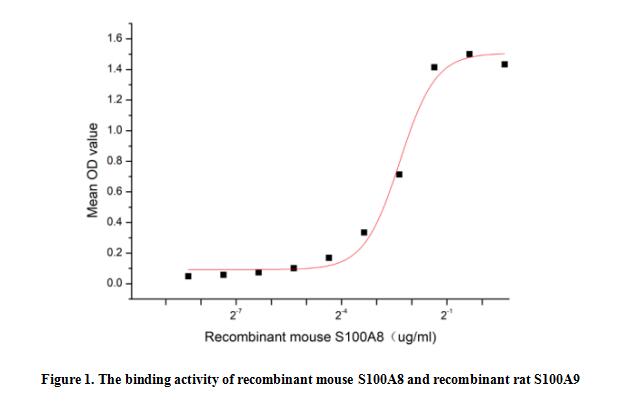 |
S100 calcium-binding protein A8 (S100A8) also known as calgranulin A, is a member of the S100 family of proteins containing 2 EF-hand calcium-binding motifs. S100 proteins are localized in the cytoplasm and/or nucleus of a wide range of cells, and involved in the regulation of a number of cellular processes such as cell cycle progression and differentiation. Besides, S100 Calcium Binding Protein A9 (S100A9) has been identified as an interactor of S100A8, thus a functional binding ELISA assay was conducted to detect the interaction of recombinant mouse S100A8 and recombinant rat S100A9. Briefly, biotin-linked S100A8 were diluted serially in PBS, with 0.01% BSA (pH 7.4). Duplicate samples of 100 ul were then transferred to S100A9-coated microtiter wells and incubated for 1h at 37℃. Wells were washed with PBST 3 times and incubation with Streptavidin-HRP for 30min, then wells were aspirated and washed 5 times. With the addition of substrate solution, wells were incubated 15-25 minutes at 37℃. Finally, add 50 µl stop solution to the wells and read at 450 nm immediately. The binding activity of recombinant mouse S100A8 and recombinant rat S100A9 was shown in Figure 1, the EC50 for this effect is 0.2 ug/mL. |
| 分子别名Alternative Names | MRP8MIF60B8AGCAGACFAGCGLACP-10L1AgNIFP8Calgranulin ACystic fibrosis antigenLeukocyte L1 complex light chainMigration inhibitory factor-related protein 8 |
|---|---|
| 背景介绍Background | S100A8 is a calcium- and zinc-binding protein which plays a prominent role in the regulation of inflammatory processes and immune response. It can induce neutrophil chemotaxis and adhesion. Predominantly found as calprotectin (S100A8/A9) which has a wide plethora of intra- and extracellular functions. The intracellular functions include: facilitating leukocyte arachidonic acid trafficking and metabolism, modulation of the tubulin-dependent cytoskeleton during migration of phagocytes and activation of the neutrophilic NADPH-oxidase. Activates NADPH-oxidase by facilitating the enzyme complex assembly at the cell membrane, transferring arachidonic acid, an essential cofactor, to the enzyme complex and S100A8 contributes to the enzyme assembly by directly binding to NCF2/P67PHOX. The extracellular functions involve proinflammatory, antimicrobial, oxidant-scavenging and apoptosis-inducing activities. Its proinflammatory activity includes recruitment of leukocytes, promotion of cytokine and chemokine production, and regulation of leukocyte adhesion and migration. Acts as an alarmin or a danger associated molecular pattern (DAMP) molecule and stimulates innate immune cells via binding to pattern recognition receptors such as Toll-like receptor 4 (TLR4) and receptor for advanced glycation endproducts (AGER). Binding to TLR4 and AGER activates the MAP-kinase and NF-kappa-B signaling pathways resulting in the amplification of the proinflammatory cascade. Has antimicrobial activity towards bacteria and fungi and exerts its antimicrobial activity probably via chelation of Zn(2+) which is essential for microbial growth. Can induce cell death via autophagy and apoptosis and this occurs through the cross-talk of mitochondria and lysosomes via reactive oxygen species (ROS) and the process involves BNIP3. Can regulate neutrophil number and apoptosis by an anti-apoptotic effect; regulates cell survival via ITGAM/ITGB and TLR4 and a signaling mechanism involving MEK-ERK. Its role as an oxidant scavenger has a protective role in preventing exaggerated tissue damage by scavenging oxidants. The iNOS-S100A8/A9 transnitrosylase complex is proposed to direct selective inflammatory stimulus-dependent S-nitrosylation of multiple targets such as GAPDH, ANXA5, EZR, MSN and VIM by recognizing a [IL]-x-C-x-x-[DE] motif; S100A8 seems to contribute to S-nitrosylation site selectivity.; (Microbial infection) Upon infection by murine coronavirus (MHV-A59), induces expansion of aberrant immature neutrophils in a TLR4-dependent manner. |
| 功能Function | S100A8 is a calcium- and zinc-binding protein which plays a prominent role in the regulation of inflammatory processes and immune response. It can induce neutrophil chemotaxis and adhesion. Predominantly found as calprotectin (S100A8/A9) which has a wide plethora of intra- and extracellular functions. The intracellular functions include: facilitating leukocyte arachidonic acid trafficking and metabolism, modulation of the tubulin-dependent cytoskeleton during migration of phagocytes and activation of the neutrophilic NADPH-oxidase. Activates NADPH-oxidase by facilitating the enzyme complex assembly at the cell membrane, transferring arachidonic acid, an essential cofactor, to the enzyme complex and S100A8 contributes to the enzyme assembly by directly binding to NCF2/P67PHOX. The extracellular functions involve proinflammatory, antimicrobial, oxidant-scavenging and apoptosis-inducing activities. Its proinflammatory activity includes recruitment of leukocytes, promotion of cytokine and chemokine production, and regulation of leukocyte adhesion and migration. Acts as an alarmin or a danger associated molecular pattern (DAMP) molecule and stimulates innate immune cells via binding to pattern recognition receptors such as Toll-like receptor 4 (TLR4) and receptor for advanced glycation endproducts (AGER). Binding to TLR4 and AGER activates the MAP-kinase and NF-kappa-B signaling pathways resulting in the amplification of the proinflammatory cascade. Has antimicrobial activity towards bacteria and fungi and exerts its antimicrobial activity probably via chelation of Zn(2+) which is essential for microbial growth. Can induce cell death via autophagy and apoptosis and this occurs through the cross-talk of mitochondria and lysosomes via reactive oxygen species (ROS) and the process involves BNIP3. Can regulate neutrophil number and apoptosis by an anti-apoptotic effect; regulates cell survival via ITGAM/ITGB and TLR4 and a signaling mechanism involving MEK-ERK. Its role as an oxidant scavenger has a protective role in preventing exaggerated tissue damage by scavenging oxidants. The iNOS-S100A8/A9 transnitrosylase complex is proposed to direct selective inflammatory stimulus-dependent S-nitrosylation of multiple targets such as GAPDH, ANXA5, EZR, MSN and VIM by recognizing a [IL]-x-C-x-x-[DE] motif; S100A8 seems to contribute to S-nitrosylation site selectivity.; (Microbial infection) Upon infection by murine coronavirus (MHV-A59), induces expansion of aberrant immature neutrophils in a TLR4-dependent manner. |
| 亚细胞定位Subcellular Location | Secreted. Cytoplasm. Cytoplasm, cytoskeleton. Cell membrane; Peripheral membrane protein. Note=Predominantly localized in the cytoplasm. Upon elevation of the intracellular calcium level, translocated from the cytoplasm to the cytoskeleton and the cell membrane. Upon neutrophil activation or endothelial adhesion of monocytes, is secreted via a microtubule-mediated, alternative pathway. |
| 数据库链接Databases |
基因功能参考文献50 条
- Specific NLRC4 activation in Mrp8 (+) cells (primarily neutrophil lineage) is sufficient to cause severe inflammatory disease. PMID: 29263322 : 29263322
- We present the reconstitution, purification, and characterization of mCP as well as the cysteine-null variant mCP-Ser. Apo mCP is a mS100A8/mS100A9 heterodimer, and Ca(II) binding causes two heterodimers to self-associate and form a heterotetramer PMID: 29659256 : 29659256
- S100A8 was required for laser-induced new collagen synthesis in skin cells. PMID: 29270708 : 29270708
- Chronic Pseudomonas aeruginosa biofilm infection reduces murine S100A8/ S100A9 expression and delays species-specific burn wound closure. PMID: 28645160 : 28645160
- data suggest that S100A8/A9 acts directly on BV-2 microglial cells via binding to TLR4 and RAGE on the membrane and then stimulates the secretion of proinflammatory cytokines through ERK and JNK-mediated NF-kappaB activity in BV-2 microglial cells. PMID: 28498464 : 28498464
- Like S100A8, S100A9 and S100A8/A9 reduced neutrophil influx in acute lung injury provoked by lipopolysaccharide (LPS) challenge. PMID: 28074060 : 28074060
- theses findings reveal unexpected gene expression differences between WT and KO mice at a young age (in the absence of physiological stress), and address the hypothesis that Mrp8 and Mrp14 accumulation promotes age-related inflammation PMID: 27224926 : 27224926
- S100A8 and S100A9 aggravate Coxsackievirus B3-induced myocarditis and might serve as therapeutic targets in inflammatory cardiomyopathies. PMID: 29158436 : 29158436
- Neutrophil-derived S100A8/A9 promotes thrombocytosis in diabetic mice PMID: 28504650 : 28504650
- Perinatal alarmins S100A8 and S100A9 specifically altered MyD88-dependent proinflammatory gene programs. S100 programming prevented hyperinflammatory responses without impairing pathogen defense. TRIF-adaptor-dependent regulatory genes remained unaffected by perinatal S100 programming and responded strongly to lipopolysaccharide, but were barely expressed. PMID: 28459433 : 28459433
- S100a8 upregulation triggers NF-kappaB signal pathway through RAGE and TLR4, in response to laser-induced dermis wound healing. PMID: 26914682 : 26914682
- Although MRP-8/-14 expression is highly increased in experimental, these proteins do not contribute to the pathogenesis in the effector phase of epidermolysis bullosa acquisita and bullous pemphigoid. PMID: 26692467 : 26692467
- TLR4, TLR2 also contributed to Mrp8-induced inflammatory response and tolerance. PMID: 26329314 : 26329314
- S100A8 appears to play a crucial role in the activation of the TLR4/MD-2 pathway and the promotion of a tumor growth-enhancing immune microenvironment. PMID: 26165843 : 26165843
- S100A8 is primarily produced from CXCR2-expressing CD11b(+)Gr-1(high) cells, and it upregulates TNF-alpha production in CD11b(+)F4/80(+) cells through cellular cross-talk, which is an important mechanism in the development of Nonalcoholic fatty liver disease PMID: 26608915 : 26608915
- Alarmins S100A8/S100A9 aggravate osteophyte formation in experimental osteoarthritis and predict osteophyte progression in early human symptomatic osteoarthritis. PMID: 25180294 : 25180294
- Inflammation-induced S100A8 promotes colorectal tumorigenesis by acting upstream to activate the Akt1-Smad5-Id3 axis. PMID: 26135667 : 26135667
- Data shows that S100A8/A9 plays a critical role during glomerulonephritis, exerting and amplifying autocrine and paracrine proinflammatory effects on bone marrow-derived macrophages, renal endothelial cells, and mesangial cells. PMID: 25759267 : 25759267
- S100A8 could be a chemokine of oocyte origin, which attracts ovarian somatic cells to form the primordial follicles. PMID: 25953201 : 25953201
- expression of S100A8 in the lungs may facilitate recruitment of MDSC, which may in turn aid in establishing a metastatic niche capable of suppressing a localized immune response. PMID: 25255046 : 25255046
- This paper found a novel activation mechanism of NK cells via S100A8/A9-RAGE signaling, which may open a novel perspective on the in vivo interaction between inflammation and innate immunity. PMID: 25911757 : 25911757
- data suggest that S100A8 exerts pro-inflammatory effect on the occurrence and development of neuro-inflammation and postoperative cognitive dysfunction by activating TLR4/MyD88 signaling in the early pathological process of the postoperative stage. PMID: 25449673 : 25449673
- S100A8 and S100A9 initiate the early inflammatory program in injured peripheral nerves PMID: 25792748 : 25792748
- Time-lapse intravital multiphoton imaging of adipose tissues identified the very early event exhibiting increased mobility of macrophages, which may be triggered by increased expression of adipose S100A8. PMID: 25848057 : 25848057
- Myocardial gene and protein expression of S100A8 was also significantly increased in mice 1 day after debanding that had been preceded by 3 days or 1 week of transverse aortic constriction. PMID: 25820336 : 25820336
- THC-induced myeloid-derived suppressor cells secreted elevated levels of S100A8. Neutralization of S100A8 in vivo reduced the ability of THC to trigger MDSCs. High S100A8 expression also promoted their suppressive function. PMID: 25713087 : 25713087
- Calprotectin heterodimer of subunits S100A8 (and S100A9 ) is detectable within 6 h of infection as immune cells respond to the invading pathogen. PMID: 23754577 : 23754577
- Myeloid-related proteins 8 and 14 contribute to monosodium urate monohydrate crystal-induced inflammation in gout. PMID: 24470119 : 24470119
- S100A8/A9 expression in the skin epidermal layer has a role in controlling skin tumor formation PMID: 24436096 : 24436096
- Data indicate that angiotensin II infusioni increased expression of S100a8/a9 in the heart. PMID: 24711518 : 24711518
- S100a8 and S100a9, associated with immune responses, were common differentially expressed genes in a mouse model of hereditary hemochromatosis. PMID: 24338419 : 24338419
- These results suggest that S100A8 alarmin is sufficient, but not necessary, to induce polymorphonuclear neutrophil migration during vulvovaginal candidiasis and this responseinvolves pattern recognition receptors. PMID: 24478092 : 24478092
- depletion increased Pseudomonas aeruginosa burden in flagellin-pretreated corneas PMID: 23340821 : 23340821
- These results suggest that rapid secretion of MRPs by neutrophils at the site of infection may protect uninfected macrophages and favor a more efficient innate inflammatory response against Leishmania infection. PMID: 24086787 : 24086787
- High levels of S100A8/A9 proteins aggravate ventilator-induced lung injury via TLR4 signaling. PMID: 23874727 : 23874727
- S100A8 and ephrin-A1 contribute to lung metastasis. PMID: 24103748 : 24103748
- Our study demonstrated a dual role for MRP8/14 in bacterial keratitis. PMID: 23299480 : 23299480
- results identify MRP8/14 as key player in protective innate immunity during Klebsiella pneumonia PMID: 23133376 : 23133376
- Mrp8, the active component of the heterocomplex, inhibits early dendritic cells (DCs) maturation and antigen presentation in a TLR-4-dependent manner. PMID: 23188082 : 23188082
- S100A8 and S100A9 proteins are crucially involved in synovial activation and cartilage destruction during osteoarthritis. PMID: 22143922 : 22143922
- S100A8 and S100A9 were specifically induced by LPS in the salivary glands. PMID: 21125321 : 21125321
- sustained activation of S100A8/A9 critically contributes to the development of post-ischemic heart failure (HF) driving the progressive course of HF through activation of RAGE. PMID: 22318783 : 22318783
- Targeted imaging with myeloid-related protein 8/14 via gadolinium immunonanoparticles demonstrates enhancement of plaque with binding to inflammatory cells and reduction in inflammation. PMID: 22308043 : 22308043
- S100a8, without S100a9, has a previously unrecognized role in embryo development. S100a8 also has a second role in the maternal deciduum, where expression is associated with the vasculature from the E8.5 stage to the formation of mature placenta. PMID: 22016186 : 22016186
- The calcium-binding proteins myeloid-related protein (MRP)-8 (S100A8) and MRP-14 (S100A9) form MRP-8/14 heterodimers (S100A8/A9, calprotectin) that regulate myeloid cell function and inflammatory responses in graft rejectionl PMID: 22144572 : 22144572
- Rab30 and S100a8/S100a9 were indicated to play roles in the initiation of liver regeneration as well as possibly in the functional switch of the liver in the newborn stage. PMID: 21308349 : 21308349
- These results thus reveal a novel role for myeloid-derived S100A8/A9 in activating specific downstream genes associated with tumorigenesis and in promoting tumor growth and metastasis. PMID: 21228116 : 21228116
- These results demonstrate that S100A8 stimulated osteoclast formation and activity and suggest that both S100A8 and TLR-4 are important factors in mediating osteoclastic bone destruction in experimental arthritis. PMID: 21337316 : 21337316
- The results may provide important information for the expression of s100a8/a9 and RAGE, linking progressive cystogenesis with inflammation in cystic kidney. PMID: 20606421 : 20606421
- Chondrocyte derived S100A8 and S100A9 may have a sustained role in cartilage degradation in inflammatory arthritis PMID: 20105291 : 20105291
蛋白复溶体积计算器缓冲液体积 = 蛋白质量 ÷ 蛋白浓度
输入任意两项,第三项自动计算 |
蛋白浓度稀释计算器初浓度 × 初体积 = 终浓度 × 终体积
输入任意三项,第四项自动计算 |



