


| 纯度Purity | Greater than 90% as determined by reducing SDS-PAGE. |
|---|---|
| 内毒素Endotoxin | Please contact with the lab for this information |
| 蛋白构建Protein Construction |
【Ile25-Ser647】序列区间
|
| Accession | P23780 |
| 表达宿主Expression Host | 293F |
| 种属Species | Mus musculus (Mouse) |
| 预测分子量Predicted MW | 72.2 kDa |
| 制剂Formulation | Lyophilized from a 0.2 μm filtered solution of PBS, pH7.4, containing 0.01% SKL, 1mM DTT, 5% Trehalose and Proclin300. |
| 运输方式Shipping | The product is shipped with ice bag. Upon receipt, store it immediately at the temperature listed below. |
| 稳定性&储存Stability & Storage | 12 months at -20°C to -80°C in lyophilized state.6 months at -20°C to -80°C under sterile conditions after reconstitution.7-10 days at 2°C to 8°C under sterile conditions after reconstitution.Please minimize freeze-thaw cycles. |
| 复溶Reconstitution | Reconstitute in 10mM PBS (pH7.4) to a concentration of 0.1-1.0 mg/mL. Do not vortex. |
 |
Greater than 90% as determined by reducing SDS-PAGE. |
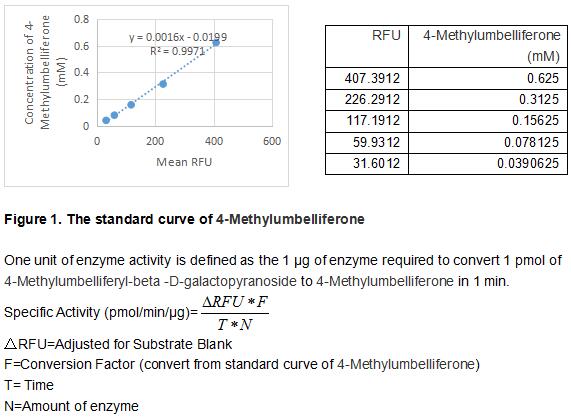 |
GLB1 is a lysosomal beta -galactosidase that hydrolyzes the terminal beta -galactose from ganglioside and keratan sulfate. Defects in this gene are the causes of lysosomal storage diseases for GM1-gangliosidosis and Morquio B syndrome (also known as mucopolysaccharidosis IVB). In GM1 gangliosidosis, GM1 ganglioside accumulates in the neurons of the central nervous system, because of the deficiency of lysosomal beta -galactosidase activity. GM1 gangliosidosis demonstrates varying degrees of clinical severity but is invariably fatal, and children with the most common and severe form of GM1 gangliosidosis usually die within 3 years of birth. Morquio B syndrome patients are neurologically normal, but display severe skeletal dysostosis multiplex because of an accumulation of keratan sulfate. The activity assay of GLB1 was measured by its ability to cleave a peptide substrate, 4-Methylumbelliferyl-beta -D-galactopyranoside. The reaction was performed in 50 mM Sodium Citrate, pH 3.5 ( Assay Buffer), ainitiated by addition 50 μL of 1.5 ug/ml uPA (diluted by Assay Buffer) to 50 µL of 1.2 mM Substrate. Read at excitation and emission wavelengths of 365 nm and 445 nm (top read), respectively, in kinetic mode for 5 minutes. The specific activity of recombinant mouse GLB1 is >17000 pmol/min/µg. |
| 分子别名Alternative Names | GL-Bb-GALbGALELNR1EBPGLB1LactaseElastin Receptor 1,67kDaElastin Receptor 1(67kD)Acid Beta-Galactosidase |
|---|---|
| 背景介绍Background | Cleaves beta-linked terminal galactosyl residues from gangliosides, glycoproteins, and glycosaminoglycans. |
| 功能Function | Cleaves beta-linked terminal galactosyl residues from gangliosides, glycoproteins, and glycosaminoglycans. |
| 亚细胞定位Subcellular Location | Lysosome. |
| 数据库链接Databases |
基因功能参考文献7 条
- A significant proportion of p16Ink4a/senescence-associated beta-galactosidase-positive cells accumulating in aging mice are macrophages that acquired this phenotype as part of their physiological reprogramming towards an M2-like phenotype. PMID: 28768895 : 28768895
- Senescence-associated-beta-gal activity in neurons cannot be attributed uniquely to cell senescence either in vitro or in vivo. PMID: 27768595 : 27768595
- beta-gal is present in the pro-urine from where it is thought to stimulate TRPV5 activity. PMID: 26747426 : 26747426
- This study shows that moderate widespread expression of betagal in the CNS of GM1 gangliosidosis mice is sufficient to achieve significant biochemical impact with phenotypic amelioration and extension in lifespan PMID: 25964428 : 25964428
- Senescence-associated beta-galactosidase is present in apical vacuoles of visceral endoderm in developing mouse embryos. PMID: 24616249 : 24616249
- We show here that mouse GLB1 has greater stability when compared to human GLB1, and that human GLB1 activity is temperature and protective-dependent on protein cathepsin A, while that of mouse GLB1 is not PMID: 22001501 : 22001501
- This protein was used as a biological marker of cell lineage, cell differentiation, and cell movement in the mouse cerebellum. PMID: 12781679 : 12781679
蛋白复溶体积计算器缓冲液体积 = 蛋白质量 ÷ 蛋白浓度
输入任意两项,第三项自动计算 |
蛋白浓度稀释计算器初浓度 × 初体积 = 终浓度 × 终体积
输入任意三项,第四项自动计算 |



