


| 纯度Purity | Greater than 90% as determined by reducing SDS-PAGE. |
|---|---|
| 内毒素Endotoxin | Please contact with the lab for this information |
| 蛋白构建Protein Construction |
【Gly21-Phe433】序列区间
|
| Accession | P06869 |
| 表达宿主Expression Host | 293F |
| 种属Species | Mus musculus (Mouse) |
| 预测分子量Predicted MW | 48.3 kDa |
| 制剂Formulation | Lyophilized from a 0.2 μm filtered solution of PBS, pH7.4, containing 0.01% SKL, 1mM DTT, 5% Trehalose and Proclin300. |
| 运输方式Shipping | The product is shipped with ice bag. Upon receipt, store it immediately at the temperature listed below. |
| 稳定性&储存Stability & Storage | 12 months at -20°C to -80°C in lyophilized state.6 months at -20°C to -80°C under sterile conditions after reconstitution.7-10 days at 2°C to 8°C under sterile conditions after reconstitution.Please minimize freeze-thaw cycles. |
| 复溶Reconstitution | Reconstitute in 10mM PBS (pH7.4) to a concentration of 0.1-1.0 mg/mL. Do not vortex. |
 |
Greater than 90% as determined by reducing SDS-PAGE. |
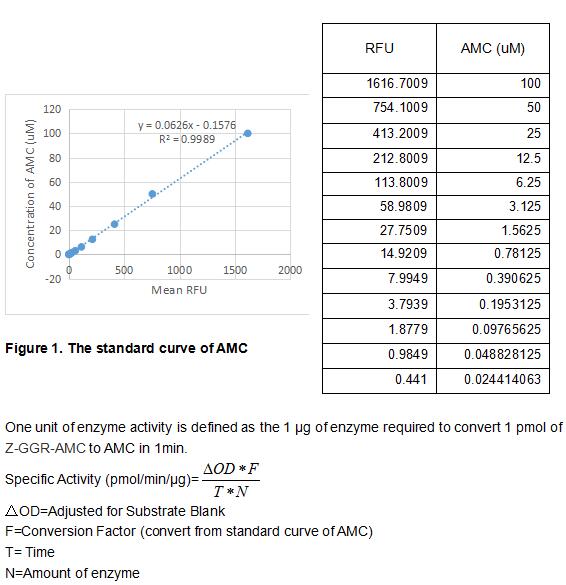 |
Urokinase Plasminogen Activator (uPA), also known as u-plasminogen activator or urokinase, is a highly-specific serine protease from the peptidase S1 family that cleaves plasminogen to form plasmin making it a key player in the plasminogen activator (PA) system. Expression of uPA is minimal in normal cells but is increased several fold in tumor cells by extracellular stimuli elevated in cancer and corresponds to poor outcomes in several types of cancer. Therefore, uPA has been identified as an excellent target for therapeutic development through inhibition of protease activity or though inhibition of uPA-dependent signaling while in complex with uPA receptor (uPAR). The activity assay of uPA was measured by its ability to cleave a peptide substrate, N-carbobenzyloxy-Gly-Gly-Arg-7-amido-4-methylcoumarin (Z-GGR-AMC). The reaction was performed in 50 mM Tris, 0.01% Tween-20, pH 8.5 ( Assay Buffer), ainitiated by addition 50 μL of 1.5 ug/ml uPA (diluted by Assay Buffer) to 50 µL of 200 uM Substrate. Read at excitation and emission wavelengths of 380 nm and 460 nm (top read), respectively, in kinetic mode for 5 minutes. The specific activity of recombinant mouse uPA is >2000 pmol/min/µg. |
| 分子别名Alternative Names | PLAUATFURKUKUP-AAbbokinaseUrokinase-Type Plasminogen Activator |
|---|---|
| 背景介绍Background | Specifically cleaves the zymogen plasminogen to form the active enzyme plasmin. |
| 功能Function | Specifically cleaves the zymogen plasminogen to form the active enzyme plasmin. |
| 亚细胞定位Subcellular Location | Secreted. |
| 数据库链接Databases |
基因功能参考文献50 条
- downregulation of uPA could decrease the fertility of male mice, which may be caused by a reduction in sperm motility. PMID: 28298247 : 28298247
- data presented here reveal important information about dynamics in uPA by demonstrating how various ligands can modulate uPA activity by mediating long-range conformational changes PMID: 29420634 : 29420634
- Lymphangioleiomyomatosis is fatal lung disease associated with germline/somatic inactivating mutations in TSC2 genes. Data suggest lung lymphangioleiomyomatosis lesions and renal angiomyolipomas overexpress uPA; Tsc2-/- (or Tsc1-/-) embryonic fibroblasts from knockout mice express higher uPA levels than wild-type cells. (uPA = urokinase-type plasminogen activator; Tsc = tuberous sclerosis complex protein) PMID: 28972182 : 28972182
- The findings suggest that the absence of uPA correlates with increased levels of Runx transcriptional regulators in a way that promotes inflammation-associated carcinogenesis. PMID: 29107070 : 29107070
- an intricate link between caveolin-1 and Src kinase-mediated cell signaling and alveolar epithelial cell apoptosis due to loss of SP-C expression through p53 and uPA system-mediated cross-talk, is reported. PMID: 28385810 : 28385810
- These studies identify uPA-dependent de-repression of vegfr1 and vegfr2 gene transcription through binding to HHEX/PRH as a novel mechanism by which uPA mediates the pro-angiogenic effects of VEGF and identifies a potential new target for control of pathologic angiogenesis. PMID: 27151212 : 27151212
- Significance of the urokinase-type plasminogen activator and its receptor in the progression of focal segmental glomerulosclerosis in clinical and mouse models. PMID: 26846181 : 26846181
- GM-CSF and uPA are required for Porphyromonas gingivalis-induced alveolar bone loss in a mouse periodontitis model. PMID: 25753270 : 25753270
- Plau deficiency does not worsen controlled cortical impact-induced brain pathology or epileptogenesis caused by TBI. PMID: 26253597 : 26253597
- we have firstly shown a fundamental mechanism of urokinase system(uPa and uPAR)-dependent regulation of the trajectory of growth and branching of blood vessels in early embryogenesis and in adults during the repair/regeneration of tissues. PMID: 26863767 : 26863767
- Pharmacological inhibition of either uPA or selected MMPs decreased atherosclerosis in transgenic uPA mice. PMID: 25616415 : 25616415
- Porphyromonas gingivalis-derived RgpA-Kgp complex activates the macrophage uPA. PMID: 25979345 : 25979345
- transgenic alphaMUPA mice, with genetically extended life span, showed a much slower age-related decline in the rate of wound healing than their wild-type counterparts PMID: 25960543 : 25960543
- Binding of urokinase to urokinase plasminogen activator receptor promotes dendritic spine recovery and functional outcome after ischemic stroke. PMID: 25339736 : 25339736
- our results suggest a role for uPA and uPAR in experimental autoimmune encephalomyelitis pathogenesis PMID: 24120085 : 24120085
- Urokinase plasminogen activator is a central regulator of macrophage three-dimensional invasion, matrix degradation, and adhesion. PMID: 24616477 : 24616477
- SERPINE2 and PLAU are involved in cumulus expansion and oocyte maturation. PMID: 24023701 : 24023701
- Data suggest urokinase-type plasminogen activator (uPA) is involved in susceptibility/resistance to Group A streptococcal infection (GAS); mice expressing human plasminogen transgene are more susceptible to invasive GAS than uPA knockout mice. PMID: 23853591 : 23853591
- Mice deficient in urokinase-type plasminogen activator have delayed healing of tympanic membrane perforations. PMID: 23236466 : 23236466
- PLAU is particularly important for memory Tregs and PLAU mediates Treg suppressor function via STAT5 and ERK signaling pathways. PMID: 23169000 : 23169000
- The data showed that myeloid-derived suppressor cell accumulation is tumor burden-dependent, and that tumor-derived factors such as plasminogen activator urokinase and its receptor play a role in their recruitment. PMID: 23060546 : 23060546
- The study establishes the 37- and 70-loops as a unique site for binding to compounds stabilizing the active state of serine proteases. PMID: 22950516 : 22950516
- Over-expression of uPA plays a synergistic role in the development of liver injury, inflammation and regeneration during acute HBV infection PMID: 22563169 : 22563169
- Data presented here suggest that MMP-9 is secreted as a multiprotein complex by T. gondii infected macrophages, similar to that observed in metastatic cells. PMID: 22177333 : 22177333
- u-PA and plasminogen are essential for the phagocytosis of cellular debris by macrophages during liver repair PMID: 22318286 : 22318286
- Expression of ALDH1A2, BEX2, EGR2, CCL3 and PLAU are upregulated in Toxoplasma gondiisusceptible C57BL/6 mice. PMID: 22451728 : 22451728
- suggest that uPA promotes cell migration by binding to fibulin-5, initiating its cleavage by plasmin, which leads to its dissociation from beta1-integrin and thereby unblocks the capacity of integrin to facilitate cell motility PMID: 22280367 : 22280367
- The uPA-uPAR axis has no effect on the formation of Ang II-induced abdominal aortic aneurysms, but uPA deficiency promotes aneurysmal rupture. PMID: 21868698 : 21868698
- Urokinase type plasminogen activator, at concentrations found under pathological conditions, reduced pulmonary arterial contractility and increased permeability though the activation of NMDA-R1. PMID: 21617202 : 21617202
- uPA acts in a cell signaling manner via binding to its receptor uPAR rather than as a protease. PMID: 21573723 : 21573723
- contributes to heterogeneity of macrophages at the border of damaged site during liver repair PMID: 21301782 : 21301782
- mechanisms of uPA/uPAR/plasminogen-accelerated atherosclerosis and aneurysm formation PMID: 21536666 : 21536666
- The interaction of sM6P/IGF2R with Plg may be an important regulatory mechanism to inhibit migration of cells using the uPA/uPAR system. PMID: 21273553 : 21273553
- We propose that u-PA has a protective role in arthritis models with 'wound healing-like' processes following local trauma PMID: 20973954 : 20973954
- Early experimental venous thrombus resolution is independent of uPA. PMID: 20886179 : 20886179
- study investigated whether host uPA is a crucial protagonist for the TIMP-1-induced modulation of a pro-metastatic microenvironment in the liver PMID: 19863693 : 19863693
- uPA/uPAR downregulation suppresses angiogenesis in endothelial cells induced by glioblastoma cell lines PMID: 20805979 : 20805979
- Selective abrogation of the uPA-uPAR interaction is associated with suppression of fibrin-associated inflammation. PMID: 20466854 : 20466854
- u-PA is required for the full development of systemic arthritis models involving immune complex formation and deposition. PMID: 20196869 : 20196869
- uPA plays a critical role in BV-2 microglial cell migration by activating pro-MMP-9, in part by its direct action on MMP-9 and also in part by the activation of plasminogen/plasmin cascade. PMID: 20177776 : 20177776
- uPA deficiency can unfavorably modulate both delayed neurodegeneration and neurogenesis but has little effect on post-injury neuronal migration and vascular density. Elevated uPA during the post-injury phase is neuroprotective. PMID: 20026272 : 20026272
- MAPK pathways ERK, JNK/SAPK, and P38-MAPK represent a significant component in the regulation of u-PA expression in human prostate cancer. PMID: 11676474 : 11676474
- During infection with Cryptococcus neoformans, mice genetically deficient in uPA have a decreased number of recruited effector T cells in the lung, fail to generate a protective T1 profile of cytokines, and display impaired antifungal activity. PMID: 11777975 : 11777975
- u-PA-/- mice developed significantly milder disease compared with the relevant wild-type mice PMID: 11891190 : 11891190
- fibrinolysis by uPA-dependent plasmin activity plays a fundamental role in skeletal muscle regeneration PMID: 11929773 : 11929773
- that u-PA plays important roles in liver regeneration after hepatectomy through control of a transcription factor, c-jun expression. PMID: 11983447 : 11983447
- the role of urokinase in the regulation of monocyte/macrophage functions, such as that occurring in inflammatory reactions PMID: 12183060 : 12183060
- uPA regulated by heregulin in mouse neoplasms PMID: 12209601 : 12209601
- inducible expression reduces fibrosis and mortality after lung injury in mice PMID: 12376355 : 12376355
- These results suggest that increasing uPA expression by an appropriate combination of growth factors and ECM components constitutes a possible approach to improving the migration of myogenic cells after transplantation. PMID: 12413883 : 12413883
蛋白复溶体积计算器缓冲液体积 = 蛋白质量 ÷ 蛋白浓度
输入任意两项,第三项自动计算 |
蛋白浓度稀释计算器初浓度 × 初体积 = 终浓度 × 终体积
输入任意三项,第四项自动计算 |



