


| 纯度Purity | Greater than 90% as determined by reducing SDS-PAGE. |
|---|---|
| 内毒素Endotoxin | Please contact with the lab for this information |
| 蛋白构建Protein Construction |
【Glu55-His206】序列区间
|
| Accession | P09920 |
| 表达宿主Expression Host | 293F |
| 种属Species | Mus musculus (Mouse) |
| 预测分子量Predicted MW | 47.3 kDa |
| 制剂Formulation | Lyophilized from a 0.2 μm filtered solution of PBS, pH7.4, containing 0.01% SKL, 1mM DTT, 5% Trehalose and Proclin300. |
| 运输方式Shipping | The product is shipped with ice bag. Upon receipt, store it immediately at the temperature listed below. |
| 稳定性&储存Stability & Storage | 12 months at -20°C to -80°C in lyophilized state.6 months at -20°C to -80°C under sterile conditions after reconstitution.7-10 days at 2°C to 8°C under sterile conditions after reconstitution.Please minimize freeze-thaw cycles. |
| 复溶Reconstitution | Reconstitute in 10mM PBS (pH7.4) to a concentration of 0.1-1.0 mg/mL. Do not vortex. |
 |
Greater than 90% as determined by reducing SDS-PAGE. |
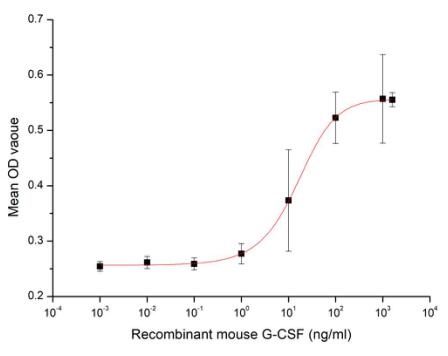 |
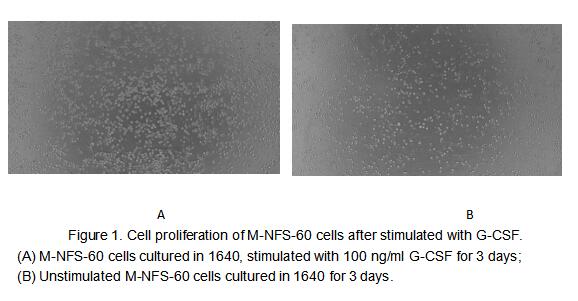
G-CSF is a pleiotropic cytokine best known for its specific effects on the proliferation, differentiation, and activation of hematopoietic cells of the neutrophilic granulocyte lineage. It is produced mainly by monocytes and macrophages upon activation by endotoxin, TNF-alpha and IFN-gamma. In addition, various carcinoma cell lines and myeloblastic leukemia cells can express G-CSF constitutively. In vitro, G-CSF stimulates growth, differentiation and functions of cells from the neutrophil lineage. Consistent with its in vitro functions, G-CSF has been found to play important roles in defense against infection, in inflammation and repair, and in the maintenance of steady state hematopoiesis. The activity of G-CSF is usually measured by a cell proliferation assay using M-NFS 60 mouse myelogenous leukemia lymphoblast cells. M-NFS 60 cells were seeded into triplicate wells of 96-well plates at a density of 8,000 cells/well with 2% serum standard 1640 which contains various concentrations of recombinant mouse G-CSF. After incubated for 3 days, cells were observed by inverted microscope and cell proliferation was measured by Cell Counting Kit-8 (CCK-8). Briefly, 10 µl of CCK-8 solution was added to each well of the plate, then the absorbance at 450 nm was measured using a microplate reader after incubating the plate for 2-4 hours at 37 ℃. Proliferation of M-NFS-60 cells after incubation with G-CSF for 3 days observed by inverted microscope was shown in Figure 1. Cell viability was assessed by CCK-8 (Cell Counting Kit-8 ) assay after incubation with recombinant mouse G-CSF for 3 days. The result was shown in Figure 2. It was obvious that G-CSF significantly increased cell viability of M-NFS-60 cells. The EC50 is 15.8-41 ng/ml. Figure 2. Cell proliferation of M-NFS-60 cells after stimulated with G-CSF. |
 |
| 分子别名Alternative Names | CSF3G-CSFGranulocyte Colony Stimulating FactorPluripoietinFilgrastimLenograstim |
|---|---|
| 背景介绍Background | Granulocyte/macrophage colony-stimulating factors are cytokines that act in hematopoiesis by controlling the production, differentiation, and function of 2 related white cell populations of the blood, the granulocytes and the monocytes-macrophages. This CSF induces granulocytes. |
| 功能Function | Granulocyte/macrophage colony-stimulating factors are cytokines that act in hematopoiesis by controlling the production, differentiation, and function of 2 related white cell populations of the blood, the granulocytes and the monocytes-macrophages. This CSF induces granulocytes. |
| 亚细胞定位Subcellular Location | Secreted. |
| 数据库链接Databases |
基因功能参考文献50 条
- We confirmed that acute lung injury was associated with high serum G-CSF levels, and elevated neutrophil elastase activity in the lungs and serum of mice with adenine-induced acute kidney injury (AKI). G-CSF could be a target for new anti-lung injury strategy in patients with AKI. PMID: 30056257 : 30056257
- The opposing roles of G-CSF and IFNgamma in regulation of innate inflammatory responses in a murine viral encephalitis model reveal G-CSF as a potential therapeutic target. PMID: 29352287 : 29352287
- central regulator of the transition to postinflammatory chronic visceral pain PMID: 28973941 : 28973941
- We propose that in aggressive pancreatic ductal adenocarcinoma , elevated G-CSF contributes to tumor progression through promoting increases in infiltration of neutrophil-like cells with high immunosuppressive activity. Such a mechanism provides an avenue for a neoadjuvant therapeutic approach for this devastating disease PMID: 28775207 : 28775207
- these data provide strong evidence for a role for G-CSF in the development of ACI after burn injury through suppression of EPO signaling in bone marrow erythroid cells. PMID: 28867537 : 28867537
- physiologically produced G-CSF not only acts as a neutrophil mobilizer at the relatively late stage of acute inflammation, but also prevents exaggerated neutrophil mobilization. PMID: 27551153 : 27551153
- data demonstrate that G-CSF is a pivotal driver of the disease progression in the K/BxN serum-transfer arthritis (STA) model and possibly acts in part by regulating neutrophil numbers in the circulation PMID: 26848119 : 26848119
- SB203580 increases G-CSF expression in macrophages by increasing the stability of G-CSF mRNA via its 3'UTR, and the effect was not due to its inhibition of p38 MAPK activity. PMID: 26772539 : 26772539
- Results suggested that G-CSF plays an important role in preventing colitis, likely through populating immune regulatory macrophages in the intestine. PMID: 26687628 : 26687628
- findings provide convincing evidence that monophosphoryl lipid A-induced G-CSF facilitates early expansion, mobilization, and recruitment of neutrophils to the site of infection after burn injury PMID: 26538529 : 26538529
- Overexpression of VEGF may compensate for the G-CSF deficit through preservation of cellular components, including blood vessels, in the postinfarction heart. PMID: 25976246 : 25976246
- rapidly induces autophagy after spinal cord injury to inhibit neuronal apoptosis PMID: 26524416 : 26524416
- G-CSF supports long-term muscle regeneration in mouse models of muscular dystrophy. PMID: 25865621 : 25865621
- constitutive activation of the NF-kappaB pathway in CAIX-depleted cells restored G-CSF secretion PMID: 25623234 : 25623234
- Exposure of Sca-1(+) cells to G-CSF in the culture medium for 72 h induced time-dependent but self-limiting cell cycle acceleration with a restricted effect on the CSC proliferation. PMID: 25160782 : 25160782
- these results suggest that the G-CSF pathway regulates the production of autoantibodies in murine models of lupus. PMID: 23566364 : 23566364
- G-CSF acts in a cell intrinsic manner to expand multipotent progenitors to increase production of tumor-derived Ly6G+ neutrophils. PMID: 25624500 : 25624500
- Endothelial cell(EC)-intrinsic MYD88 signaling and subsequent G-CSF production by ECs is required for myeloid progenitor lineage skewing toward granulocyte-macrophage progenitors, increased colony-forming unit granulocyte activity. PMID: 24990886 : 24990886
- Adventitial CXCL1/granulocyte-colony stimulating factor expression in response to aortic dissection triggers local neutrophil recruitment and activation. This leads to adventitial inflammation via IL-6 and results in aortic expansion and rupture. PMID: 25563839 : 25563839
- Cultured mouse enteric nervous system -neurospheres show increased expansion with increased G-CSF concentrations, in contrast to central nervous system - derived spheres. PMID: 24253464 : 24253464
- G-CSF STAT3 axis constitutes a key protective mechanism induced by injury to reduce the risk for posttraumatic infection. PMID: 24470495 : 24470495
- After deletion of Pten in mice lacking G-CSF, the splenomegaly, myeloproliferative disease, and splenic hematopoietic stem cell accumulation are rescued. PMID: 24127490 : 24127490
- Our results suggest 5-AED survival enhancement is G-CSF-dependent, and that it stimulates innate immune cell function and reduces radiation-induced DNA damage via induction of genes that modulate cell cycle progression and apoptosis. PMID: 22843381 : 22843381
- activation of the RAS/MEK/ERK pathway regulates G-CSF expression through the Ets transcription factor PMID: 23530240 : 23530240
- G-CSF protein is necessary and sufficient to restore monocyte chemoattractant protein (MCP)-1 deficiency in neutrophil-mediated host immunity following Klebsiella pneumoniae lung infection. PMID: 23129755 : 23129755
- Ang2 deficiency results in enhanced recruitment of myeloid cells depending on G-CSF, and that the enhancement results in more aggressive tumor growth and neo-angiogenesis during liver colonization. PMID: 22699974 : 22699974
- Il-1rn knockout mice exhibit delayed resolution in acute lung inflammation after exposure to lipopolysaccharide, a process that appears to be mediated via the granulocyte colony-stimulating factor/IL-17A axis. PMID: 22592923 : 22592923
- Induction of Bv8 expression by granulocyte colony-stimulating factor in CD11b+Gr1+ cells: key role of Stat3 signaling. PMID: 22528488 : 22528488
- BMMCs and G-CSF co-administration exhibits synergistic beneficial effect over time. PMID: 21699735 : 21699735
- granulocyte and macrophage populations of murine bone marrow cells are regulated by G-CSF and CD137 protein PMID: 21179444 : 21179444
- TLR2 signaling in G-CSF mobilized PBSCs correlates with their ability to rapidly differentiate into myeloid cells, resulting in improved engraftment PMID: 21239180 : 21239180
- G-CSF is crucial for skeletal myocyte development and regeneration PMID: 21422169 : 21422169
- G-CSF and IL-6 provide signals that determine the angiogenic potential of BM resident monocytes. PMID: 20354107 : 20354107
- G-CSF stimulates the expression of the MIP-2 receptor via STAT3-dependent transcriptional activation of Il8rb PMID: 20185584 : 20185584
- G-CSF exerts potent anti-apoptotic activities towards motoneurons in vivo and suggests that the protection offered by G-CSF in ALS mouse models is due to its direct neuroprotective activity PMID: 20178614 : 20178614
- Overexpression of STAT3beta did not alter the kinetics of G-CSF-mediated neutrophilic differentiation or p27 induction in 32D/G-CSF-R WT cells. PMID: 11920194 : 11920194
- Increased production of G-CSF in mice mounting the acute phase response is a key physiological component of host defense. PMID: 12097396 : 12097396
- Evaluation of role of G-CSF in the production, survival, and release of neutrophils from bone marrow into circulation using G-CSF-deficient mice PMID: 12130495 : 12130495
- G-CSF induces neutrophil mobilization indirectly through the generation of trans-acting signals PMID: 12387736 : 12387736
- G-CSF mediates granulopoiesis and, as a corollary, participates in neutrophilia in LFA-1 deficient mice. PMID: 12734371 : 12734371
- regulation of G-CSF levels may provide a mechanism for directing primitive hematopoietic progenitors into the common myeloid lineage in response to environmental stresses PMID: 12893769 : 12893769
- G-CSF treatment leads to Lyn-mediated tyrosine phosphorylation of Gab2, which may serve as an important intermediate of enhanced Akt activity and myeloid differentiation, not growth/survival response. PMID: 14656892 : 14656892
- G-CSF signaling in neutrophils is negatively regulated by SOCS3 PMID: 14699146 : 14699146
- observations show that lipocalin 24p3 is not involved in the granulocyte-colony stimulating factor withdrawal-induced apoptosis PMID: 14703690 : 14703690
- critical role for G-CSF in driving joint inflammation and as a potential therapeutic target in inflammatory joint diseases, such as rheumatoid arthritis. PMID: 15272075 : 15272075
- G-CSF induces stabilization of Fli-1 protein in myeloid cells PMID: 15557108 : 15557108
- G-CSF treatment significantly improved survival and liver histology in chemically injured mice, predominantly by promoting endogenous repair mechanisms; immunohistochemistry showed a higher percentage of bone marrow-origin hepatocytes PMID: 15661404 : 15661404
- Febrile-range hyperthermia-induced expression of G-CSF drives the sustained peripheral neutrophilia that occurs during sustained (36 h) hyperthermia in a conscious temperature-clamped mouse model. PMID: 15829718 : 15829718
- G-CSF modulates angiogenesis by increasing myelomonocytic cells (VEGFR1+ neutrophils) and their release of VEGF PMID: 16223785 : 16223785
- monocytes mobilized into the blood by G-CSF or AMD3100 stimulate angiogenesis at sites of ischemia through a paracrine mechanism PMID: 16735597 : 16735597
蛋白复溶体积计算器缓冲液体积 = 蛋白质量 ÷ 蛋白浓度
输入任意两项,第三项自动计算 |
蛋白浓度稀释计算器初浓度 × 初体积 = 终浓度 × 终体积
输入任意三项,第四项自动计算 |



