


Recombinant Human ANGPTL3 (C-Fc)
Alternative NamesAngiopoietin-related protein 3; ANGPTL3; Angiopoietin-5; ANG-5; Angiopoietin-like protein 3; ANGPT5
规格参数 Specifications
| 纯度Purity | Greater than 95% as determined by reducing SDS-PAGE |
|---|---|
| 内毒素Endotoxin | <1 EU/µg as determined by LAL test. |
| 蛋白构建Protein Construction |
【Ser17-Pro220】序列区间-FcC 端标签
|
| Accession | Q9Y5C1 |
| 表达宿主Expression Host | HEK293 |
| 种属Species | Human |
| 预测分子量Predicted MW | 50.7 kDa |
| 制剂Formulation | Lyophilized from a 0.2 μm filtered solution of PBS, 5% Trehalose, pH 7.4. |
| 运输方式Shipping | The product is shipped with ice bag. Upon receipt, store it immediately at the temperature listed below. |
| 稳定性&储存Stability & Storage | 12 months at -20°C to -80°C in lyophilized state.6 months at -20°C to -80°C under sterile conditions after reconstitution.7-10 days at 2°C to 8°C under sterile conditions after reconstitution.Please minimize freeze-thaw cycles. |
| 复溶Reconstitution | Always centrifuge tubes before opening. Do not mix by vortex or pipetting. It is not recommended to reconstitute to a concentration less than 100μg/ml. Dissolve the lyophilized protein in distilled water. Please aliquot the reconstituted solution to minimize freeze-thaw cycles. |
!
本司产品仅用于科研,不用于临床诊断和治疗。
产品图片 Product Images点击图片可查看原图
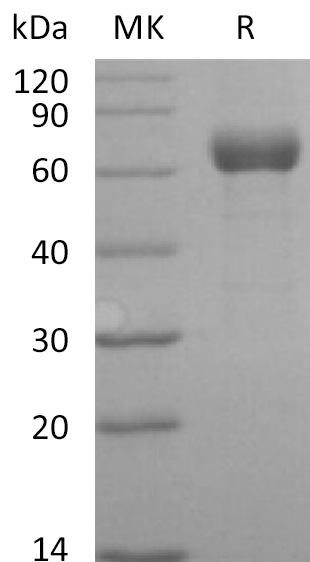 |
Greater than 95% as determined by reducing SDS-PAGE. |
靶点信息 Target Information
| 分子别名Alternative Names | Angiopoietin-related protein 3ANGPTL3Angiopoietin-5ANG-5Angiopoietin-like protein 3ANGPT5 |
|---|---|
| 功能Function | Acts in part as a hepatokine that is involved in regulation of lipid and glucose metabolism. Proposed to play a role in the trafficking of energy substrates to either storage or oxidative tissues in response to food intake. Has a stimulatory effect on plasma triglycerides (TG), which is achieved by suppressing plasma TG clearance via inhibition of LPL activity. The inhibition of LPL activity appears to be an indirect mechanism involving recruitment of proprotein convertases PCSK6 and FURIN to LPL leading to cleavage and dissociation of LPL from the cell surface; the function does not require ANGPTL3 proteolytic cleavage but seems to be mediated by the N-terminal domain, and is not inhibited by GPIHBP1. Can inhibit endothelial lipase, causing increased plasma levels of high density lipoprotein (HDL) cholesterol and phospholipids. Can bind to adipocytes to activate lipolysis, releasing free fatty acids and glycerol. Suppresses LPL specifically in oxidative tissues which is required to route very low density lipoprotein (VLDL)-TG to white adipose tissue (WAT) for storage in response to food; the function may involve cooperation with circulating, liver-derived ANGPTL8 and ANGPTL4 expression in WAT. Contributes to lower plasma levels of low density lipoprotein (LDL)-cholesterol by a mechanism that is independent of the canonical pathway implicating APOE and LDLR. May stimulate hypothalamic LPL activity.; In vitro inhibits LPL activity; not effective on GPIHBP1-stabilized LPL.; Involved in angiogenesis. Binds to endothelial cells via integrin alpha-V/beta-3 (ITGAV:ITGB3), activates FAK, MAPK and Akt signaling pathways and induces cell adhesion and cell migration. Secreted from podocytes, may modulate properties of glomerular endothelial cells involving integrin alpha-V/beta-3 and Akt signaling. May increase the motility of podocytes. May induce actin filament rearrangements in podocytes implicating integrin alpha-V/beta-3 and Rac1 activation. Binds to hematopoietic stem cells (HSC) and is involved in the regulation of HSC activity probably implicating down-regulation of IKZF1/IKAROS. |
| 亚细胞定位Subcellular Location | Secreted. Cell projection, lamellipodium. |
| 数据库链接Databases |
基因功能参考文献50 条
- Association of low-density lipoprotein receptor-related protein 1 rs11613352 and angiopoietin-like 3 rs2131925 with hypertension might imply a direct effect at the artery wall. PMID: 29989339 : 29989339
- The present data leads to new insights into the role of ANGPTL3 in glioblastomas and provides an independent predictive factor PMID: 26639238 : 26639238
- The role of ANGPLT3 in controlling lipoprotein metabolism and risk of cardiovascular diseases is reviewed here. PMID: 29334984 : 29334984
- these results suggest that the DOCK-ANGPTL3 SNPs and their haplotypes were associated with the angiographic severity to coronary artery atherosclerosis and the risk of coronary artery disease (CAD) and ischemic stroke in the Southern Chinese Han population. PMID: 29454388 : 29454388
- Subjects who carried ANGPTL3 sequence variants rs12563308 and rs199772471 had abnormally high total cholesterol and LDL-cholesterol concentrations. PMID: 28972399 : 28972399
- circulating ANGPTL3 and ANGPTL 4 expression was significantly elevated in hepatocellular carcinoma cases compared to chronic hepatitis patients and controls PMID: 28371666 : 28371666
- ANGPTL8 has a functional LPL inhibitory motif, but only inhibits LPL and increases plasma TG levels in mice in the presence of ANGPTL3 PMID: 28413163 : 28413163
- Our findings demonstrate that complete ANGPTL3 deficiency associates with highly reduced postprandial lipemia probably due to faster catabolism of intestinally derived lipoproteins, larger expansion of the postprandial FFA pool, and decreased influx of dietary-derived fatty acids into the liver. These results add information on mechanisms underlying hypolipidemia in familial combined hypolipidemia (FHBL2). PMID: 27040449 : 27040449
- participants with heterozygous loss-of-function variants in ANGPTL3 had significantly lower serum levels of triglycerides, HDL cholesterol, and LDL cholesterol than participants without these variants. PMID: 28538136 : 28538136
- ANGPTL3 deficiency is associated with protection from coronary artery disease. PMID: 28385496 : 28385496
- our data shows that ANGPTL3, 4 and 8 are increased in obesity and type 2 diabetes (T2D). ANGPTL8 associates with ANGPTL3 in the non-diabetic subjects while it associated more with ANGPTL4 in the obese and T2D subjects. PMID: 27733177 : 27733177
- ANGPTL3 is specifically correlated with HDL-c, apoA-I, SAA and HDL function in female non-diabetic participants. The decrease of ANGPTL3 level in female T2DM patients might contribute to its weak association to HDL components and function. PMID: 27620179 : 27620179
- The ANGPTL3 gene lies within DOCK7, although the variant is within non-coding regions outside of ANGPTL3, within DOCK7, suggesting complex long-range regulatory effects on gene expression in coronary artery disease. PMID: 26800306 : 26800306
- ANGPTL3 levels were associated with fasting insulin and the homeostasis model assessment of insulin resistance in Korean children. PMID: 26739706 : 26739706
- An ANGPTL3-4-8 model was proposed to explain the variations of lipoprotein lipase (LPL) activity during the fed-fast cycle. Feeding induces ANGPTL8, activating the ANGPTL8-ANGPTL3 pathway, which inhibits LPL in cardiac and skeletal muscles to direct circulating triglycerides (TG) to white adipose tissue; the reverse is true during fasting, which suppresses ANGPTL8 but induces ANGPTL4, thereby directing TG to muscles. PMID: 27053679 : 27053679
- Inactivation of ANGPTL3 reduces hepatic VLDL-triglyceride secretion PMID: 25954050 : 25954050
- Novel mutation Y344S found in ANGPTL3 gene in two diabetic patients with familial hypobetalipoproteinemia. PMID: 25733326 : 25733326
- Data suggest that silencing of ANGPTL 3 (angiopoietin-like protein 3) improves insulin sensitivity. PMID: 25495645 : 25495645
- HCV core represses ANGPTL-3 expression through loss of HNF-1alpha binding activity and blockage of LXR/RXR transactivation PMID: 23978712 : 23978712
- Data suggest that genetic polymorphisms in ANGPTL3 (angiopoietin-like 3 protein), TIMD4 (T cell immunoglobulin mucin-4), and apolipoproteins A5 and B are among the genetic determinants of hypertriglyceridemia in Amerindian populations. [REVIEW] PMID: 24768220 : 24768220
- ANGPTL3 is positively associated with low-density lipoprotein cholesterol and high-density lipoprotein cholesterol and not with metabolic syndrome traits including triglycerides. PMID: 24626437 : 24626437
- Identification of loss-of-function ANGPTL3 mutation is shedding light on a possible role of ANGPTL3 at the crossroads of lipoproteins, fatty acids, and glucose metabolism. [Review] PMID: 23839332 : 23839332
- Although partial Angptl3 deficiency did not affect the activities of lipolytic enzymes, the complete absence of Angptl3 results in an increased lipoprotein lipase activity and mass and low circulating free fatty acid levels. PMID: 23661675 : 23661675
- No gene-gene interaction was identified other than an interaction between SNPs in the ANGPTL3 and RXRA regions, which results in the inhibition of ApoB reduction in response to statin-FNA therapy. PMID: 22896670 : 22896670
- ANGPTL3 activation is modulated by O-glycosylation and the proprotein undergoes convertase processing for activation. PMID: 20837471 : 20837471
- Familial combined hypolipidemia segregates as a recessive trait so that apolipoprotein B- and apolipoprotein A-I-containing lipoproteins are comprehensively affected only by the total deficiency of Angptl3. PMID: 22659251 : 22659251
- the homozygous or compound heterozygous for ANGPTL3 loss-of-function mutations (p.G400VfsX5, p.I19LfsX22/p.N147X) had low plasma ANGPTL3 and moderately reduced low-density lipoprotein cholesterol but normal plasma high-density lipoprotein cholesterol. PMID: 22062970 : 22062970
- It denominated familial combined hypolipidemia, which consist of a biochemical phenotype of low LDLc, low apoB, low TG and, unlike APOB mutations, low HDL cholesterol, due to a loss-of-function mutation in ANGPTL3. PMID: 22155345 : 22155345
- The prevalence and effect of mutations in ANGPTL3, in carriers of pathogenic autosomal dominant hypercholesterolemia mutations with unexpected low LDL-C levels. PMID: 22095935 : 22095935
- In a cohort of subjects with severe primary hypobetalipoproteinemia the prevalence of ANGPTL3 gene mutations responsible for a combined hypolipidemia phenotype is about 10%. PMID: 22247256 : 22247256
- Serum Angptl3 was positively correlated with adiponectin in metabolic syndrome patients. PMID: 20360639 : 20360639
- Dysmorphic findings in two cases involving FBHL2 are reported. PMID: 19282754 : 19282754
- relationship between plasma angiopoietin-like protein 3 (ANGPTL3), and lipoprotein lipase (LPL) activity and hepatic triglyceride lipase PMID: 20595410 : 20595410
- Found two distinct nonsense mutations in ANGPTL3 in 2 family members out of 38 with combined hypolipidemia. PMID: 20942659 : 20942659
- Data suggest roles for ANGPTL3 and ANGPTL4 in modulation of serum TG and HDL levels in obesity in a Finnish population sample. PMID: 19826106 : 19826106
- Like ANGPTL4, ANGPTL3 inhibited nonstabilized LPL but not GPIHBP1-stabilized LPL PMID: 19542565 : 19542565
- ANGPTL3 may be a novel factor contributing to uremic dyslipidemia. PMID: 19540497 : 19540497
- ANGPTL3 stimulates endothelial cell adhesion and migration via integrin alpha vbeta 3 and induces blood vessel formation in vivo PMID: 11877390 : 11877390
- Angptl3 gene is a direct target of the liver X receptor (LXR). PMID: 12518032 : 12518032
- Data show that angiopoietin-like protein 3 (ANGPTL3) targets adipose cells and induces lipolysis. PMID: 12565906 : 12565906
- the cleavage of ANGPTL3 at two sites is important for the activation of ANGPTL3 in vivo PMID: 12909640 : 12909640
- liver-derived Angptl3 inhibits lipoprotein lipase activity primarily in the fed state PMID: 16531751 : 16531751
- Angptl3 acts as an inhibitor of EL and may be involved in the regulation of plasma HDL cholesterol and HDL-PL levels in humans and rodents. PMID: 17110602 : 17110602
- The pilot study supports the hypothesis about the role of Angptl3 as a new class of lipid metabolism modulator. PMID: 18063851 : 18063851
- probucol decreases plasma ANGPTL3 and HDL phospholipids while increasing prebeta1-HDL and cholesteryl ester transfer protein PMID: 18279878 : 18279878
- Our results also indicated that the integrin alphaVbeta3 antibody (LM609) could block the Angptl3-induced protein kinase B phosphorylation. PMID: 18535744 : 18535744
- ANGPTL3, the inhibitor of endothelial lipase, may be strongly associated with increased HDL-cholesterol PMID: 18804459 : 18804459
- The finding that ANGPTL3 and ANGPTL4 inhibit LPL activity through distinct mechanisms indicates that the two proteins play unique roles in modulation of lipid metabolism in vivo. PMID: 19028676 : 19028676
- The present study underlines the role of ANGPTL3 in HDL-cholesterol metabolism as early as in adolescence PMID: 19890028 : 19890028
- ANGPTL3 is the first member of the angiopoietin-like family of secreted factors binding to integrin alpha(v)beta(3), which suggests a possible role in the regulation of angiogenesis. PMID: 11877390 : 11877390
蛋白复溶体积计算器缓冲液体积 = 蛋白质量 ÷ 蛋白浓度
输入任意两项,第三项自动计算 |
蛋白浓度稀释计算器初浓度 × 初体积 = 终浓度 × 终体积
输入任意三项,第四项自动计算 |



