


Recombinant Human GPIHBP1 (C-Fc)
Alternative Namesglycosylphosphatidylinositol-anchored high density lipoprotein-binding protein1; GPI anchored high density lipoprotein binding protein 1; GPI-Anchored HDL-Binding Protein 1; GPIHBP1; GPI-HBP1; GPI-HBP1LOC338328; HBP1; High density lipoprotein-binding protein 1; HYPL1D
规格参数 Specifications
| 纯度Purity | Greater than 95% as determined by reducing SDS-PAGE |
|---|---|
| 内毒素Endotoxin | <1 EU/µg as determined by LAL test. |
| 蛋白构建Protein Construction |
【Thr22-Gly151】序列区间-FcC 端标签
|
| Accession | Q8IV16 |
| 表达宿主Expression Host | HEK293 |
| 种属Species | Human |
| 预测分子量Predicted MW | 41.7 kDa |
| 制剂Formulation | Lyophilized from a 0.2 μm filtered solution of PBS, pH 7.4. |
| 运输方式Shipping | The product is shipped with ice bag. Upon receipt, store it immediately at the temperature listed below. |
| 稳定性&储存Stability & Storage | 12 months at -20°C to -80°C in lyophilized state.6 months at -20°C to -80°C under sterile conditions after reconstitution.7-10 days at 2°C to 8°C under sterile conditions after reconstitution.Please minimize freeze-thaw cycles. |
| 复溶Reconstitution | Always centrifuge tubes before opening. Do not mix by vortex or pipetting. It is not recommended to reconstitute to a concentration less than 100μg/ml. Dissolve the lyophilized protein in distilled water. Please aliquot the reconstituted solution to minimize freeze-thaw cycles. |
!
本司产品仅用于科研,不用于临床诊断和治疗。
产品图片 Product Images点击图片可查看原图
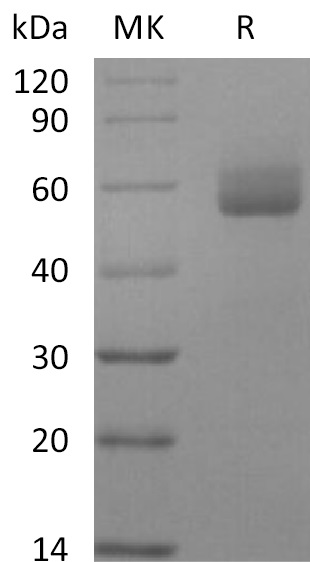 |
Greater than 95% as determined by reducing SDS-PAGE. |
靶点信息 Target Information
| 分子别名Alternative Names | glycosylphosphatidylinositol-anchored high density lipoprotein-binding protein1GPI anchored high density lipoprotein binding protein 1GPI-Anchored HDL-Binding Protein 1GPIHBP1GPI-HBP1GPI-HBP1LOC338328HBP1High density lipoprotein-binding protein 1HYPL1D |
|---|---|
| 功能Function | Mediates the transport of lipoprotein lipase LPL from the basolateral to the apical surface of endothelial cells in capillaries. Anchors LPL on the surface of endothelial cells in the lumen of blood capillaries. Protects LPL against loss of activity, and against ANGPTL4-mediated unfolding. Thereby, plays an important role in lipolytic processing of chylomicrons by LPL, triglyceride metabolism and lipid homeostasis. Binds chylomicrons and phospholipid particles that contain APOA5. Binds high-density lipoprotein (HDL) and plays a role in the uptake of lipids from HDL. |
| 亚细胞定位Subcellular Location | Apical cell membrane; Lipid-anchor, GPI-anchor. Basolateral cell membrane; Lipid-anchor, GPI-anchor. Cell membrane; Lipid-anchor, GPI-anchor. |
| 数据库链接Databases |
基因功能参考文献38 条
- the negatively charged IDR of GPIHBP1 traverses a vast space, facilitating capture of LPL by capillary endothelial cells and simultaneously contributing to GPIHBP1's ability to preserve LPL structure and activity. PMID: 29899144 : 29899144
- The increased GPIHBP1 was significantly associated with decreased body weight. PMID: 29056530 : 29056530
- apoC-III potently inhibits triglyceride hydrolysis when LPL is bound to GPIHBP1 PMID: 28694296 : 28694296
- mutation of a conserved cysteine in GPIHBP1 abolishes the ability of GPIHBP1 to bind LPL PMID: 28476858 : 28476858
- One of 33 patients with unexplained chylomicronemia had the GPIHBP1 autoantibody syndrome PMID: 28666713 : 28666713
- Triglyceride-raising variant alleles of the GPIHBP1, encoding glycosylphosphatidylinositol-anchored HDL-binding protein 1,associated with clinical Cardiovascular endpoints. PMID: 28534127 : 28534127
- The authors now show: (1) that ANGPTL4 inactivates LPL by catalyzing the unfolding of its hydrolase domain; (2) that binding to GPIHBP1 renders LPL largely refractory to this inhibition; and (3) that both the LU domain and the intrinsically disordered acidic domain of GPIHBP1 are required for this protective effect. PMID: 27929370 : 27929370
- familial chylomicronemia due to mutations in GPIHBP1 gene PMID: 27578123 : 27578123
- mAbs RE3 and RG3 bound with reduced affinity to a mutant GPIHBP1 containing an Ly6 domain mutation (W109S) that abolishes LPL binding. Immunohistochemistry studies with the GPIHBP1 mAbs revealed that human GPIHBP1 is expressed only in capillary endothelial cells. Finally, we created an ELISA that detects GPIHBP1 in human plasma. PMID: 27875259 : 27875259
- The binding of both antibody 88B8 and GPIHBP1 to LPL depends on large segments of LPL's carboxyl-terminal domain. PMID: 27494936 : 27494936
- An LPL structural model suggests that the LPL S447X truncation exposes residues implicated in LPL binding to lipoprotein binding uptake receptors, such as GPIHBP1. PMID: 27984852 : 27984852
- The acidic domain of GPIHBP1 stabilizes LPL catalytic activity by mitigating the global unfolding of LPL's catalytic domain. PMID: 26725083 : 26725083
- 2 novel GPIHBP1 missense mutations in 2 unrelated patients as the cause of their severe hypertriglyceridemia PMID: 26892125 : 26892125
- GPIHBP1 mutations should be considered in neonates with chylomicronemia negative for mutations in LPL gene PMID: 25911085 : 25911085
- the two domains of GPIHBP1 interact independently with LPL and the functionality of LPL depends on its localization on GPIHBP1 PMID: 25873395 : 25873395
- No GPIHBP1 mutations were identified in a cohort of patients with diabetic lipemia. PMID: 25131724 : 25131724
- patient with type I hyperlipoproteinemia harbored homozygous mutation in case series PMID: 24793350 : 24793350
- GPIHBP1 missense mutations leading to protein multimerization prevent lipoprotein lipase binding. PMID: 25387803 : 25387803
- Homozygosity for a deletion of exons 3 and 4 of GPIHBP1 results in Type 1 hyperlipoproteinemia. PMID: 24589565 : 24589565
- an extra cysteine in the GPIHBP1 Ly6 motif results in multimerization of GPIHBP1, defective LPL binding, and severe hypertriglyceridemia. PMID: 24847059 : 24847059
- Wild-type lipoprotein lipase (LPL) and a mutated (S447X-LPL) protein bind to the endothelial cell LPL transporter GPIHBP1 with equal efficiency. PMID: 24704550 : 24704550
- A polymorphism in the GPIHBP1 gene promoter was associated with an increased risk of hypertriglyceridemia and had an additive effect on the risk conferred by LPL defective alleles. PMID: 21978733 : 21978733
- Mutations in GPIHBP1 are rare but the associated clinical phenotype of hypertriglyceridaemia is severe. PMID: 22239554 : 22239554
- analysis of a neonate with complete GPIHBP1 deficiency due to homozygosity for a deletion of GPIHBP1 [case report] PMID: 22008945 : 22008945
- Expression of glycosylphosphatidylinositol-anchored high-density lipoprotein binding protein 1 tended to be higher in young healthy subjects than in subjects with type 2 diabetes mellitus or Colder control subjects PMID: 22078753 : 22078753
- function and genetics of GPIHBP1 in lipoprotein lipase transport PMID: 21844202 : 21844202
- we first report a mutation of the hydrophobic C-terminal domain that impairs GPIHBP1 membrane targeting PMID: 21816778 : 21816778
- Findings provide further evidence that GPIHBP1 is involved in the catabolism of triglyceride-rich lipoproteins and plays a role in childhood-onset chylomicronaemia. PMID: 21314738 : 21314738
- the Ly6 domain of GPIHBP1 is important for the ability of GPIHBP1 to bind and transport LPL. PMID: 21478160 : 21478160
- report that two LPL missense mutations initially identified in patients with chylomicronemia, C418Y and E421K, abolish LPL's ability to bind to GPIHBP1 without interfering with LPL catalytic activity or binding to heparin PMID: 21518912 : 21518912
- GPIHBP1 binds lipoprotein lipase but does not bind other lipase family members. GPIHBP1 binds apoAV but does not bind apoAI or high-density lipoprotein. GPIHBP1 binding to chylomicrons is mediated by lipoprotein lipase. PMID: 20966398 : 20966398
- The conserved cysteines in the Ly6 domain are crucial for GPIHBP1 function. PMID: 20026666 : 20026666
- Observational study of gene-disease association. (HuGE Navigator) PMID: 20237496 : 20237496
- GPIHBP1 functions as an LPL stabilizer PMID: 19542565 : 19542565
- a very rare GPIHBP1 missense mutation appears to be associated with severe hypertriglyceridemia and chylomicronemia. PMID: 17883852 : 17883852
- Data show that the G56R substitution did not affect the ability of GPIHBP1 to reach the cell surface, nor did the amino acid substitution have any discernible effect on the binding of lipoprotein lipase, chylomicrons, or apo-AV. PMID: 17997385 : 17997385
- the acidic domain of GPIHBP1 is important and electrostatic interactions play a key role in ligand binding PMID: 18713736 : 18713736
- Case Report: Chylomicronemia with a mutant GPIHBP1 (Q115P) that cannot bind lipoprotein lipase. PMID: 19304573 : 19304573
蛋白复溶体积计算器缓冲液体积 = 蛋白质量 ÷ 蛋白浓度
输入任意两项,第三项自动计算 |
蛋白浓度稀释计算器初浓度 × 初体积 = 终浓度 × 终体积
输入任意三项,第四项自动计算 |



