


| 纯度Purity | Greater than 95% as determined by reducing SDS-PAGE |
|---|---|
| 内毒素Endotoxin | <1 EU/µg as determined by LAL test. |
| 蛋白构建Protein Construction |
【Glu31-Arg370】序列区间-6HisC 端标签
|
| Accession | P78324 |
| 表达宿主Expression Host | HEK293 |
| 种属Species | Human |
| 预测分子量Predicted MW | 38.1 kDa |
| 制剂Formulation | Lyophilized from a 0.2 μm filtered solution of 20mM PB, 150mM NaCl, pH 7.2. |
| 运输方式Shipping | The product is shipped with ice bag. Upon receipt, store it immediately at the temperature listed below. |
| 稳定性&储存Stability & Storage | 12 months at -20°C to -80°C in lyophilized state.6 months at -20°C to -80°C under sterile conditions after reconstitution.7-10 days at 2°C to 8°C under sterile conditions after reconstitution.Please minimize freeze-thaw cycles. |
| 复溶Reconstitution | Always centrifuge tubes before opening. Do not mix by vortex or pipetting. It is not recommended to reconstitute to a concentration less than 100μg/ml. Dissolve the lyophilized protein in distilled water. Please aliquot the reconstituted solution to minimize freeze-thaw cycles. |
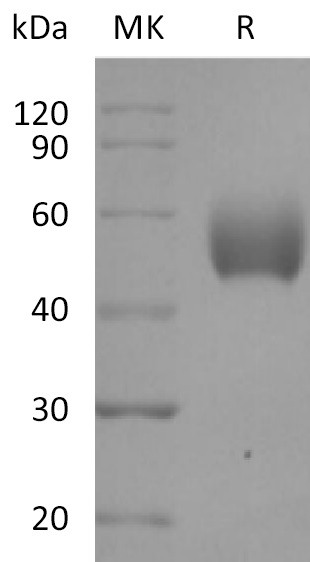 |
Greater than 95% as determined by reducing SDS-PAGE. |
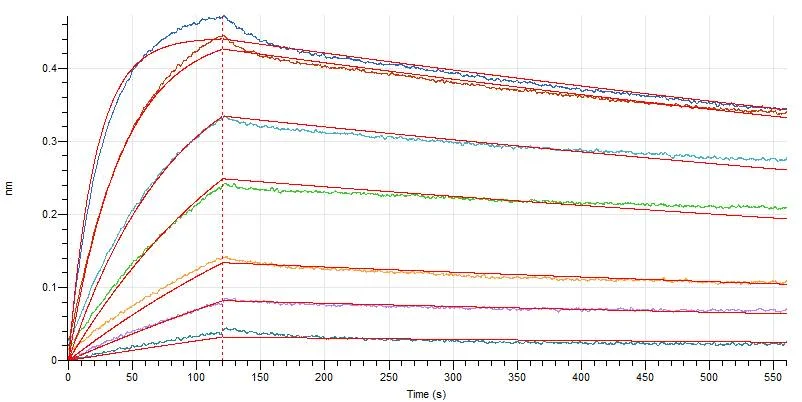 |
Loaded Anti-Human SIRPA mAb-Fc on Protein A Biosensor, can bind Human SIRPA-His with an affinity constant of 1.22 nM as determined in BLI assay. |
| 分子别名Alternative Names | Tyrosine-Protein Phosphatase Non-Receptor Type Substrate 1SHP Substrate 1SHPS-1Brain Ig-Like Molecule with Tyrosine-Based Activation MotifsBitCD172 Antigen-Like Family Member AInhibitory Feceptor SHPS-1Macrophage Fusion ReceptorMyD-1 AntigenSignal-Regulatory Protein Alpha-1Sirp-Alpha-1Signal-Regulatory Protein Alpha-2Sirp-Alpha-2Signal-Regulatory Protein Alpha-3Sirp-Alpha-3p84CD172aSIRPABITMFRMYD1PTPNS1SHPS1SIRP |
|---|---|
| 功能Function | Immunoglobulin-like cell surface receptor for CD47. Acts as docking protein and induces translocation of PTPN6, PTPN11 and other binding partners from the cytosol to the plasma membrane. Supports adhesion of cerebellar neurons, neurite outgrowth and glial cell attachment. May play a key role in intracellular signaling during synaptogenesis and in synaptic function. Involved in the negative regulation of receptor tyrosine kinase-coupled cellular responses induced by cell adhesion, growth factors or insulin. Mediates negative regulation of phagocytosis, mast cell activation and dendritic cell activation. CD47 binding prevents maturation of immature dendritic cells and inhibits cytokine production by mature dendritic cells. |
| 亚细胞定位Subcellular Location | Membrane; Single-pass type I membrane protein. |
| 数据库链接Databases |
基因功能参考文献50 条
- Accumulation of SIRPalpha-inhibited macrophages in tumors favored tumor regression for 1-2 weeks, but donor macrophages quickly differentiated toward non-phagocytic, high-SIRPalpha TAMs. PMID: 28669759 : 28669759
- SIRP alpha protein is under-expressed in low and high-grades of astrocytoma from patients' brain samples. PMID: 27900675 : 27900675
- Anti-SIRPA antibody immunotherapy enhances neutrophil and macrophage antitumor activity. PMID: 29158380 : 29158380
- SIRPalpha might play an important role in the progression of oral leukoplakia and oral cancer, and could be a pivotal therapeutic target in oral squamous cell carcinoma, regulating the phenotype of macrophages via targeting NF-kappaB signaling. PMID: 27793032 : 27793032
- TTI-621 (SIRPalphaFc) is a fully human recombinant fusion protein that blocks the CD47-SIRPalpha axis by binding to human CD47 and enhancing phagocytosis of malignant cells..These data indicate that TTI-621 is active across a broad range of human tumors. PMID: 27856600 : 27856600
- data suggest that TTI-621 may be efficacious in triggering the destruction of cancer cells by a diverse population of TAMs found in vivo and support possible combination approaches to augment the activity of CD47 blockade PMID: 29084248 : 29084248
- CD47, TSP1, and to a lesser extent SIRPalpha facilitate exosome-mediated myeloid-derived suppressor cells chemotaxis and migration. PMID: 27728760 : 27728760
- exploited by Hepatitis E virus to negative regulated IFN-beta of the host innate immune system to promote viral infection PMID: 26492885 : 26492885
- Data suggest a reduction in the CD47 antigen/signal-regulatory protein alpha (SIRPalpha) pathway by programmed cell death protein 1 (PD-1) blockade, which regulates Myeloid-derived suppressor cells (MDSCs) and tumor associated macrophages (TAMs). PMID: 26573233 : 26573233
- agents that block the CD47:SIRP-alpha engagement are attractive therapeutic targets as a monotherapy or in combination with additional immune-modulating agents for activating antitumor T cells in vivo PMID: 26116271 : 26116271
- the data suggest that combinatorial actions of ADAM10 and gamma-secretase on SIRPalpha cleavage promote inflammatory signaling. PMID: 26534964 : 26534964
- Loss of cell surface CD47 clustering formation and binding avidity to SIRPalpha facilitate apoptotic cell clearance by macrophages. PMID: 26085683 : 26085683
- Velcro" engineering of high affinity CD47 ectodomain as signal regulatory protein alpha (SIRPalpha) antagonists that enhance antibody-dependent cellular phagocytosis PMID: 25837251 : 25837251
- negatively regulates neutrophil accumulation during inflammation PMID: 24516072 : 24516072
- Combinatorial expression of NKX2-5, SIRPA, VCAM1 and CD34 can be used to define discrete stages of cardiovascular cell lineage differentiation. PMID: 24968096 : 24968096
- These results suggest that thrombospondin-1 binding to SIRP-alpha on nonphagocytic cells activates NADPH oxidase, limits vasodilation, and promotes renal ischemia reperfusion injury. PMID: 24511121 : 24511121
- 'clustering' SIRPalpha into plasma membrane microdomains is essential for activated monocytes and macrophages to effectively interact with CD47 and initiate intracellular signaling PMID: 24143245 : 24143245
- Polymorphisms in the human inhibitory signal-regulatory protein alpha do not affect binding to its ligand CD47. PMID: 24550402 : 24550402
- SIRPA plays a protective role in cardiac hypertrophy through negative regulation of the Toll-like receptor 4/nuclear factor-kappaB pathway. PMID: 24101669 : 24101669
- These results demonstrate a SIRPalpha-based mechanism that dynamically regulates polymorphonuclear leukocyte inflammatory responses. PMID: 24026300 : 24026300
- Signal regulatory protein alpha is associated with tumor-polarized macrophages phenotype switch and plays a pivotal role in tumor progression. PMID: 23504854 : 23504854
- An avidity-improved CD47 fusion protein (CD47-Var1) suppresses the release of a wide array of inflammatory cytokines by CD172a(+) cells. PMID: 23669395 : 23669395
- Expression of SIRPalpha on two low SIRPalpha acute myeloid leukemia (AML) expressing cell lines could be upregulated upon differentiation of the cells. PMID: 23320069 : 23320069
- SHPS-1 negatively regulates the MyD88-dependent TLR signaling pathway through the inhibition of NF-kappaB activation PMID: 23314616 : 23314616
- IFN-beta and IFN-gamma/TNF-alpha decrease erythrophagocytosis by human monocytes in vitro, and this effect does not apparently require an increase in SIRP-alpha or SHP-1 expression. PMID: 22738830 : 22738830
- neutrophils reduce their SIRPalpha expression during apoptosis, which may be part of the functional down-regulation seen in apoptotic neutrophils. PMID: 23271705 : 23271705
- thymic Sirpalpha(+) cDCs crucially contribute to a process of intrathymic tumor immune tolerance that involves CCR2 and CCL2 PMID: 22815949 : 22815949
- In the glomeruli of CNS patients carrying mutations in NPHS1, where SD formation is disrupted, the expression of SIRPalpha as well as Neph1 and nephrin was significantly decreased, indicating that SIRPalpha is closely associated with the nephrin complex PMID: 22747997 : 22747997
- Surfactant protein D (Sp-D) binds to membrane-proximal domain (D3) of signal regulatory protein alpha (SIRPalpha), a site distant from binding domain of CD47, while also binding to analogous region on signal regulatory protein beta (SIRPbeta). PMID: 22511785 : 22511785
- SIRPalpha1 in hepatic sinusoid Kupffer cells is associated with the extent of autoimmune hepatitis. PMID: 22409853 : 22409853
- data, taken together with similar findings with other human neoplasms, show that CD47 is a commonly expressed molecule on all cancers, its function to block phagocytosis is known, and blockade of its function leads to tumor phagocytosis and elimination PMID: 22451913 : 22451913
- SIRPalpha/CD172a and FHOD1 are unique markers of littoral cells, a recently evolved major cell population of red pulp of human spleen. PMID: 22490440 : 22490440
- Sensing of cell surface CD47 expression by phagocyte SIRPalpha is a critical determinant of T- and natural killer-cell homeostasis under steady-state conditions in vivo. PMID: 21788504 : 21788504
- hSIRPa-transgenic Rag2(-/-)gamma(c)(-/-) mice represent a unique mouse strain supporting high levels of human cell engraftment. PMID: 21788509 : 21788509
- The prolactin receptor (PRLr)-SIRPalpha-integrin complex provides a basis for integrin-PRLr cross-talk that contributes to the biology of breast cancer. PMID: 20826546 : 20826546
- the relationships between SIRPalpha1 and beta-catenin in leukemia cells. PMID: 21369691 : 21369691
- Single Nucleotide Polymorphisms in PTPNS1 is associated with inflammatory bowel disease. PMID: 21225905 : 21225905
- SHP-2 as an essential component of tumor suppression and anoikis mediated by SIRPalpha1 in human breast carcinoma cells as well as in v-Src-transformed cells. PMID: 21169408 : 21169408
- Poor prognosis of breast cancer patients with high expression of CD47 is due to an active CD47/SIRPA signaling pathway in circulating cells. PMID: 20705613 : 20705613
- The role of cis dimerization of signal regulatory protein alpha (SIRPalpha) in binding to CD47. PMID: 20826801 : 20826801
- Findings reveal a novel mechanism for recruitment of PDK1 to the SHPS-1 signaling complex, which is required for IGF-I-stimulated AKT Thr(308) phosphorylation and inhibition of apoptosis. PMID: 20643654 : 20643654
- Inhibition of engulfment correlates with affinity of CD47 for SIRPA - but only at low levels of CD47. PMID: 20299253 : 20299253
- SIRPalpha1 specifically affects the SHP-2/FAK/Grb2/Sos-1/MAPK activation loop to downmodulate EGFRvIII-mediated migration and transformation. PMID: 20473329 : 20473329
- Insulin-like growth factor-I-stimulated insulin receptor substrate-1 negatively regulates Src homology 2 domain-containing protein-tyrosine phosphatase substrate-1 function in vascular smooth muscle cells. PMID: 20207740 : 20207740
- SIRP alpha gene expression is higher in monocytes from autoimmune hemolytic anemia patients, compared with basal expression. PMID: 19874234 : 19874234
- CD47/SIRP-alpha interactions are implicated in the pathogenesis of DC-driven allergic airway inflammation. PMID: 19748659 : 19748659
- Signal regulatory protein (SIRPalpha), a cellular ligand for CD47, regulates neutrophil transmigration PMID: 11792697 : 11792697
- The interaction of SHPS-1 with CD47 may contribute to the recruitment of B lymphocytes via endothelial cells under steady state conditions. PMID: 11907074 : 11907074
- MyD-1-coupling to this PI 3-kinase-dependent signaling pathway may therefore present a novel target for the development of therapeutic strategies for combating TNFalpha production and consequent inflammatory disease. PMID: 12805067 : 12805067
- Expression of SIRPalpha1 on astrocytomas may be of considerable importance in brain tumor biology. PMID: 14729615 : 14729615
蛋白复溶体积计算器缓冲液体积 = 蛋白质量 ÷ 蛋白浓度
输入任意两项,第三项自动计算 |
蛋白浓度稀释计算器初浓度 × 初体积 = 终浓度 × 终体积
输入任意三项,第四项自动计算 |



