


Recombinant Human tPA (C-6His)
Alternative NamesT-PA; TPA; t-plasminogen activator; Tissue plasminogen activator
规格参数 Specifications
| 纯度Purity | Greater than 95% as determined by reducing SDS-PAGE |
|---|---|
| 内毒素Endotoxin | <1 EU/µg as determined by LAL test. |
| 蛋白构建Protein Construction |
【Ser36-Pro562】序列区间-6HisC 端标签
|
| Accession | P00750 |
| 表达宿主Expression Host | HEK293 |
| 种属Species | Human |
| 预测分子量Predicted MW | 60.1 kDa |
| 制剂Formulation | Lyophilized from a 0.2 μm filtered solution of 20mM Succinate, 4% Trehalose, 4% Mannitol, 0.2mM CaCl2, 0.02% Tween 80, pH 4.5. |
| 运输方式Shipping | The product is shipped with ice bag. Upon receipt, store it immediately at the temperature listed below. |
| 稳定性&储存Stability & Storage | 12 months at -20°C to -80°C in lyophilized state.6 months at -20°C to -80°C under sterile conditions after reconstitution.7-10 days at 2°C to 8°C under sterile conditions after reconstitution.Please minimize freeze-thaw cycles. |
| 复溶Reconstitution | Always centrifuge tubes before opening. Do not mix by vortex or pipetting. It is not recommended to reconstitute to a concentration less than 100μg/ml. Dissolve the lyophilized protein in distilled water. Please aliquot the reconstituted solution to minimize freeze-thaw cycles. |
!
本司产品仅用于科研,不用于临床诊断和治疗。
产品图片 Product Images点击图片可查看原图
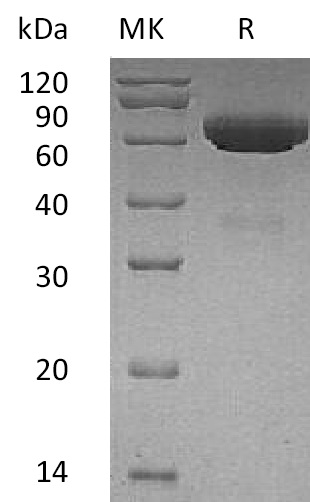 |
Greater than 95% as determined by reducing SDS-PAGE. |
靶点信息 Target Information
| 分子别名Alternative Names | T-PATPAt-plasminogen activatorTissue plasminogen activator |
|---|---|
| 功能Function | Converts the abundant, but inactive, zymogen plasminogen to plasmin by hydrolyzing a single Arg-Val bond in plasminogen. By controlling plasmin-mediated proteolysis, it plays an important role in tissue remodeling and degradation, in cell migration and many other physiopathological events. During oocyte activation, plays a role in cortical granule reaction in the zona reaction, which contributes to the block to polyspermy. |
| 亚细胞定位Subcellular Location | Secreted, extracellular space. |
| 数据库链接Databases |
基因功能参考文献50 条
- These findings provides evidence that gene-gene interactions between p11, tPA and BDNF are all associated with post stroke depression. PMID: 29028593 : 29028593
- Underexpression of Tissue plasminogen activator is associated with diabetic foot syndrome. PMID: 28193577 : 28193577
- By mediating the tPA response in macrophages, the NMDA-R provides a pathway by which the fibrinolysis system may regulate innate immunity. PMID: 28684538 : 28684538
- Data suggest that protein aggregates interact with tissue-type plasminogen activator and plasminogen to efficiently generate plasmin; this aggregate-bound plasmin is shielded from inhibition by alpha-2-antiplasmin and degrades protein aggregates to release smaller, soluble but relatively hydrophobic peptide fragments; these fragments bind to and are cytotoxic to microglia (by not vascular endothelial cells). PMID: 28710283 : 28710283
- Altogether, this preclinical study demonstrates that the tPA present in the blood stream is a key player of the formation of intracranial aneurysms. PMID: 28754830 : 28754830
- tPA is a ligand of the N-terminal domain of the obligatory GluN1 subunit of NMDAR acting as a modulator of their dynamic distribution at the neuronal surface and subsequent signaling. PMID: 27831563 : 27831563
- t-PA binds to Lys91 in the MBP NH2-terminal region and PLGbinds to Lys122 in the MBP COOH-terminal region. This proximity promotes the activation of Pg by t-PA. PMID: 28648598 : 28648598
- local accumulation of cortisol is a causative factor for amnion epithelial apoptosis via activation of tPA/plasmin system toward the end of gestation. This may contribute to the ROM at both term and preterm birth. PMID: 27690691 : 27690691
- We identified a homozygous null mutation in PLAT that abrogated t-PA level in patient cells. This is the first reported human knockout mutation of PLAT. The apparent association with hydranencephaly, diaphragmatic hernia and postnatal lethality requires further validation. PMID: 27417437 : 27417437
- Tissue plasminogen activator (t-PA) antigen is a marker of cardiovascular risk. Exercise interventions associated with weight loss reduce t-PA antigen. Endurance training per se reduces t-PA antigen in healthy overweight men. PMID: 28254694 : 28254694
- we reviewed current knowledge of mechanisms by which tPA can influence brain function in physiological and pathological conditions--REVIEW} PMID: 26626577 : 26626577
- Data suggest that baseline levels of adiponectin, C-reactive protein, TPA, and fibrinogen or changes in these levels do not explain increased risk of diabetes type 2 in overweight women with glucose intolerance and histories of gestational diabetes. PMID: 25970741 : 25970741
- Tissue plasminogen activator (tPA) may be a general factor in the immunological response to viruses. PMID: 26704613 : 26704613
- tPA has a role in progression of periventricular white matter hyperintensities PMID: 26942412 : 26942412
- These data indicate that oxygen-glucose deprivation-triggered Cav-1 S-nitrosylation interacts with tPA-induced ERK activation to augment MMP2 and 9 secretion and subsequent extracellular matrix degradation. PMID: 26881424 : 26881424
- tPA-dependent activation of EGFRs leads to downregulation of NMDAR signaling and to subsequent neurotrophic effects. PMID: 26469972 : 26469972
- Tissue-type plasminogen activator-binding RNA aptamers inhibiting low-density lipoprotein receptor family-mediated internalization may improve safety of thrombolytic therapy. PMID: 25855589 : 25855589
- Intravenous tissue plasminogen activator therapy was associated with improved clinical outcomes without significant increase in risk of hemorrhagic complications in very old patients (aged>80 years) with acute ischemic stroke. PMID: 25329379 : 25329379
- Review: t-PA function and regulation of its pericellular activity, with an emphasis on regulation of its gene expression. PMID: 24718307 : 24718307
- data implicate MCP-1 as the key molecule governing tPA-induced fluid accumulation. The role of MCP-1 in the development of other exudative effusions warrants examination. PMID: 25474480 : 25474480
- remarkable association especially between the -1131C Apo A5 variant and increased tPA levels in asymptomatic dyslipidemic patients PMID: 24815086 : 24815086
- The results suggest roles for TLR3, TLR10, PLAT (n=2), VEGFA and DENND1B in susceptibility to chronic cavitary pulmonary aspergillosis. PMID: 24712925 : 24712925
- shRNA-mediated silencing of PLAT in glioma-initiating cells phenocopied the effects of miR340 overexpression in vitro effects of miR340 overexpression in vitro PMID: 25627976 : 25627976
- Activation of T cells triggered a rapid, 8.4-fold up-regulation of the serine protease tissue plasminogen activator, the protease target for neuroserpin. PMID: 25670787 : 25670787
- Report tPA with a cutoff of 8.5 ng/mL has a high sensitivity and negative predictive value for exclusion of pulmonary embolism. PMID: 25339163 : 25339163
- Data indicate that binding of tissue-type plasminogen activator (t-PA) to glucose-regulated protein 78 (GRP78) stimulates its amidolytic activity, activation of plasminogen (Pg), and cell proliferation. PMID: 25059665 : 25059665
- Obese men exhibited lower levels of TPA activity compared to normal weight men. PMID: 25306554 : 25306554
- plasminogen and plasmin but not tissue-type plasminogen activator have roles in regulating fibrinolysis by C-terminal lysines PMID: 22974122 : 22974122
- It is involved in Amyloid-beta catabolism and clearance, which is particularly efficient for degrading Amyloid-beta aggregates. Thus, endogenous tPA could delay Alzheimer's disease pathogenesis by maintaining low levels of brain Amyloid beta. PMID: 24126163 : 24126163
- Data suggest that tPA is required for bone repair and osteoblast proliferation; recombinant tPA stimulates proliferation of osteoblastic cell line. PMID: 24918201 : 24918201
- Endogenously released tPA promotes neutrophil transmigration to reperfused tissue via proteolytic activation of plasmin and gelatinases. PMID: 24764453 : 24764453
- There are correlations between t-PA, PAI-1 and some rotational thromboelastometry parameters in multiple myeloma patients. PMID: 24964508 : 24964508
- Identify 3 loci associated with circulating tPA levels, the PLAT region, STXBP5, and STX2. Functional studies implicate a novel role for STXBP5 and STX2 in regulating tPA release. PMID: 24578379 : 24578379
- Studies suggest that inadequate synthesis and release of tissue plasminogen activator (tPA) or low tPA activity be considered a critical component of schizophrenia pathophysiology. PMID: 24108470 : 24108470
- Tissue plasminogen activator (t-PA) is a model of preterm intracerebral-intraventricular hemorrhages for the ontogenic window of vascular immaturity and protection against later neurodisabilities. PMID: 24709679 : 24709679
- Data suggest plasma tissue plasminogen activator (t-PA) and fibrin fragment D-dimer levels are higher in abdominal aortic aneurysm patients than in controls; however, there is a negative relationship between t-PA and intraluminal thrombus thickness. PMID: 23959729 : 23959729
- LRP1 assembles unique co-receptor systems to initiate cell signaling in response to tissue-type plasminogen activator and myelin-associated glycoprotein. PMID: 24129569 : 24129569
- Renal impairment is associated with higher risk of symptomatic intracranial hemorrhage (sICH) after administration of intravenous tPA. PMID: 24145699 : 24145699
- Successful thrombolysis can resolve DWI lesions but does not always improve the neurological symptoms. PMID: 21848677 : 21848677
- Excess tissue-type plasminogen activator causes targeted Purkinje cell degeneration and ataxia. PMID: 23939410 : 23939410
- II genotype carrier osteomyelitis patients had lower PAI-1/tPA complex levels. PMID: 23570848 : 23570848
- Intravenous thrombolysis with alteplase does not appear to increase the risk of hemorrhagic complications in these non-metastatic cancer patients, in absence of additional risk factors of bleeding. PMID: 23317922 : 23317922
- The combination of recombinant PA and erythropoietin increases release of the endogenous nitric oxide synthase inhibitor asymmetric dimethylarginine (ADMA) and thereby potentially deteriorates ischemic stroke outcome. PMID: 23788583 : 23788583
- Use of intraventricular tPA for aneurysmal subarachnoid hemorrhage surgery results in less vasospasm, fewer angioplasties, and fewer cerebrospinal fluid shunting procedures. PMID: 20559098 : 20559098
- Persons who develop non-affective psychoses have lower levels of certain acute phase proteins, including tPA, at the time of birth. PMID: 23423137 : 23423137
- This meta-analysis suggested that the -7351C/T polymorphism in TPA gene would be a risk factor for ischemic stroke. PMID: 23326456 : 23326456
- These results suggest that retained tPA on vascular endothelial cells effectively activated plasminogen to plasmin. PMID: 23118500 : 23118500
- The serine protease tissue plasminogen activator (tPA) and two matrix metalloproteinases, ADAMTS-4 and ADAMTS-5, were identified as Reelin cleaving enzymes. PMID: 23082219 : 23082219
- Intraventricular fibrinolysis with recombinant tPA does not lead to increased perihemorrhagic edema after intracerebral hemorrhage. PMID: 23306318 : 23306318
- VDAC binds tissue-type plasminogen activator (t-PA) on human neuroblastoma SK-N-SH cells PMID: 23161549 : 23161549
蛋白复溶体积计算器缓冲液体积 = 蛋白质量 ÷ 蛋白浓度
输入任意两项,第三项自动计算 |
蛋白浓度稀释计算器初浓度 × 初体积 = 终浓度 × 终体积
输入任意三项,第四项自动计算 |



