


Recombinant Human PIgR (C-6His)
Alternative NamesPolymeric Immunoglobulin Receptor; PIgR; Poly-Ig Receptor; Hepatocellular Carcinoma-Associated Protein TB6; PIGR
规格参数 Specifications
| 纯度Purity | Greater than 95% as determined by reducing SDS-PAGE |
|---|---|
| 内毒素Endotoxin | <1 EU/µg as determined by LAL test. |
| 蛋白构建Protein Construction |
【Lys19-Arg638】序列区间-6HisC 端标签
|
| Accession | P01833 |
| 表达宿主Expression Host | HEK293 |
| 种属Species | Human |
| 预测分子量Predicted MW | 68.88 kDa |
| 制剂Formulation | Lyophilized from a 0.2 μm filtered solution of 20mM PB, 150mM NaCl, pH 7.2. |
| 运输方式Shipping | The product is shipped with ice bag. Upon receipt, store it immediately at the temperature listed below. |
| 稳定性&储存Stability & Storage | 12 months at -20°C to -80°C in lyophilized state.6 months at -20°C to -80°C under sterile conditions after reconstitution.7-10 days at 2°C to 8°C under sterile conditions after reconstitution.Please minimize freeze-thaw cycles. |
| 复溶Reconstitution | Always centrifuge tubes before opening. Do not mix by vortex or pipetting. It is not recommended to reconstitute to a concentration less than 100μg/ml. Dissolve the lyophilized protein in distilled water. Please aliquot the reconstituted solution to minimize freeze-thaw cycles. |
!
本司产品仅用于科研,不用于临床诊断和治疗。
产品图片 Product Images点击图片可查看原图
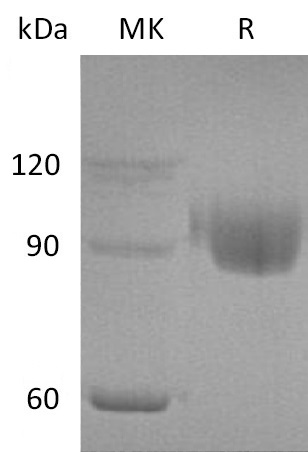 |
Greater than 95% as determined by reducing SDS-PAGE. |
靶点信息 Target Information
| 分子别名Alternative Names | Polymeric Immunoglobulin ReceptorPIgRPoly-Ig ReceptorHepatocellular Carcinoma-Associated Protein TB6PIGR |
|---|---|
| 功能Function | Mediates selective transcytosis of polymeric IgA and IgM across mucosal epithelial cells. Binds polymeric IgA and IgM at the basolateral surface of epithelial cells. The complex is then transported across the cell to be secreted at the apical surface. During this process, a cleavage occurs that separates the extracellular (known as the secretory component) from the transmembrane segment.; Through its N-linked glycans ensures anchoring of secretory IgA (sIgA) molecules to mucus lining the epithelial surface to neutralize extracellular pathogens. On its own (free form) may act as a non-specific microbial scavenger to prevent pathogen interaction with epithelial cells. |
| 亚细胞定位Subcellular Location | [Polymeric immunoglobulin receptor]: Cell membrane; Single-pass type I membrane protein.; [Secretory component]: Secreted. |
| 数据库链接Databases |
基因功能参考文献40 条
- We identified two SLN genes (PIGR and TFAP2A) that provided high prognostic accuracy in SLN-positive melanoma patients (AUC = 0.864). These two SLN genes, along with clinicopathological features, can differentiate the high- and low-risk groups in node-positive melanoma patients. PMID: 27663566 : 27663566
- pIgR may be involved in pancreatic ductal adenocarcinoma progression and may be linked stromal activity. Further work on its precise role is mandated in in vivo models, to understand its influence on cancer progression. PMID: 28173980 : 28173980
- A genome-wide trans-ethnic interaction study links the PIGR-FCAMR locus to coronary atherosclerosis via interactions between genetic variants and residential exposure to traffic pollution. PMID: 28355232 : 28355232
- The polymeric immunoglobulin receptor secretory component structure comprises five immunoglobulin-like domains (D1-D5) arranged as a triangle, with an interface between ligand-binding domains D1 and D5. PMID: 26943617 : 26943617
- Reduced expression of the polymeric immunoglobulin receptor in pancreatic and periampullary adenocarcinoma signifies tumour progression and poor prognosis. PMID: 25397670 : 25397670
- Crohn disease patients were characterized as having decreased median expression of PIGR, in non-inflamed colonic mucosa. By contrast, Ulcerative colitis patients exhibited decreased expression of PIGR in colon mucosa. PMID: 25956706 : 25956706
- Report PIGR expression in human fallopian tubes, primary epithelial ovarian tumours and metastases. PMID: 24568264 : 24568264
- the polymeric immunoglobulin receptor (pIgR) is highly expressed by renal cyst-lining cells. pIgR expression is, in part, driven by aberrant STAT6 pathway activation. PMID: 25922073 : 25922073
- Positive expression of pIgR was statistically significantly associated with poor prognosis of patients with colon carcinoma hepatic metastasis. PMID: 26176052 : 26176052
- In conclusion these data suggest that Streptococcus pneumoniae PspC-promoted uptake via the polymeric immunoglobulin receptor of epithelial cells is mediated by both clathrin and caveolin dependent pathway. PMID: 25455218 : 25455218
- Polymeric immunoglobulin receptor expression is correlated with poor prognosis in patients with osteosarcoma. PMID: 24699841 : 24699841
- High PIGR expression independently predicts a decreased risk of recurrence and an improved survival in patients with adenocarcinoma of the upper gastrointestinal tract PMID: 24694107 : 24694107
- pIgR down-regulation in chronic obstructive pulmonary disease correlates with severity. Bronchial epithelium in vitro retains aberrant imprinting for pIgR expression. pIgR down-regulation is linked to TGF-beta-driven reprogramming of bronchial epithelium. PMID: 25078120 : 25078120
- Results indicated that the polymeric immunoglobulin receptor (pIgR) can be divided into several functionally distinct regions. PMID: 23809084 : 23809084
- Polymeric immunoglobulin receptor (PIGR)expression was lost in most lung cancers and pre-invasive bronchial lesions, suggesting that PIGR downregulation is an early event in lung tumourigenesis. PIGR overexpression inhibited cell proliferation. PMID: 21965228 : 21965228
- The comparison of nonsmokers, smokers, and smokers with moderate COPD revealed 15 changed proteins with the majority, including polymeric immunoglobulin receptor (PIGR), being elevated in smokers and subjects with COPD. PMID: 22053820 : 22053820
- Both native and phage-bound variable domain of camelid derived heavy chain only antibodies, were only able to get across polarized MDCK cells that express the human pIgR gene in a basolateral to apical fashion. PMID: 22022593 : 22022593
- Results identify pIgR as a potential link between hepatitis B virus-derived hepatitis and HCC metastasis and provide evidence in support of pIgR as a prognostic biomarker for HCC and a potential therapeutic target. PMID: 22025622 : 22025622
- Streptococcus pneumoniae infection of host epithelial cells via polymeric immunoglobulin receptor transiently induces calcium release from intracellular stores. PMID: 21454571 : 21454571
- Data illustrate the importance of a coordinated signaling between Src PTKs, ERK1/2, and JNK during pIgR-mediated uptake of pneumococci by host epithelial cells. PMID: 20829350 : 20829350
- characterization of the human pIgR promoter and the essential role that eight different nuclear complexes have in controlling basal expression of this gene in Caco-2 cells PMID: 12121890 : 12121890
- cooperative binding of multiple transcription factors regulates basal activity of the human PIGR promoter PMID: 12165516 : 12165516
- facilitates invasion of epithelial cells by Streptococcus pneumoniae in a strain-specific and cell type-specific manner PMID: 12183558 : 12183558
- The carboxyl-terminal domains of IgA and IgM direct isotype-specific polymerization and interaction with this receptor PMID: 12213814 : 12213814
- This protein is cleaved by neutrophil serine proteinases but its epithelial production is increased by neutrophils through NF-kappa B- and p38 mitogen-activated protein kinase-dependent mechanisms. PMID: 12654638 : 12654638
- It seems that a gene associated with susceptibility to immunoglobulin A nephropathy lies within or close to the PIGR gene locus on chromosome 1q in the Japanese population. PMID: 12740691 : 12740691
- there is a conformational CbpA-binding motif in the D3/D4 region of human polymeric immunoglobulin receptor, which is functionally separated from the IgA-binding site PMID: 13679368 : 13679368
- transcription factors upstream stimulatory factor (USF) and c-Myc may exert opposing effects on PIGR promoter activity PMID: 14644095 : 14644095
- Ectodomains 3 and 4 of human polymeric Immunoglobulin receptor have a role in mediating adherence and internalization of Streptococcus pneumoniae into epithelial cells PMID: 14660617 : 14660617
- TNF-induced up-regulation of the human pIgR critically depends on an NF-kappa B site and flanking sequences within a 204-bp region of the first intron in the pIgR gene, a region largely overlapping with a recently characterized IL-4-responsive enhancer. PMID: 15265917 : 15265917
- USF1 and USF2 mRNA levels were reduced in non-small cell lung carcinoma; AP2-alpha levels were elevated; regression analysis demonstrated that reduced USF2 mRNA & increased AP2-alpha mRNA levels were predictive of downregulated PIGR mRNA expression PMID: 15864740 : 15864740
- TLR3 and TLR4 signal primarily through NF-kappaB to enhance transcription of pIgR mRNA. PMID: 15972671 : 15972671
- This review expands our view of the immunobiology of pIgR, a key component of the mucosal immune system that bridges innate and adaptive immune defense. PMID: 16048543 : 16048543
- interaction of dimeric IgA (dIgA) (the predominant form of IgA polymer) with the pIgR PMID: 16272325 : 16272325
- Secretory component (SC) is derived from the polymeric immunoglobulin receptor (pIgR). The purified free form of SC binds IgM with a physiological equilibrium dissociation constant of 4.6x10(-8) M and shares structural similarity to native SC. PMID: 16288892 : 16288892
- This work represents the first analysis of the three-dimensional structure of full-length free secretory component (SC) and paves the way to a better understanding of the association between SC and its potential ligands. PMID: 17428798 : 17428798
- In cultured Caco-2 cells, tumor necrosis factor-alpha (TNF-alpha) dose-dependently increased polymeric immunoglobulin receptor (pIg) mRNA. PMID: 17460948 : 17460948
- Fcalpha/muR had different tissue distribution patterns to pIgR in the intestine. PMID: 19338768 : 19338768
- A novel NF-kappa B/Rel site in intron 1 cooperates with proximal promoter elements to mediate TNF-alpha-induced transcription of the human polymeric Ig receptor PMID: 11714807 : 11714807
- IL-4 responsiveness mediated by an enhancer located in intron 1; both direct and indirect involvement of STAT6 PMID: 11034397 : 11034397
蛋白复溶体积计算器缓冲液体积 = 蛋白质量 ÷ 蛋白浓度
输入任意两项,第三项自动计算 |
蛋白浓度稀释计算器初浓度 × 初体积 = 终浓度 × 终体积
输入任意三项,第四项自动计算 |



