


Recombinant Human PGK1 (C-6His)
Alternative NamesPhosphoglycerate kinase 1;Cell migration-inducing gene 10 protein;Primer recognition protein 2;PGK1;PGKA
规格参数 Specifications
| 纯度Purity | Greater than 95% as determined by reducing SDS-PAGE |
|---|---|
| 内毒素Endotoxin | <1 EU/µg as determined by LAL test. |
| 蛋白构建Protein Construction |
【Ser2-Ile417】序列区间-6HisC 端标签
|
| Accession | P00558 |
| 表达宿主Expression Host | HEK293 |
| 种属Species | Human |
| 预测分子量Predicted MW | 45.5 kDa |
| 制剂Formulation | Lyophilized From a 0.2 μm filtered solution of 20mM Tris-HCl, 150mM NaCl, 20% Glycerol, pH 8.0. |
| 运输方式Shipping | The product is shipped with ice bag. Upon receipt, store it immediately at the temperature listed below. |
| 稳定性&储存Stability & Storage | 12 months at -20°C to -80°C in lyophilized state.6 months at -20°C to -80°C under sterile conditions after reconstitution.7-10 days at 2°C to 8°C under sterile conditions after reconstitution.Please minimize freeze-thaw cycles. |
!
本司产品仅用于科研,不用于临床诊断和治疗。
产品图片 Product Images点击图片可查看原图
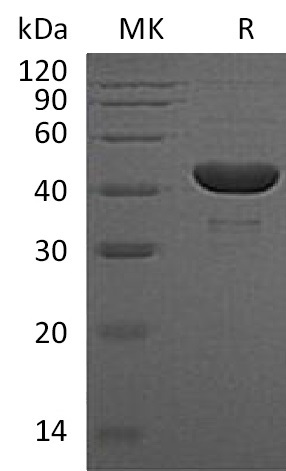 |
Greater than 95% as determined by reducing SDS-PAGE. |
靶点信息 Target Information
| 分子别名Alternative Names | Phosphoglycerate kinase 1Cell migration-inducing gene 10 proteinPrimer recognition protein 2PGK1PGKA |
|---|---|
| 功能Function | Catalyzes one of the two ATP producing reactions in the glycolytic pathway via the reversible conversion of 1,3-diphosphoglycerate to 3-phosphoglycerate. In addition to its role as a glycolytic enzyme, it seems that PGK-1 acts as a polymerase alpha cofactor protein (primer recognition protein). May play a role in sperm motility. |
| 亚细胞定位Subcellular Location | Cytoplasm. |
| 数据库链接Databases |
基因功能参考文献49 条
- PGK1 mutated variants display different catalytic activity and conformational stability compared to the native enzyme. PMID: 29995887 : 29995887
- The results indicate that ALDOA and PGK1 may indicate resistance to cisplatin in osteosarcoma PMID: 29199648 : 29199648
- PGK1 is used to indicate the prognosis of hepatocellular carcinoma (HCC). PMID: 28749413 : 28749413
- Data show that LINC00963 (MetaLnc9) interacted with the glycolytic kinase PGK1 and prevented its ubiquitination in non-small cell lung cancer (NSCLC) cells, leading to activation of the oncogenic AKT/mTOR signaling pathway. PMID: 28923857 : 28923857
- Acetylated PGK1 binds to and phosphorylates Beclin1 at S30, leading to activation of the VPS34-Beclin1 complex to initiate autophagosomal formation. PMID: 28238651 : 28238651
- Data suggest that, in breast cancer cells, MYC acts as an upstream regulator leading to PGK1 activation. (MYC, proto-oncogene c-myc; PGK1, phosphoglycerate kinase 1) PMID: 28457968 : 28457968
- PGK1, a glycolytic enzyme catalyzing the conversion of 3-phosphoglycerate into 2-phosphoglycerate, has increased expression in synovial tissues and blood of rheumatoid arthritis, which may be involved in pro-inflammation and synovial hyperplasia of the disease PMID: 27342824 : 27342824
- In neuroblastoma cells, CAIX and PGK1 expression is up regulated under hypoxia and correlates with response to targeted anti-proliferative treatment. PMID: 26510737 : 26510737
- Mitochindrial PGK1 acts as a protein kinase in coordinating glycolysis and the tricarboxylic acid cycle, which is instrumental in cancer metabolism and tumorigenesis. PMID: 26942675 : 26942675
- PI3K/AKT/mTOR pathway regulates HDAC3 S424 phosphorylation, which promotes HDAC3-PGK1 interaction and PGK1 K220 deacetylation PMID: 26356530 : 26356530
- Retinal dystrophy may be one of the clinical manifestations of phosphoglycerate kinase deficiency. PMID: 26396085 : 26396085
- mutations associated with hPGK1 deficiency lead to increased aggregation and proteolysis rates in vitro and inside cells due to protein thermodynamic destabilization PMID: 24838780 : 24838780
- Results show that PGK1 mRNA and protein expression were significantly increased in breast cancer tissues and can be considered as a prognostic biomarker of chemoresistance to paclitaxel treatment in breast cancer. PMID: 25867275 : 25867275
- Suppression of PGK1 enhanced the radiosensitivity of U251 xenografts and suggest that PGK1 may serve as a useful target in the treatment of radioresistant glioma. PMID: 25175369 : 25175369
- Phosphoglycerate kinase deficiency due to a novel mutation (c. 1180A>G) manifesting as chronic hemolytic anemia in a Japanese boy. PMID: 24934115 : 24934115
- PGK1 appears to play an important role for neuroblastoma PMID: 24376734 : 24376734
- different factors contributing to hPGK1 thermodynamic and kinetic stability PMID: 24721582 : 24721582
- PGK1 could promote radioresistance in U251 human cells. PMID: 24284928 : 24284928
- increased expression of PGK1 in colon cancer tissue is associated with metastasis. PMID: 23727790 : 23727790
- Generif: Phosphoglycerate kinase is a moonlighting protein that functions as both a glycolytic enzyme and a primer recognition protein of DNA polymerase alpha. PMID: 2324090 : 2324090
- Phosphoglycerate kinase is a moonlighting protein that functions as both a glycolytic enzyme and a disulfide reductase. PMID: 11130727 : 11130727
- Conformational dynamics in the catalytic cycle of phosphoglycerate kinase, molecular details provided by structural analysis. [Review] PMID: 23684636 : 23684636
- Glycolytic enzymes PGK1 and PKM2 are novel transcriptional targets of PPARgamma in breast cancer. PMID: 23130662 : 23130662
- the low kinetic stability displayed by PGK1 protein mutations is causing human PGK1 deficiency PMID: 23336698 : 23336698
- Phosphoglycerate kinase 1 was up-regulated significantly in radioresistant astrocytomas and also seems to be correlated with the negative prognosis following radiotherapy. PMID: 22742733 : 22742733
- carbonic anhydrase I, phosphoglycerate kinase 1 and apolipoprotein A-I appeared to be the most significant variations of proteins in patients with osteopenia and osteoarthritis PMID: 22619369 : 22619369
- two key (hub) PPARgamma direct target genes, PRKCZ and PGK1, were experimentally validated to be repressed upon PPARgamma activation by its natural ligand, 15d-PGJ2 in three prostrate cancer cell lines PMID: 21780947 : 21780947
- All findings indicate that the different clinical manifestations associated with PGK1 deficiency chiefly depend on the distinctive type of perturbations caused by mutations in the PGK1 gene PMID: 22348148 : 22348148
- enzyme kinetics studies show that the absence of the ribose OH-groups with is better tolerated for the purine than for the pyrimidine containing compounds in phosphoglycerate kinase 1 PMID: 21505655 : 21505655
- Molecular dynamics simulations were carried out with four different nucleotides (D-/L-ADP and D-/L-CDP) in complex with PGK and 1,3-bisphospho-d-glycerate. The binding affinities of CDPs were very weak while D- and L-ADP were better substrates. PMID: 21549683 : 21549683
- PGK domain movement and catalysis is regulated by a spring-loaded release mechanism PMID: 21349853 : 21349853
- Phosphoglycerate kinase 1 (PGK1) showed a difference between follicular cells from follicles leading to a pregnancy or developmental failure. PMID: 19778949 : 19778949
- PGK1-overexpressing fibroblasts with prostate tumor cells promoted tumor cell growth in vivo. Observations suggest that PGK1 helps support the interactions between cancer and its microenvironment. PMID: 20068185 : 20068185
- Data show that PGK1 regulates the expression of CXCR4 and beta-catenin at the mRNA and protein levels. PMID: 19688824 : 19688824
- Results suggest that conformational rearrangements in the hinge generated by binding of both substrates provide the main driving force for domain closure overcoming the slightly unfavourable contact interactions between the domains. PMID: 19854185 : 19854185
- Phosphorylates pyrimidine L-deoxynucleoside analog diphosphaates PMID: 12080078 : 12080078
- Overexpression induces a multidrug resistance phenotype. PMID: 12174867 : 12174867
- 3-phosphoglycerate kinase has a role in the activation of L-nucleoside analogs PMID: 12869554 : 12869554
- These results demonstrate that phosphpglycerate kinase regulates uPAR expression at the post-transcriptional level. PMID: 14764427 : 14764427
- production and secretion of PGK are regulated separately and oxygen and the protein hydroxylases can control not only gene expression but also protein secretion PMID: 15053920 : 15053920
- phosphoglycerate kinase does not appear to have a role in the development or progression of neoplasms [letter] PMID: 15255553 : 15255553
- During domain closure, Lys 215 in 3-phosphoglycerate kinase possibly moves together with the transferring phosphate, and this group is being positioned properly for catalysis. PMID: 16363799 : 16363799
- The impact of hypoxic treatment on the expression of PGK1 and the cytotoxicity of troxacitabine and gemcitabine are reported. PMID: 17565005 : 17565005
- our study indicates that inhibition of the transcription mechanism is the cause of PGK deficiency. PMID: 17661373 : 17661373
- Aa steady state kinetic and biophysical study of the interaction of the model compound l-MgADP with hPGK, is presented. PMID: 18096512 : 18096512
- Although L-ADP is almost as catalytically competent as D-ADP, under our experimental conditions (buffer containing 30% methanol, 4 degrees C) phosphoglycerate kinase binds D- and L-ADP with similar kinetics. PMID: 18288812 : 18288812
- overexpression of PGK1 and its signalling targets may be a expression-pathway in diffuse primary gastric carcinomas promoting peritoneal dissemination PMID: 18453750 : 18453750
- transmission path of the nucleotide effect toward the main hinge of phosphoglycerate kinase is described for the first time at the level of interactions existing in the tertiary structure[ 3-phosphoglycerate kinase] PMID: 18540639 : 18540639
- PGK1 was selectively overexpressed in human colon tumor cells by treating with hydrogen peroxide as oxidative stress, while its expression was suppressed by co-treatment with antioxidants. PMID: 18603805 : 18603805
蛋白复溶体积计算器缓冲液体积 = 蛋白质量 ÷ 蛋白浓度
输入任意两项,第三项自动计算 |
蛋白浓度稀释计算器初浓度 × 初体积 = 终浓度 × 终体积
输入任意三项,第四项自动计算 |



