


| 纯度Purity | Greater than 90% as determined by reducing SDS-PAGE. |
|---|---|
| 内毒素Endotoxin | Please contact with the lab for this information |
| 蛋白构建Protein Construction |
【Phe31-Val817】序列区间
|
| Accession | P19021 |
| 表达宿主Expression Host | 293F |
| 种属Species | Homo sapiens (Human) |
| 预测分子量Predicted MW | 89.7 kDa |
| 制剂Formulation | Lyophilized from a 0.2 μm filtered solution of PBS, pH7.4, containing 0.01% SKL, 1mM DTT, 5% Trehalose and Proclin300. |
| 运输方式Shipping | The product is shipped with ice bag. Upon receipt, store it immediately at the temperature listed below. |
| 稳定性&储存Stability & Storage | 12 months at -20°C to -80°C in lyophilized state.6 months at -20°C to -80°C under sterile conditions after reconstitution.7-10 days at 2°C to 8°C under sterile conditions after reconstitution.Please minimize freeze-thaw cycles. |
| 复溶Reconstitution | Reconstitute in 10mM PBS (pH7.4) to a concentration of 0.1-1.0 mg/mL. Do not vortex. |
 |
Greater than 90% as determined by reducing SDS-PAGE. |
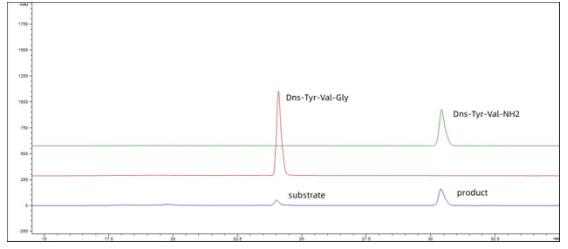 |
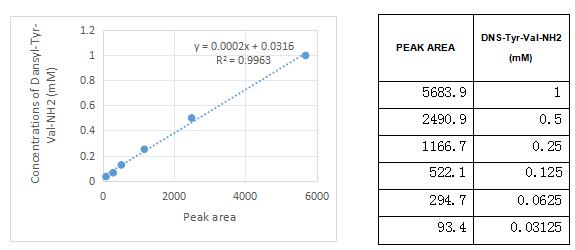
Peptidyl-glycine alpha-amidating monooxygenase (PAM) is an enzyme that is required for the biosynthesis of many signaling peptides. It has two enzymatically active domains with catalytic activities-peptidylglycine alpha-hydroxylating monooxygenase (PHM) and peptidyl-alpha-hydroxyglycine alpha-amidating lyase (PAL). These catalytic domains work sequentially to catalyze neuroendocrine peptides to active alpha-amidated products. A typical activity assay was using Dns-Tyr-Val-Gly as substrate, thus the activity of recombinant human PAM was measured by its ability to hydrolyze Dns-Tyr-Val-Gly to Dns-Tyr-Val-NH2. The reaction was performed in 100 mM MES/KOH pH 6.0, 30 mM KI, 30 mM KCl, 1 uM cupric sulfate, 100 ug/ml catalase (APC418Hu05), 1% (v/v) ethanol, 0.001% (v/v) Triton X-100 and 10 mM ascorbate. 250 ul 0.7 mM substrate of Dns-Tyr-Val-Gly was added with 250 ul various concentrations of recombinant human PAM (1 ug/ml,5 ug/ml, 10 ug/ml and 20 ug/ml). Incubated at 37℃ for 30min, the reaction was stopped by addition 6% (v/v) TCA. The product and substrate was detected by RP-HPLC with UV-detection at 280 nm, the analyses were performed at 25℃ employing a Agilent ZORBAX Poroshell SB C18 column (9.4×250 mm, 5 μm), the flow rate was 1 ml/min. The mobile phase consisted of 100 mM sodium acetate (pH 6.5) and 30 min linear gradient of 10-90% acetonitrile. At 30-35 min, the mobile phase consisted of 90% acetonitrile and 10% sodium acetate. The result was shown in Figure 1. As the Figure 1 shows, the substrate have been hydrolyzed to Dns-Tyr-Val-NH2 after incubating with recombinant human PAM. The retention time of Dns-Tyr-Val-Gly and Dns-Tyr-Val-NH2 is 24.088 and 30.421 respectively (Figure 2). The specific activity of recombinant human PAM is >6600 pmol/min/µg. Figure 2. The reaction product compared with standard Dns-Tyr-Val-Gly and Dns-Tyr-Val-NH2. Figure 3. The sandard curve of Dns-Tyr-Val-NH2 |
 |
| 分子别名Alternative Names | PALPHMPeptidylamidoglycolate lyasePeptidyl-Alpha-hydroxyglycine Alpha-amidating LyasePeptidylglycine Alpha-Hydroxylating Monooxygenase |
|---|---|
| 背景介绍Background | Bifunctional enzyme that catalyzes the post-translational modification of inactive peptidylglycine precursors to the corresponding bioactive alpha-amidated peptides, a terminal modification in biosynthesis of many neural and endocrine peptides. Alpha-amidation involves two sequential reactions, both of which are catalyzed by separate catalytic domains of the enzyme. The first step, catalyzed by peptidyl alpha-hydroxylating monoxygenase (PHM) domain, is the copper-, ascorbate-, and O2- dependent stereospecific hydroxylation (with S stereochemistry) at the alpha-carbon (C-alpha) of the C-terminal glycine of the peptidylglycine substrate. The second step, catalyzed by the peptidylglycine amidoglycolate lyase (PAL) domain, is the zinc-dependent cleavage of the N-C-alpha bond, producing the alpha-amidated peptide and glyoxylate. Similarly, catalyzes the two-step conversion of an N-fatty acylglycine to a primary fatty acid amide and glyoxylate. |
| 功能Function | Bifunctional enzyme that catalyzes the post-translational modification of inactive peptidylglycine precursors to the corresponding bioactive alpha-amidated peptides, a terminal modification in biosynthesis of many neural and endocrine peptides. Alpha-amidation involves two sequential reactions, both of which are catalyzed by separate catalytic domains of the enzyme. The first step, catalyzed by peptidyl alpha-hydroxylating monoxygenase (PHM) domain, is the copper-, ascorbate-, and O2- dependent stereospecific hydroxylation (with S stereochemistry) at the alpha-carbon (C-alpha) of the C-terminal glycine of the peptidylglycine substrate. The second step, catalyzed by the peptidylglycine amidoglycolate lyase (PAL) domain, is the zinc-dependent cleavage of the N-C-alpha bond, producing the alpha-amidated peptide and glyoxylate. Similarly, catalyzes the two-step conversion of an N-fatty acylglycine to a primary fatty acid amide and glyoxylate. |
| 亚细胞定位Subcellular Location | Cytoplasmic vesicle, secretory vesicle membrane; Single-pass membrane protein.; [Isoform 1]: Membrane; Single-pass type I membrane protein.; [Isoform 2]: Membrane; Single-pass type I membrane protein.; [Isoform 3]: Secreted. Note=Secreted from secretory granules.; [Isoform 4]: Secreted. Note=Secreted from secretory granules. |
| 数据库链接Databases |
基因功能参考文献9 条
- PAM single nucleotide polymorphism rs13175330 is associated with hypertension and insulin resistance in a Korean population. PMID: 29162152 : 29162152
- The ancient ability of PAM to localize to ciliary membranes, which release bioactive ectosomes, may be related to its ability to accumulate in intralumenal vesicles and exosomes PMID: 28377049 : 28377049
- Data suggest that His108 and a substrate molecule are involved in the reductive pathway while His172 and Tyr79 are important in the catalytic pathway in the copper-centered electron transfer catalyzed by peptidylglycine monooxygenase. PMID: 26982589 : 26982589
- PAM expression is increased in the secretory pathway of differentiated neurons. PMID: 26879543 : 26879543
- Oxygen Sensitivity of the Peptidylglycine alpha-Amidating Monooxygenase (PAM) in Neuroendocrine Cells PMID: 26296884 : 26296884
- Two missense variants in PAM, encoding p.Asp563Gly (frequency of 4.98%) and p.Ser539Trp (frequency of 0.65%), confer moderately higher risk of type 2 diabetes (OR = 1.23, P = 3.9 x 10(-10) and OR = 1.47, P = 1.7 x 10(-5), respectively) PMID: 24464100 : 24464100
- Detail the production of the catalytic core of human peptidylglycine alpha-hydroxylating monooxygenase (hPHMcc) in Escherichia coli possessing a N-terminal fusion to thioredoxin (Trx). PMID: 22554821 : 22554821
- Data indicate that catalytic inactivation of PHM caused by pH changes is accompanied by structural change between two states of the protein involving strong Cu-S interaction that does not involve M314. PMID: 22080626 : 22080626
- nuclear retention of PAM mRNA is lost upon expressing the La proteins that lack a conserved nuclear retention element, suggesting a direct association between PAM mRNA and La protein in vivo PMID: 16107699 : 16107699
蛋白复溶体积计算器缓冲液体积 = 蛋白质量 ÷ 蛋白浓度
输入任意两项,第三项自动计算 |
蛋白浓度稀释计算器初浓度 × 初体积 = 终浓度 × 终体积
输入任意三项,第四项自动计算 |



