


| 纯度Purity | Greater than 95% as determined by reducing SDS-PAGE. |
|---|---|
| 内毒素Endotoxin | Please contact with the lab for this information |
| 蛋白构建Protein Construction |
【Arg25-Pro372】序列区间
|
| Accession | P06127 |
| 表达宿主Expression Host | 293F |
| 种属Species | Homo sapiens (Human) |
| 预测分子量Predicted MW | 40.3 kDa |
| 制剂Formulation | Lyophilized from a 0.2 μm filtered solution of PBS, pH7.4, containing 0.01% SKL, 1mM DTT, 5% Trehalose and Proclin300. |
| 运输方式Shipping | The product is shipped with ice bag. Upon receipt, store it immediately at the temperature listed below. |
| 稳定性&储存Stability & Storage | 12 months at -20°C to -80°C in lyophilized state.6 months at -20°C to -80°C under sterile conditions after reconstitution.7-10 days at 2°C to 8°C under sterile conditions after reconstitution.Please minimize freeze-thaw cycles. |
| 复溶Reconstitution | Reconstitute in 10mM PBS (pH7.4) to a concentration of 0.1-1.0 mg/mL. Do not vortex. |
 |
Greater than 95% as determined by reducing SDS-PAGE. |
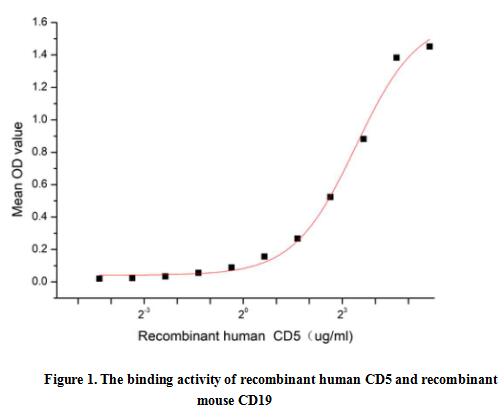 |
Cluster Of Differentiation 5 (CD5) is a cluster of differentiation found on a subset of IgM-secreting B cells called B-1 cells, and also on T cells. B-1 cells have limited diversity of their B-cell receptor due to their lack of the enzyme terminal deoxynucleotidyl transferase (TdT) and are potentially self-reactive. CD5 serves to mitigate activating signals from the BCR so that the B-1 cells can only be activated by a very strong stimuli (such as bacterial proteins) and not by normal tissue proteins. CD5 was used as a T-cell marker until monoclonal antibodies against CD3 were developed. In humans, the gene is located on the long arm of chromosome 11. T cells express higher levels of CD5 than B cells. CD5 is upregulated on T cells upon strong activation. Cluster Of Differentiation 19 (CD19) has a remarkably high affinity for CD5, thus a functional binding ELISA assay was conducted to detect the interaction of recombinant human CD5 and recombinant mouse CD19. Briefly, biotin-linked CD5 were diluted serially in PBS, with 0.01% BSA (pH 7.4). Duplicate samples of 100 ul were then transferred to CD19-coated microtiter wells and incubated for 1h at 37℃. Wells were washed with PBST 3 times and incubation with Streptavidin-HRP for 30min, then wells were aspirated and washed 5 times. With the addition of substrate solution, wells were incubated 15-25 minutes at 37℃. Finally, add 50 µl stop solution to the wells and read at 450 nm immediately. The binding activity of recombinant human CD5 and recombinant mouse CD19 was shown in Figure 1, the EC50 for this effect is 10.6 ug/mL. |
| 分子别名Alternative Names | T1LEU1Lymphocyte antigen T1/Leu-1 |
|---|---|
| 背景介绍Background | May act as a receptor in regulating T-cell proliferation. |
| 功能Function | May act as a receptor in regulating T-cell proliferation. |
| 亚细胞定位Subcellular Location | Cell membrane; Single-pass type I membrane protein. |
| 数据库链接Databases |
基因功能参考文献50 条
- the present results support the notion that CD5 is not only a phenotypic marker but a relevant player in CLL cell biology, as demonstrated by the influence of germline-defined functional CD5 variants on CLL outcome. PMID: 26991857 : 26991857
- ZAP70 is the only gene that is differentially expressed in CD5-high and CD5-low normal B-lymphocytes, confirming the key role of Zap-70 tyrosine kinase in BCR signaling alterations in B-CLL. PMID: 29125235 : 29125235
- The high CD5 plasma levels in patients with severe ASD, probably indicated that CD5 might be implicated in the physiology of autism. However, this finding should be treated with caution until further investigations are performed with larger populations to determine whether the increase in plasma CD5 levels is a mere consequence of autism or it plays a pathogenic role in the disease. PMID: 28406773 : 28406773
- A CD34-negative MYC-rearranged B-lymphoblastic lymphoma aberrantly expresses CD3 and CD5. PMID: 28280048 : 28280048
- study provides understanding of the regulation of CD5 expression on leukaemic T cells, and may help in understanding the molecular mechanism of CD5 down-regulation. PMID: 28752543 : 28752543
- CD5 transcription is increased, leading to the production of three mRNA isoforms by APA, all contributing for protein production, at different levels. PTBP1 binds in the vicinity of pA1, leading to an increase in mRNA levels and miR-204 targets the longer CD5 mRNA. PMID: 27005442 : 27005442
- High CD5 expression is associated with lymphoma in Waldeyer ring. PMID: 27616053 : 27616053
- Thus, trans-signaling of IL-6 can only occur via sIL-6R, but not sCD5. PMID: 28159554 : 28159554
- The major proportion of CD5(low) B cells in patients are leukemic, thus identifying CD5(low) B cells as an important component of CLL, with implications for CLL pathogenesis, clinical monitoring, and the development of anti-CD5-directed therapies. PMID: 27693386 : 27693386
- the CD5 Pro224-Ala471 haplotype in homozygosis improved melanoma survival in the entire set of patients (HR = 0.27, 95% CI 0.11-0.67, Adj. p = 0.005). These findings highlight the relevance of genetic variability in immune-related genes for clinical outcome in melanoma. PMID: 27169428 : 27169428
- R-EPOCH therapy does not seem to impact the known poorer prognosis of patients with de novo CD5+ diffuse large B-cell lymphoma , and CD5 expression was still an independent prognostic factor in R-EPOCH-treated patients with diffuse large B-cell lymphoma. PMID: 28039906 : 28039906
- CD5+B lymphocytes were increased and activated in autoimmune hemolytic anemia patients. PMID: 26968550 : 26968550
- This study confirms the poor prognosis of de novo CD5+ DLBCL in a large multi-center cohort despite initial rituximab-containing chemotherapy and suggests that stem cell transplantation fails to salvage the majority of these patients. PMID: 26800311 : 26800311
- 5.2 % were positive for CD5 and 5.7 % positive for epstein-Barr virus encoded RNA PMID: 26369546 : 26369546
- CD5 polymorphisms are associated with systemic lupus erythematosus. PMID: 25402503 : 25402503
- three tyrosine-based domains within CD5 cytoplasmic tail promote T-cell survival through non-overlapping mechanisms PMID: 26363459 : 26363459
- A case of mantle cell lymphoma with a unique pattern of CD5 negative to positive expression switching in relapse. PMID: 24166616 : 24166616
- useful in distinguishing thymic carcinoma from poorly differentiated lung carcinoma PMID: 23958552 : 23958552
- Data show that the proportion of CD5+ B cells at 1 mo of age is inversely correlated to total IgG levels at 18 and 36 mo of age. PMID: 24928995 : 24928995
- down-regulation of CD5 on activated CD8(+) T cells may serve as a useful marker of dysregulated T cell activation and proliferation in FHL2. PMID: 24051121 : 24051121
- CD5 expression in nodal marginal zone lymphoma correlates with a higher frequency of dissemination, but patients have an indolent clinical course and excellent overall survival. PMID: 24124149 : 24124149
- Our results indicate that CD5(+) B cell subsets might be associated with pathogenesis of SPMS. PMID: 22732449 : 22732449
- Functional CD5-dependent casein kinase 2 signaling is necessary in a CD5 knock-in mouse for efficient differentiation of naive CD4+ T cells into T helper (Th)2 and Th17 cells, but not Th1-type cells. PMID: 22904299 : 22904299
- Case Report: CD5-positive marginal zone B-cell lymphoma of the mucosa-associated lymphoid tissue (MALT) of the lung. PMID: 22333190 : 22333190
- Our results show that CD5 expression is rare in MALT lymphoma, and is often associated with nongastric disease and an increased tendency to present with disseminated disease. PMID: 22406370 : 22406370
- Hepatitis C virus infection of human T lymphocytes is mediated by CD5. PMID: 22278227 : 22278227
- The primary carcinoma showing thymus-like elements of the thyroid frequently expresses KIT and CD5 proteins. PMID: 21835435 : 21835435
- Alternative costimulation via CD5, rather than classic costimulation via CD28, primes naive T cells for stable Th17 development through promoting the expression of IL-23R. PMID: 21926348 : 21926348
- Post-thymic regulation of CD5 levels in human memory T cells is inversely associated with the strength of responsiveness to interleukin-15. PMID: 21539877 : 21539877
- immunological significance of CD19 for the IL-10 production by CD5(+) B cells PMID: 21786452 : 21786452
- Case Report: describe the recurrence of CD5 positive MALT lymphoma in the oral cavity and compared the immunohistochemical expressions of CD5, lambda, and kappa between the primary and recurrent tumors. PMID: 21892966 : 21892966
- CD5 glycoprotein-mediated T cell inhibition dependent on inhibitory phosphorylation of Fyn kinase PMID: 21757751 : 21757751
- Conclude that high percentages of CD5+B cells independently associate with increased risk of early conversion to multiple sclerosis in clinically isolated syndrome patients. PMID: 21436320 : 21436320
- Data show that CD5 expression is associated with NFAT2 activity and mildly STAT3 activity, indicating that CD5 controls IL-10 secretion. PMID: 21398617 : 21398617
- full-length protein variant, encoded by E1A-cd5, translocates the phosphatase SHP-1 to the vicinity of the B-cell receptor, raises its threshold, and thereby limits the response of autoreactive B cells [review] PMID: 21395509 : 21395509
- CD5-positive splenic marginal zone lymphoma may be related to memory B-cell neoplasm or plasma cell differentiation PMID: 21123968 : 21123968
- Type B3 thymic epithelial tumor in an adolescent detected by immunohistochemical staining for CD5, CD99, and KIT (CD117): a case report. PMID: 19901887 : 19901887
- CD5-negative regulation of B cell receptor signaling originates from tyrosine residue Y429 outside an immunoreceptor tyrosine-based inhibitory motif PMID: 11751967 : 11751967
- Origins and functions of B-1 cells with notes on the role of CD5. Review. PMID: 11861604 : 11861604
- multiple somatic mutations in human cancers. the value of the CD5 microsatellite as a marker for instability in different tumor types, particularly in B-cell leukemia and lymphoma. PMID: 11869933 : 11869933
- CD5 supports the survival of B cells by stimulating IL-10 production and by concurrently exerting negative feedback on BCR-induced signaling events that can promote cell death. PMID: 12393419 : 12393419
- CD5-negative, CD10-negative small B-cell leukemia: variant of chronic lymphocytic leukemia or a distinct entity PMID: 12447961 : 12447961
- CD5 is rapidly recruited at the immunological synapse (IS) and lowers the T cell response elicited by antigen presentation by targeting downstream signaling events without affecting IS formation. PMID: 12707340 : 12707340
- The CD5+ diffuse large-B-cell lymphoma (DLBCL) constitutes a disease category distinct from that of CD5- DLBCL and other CD5+ malignancies. PMID: 14603444 : 14603444
- the 5'-flanking region of human CD5 is transcriptionally active in T cells, and Ets transcription factors in conjunction with other regulatory elements are responsible for constitutive and tissue-specific CD5 expression PMID: 15187131 : 15187131
- Overexpression in these cells indicates diseaase progression in B=cell leukemia patients. PMID: 15549146 : 15549146
- CD5 is associated with receptor revision in activated mature B cells and likely to promote expression of suitable immunoglobulin gene receptors capable of initiating the germinal center reaction. PMID: 15843554 : 15843554
- The polymorphic CD5 promoter is associated with increased susceptibility to B-cell chronic lymphocytic leukemia and mantle cell lymphoma. PMID: 15981803 : 15981803
- balance between the 2 alternative exons 1 might be central to the regulation of membrane CD5 in human B cells PMID: 15998834 : 15998834
- analysis of CD5-positive diffuse large B-cell lymphoma with the unusual phenotype of cytoplasmic CD20 (+), surface CD20 (-) [case report] PMID: 16923582 : 16923582
蛋白复溶体积计算器缓冲液体积 = 蛋白质量 ÷ 蛋白浓度
输入任意两项,第三项自动计算 |
蛋白浓度稀释计算器初浓度 × 初体积 = 终浓度 × 终体积
输入任意三项,第四项自动计算 |



