


| 纯度Purity | Greater than 90% as determined by reducing SDS-PAGE. |
|---|---|
| 内毒素Endotoxin | Please contact with the lab for this information |
| 蛋白构建Protein Construction |
【Cys2-Ala132】序列区间
|
| Accession | P15090 |
| 表达宿主Expression Host | 293F |
| 种属Species | Homo sapiens (Human) |
| 预测分子量Predicted MW | 16.2 kDa |
| 制剂Formulation | Lyophilized from a 0.2 μm filtered solution of PBS, pH7.4, containing 0.01% SKL, 1mM DTT, 5% Trehalose and Proclin300. |
| 运输方式Shipping | The product is shipped with ice bag. Upon receipt, store it immediately at the temperature listed below. |
| 稳定性&储存Stability & Storage | 12 months at -20°C to -80°C in lyophilized state.6 months at -20°C to -80°C under sterile conditions after reconstitution.7-10 days at 2°C to 8°C under sterile conditions after reconstitution.Please minimize freeze-thaw cycles. |
| 复溶Reconstitution | Reconstitute in 10mM PBS (pH7.4) to a concentration of 0.1-1.0 mg/mL. Do not vortex. |
 |
Greater than 90% as determined by reducing SDS-PAGE. |
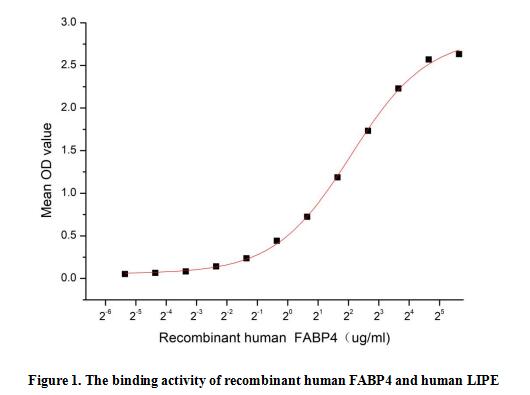 |
Fatty acid binding protein-4 (FABP4) is a member of a large superfamily of lipid binding proteins that are expressed in a tissue specific manner. FABP4 is one of ten cytoplasmic FABPs that are 14-15 kDa in size and range from 126-140 amino acids (aa) in length. Although all are highly conserved in their tertiary structure, there is only modest aa identity between any two members. Lipase, Hormone Sensitive (LIPE) has been identified as an interactor of FABP4, thus a binding ELISA assay was conducted to detect the interaction of recombinant human FABP4 and recombinant human LIPE. Briefly, FABP4 were diluted serially in PBS, with 0.01% BSA (pH 7.4). Duplicate samples of 100 ul were then transferred to LIPE-coated microtiter wells and incubated for 1h at 37℃. Wells were aspirated and incubated for 1h with anti-FABP4 mAb, then aspirated and washed 3 times. After incubation with HRP labelled secondary antibody, wells were aspirated and washed 5 times. With the addition of substrate solution , wells were incubated 15-25 minutes at 37℃. Finally, add 50 µL stop solution to the wells and read at 450 nm immediately. The binding activity of FABP4 and LIPE was shown in Figure 1, and this effect was in a dose dependent manner. The EC50 for this effect is 4.23 ug/mL. |
| 分子别名Alternative Names | A-FABPAFABPAP2Fatty Acid Binding Protein 4, AdipocyteAdipocyte Protein 2Adipocyte-type fatty acid-binding protein |
|---|---|
| 背景介绍Background | Lipid transport protein in adipocytes. Binds both long chain fatty acids and retinoic acid. Delivers long-chain fatty acids and retinoic acid to their cognate receptors in the nucleus. |
| 功能Function | Lipid transport protein in adipocytes. Binds both long chain fatty acids and retinoic acid. Delivers long-chain fatty acids and retinoic acid to their cognate receptors in the nucleus. |
| 亚细胞定位Subcellular Location | Cytoplasm. Nucleus. |
| 数据库链接Databases |
基因功能参考文献50 条
- FABP4 shows potential as a novel biomarker for diabetic retinopathy prediction in Chinese patients with type 2 diabetes (T2DM), and strict glycemic control and more frequent retinal examination should be highlighted for T2DM patients with the highest quartile range of FABP4. PMID: 29305311 : 29305311
- association between serum FABP4 concentrations and sarcopenia in chronic hemodialysis patients PMID: 29935964 : 29935964
- intermittent high glucose potentiates A-FABP activation and inflammatory responses via TLR4/p-JNK signaling in THP-1 cells PMID: 29850615 : 29850615
- High serum A-FABP concentration is associated with peripheral arterial disease in women, but not men, with type 2 diabetes mellitus. PMID: 28303680 : 28303680
- FABP4 from adipocytes mediate adipocyte-cholangiocarcinoma interactions that are crucial for the invasion, migration and epithelial-mesenchymal transition of cholangiocarcinoma cells PMID: 29237483 : 29237483
- Compared with the low arterial stiffness group, the high arterial stiffness group had higher values for age, systolic blood pressure, pulse pressure, duration of kidney transplantation and serum A-FABP PMID: 28660445 : 28660445
- Blood FABP4 is a biomarker for metabolic syndrome and cardiovascular disease independently of HIV status and antiretroviral therapy. PMID: 29304747 : 29304747
- Increased FABP4 blood level is a biomarker of lead exposure in women. PMID: 29264639 : 29264639
- ubiquitylation destabilizes the fold of two proteins, FKBP12 and FABP4 PMID: 27991582 : 27991582
- Compared to control group, breast cancer patients show higher FABP4 and FABP5 blood levels. Our data suggest that, particularly, circulating FABP4 levels could be considered a new independent breast cancer biomarker. Our work translates basic science data to clinic linking the relationship between adipose tissue and lipid metabolism to breast cancer. PMID: 28701570 : 28701570
- findings reveal a pro-angiogenic role of FABP4 in first trimester placental trophoblast cells and its regulation may have impact in placental physiology. PMID: 28620819 : 28620819
- A-FABP concentration was an independent predictor of cardiovascular events in patients with stable angina undergoing percutaneous coronary intervention. PMID: 29017449 : 29017449
- Ectopic expression and secretion of FABP4 in vascular endothelial cells contribute to neointima formation after vascular injury. PMID: 28903937 : 28903937
- Elevated A-FABP concentration could be a predictor for MetS and arterial stiffness in hypertensive patients PMID: 28860092 : 28860092
- The present study demonstrated that the androgen was correlated with the serum A-FABP levels negatively in men, but positively in women. PMID: 27270834 : 27270834
- Increased second trimester plasma FABP4 independently predicted GH/PE in GDM patients PMID: 29394285 : 29394285
- our research demonstrated that high FABP3 or FABP4 expression had strong prognostic value for overall survival in non-small cell lung cancer PMID: 27323829 : 27323829
- The distribution of genotype frequencies in the assessed women (PON1 Q192R polymorphism) was QQ = 20%, QR = 48% and RR = 32%. Significantly higher serum FABP4 levels were found in women with genotype QR/RR (20.6 +/- 2.20 ng/mL), when compared with the levels found in the QQ group (12.8 +/- 1.70 ng/mL) (p = .004). PMID: 27712128 : 27712128
- serum A-FABP levels were increased significantly in normoglycemic individuals with a first-degree family history of diabetes; the use of serum A-FABP as a biomarker in the first-degree relatives of patients with diabetes may result in overestimation of the risk of obesity-induced metabolic disease and cardiovascular disease PMID: 27534843 : 27534843
- Findings in the dorsolateral prefrontal cortex in schizophrenia provide evidence of altered proteins involved in synaptic function (FABP4), cytoarchitecture organization (NEFH), and circadian molecular clock signaling (CSNK1E), which may be contributing to the cognitive and/or negative symptoms in this disorder. FABP4, CSNK1E and NEFH could become potentially useful biomarkers for schizophrenia. PMID: 27236410 : 27236410
- Circulating levels of AFABP and EFABP are not decreased in Lipodystrophy despite adipose tissue loss in contrast to other adipokines including leptin and adiponectin. PMID: 28088613 : 28088613
- Taken together, PPAR gamma and FABP4 gene expression levels in PBMCs [peripheral blood mononuclear cells] may be indicators of metabolic factors and body composition components. PMID: 27563749 : 27563749
- eFABP4 induces ER stress and potentiates the effect of linoleic acid in HepG2 cells, suggesting that FABP4 could be a link between obesity-associated metabolic abnormalities and hepatic insulin resistance mechanisms PMID: 27155388 : 27155388
- Increased second-trimester FABP4 independently predicted pre-eclampsia in women with type 1 diabete and significantly improved reclassification and discrimination. PMID: 27630211 : 27630211
- High levels of FABP4 are significantly related to stroke risk and severity, independent from other traditional and emerging risk factors, suggesting that they may play a role in stroke pathogenesis. PMID: 28781090 : 28781090
- We found that serum FABP4 concentration were associated with insulin resistance and secretion in type 2 diabetes mellitus. This suggests that FABP4 may play an important role in glucose homeostasis. PMID: 28654680 : 28654680
- High FABP4 expression is associated with ovarian cancer. PMID: 27568980 : 27568980
- AFABP levels were higher in neonates compared with adults. Preterm infants had higher AFABP levels compared with full-term infants. Among full-term infants, AFABP levels in SGA infants were lower, compared with appropriate for gestational age and large for gestational age infants. PMID: 28324040 : 28324040
- Exogenous FABP4 plays a key role in tumor proliferation and activates the expression of fatty acid transport proteins in MCF-7 breast cancer cells. PMID: 27061264 : 27061264
- High FABP4 expression is associated with Acute Monocytic Leukemia. PMID: 28108519 : 28108519
- FABP4 over-expression in cardiomyocytes can aggravate the development of cardiac hypertrophy through the activation of ERK signal pathway. PMID: 27294862 : 27294862
- Results show that serum FABP4 levels were significantly increased in patients with psoriasis. PMID: 27864793 : 27864793
- secreted FABP4 and FABP5 from adipocytes as adipokines differentially affect transcriptional and metabolic regulation in ADSC near adipocytes PMID: 27936164 : 27936164
- FABP4 locally produced by epicardial/perivascular fat and macrophages in vascular plaques contributes to the development of coronary atherosclerosis. PMID: 27013610 : 27013610
- Elevated levels of FABP4 are associated with higher cardiovascular mortality among men with type 2 diabetes. PMID: 27609367 : 27609367
- These genes should be at the downstream of signal pathways and be regulated by the 23 genes identified before. Our findings may provide a unique new model for studying the molecular control of cattle cross-talk between adipose and skeletal muscle. PMID: 27856250 : 27856250
- higher serum A-FABP level is positively associated with MetS in type 2 DM patients PMID: 28042581 : 28042581
- FABP4 level was independently associated with gender, adiposity, renal dysfunction, and levels of cholesterol. PMID: 27241838 : 27241838
- FABP4 DNA hypomethylation induced by Hcy may be involved in the overexpression of FABP4, thereby inducing cholesterol accumulation in macrophages. PMID: 27221153 : 27221153
- Study found that the fasting insulin and age-adjusted AFABP concentrations were significantly higher in the gestational diabetes mellitus group of women compared with the normal glucose tolerance participants in the mid- and late stages of pregnancy. PMID: 27181269 : 27181269
- mTOR/FABP4 signaling pathway directly regulates the proliferation of endothelial cells in hemangioma. Rapamycin and inhibitors of FABP4 have therapeutic potential for treating infantile hemangiomas. PMID: 27914823 : 27914823
- Results suggested that the expression of a lipid metabolism-related gene and an important SNP in the 3'-UTR of FABP4 are associated with TNBC prognosis. PMID: 26959740 : 26959740
- In multiple linear regression stepwise analysis, BMI, HbA1C, and HOMA-IR were significantly independent determinants for A-FABP. BMI, HbA1C, and HOMA-IR are independently associated with A-FABP in obese subjects with newly diagnosed type 2 diabetes. A-FABP may be related to insulin resistance and inflammation in type 2 diabetes and concomitant obesity. PMID: 27819006 : 27819006
- The increase in placental FABP4 expression in preeclampsia may affect the function of trophoblast, and this increase may have a role in the pathogenesis of preeclampsia. PMID: 26992681 : 26992681
- our findings set up a novel mechanism for FABP4, adipsin and adiponectin through gut microbiota mediating expression in gut Paneth cells. PMID: 26687459 : 26687459
- results underline a gender difference in FABP4 secretion in stable COPD patients. PMID: 26823558 : 26823558
- Increased FABP4 level showed increased risk for reduced lung function in subjects with normal ventilatory function. PMID: 26887419 : 26887419
- High FABP expression is associated with Sepsis. PMID: 27089280 : 27089280
- Serum irisin might exert antagonistic effects on FABP4 in the middle-aged Chinese population. PMID: 26752184 : 26752184
- Urinary FABP4 level is independently correlated with level of albuminuria and possibly predicts yearly decline of estimated glomerular filtration rate. Urinary FABP4 would be a novel biomarker of glomerular damage. PMID: 25506691 : 25506691
蛋白复溶体积计算器缓冲液体积 = 蛋白质量 ÷ 蛋白浓度
输入任意两项,第三项自动计算 |
蛋白浓度稀释计算器初浓度 × 初体积 = 终浓度 × 终体积
输入任意三项,第四项自动计算 |



