


| 纯度Purity | Greater than 80% as determined by reducing SDS-PAGE. |
|---|---|
| 内毒素Endotoxin | Please contact with the lab for this information |
| 蛋白构建Protein Construction |
【Arg23-Leu145】序列区间
|
| Accession | P22749 |
| 表达宿主Expression Host | 293F |
| 种属Species | Homo sapiens (Human) |
| 预测分子量Predicted MW | 15.6 kDa |
| 制剂Formulation | Lyophilized from a 0.2 μm filtered solution of PBS, pH7.4, containing 0.01% SKL, 1mM DTT, 5% Trehalose and Proclin300. |
| 运输方式Shipping | The product is shipped with ice bag. Upon receipt, store it immediately at the temperature listed below. |
| 稳定性&储存Stability & Storage | 12 months at -20°C to -80°C in lyophilized state.6 months at -20°C to -80°C under sterile conditions after reconstitution.7-10 days at 2°C to 8°C under sterile conditions after reconstitution.Please minimize freeze-thaw cycles. |
| 复溶Reconstitution | Reconstitute in 10mM PBS (pH7.4) to a concentration of 0.1-1.0 mg/mL. Do not vortex. |
 |
Greater than 80% as determined by reducing SDS-PAGE. |
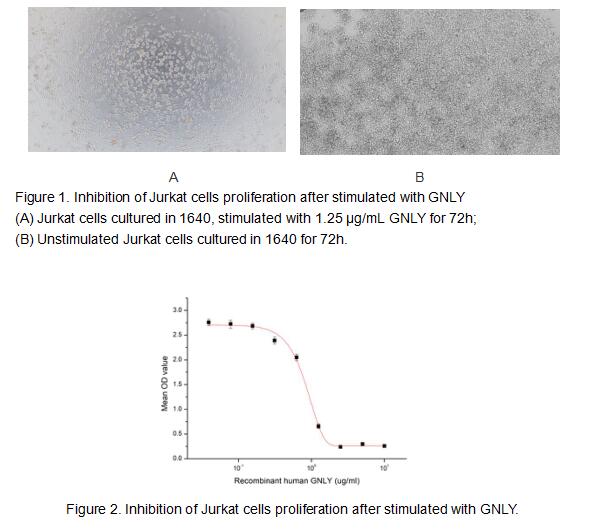 |
Granulysin (GNLY) is a member of the saposin-like protein (SAPLIP) family of membrane disrupting proteins. Granulysin is expressed in granules of natural killer and activated cytotoxic T cells. It exhibits cytolytic activity against intracellular or extracellular microbes and also tumors, either alone or in synergy with perforin. Human granulysin has structural similarity and 30 - 40% aa identity to granulysins and NK-lysins of other mammals such as bovine, porcine and canine; similar peptides in rodents have not been identified. The 15 kDa unglycosylated protein contains five helical domains; helix 2 and 3 contain 9 arginines and one cysteine critical for activity. The activity of GNLY is usually measured by a cell apoptosis assay using Jurkat cells. Jurkat cells were seeded into triplicate wells of 96-well plates at a density of 8,000 cells/well with 5% serum standard 1640 which contains various concentrations of recombinant human GM-CSF. After incubated for 3 days, cells were observed by inverted microscope and cell proliferation was measured by Cell Counting Kit-8 (CCK-8). Briefly, 10 µl of CCK-8 solution was added to each well of the plate, then the absorbance at 450 nm was measured using a microplate reader after incubating the plate for 2-4 hours at 37 ℃. Apoptosis of Jurkat cells after incubation with GNLY for 3 days observed by inverted microscope was shown in Figure 1. Cell viability was assessed by CCK-8 (Cell Counting Kit-8 ) assay after incubation with recombinant human GNLY for 3 days. The result was shown in Figure 2. It was obvious that GNLY significantly decreased cell viability of Jurkat cells. The ED50 is 0.84 ug/ml. |
| 分子别名Alternative Names | NKG5LAG-2TLA519T-Lymphocyte Activation Gene 519 |
|---|---|
| 背景介绍Background | Antimicrobial protein that kills intracellular pathogens. Active against a broad range of microbes, including Gram-positive and Gram-negative bacteria, fungi, and parasites. Kills Mycobacterium tuberculosis. |
| 功能Function | Antimicrobial protein that kills intracellular pathogens. Active against a broad range of microbes, including Gram-positive and Gram-negative bacteria, fungi, and parasites. Kills Mycobacterium tuberculosis. |
| 亚细胞定位Subcellular Location | Secreted. Note=Located in the cytotoxic granules of T-cells, which are released upon antigen stimulation. |
| 数据库链接Databases |
基因功能参考文献50 条
- The results suggest granulysin as a novel marker for a subset of cytotoxic natural killer cell derived malignancies PMID: 30151671 : 30151671
- These results suggest that the 15 kDa granulysin exhibits a novel mechanism in bacteria killing in a way that's different from most antimicrobial peptides. PMID: 27276051 : 27276051
- Decreased blood granulysin at the protein level, is linked to the immunological condition of latent tuberculosis infection. PMID: 27756230 : 27756230
- Carbamate pesticides significantly reduced the intracellular levels of perforin, GrA, GrB, Gr3/K, and GRN in NK-92CI cells. PMID: 25921628 : 25921628
- serum GNLY is closely associated with the clinical characteristics of nasopharyngeal carcinoma and may be a potential biomarker for nasopharyngeal carcinoma PMID: 26751807 : 26751807
- GNLY delivers Gzms into three protozoan parasites (Trypanosoma cruzi, Toxoplasma gondii and Leishmania major), in which the Gzms generate superoxide and inactivate oxidative defense enzymes to kill the parasite. PMID: 26752517 : 26752517
- Studies indicate that cytotoxic mechanisms mediated by granulysin and TRAIL (TNF-related apoptosis inducing ligand) seem to be less secondary effects on normal tissues. PMID: 26314314 : 26314314
- High Granulysin expression is associated with Cutaneous T Cell Lymphoma and Sezary Syndrome. PMID: 26225678 : 26225678
- A three-way interaction between SNPs in HLA-DQ and GNLY was identified in terms of HBV clearance. PMID: 25644528 : 25644528
- GNLY-expressing lymphocytes, probably attracted by IL-15, not only participate partially in myocardial cell apoptosis, but also hasten resolution of cardiac leukocyte infiltration in patients with myocardial infarction. PMID: 21967803 : 21967803
- Peptides encoded by this gene display antimicrobial activity against S. typhimurium, L. monocytogenes, E. coli, S. aureus, C. neoformans, C. albicans, L. major, and M. tuberculosis. PMID: 10644038 : 10644038
- Serum granulysin levels were significantly elevated in both acute and chronic alopecia areata patients. PMID: 24035442 : 24035442
- Human, but not rodent, cytotoxic granules also contain granulysin, an antimicrobial peptide in addition to granzymes; study shows that granulysin delivers granzymes into bacteria to kill diverse bacterial strains. PMID: 24906149 : 24906149
- It was concluded taht granulysin induces apoptosis on hematological tumor cells and on cells from B-cell lymphocytic leukemia patients, opening the door to research on its use as a new anti-tumoral treatment. PMID: 24269628 : 24269628
- suggested that the alteration of circulating granulysin has potential function in host immune response against TB and HIV/TB coinfection PMID: 23801887 : 23801887
- study to determine: expression of GNLY at the gene and protein levels at the maternal-fetal interface, relationship(s) between GNLY and perforin, and GNLY secretion by stimulated NK cells PMID: 23399514 : 23399514
- Granulysin is closely associated with the characteristics of NK-cell neoplasms and serum granulysin may serve as a novel biomarker for these disorders. PMID: 22890551 : 22890551
- GNLY polymorphism genotypes and diplotypes were associated with the chronicity of HBV PMID: 22788687 : 22788687
- recombinant 15 kDa granulysin is not cytolytic but is a potent inducer of monocytic differentiation to dendritic cells PMID: 22586033 : 22586033
- Proliferating memory T cells (CFSE(low)CD4(+)CD45RO(+)) were identified as main source of granulysin and these cells expressed both central and effector memory phenotype PMID: 22216262 : 22216262
- Findings suggest that Vgamma9Vdelta2 T cell-mediated production of granulysin as an underestimated immune effector in malaria. PMID: 22045985 : 22045985
- Granulysin is expressed at different levels in multiple cutaneous adverse drug reactions both by NKp46(+) cells and by CD8(+) T cells. PMID: 21819408 : 21819408
- All these data clearly show the abundant expression and spontaneous secretion of GNLY by decidual NK cells during first trimester pregnancy. PMID: 21623991 : 21623991
- Gene expression profiles of monocytes cultured with 15 kDa Granulysin or GM-CSF for 4, 12, 24 and 48 hours were analysed to unravel both similarities and differences between the effects of these stimulators. PMID: 21501511 : 21501511
- Cytotoxic T- and natural killer (NK) cell-delivered transgenic granulysin induces endoplasmic reticulum stress, activating caspase-7 and distinct apoptotic pathways in target cells. PMID: 21296981 : 21296981
- Both 9- and 15-kDa forms of recombinant GNLY-induced in vitro chemotaxis and activation of both human and mouse dendritic cells. PMID: 20660289 : 20660289
- these data provide details about the complex regulation leading to granulysin expression and anticryptococcal activity in primary CD4(+) T cells. PMID: 20889547 : 20889547
- The megakaryoblastic leukemia cell line CMK, from a Down's syndromept, expressed granulysin mRNA, suggesting that GNLY is occasionally present in immature multilineage cells or may be characteristic of leukemic cells obtained from Down's syndrome pts. PMID: 12145461 : 12145461
- Up-regulation of granulysin in primary CD8 T cells correlates with the acquisition of anticryptococcal activity, which can be blocked by specific inhibition of granulysin. PMID: 12421959 : 12421959
- Sequence analysis of this gene do not support it as a candidate gene for familial hemophagocytic lymphohistiocytosis. PMID: 12483306 : 12483306
- Data report the initial crystal structure of selenomethionyl granulysin by MAD phasing at 2A resolution. PMID: 12488100 : 12488100
- Granulysin is detected in a granular pattern in the cytoplasm of alpha GalCer-activated NKT cells consistent with their presence within cytotoxic granules and suggests that these cells can mediate antimicrobial activity. PMID: 12626573 : 12626573
- mRNA expression measurement of granulysin in urinary cells of renal allograft ents allows the early noninvasive detection of ongoing acute rejection. PMID: 15223905 : 15223905
- granulysin was found exclusively in endosomal-phagosomal vesicles; lipid raft microdomains, enriched in the immunological synapse, may thus enhance uptake and transfer of granulysin into bacterial infected host cells PMID: 15778384 : 15778384
- Granulysin not only contributes to innate immunity but also to adaptive immunity as it attracts and activates human monocytes, dendritic, natural killer (NK) and T cells. PMID: 15843520 : 15843520
- Granulysin expression in CD8 cells seems to be correlated with steroid resistance in polymyositis PMID: 16980658 : 16980658
- These cells use granulysin as the effector molecule, and priming is dysregulated in HIV-infected patients, which results in defective microbicidal activity PMID: 17038537 : 17038537
- This study shows that the regulation of granulysin synthesis in response to IL-2 or bacterial antigen stimulation occurs at several levels: RNA expression, extensive alternative splicing and posttranslational processing. PMID: 17596262 : 17596262
- Serum granulysin is elevated in patients with hemophagocytic lymphohistiocytosis PMID: 18192122 : 18192122
- study found PI3K & STAT5 signaling pathways are required for granulysin expression & IL-2Rbeta induction & IL-2Rbeta induction is a prerequisite for granulysin expression; both signaling pathways are defective in CD4+ T cells from HIV-infected patients PMID: 18490721 : 18490721
- Increased expression in pbmc and elevated serum levels correlated with the severity of primary biliary cirrhosis PMID: 18584314 : 18584314
- granulysin is involved in spontaneous abortion. PMID: 18688023 : 18688023
- Granulysin in the blister fluids was a 15-kDa secretory form PMID: 19029983 : 19029983
- serum granulysin is a novel parameter of patients cancer immunity PMID: 19106590 : 19106590
- Results demonstrate the localization and effect of intracellularly expressed granulysin on non-native cancer cells and indicate its potential utility in gene therapy for cancer. PMID: 19111751 : 19111751
- High granulysin mrna expression is associated with systemic anaplastic large cell lymphoma. PMID: 19243819 : 19243819
- Granulysin can target lysosomes to induce partial release of lysosomal contents into the cytosol; relocalized lysosomal cathepsin B can process Bid to active tBid to cause cytochrome c and apoptosis-activating factor release from mitochondria. PMID: 19454696 : 19454696
- HIV-1 infection of peripheral blood mononuclear cells may reduce the antimicrobial profile of activated CD8+ T cells by disrupting signaling events that are critical for the induction of granulysin. PMID: 19687290 : 19687290
- GLS/IL-12-modified Mycobacterium smegmatis as a novel anti-tuberculosis immunotherapeutic vaccine. PMID: 19861007 : 19861007
- This molecule activates a pathway of CTL- and NK cell-mediated death via disruption of cell and mitochondrial membranes. This is a distinct pathway from granzyme- and death receptor-induced apoptosis. PMID: 11418670 : 11418670
蛋白复溶体积计算器缓冲液体积 = 蛋白质量 ÷ 蛋白浓度
输入任意两项,第三项自动计算 |
蛋白浓度稀释计算器初浓度 × 初体积 = 终浓度 × 终体积
输入任意三项,第四项自动计算 |



