


| 纯度Purity | Greater than 90% as determined by reducing SDS-PAGE. |
|---|---|
| 内毒素Endotoxin | Please contact with the lab for this information |
| 蛋白构建Protein Construction |
【Phe22-Trp435】序列区间
|
| Accession | Q12794 |
| 表达宿主Expression Host | 293F |
| 种属Species | Homo sapiens (Human) |
| 预测分子量Predicted MW | 47.6 kDa |
| 制剂Formulation | Lyophilized from a 0.2 μm filtered solution of PBS, pH7.4, containing 0.01% SKL, 1mM DTT, 5% Trehalose and Proclin300. |
| 运输方式Shipping | The product is shipped with ice bag. Upon receipt, store it immediately at the temperature listed below. |
| 稳定性&储存Stability & Storage | 12 months at -20°C to -80°C in lyophilized state.6 months at -20°C to -80°C under sterile conditions after reconstitution.7-10 days at 2°C to 8°C under sterile conditions after reconstitution.Please minimize freeze-thaw cycles. |
| 复溶Reconstitution | Reconstitute in 10mM PBS (pH7.4) to a concentration of 0.1-1.0 mg/mL. Do not vortex. |
 |
Greater than 90% as determined by reducing SDS-PAGE. |
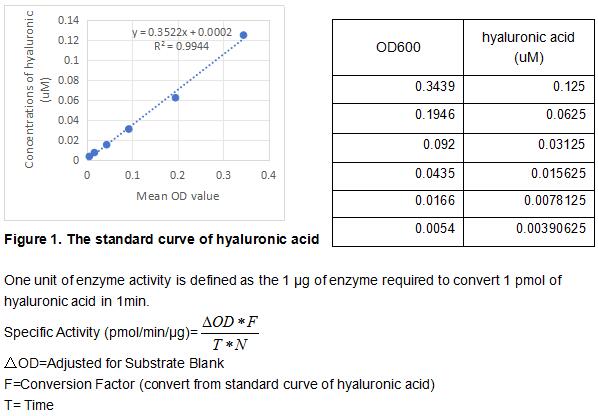 |
Hyaluronidase (HAase) is a general term for enzymes that can hydrolyze hyaluronic acid. It is an enzyme that can reduce the activity of hyaluronic acid in the body, thereby improving the fluid permeability in tissues. When used in the human body, it can temporarily reduce the viscosity of the intercellular matrix, promote subcutaneous infusion, locally accumulated exudate or blood to accelerate diffusion and facilitate absorption, and is an important drug dispersant. Clinically used as a drug penetrating agent to promote drug absorption, promote local edema or hematoma dissipation after surgery and trauma. Human HAase consists of 435 amino acids which contains a signal peptide of 1-21 amino acids and it shares 74% and 75% amino acid sequence homology with mouse and rat respectively. The activity assay of recombinant human HAase was measured by its ability to hydrolyze the substrate hyaluronic acid. The rhHAase was diluted to 0.5 ug/ml in 8.46 mM NaH2PO4, 11.54 mM Na2HPO4, 77 mM NaCl, 0.1 mg/ml BSA, pH 7. 50 ul 0.5 ug/ml rhHAase was added into the microplate and start the reaction by adding 50 µL of 0.3 mg/ml substrate which was diluted in 300mM NaH2PO4, pH 5.35. Incubated at 37 °C for 5min and add 50 ul reaction mixture to 250 ul 1 mg/ml BSA in 24 mM sodium acetic, 79 mM acetic acid, pH 3.75. Incubated at room temperature for 10min and read at a wavelength of 600 nm. The specific activity of recombinant human HAase is >30 pmol/min/µg. |
| 分子别名Alternative Names | Hyaluronic LaseHyaluroniclase |
|---|---|
| 背景介绍Background | May have a role in promoting tumor progression. May block the TGFB1-enhanced cell growth. |
| 功能Function | May have a role in promoting tumor progression. May block the TGFB1-enhanced cell growth. |
| 亚细胞定位Subcellular Location | Secreted. Lysosome. |
| 数据库链接Databases |
基因功能参考文献39 条
- Data revealed a significant inverse correlation between ERalpha and HYAL1 gene expression in human breast tumors. HYAL1 was found repressed by estrogen through ERalpha binding to a consensus response element (ERE) located in the proximal promoter of HYAL1 and flanked by an Sp1 binding site, required to achieve optimal estrogen repression. PMID: 27764788 : 27764788
- Ureaplasma urealyticum infection may affect the activity of hyaluronidase on spermatozoa PMID: 28012250 : 28012250
- our results suggest that the enzyme HYAL1 plays a role in tumor dissemination and brain-specific colonization, rather than in subsequent metastatic out-growth. PMID: 28168629 : 28168629
- HAS2 and HAS3 were the only hyaluronan synthases detected, the expression of which was almost similar in NPs and NM. PMID: 26661071 : 26661071
- Molecular docking simulation explains the less favorable binding energy of substrate towards mutant E268K, thereby providing a structural basis for its reduced catalytic activity. PMID: 27424109 : 27424109
- The receiver-operating characteristic curve analyses demonstrated that each one had good sensitivity and specificity for distinguishing BC patients from non-BC ones (HYAL1, miR-210, miR-96, lncRNA-UCA1, 91.5 and ). PMID: 26138586 : 26138586
- Study showed that reduced HYAL1 expression was associated with endometrial carcinoma aggressiveness, which further supported the role of hyaluronan degradation in cancer progression. PMID: 25584766 : 25584766
- Results demonstrated that HYAL1 was C-mannosylated and suggest the possible role of C-mannosylation for secretion and enzymatic activity of HYAL1. PMID: 24820161 : 24820161
- In contrast to the previously described MPS IX patient, our three patients display a phenotype limited to the joints, suggesting that this is the primary manifestation of HYAL1 deficiency. PMID: 21559944 : 21559944
- Upregulation of HYAL1 expression in breast cancer promoted tumor cell proliferation, migration, invasion and angiogenesis. PMID: 21829529 : 21829529
- This is the first report showing high HYAL-1 levels in epithelial ovarian cancer. PMID: 21695196 : 21695196
- HYAL-1 and HAS1 expression predicted BCa metastasis, and HYAL-1 expression also predicted disease-specific survival. PMID: 20960509 : 20960509
- HYAL1 overexpression is correlated with the malignant behavior of breast cancer. PMID: 20473947 : 20473947
- Hyaluronan synthases (HAS1-3) and hyaluronidases (HYAL1-2) in the accumulation of hyaluronan in endometrioid endometrial carcinoma PMID: 20875124 : 20875124
- Overexpression of HYAL1 is associated with colorectal cancer. PMID: 20849597 : 20849597
- The protein products HABP2 and HYAL1 were associated with plasma PAI-1 concentration and play key roles in hyaluronan metabolism, providing genetic evidence to link these pathways. PMID: 20558613 : 20558613
- rhHyal-1 is endocytosed by the liver. PMID: 20572808 : 20572808
- HYAL-1 is a potential prognostic marker for predicting progression to muscle invasion and recurrence in bladder cancer. PMID: 19345473 : 19345473
- Data show that a significant in expression levels of HA synthases (HASs) and hyaluronidases (Hyals) was observed in vitro on stimulation of epithelial ovarian carcinoma cells by gonadotropins. PMID: 20072653 : 20072653
- Characterization of the murine hyaluronidase gene region reveals complex organization and cotranscription of Hyal1 with downstream genes, Fus2 and Hyal3. PMID: 11929860 : 11929860
- Alternative mRNA splicing controls cellular expression of enzymatically active hyaluronidase. PMID: 12084718 : 12084718
- Down-regulation of HYAL1 is associated with small cell lung cancer and glioma PMID: 12684632 : 12684632
- Increased expression of hyaluronidase is associated with head and neck tumors PMID: 12845686 : 12845686
- Hyaluronidase and CD44 hyaluronan receptor are expressed in squamous cell laryngeal carcinoma PMID: 16713680 : 16713680
- Gene silencing of HYAL1 inhibited cell proliferation and induced cell cycle arrest in human breast cancer cells. PMID: 16831275 : 16831275
- HYAL1-v1 transfectants grew 3- to 4-fold slower due to cell cycle arrest in the G(2)-M phase and increased apoptosis. PMID: 17145867 : 17145867
- Purified recombinant Hyal-1 from Drosophila cells was used for the investigation of the inhibitory activity of new ascorbic acid derivatives PMID: 17227790 : 17227790
- further support to altered glycosaminoglycan metabolism (hyaluronan and hyaluronidase blood levels)in type 1 diabetes as a potential mechanism involved in accelerated atherogenesis. PMID: 17415544 : 17415544
- hyaluronan processing by elevated HYAL1 expression in invasive prostate cancer is a requirement for progression. PMID: 17502371 : 17502371
- crystal structure reveals a molecule composed of two closely associated domains: a catalytic domain that adopts a distorted (beta/alpha)8 barrel resembling that of bee venom hyaluronidase, and a novel, EGF-like domain PMID: 17503783 : 17503783
- Hyaluronidase activity is modulated by complexing with various polyelectrolytes including hyaluronan PMID: 18083358 : 18083358
- The expression of HYAL1 in ductal hyperplastic tissues is a strong predictor of subsequent development of invasive breast cancer PMID: 18281563 : 18281563
- Bovine serum albumin competes with human hyalurinodase and thus increases hyaluronidase release resulting in a large increase in the hydrolysis rate. PMID: 18677769 : 18677769
- HYAL-1 expression is epigenetically regulated by the binding of different transcription factors to the methylated and unmethylated HYAL-1 promoter PMID: 18718911 : 18718911
- Down-regulation of RBSP3/CTDSPL, NPRL2/G21, RASSF1A, ITGA9, HYAL1 and HYAL2 genes in non-small cell lung cancer PMID: 19140316 : 19140316
- define key components of Hyal1 active site catalysis, and structural factors critical for stability PMID: 19201751 : 19201751
- HYAL1, but not HYAL2, expression is reduced and correlates with the accumulation of hyaluronan in ovarian carcinomas. PMID: 19435493 : 19435493
- Data showed that the HYAL1 variant exhibited hyaluronan degradation at elevated pH. PMID: 19478093 : 19478093
- Invasive features of ER(-) breast cancer cells can be characterized in vitro by higher secretion of hyaluronidase, higher expression of proteinases MMP-9, cath-D, and the angiogenesis promoting factor VEGF. PMID: 19567141 : 19567141
蛋白复溶体积计算器缓冲液体积 = 蛋白质量 ÷ 蛋白浓度
输入任意两项,第三项自动计算 |
蛋白浓度稀释计算器初浓度 × 初体积 = 终浓度 × 终体积
输入任意三项,第四项自动计算 |



