


| 纯度Purity | Greater than 90% as determined by reducing SDS-PAGE. |
|---|---|
| 内毒素Endotoxin | Please contact with the lab for this information |
| 蛋白构建Protein Construction |
【Ala21-Phe375】序列区间
|
| Accession | P35247 |
| 表达宿主Expression Host | 293F |
| 种属Species | Homo sapiens (Human) |
| 预测分子量Predicted MW | 37.1 kDa |
| 制剂Formulation | Lyophilized from a 0.2 μm filtered solution of PBS, pH7.4, containing 0.01% SKL, 1mM DTT, 5% Trehalose and Proclin300. |
| 运输方式Shipping | The product is shipped with ice bag. Upon receipt, store it immediately at the temperature listed below. |
| 稳定性&储存Stability & Storage | 12 months at -20°C to -80°C in lyophilized state.6 months at -20°C to -80°C under sterile conditions after reconstitution.7-10 days at 2°C to 8°C under sterile conditions after reconstitution.Please minimize freeze-thaw cycles. |
| 复溶Reconstitution | Reconstitute in 10mM PBS (pH7.4) to a concentration of 0.1-1.0 mg/mL. Do not vortex. |
 |
Greater than 90% as determined by reducing SDS-PAGE. |
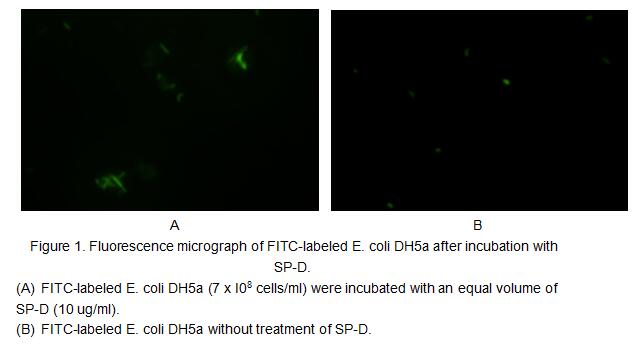 |
SP-D (surfactant protein-D) is a 43 kDa member of the collectin family of innate immune modulators. It is constitutively secreted by alveolar lining cells and epithelium associated with tubular structures. Its principal components consist of a collagen-like region and a C-terminal carbohydrate recognition domain (CRD), a structure that further places it in a subset of an expanded group of proteins termed defense collagens. SP-D is known to bind both SIRP alpha and the calreticulin/CD91 complex on macrophages. When the ratio of antigen/pathogen to available CRDs is low, antigen can be bound without occupying all available CRDs. The free CRDs will bind to SIRP alpha, generating a signal that downmodulates the inflammatory response. When virtually all CRDs are occupied by ligand, however, free CRDs are not available for SIRP alpha binding. The activity of the recombinant human SPD was measured by its ability to bind fluorescein-conjugated E. coli bioparticles. The rhSPD was diluted to 10 ug/ml in assay buffer of 20 mM Tris, 137 mM NaCl, 1 mM CaC12, pH7.4 and fluorescein-conjugated E. coli was diluted to 7*108 cells/ml. Equal volume of 10 ug/ml rhSPD and fluorescein-conjugated E. coli were mixed and incubated at room temperature for 1h. 10 ul mixture was took onto the slide and observed under the fluorescence microscopy. The result was shown in figure 1, the rhSPD could bind fluorescein-conjugated E. coli bioparticles. |
| 分子别名Alternative Names | SFTPDCOLEC7PSP-DSFTP4SP-DPulmonary Surfactant Protein DCollectin-7Lung surfactant protein D |
|---|---|
| 背景介绍Background | Contributes to the lung's defense against inhaled microorganisms, organic antigens and toxins. Interacts with compounds such as bacterial lipopolysaccharides, oligosaccharides and fatty acids and modulates leukocyte action in immune response. May participate in the extracellular reorganization or turnover of pulmonary surfactant. Binds strongly maltose residues and to a lesser extent other alpha-glucosyl moieties. |
| 功能Function | Contributes to the lung's defense against inhaled microorganisms, organic antigens and toxins. Interacts with compounds such as bacterial lipopolysaccharides, oligosaccharides and fatty acids and modulates leukocyte action in immune response. May participate in the extracellular reorganization or turnover of pulmonary surfactant. Binds strongly maltose residues and to a lesser extent other alpha-glucosyl moieties. |
| 亚细胞定位Subcellular Location | Secreted, extracellular space, extracellular matrix. Secreted, extracellular space, surface film. |
| 数据库链接Databases |
基因功能参考文献50 条
- these findings indicate that the membrane-type surfactant protein D serve as an effective therapeutic strategy for inhibiting macrophage-mediated xenograft rejection in xenotransplantation PMID: 29425774 : 29425774
- Assays that can separate SP-D proteolytic breakdown products or modified forms from naturally occurring SP-D trimers may result in optimal disease markers for pulmonary inflammatory diseases PMID: 28960651 : 28960651
- the SPA and SPD levels in EBC were correlated with lung function, which contributed to COPD diagnosis. PMID: 28791362 : 28791362
- Studied predictive value of surfactant protein D (SP-D) in lung cancer patients with interstitial lung disease induced by anticancer agents (ILD-AA). Results suggest that SP-D level change was a risk factor for mortality in patients with ILD-AA, and that SP-D might be a predictive prognostic biomarker of ILD-AA. PMID: 28464801 : 28464801
- SP-D also delays FasL-induced death of primary human T cells. SP-D delaying the progression of the extrinsic pathway of apoptosis could have important implications in regulating immune cell homeostasis at mucosal surfaces PMID: 28168327 : 28168327
- Trimeric SP-D wildtype recognized larger LPS inner core oligosaccharides with slightly enhanced affinity than smaller compounds suggesting the involvement of stabilizing secondary interactions. PMID: 27350640 : 27350640
- rs2819096 in the surfactant protein D (SFTPD) gene was associated with a higher risk of COPD GOLD III + IV. PMID: 27078193 : 27078193
- SP-D increases the formation of nuclear and membrane blebs. Inhibition of caspase-8 confirms the effect of SP-D is unique to the caspase-8 pathway. PMID: 29107869 : 29107869
- Findings indicate serum pulmonary surfactant protein D (SP-D, SFTPD) level as a potential marker to estimate the efficacy of epidermal growth factor receptor (EGFR)-tyrosine kinase inhibitor (TKIs). PMID: 28745320 : 28745320
- Patients with SP-D 11Thr/Thr genotype were more susceptible to acute kidney injury (AKI). Compared with healthy controls, serum SP-D levels at day 1, 3 and 7 were significantly elevated in AKI patients. PMID: 28212617 : 28212617
- This review intends to provide a current overview of the genetics, structure and extra-pulmonary functions of the surfactant collectin proteins. PMID: 28351530 : 28351530
- Meta-analysis found that serum SP-A/D detection might be useful for differential diagnosis and prediction of survival in patients with idiopathic pulmonary fibrosis. PMID: 28591049 : 28591049
- The findings suggest that SP-D inhibits LPS-stimulated production of interleukin-12p40 via the SIRPalpha/ROCK/ERK signaling pathway. PMID: 28641719 : 28641719
- Efficient lipopolysaccharide recognition by SP-D requires multiple binding interactions utilizing the three major ligand-binding determinants in the SP-D binding pocket, with Ca-dependent binding of inner-core heptose accompanied by interaction of anhydro-Kdo (4,7-anhydro-3-deoxy-d-manno-oct-2-ulosonic acid) with Arg343 and Asp325. PMID: 26953329 : 26953329
- SP-D levels in bronchoalveolar lavage samples were significantly lower in severe asthma compared with healthy controls and mild asthma. Serum SP-D was significantly increased in severe asthma compared with healthy controls and mild asthma. PMID: 26836907 : 26836907
- Surfactant protein D levels differed among idiopathic pulmonary fibrosis, pulmonary sarcoidosis and chronic pulmonary obstructive disease. PMID: 27758987 : 27758987
- Elevated levels of SP-D are Associated with Idiopathic Pulmonary Fibrosis. PMID: 27293304 : 27293304
- Data do not support that pSP-D levels influence or reflect the development of subclinical atherosclerosis. However, the data support that SP-D plays a role in the etiology of atherosclerotic disease development. PMID: 26748346 : 26748346
- Human and murine data together indicate that SP-A, SP-D and MBL are synthesized in early gestational tissues, and may contribute to regulation of immune response at the feto-maternal interface during pregnancy. PMID: 26603976 : 26603976
- Serum SP-D may serve as a convenient medium to distinguish lung infection caused by M. pneumoniae. PMID: 26617840 : 26617840
- findings shed new light on the discovery and/or development of a useful biomarker based on glycosylation changes for diagnosing COPD. PMID: 26206179 : 26206179
- Quantitative real-time PCR experiments disclosed significantly increased leukocyte NOS2 and SFTPD mRNA levels in hyperglycemic gestational diabetes mellitus patients (P < 0.05). PMID: 26568332 : 26568332
- Serum SP-D was not significantly different between patients with connective tissue disease-interstitial lung disease, chronic fibrosing interstitial pneumonia patients and healthy controls. PMID: 26424433 : 26424433
- Letter: report higher serum SP-D levels in bird-related hypersensitivity pneumonitis during winter. PMID: 25591150 : 25591150
- The SP-D level showed positive correlations with carotid IMT and coronary artery calcification in patients on long-term hemodialysis. PMID: 27012038 : 27012038
- SP-D is expressed differently in airways of asthmatics relative to that of non-asthmatics. PMID: 25848896 : 25848896
- Sputum and bronchoalveolar lavage fluid SFTPD were significantly higher in patients with severe asthma compared to mild-moderate asthma and healthy controls. PMID: 25728058 : 25728058
- We demonstrated for the first time in a Chinese population cohort that genetic polymorphisms of SP-D are not only associated with risk of COPD development, but also related to disease manifestation and that they predict outcomes. PMID: 25376584 : 25376584
- In chromium-exposed workers, blood levels of CC16, and CC16/SP-D were lower than in controls. Positive relationships were shown between CC16 or CC16/SP-D and indicators of lung function. PMID: 25851191 : 25851191
- In Sjogren's syndrome, high SP-D levels were found in patients with severe glandular involvement, hypergammaglobulinemia, leukopenia, extraglandular manifestations, and positive anti-Ro/La antibodies. PMID: 25362659 : 25362659
- Results revealed that higher circulating levels of SP-D are associated with higher mortality risk in critically ill A/H1N1 patients. PMID: 25537934 : 25537934
- In idiopathic pleuroparenchymal fibroelastosis SP-D was elevated, while KL-6 was within a normal range. PMID: 24880792 : 24880792
- These data suggest that SP-D reduces EGF binding to EGFR through the interaction between the carbohydrate recognition domain of SP-D and N-glycans of EGFR, and downregulates EGF signaling. PMID: 24608429 : 24608429
- the multi-faceted role of human SP-D against HIV-1 PMID: 25036364 : 25036364
- SFTPD polymorphism is associated with the risk of respiratory outcomes; it may be an essential factor affecting pulmonary adaptation in premature infants PMID: 25015576 : 25015576
- Results suggest that Smokers who are carriers of the SFTPD AG and AA polymorphic genotypes may be at a higher risk of developing Chronic obstructive pulmonary disease when compared with wild-type GG genotype carriers. PMID: 24504887 : 24504887
- Both mRNA and protein levels of gp340 were significantly higher in patients with biofilm associated chronic rhinosinusitis (CRS) than those with CRS and no biofilm and controls. PMID: 24121782 : 24121782
- In this review, we highlight the associations of eosinophilic lung diseases with SP-A and SP-D levels and functions. PMID: 24960334 : 24960334
- murine expression of human polymorphic variants does not significantly influence the severity of allergic airway inflammation PMID: 24712849 : 24712849
- Genetic disposition for low surfactant protein-D was not associated with rheumatoid arthritis but with erosive rheumatoid arthritis by interaction with smoking. PMID: 24264011 : 24264011
- SP-D levels were significantly higher in the sub-massive pulmonary embolism group overall. PMID: 25291941 : 25291941
- a novel pathway for the immunomodulatory functions of SP-D mediated via binding of its collagenous domains to LAIR-1. PMID: 24585933 : 24585933
- Human surfactant protein D alters oxidative stress and HMGA1 expression to induce p53 apoptotic pathway in eosinophil leukemic cell line. PMID: 24391984 : 24391984
- Surfactant protein D substitutions at the 325 and 343 positions (D325A+R343V) exhibit markedly increased antiviral activity for seasonal strains of influenza A virus. PMID: 24705721 : 24705721
- SFTPD single-nucleotide polymorphisms, rs1923536 and rs721917, and haplotypes, including these single-nucleotide polymorphisms or rs2243539, were inversely associated with expiratory lung function in interaction with smoking. PMID: 24610936 : 24610936
- Increases in serum KL-6 and SP-D levels during the first 4 weeks after starting therapy, but not their levels at any one time point, predict poor prognosis in patients with polymyositis/dermatomyositis. PMID: 22983659 : 22983659
- serum SP-D, but not SP-A, levels were significantly higher in the German than in the Japanese cohort PMID: 24400879 : 24400879
- Lower oligomeric form of surfactant protein D is associated with cystic fibrosis. PMID: 24120837 : 24120837
- Lung permeability biomakers [surfactant protein D (SP-D) and Clara cell secretory protein (CC16) in plasma] and forced expiratory volumes and flow were measured in swimmers in indoor swimming pool waters treated with different disinfection methods. PMID: 23874631 : 23874631
- In patients with systemic sclerosis-related interstitial lung disease, surfactant protein D was correlated with forced vital capacity. It was not a longterm prognostic indicator. PMID: 23588945 : 23588945
蛋白复溶体积计算器缓冲液体积 = 蛋白质量 ÷ 蛋白浓度
输入任意两项,第三项自动计算 |
蛋白浓度稀释计算器初浓度 × 初体积 = 终浓度 × 终体积
输入任意三项,第四项自动计算 |



