


| 纯度Purity | Greater than 95% as determined by reducing SDS-PAGE. |
|---|---|
| 内毒素Endotoxin | Please contact with the lab for this information |
| 蛋白构建Protein Construction |
【Ala18-Ile303】序列区间
|
| Accession | P09486 |
| 表达宿主Expression Host | 293F |
| 种属Species | Homo sapiens (Human) |
| 预测分子量Predicted MW | 34.3 kDa |
| 制剂Formulation | Lyophilized from a 0.2 μm filtered solution of PBS, pH7.4, containing 0.01% SKL, 1mM DTT, 5% Trehalose and Proclin300. |
| 运输方式Shipping | The product is shipped with ice bag. Upon receipt, store it immediately at the temperature listed below. |
| 稳定性&储存Stability & Storage | 12 months at -20°C to -80°C in lyophilized state.6 months at -20°C to -80°C under sterile conditions after reconstitution.7-10 days at 2°C to 8°C under sterile conditions after reconstitution.Please minimize freeze-thaw cycles. |
| 复溶Reconstitution | Reconstitute in 10mM PBS (pH7.4) to a concentration of 0.1-1.0 mg/mL. Do not vortex. |
 |
Greater than 95% as determined by reducing SDS-PAGE. |
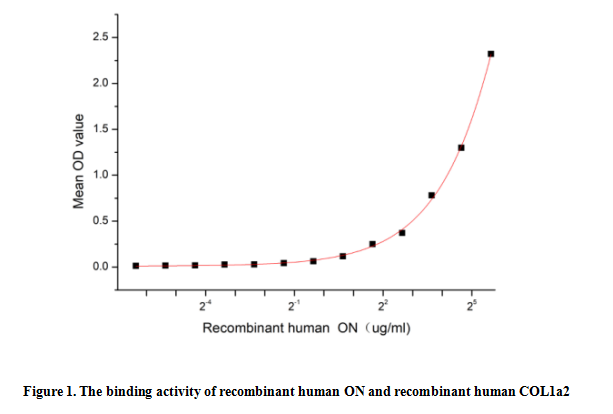 |
SPARC, also known as osteonectin(ON), is the founding member of a family of secreted matricellular proteins with similar domain structure. The 302 amino acid (aa), 43 kDa protein contains a 17 aa signal sequence, an N-terminal acidic region that binds calcium, a follistatin domain containing Kazal-like sequences, and a C-terminal extracellular calcium (EC) binding domain with two EF-hand motifs. SPARC is produced by fibroblasts, capillary endothelial cells, platelets and macrophages, especially in areas of tissue morphogenesis and remodeling. SPARC shows context-specific effects, but generally inhibits adhesion, spreading and proliferation, and promotes collagen matrix formation. Besides, Collagen Type I Alpha 2 (COL1a2)) has been identified as an interactor of SPARC, thus a functional binding ELISA assay was conducted to detect the interaction of recombinant human SPARC and recombinant human COL1a2. Briefly, SPARC was diluted serially in PBS with 0.01% BSA (pH 7.4). Duplicate samples of 100 μl were then transferred to COL1a2-coated microtiter wells and incubated for 1h at 37℃. Wells were washed with PBST and incubated for 1h with anti-SPARC pAb, then aspirated and washed 3 times. After incubation with HRP labelled secondary antibody for 1h at 37℃, wells were aspirated and washed 5 times. With the addition of substrate solution, wells were incubated 15-25 minutes at 37℃. Finally, add 50 µL stop solution to the wells and read at 450/630 nm immediately. The binding activity of recombinant human SPARC and recombinant human COL1a2 was shown in Figure 1, and this effect was in a dose dependent manner. |
| 分子别名Alternative Names | SPARCBM-40Secreted Protein,Acidic,Cysteine-RichBasement-membrane protein 40Secreted protein acidic and rich in cysteine |
|---|---|
| 背景介绍Background | Appears to regulate cell growth through interactions with the extracellular matrix and cytokines. Binds calcium and copper, several types of collagen, albumin, thrombospondin, PDGF and cell membranes. There are two calcium binding sites; an acidic domain that binds 5 to 8 Ca(2+) with a low affinity and an EF-hand loop that binds a Ca(2+) ion with a high affinity. |
| 功能Function | Appears to regulate cell growth through interactions with the extracellular matrix and cytokines. Binds calcium and copper, several types of collagen, albumin, thrombospondin, PDGF and cell membranes. There are two calcium binding sites; an acidic domain that binds 5 to 8 Ca(2+) with a low affinity and an EF-hand loop that binds a Ca(2+) ion with a high affinity. |
| 亚细胞定位Subcellular Location | Secreted, extracellular space, extracellular matrix, basement membrane. Note=In or around the basement membrane. |
| 数据库链接Databases |
基因功能参考文献50 条
- Hepatic SPARC expression is associated with liver injury and fibrogenic processes in non-alcoholic fatty liver disease. PMID: 29335425 : 29335425
- Plasma samples from lung cancer patients and healthy heavy-smokers controls were tested for levels of COL11A1 and COL10A1 (n = 57 each) and SPARC (n = 90 each). Higher plasma levels of COL10A1 were detected in patients (p PMID: 30227835 : 30227835:
- The authors have confirmed the presence of SPARC expression in melanoma, Kaposi sarcomas (KS), leiomyosarcomas (LMS) and angiosarcomas (AS) and also detected it for the first time in atypical fibroxanthomas (AFX). PMID: 29660567 : 29660567
- Results revealed that hypermethylation of the SPARC promoter was the primary mechanism of SPARC downregulation in prostate cancer. SPARC expression was frequently lost during the promoter hypermethylation but could be restored by 5-Aza-Cdr. PMID: 29207175 : 29207175
- Stromal SPARC expression was a useful biomarker for predicting prognosis in patients with resected pancreatic ductal adenocarcinoma. PMID: 29295776 : 29295776
- SPARC is closely related to the development of breast cancer and can be used as a tumor marker for breast cancer recurrence. PMID: 29237913 : 29237913
- SPARC expression was inversely associated with the degree of malignancy and it had a negative correlation with VEGF-C and VEGF-D expression. Results suggest SPARC might function as a tumor suppressor inhibiting angiogenesis and lymphangiogenesis in ovarian cancer by reducing the expression of VEGF-C and VEGF-D. PMID: 29075785 : 29075785
- SPARC may be involved in gastric cancer metastasis by effecting on tumor microenvironment PMID: 29077165 : 29077165
- SPARC treatment enhances the epithelial mesenchymal transition signaling pathway via activation of AKT, and exogenous SPARC and tumor expressing SPARC might be associated with tumor progression in head and neck cancers. PMID: 28718842 : 28718842
- The epicardial adipose tissue expresses the mRNA of osteopontin, osteoprotegerin, and osteonectin genes that have been implicated in the calcification process; such expression is statistically associated with some components of HDL subclasses in coronary artery disease patients. PMID: 28821297 : 28821297
- detection of SPARC mRNA and protein expression levels may facilitate early diagnosis and prognosis assessment of esophageal squamous cell carcinoma. PMID: 28713937 : 28713937
- SPARC rs17718347 and rs2347128 single nucleotide polymorphisms are associated with progression-free survival in locally advanced and metastatic pancreatic cancer patients. PMID: 28687963 : 28687963
- results demonstrated that loss of miR-211 expression and thus uncontrolled SPARC overexpression might drive progression of hepatocellular carcinoma (HCC), which may provide a novel therapeutic strategy for the treatment of HCC. PMID: 27230656 : 27230656
- Data suggest that plasma SPARC levels may be biomarker for vascular complications among Chinese type 2 diabetic patients; patients in lowest SPARC tertile have increased odds of aortic stiffness but reduced odds of peripheral arterial disease. PMID: 28479157 : 28479157
- The profiled circulating tumour cells also expressed elevated levels of stem cell markers, and the extracellular matrix protein, SPARC. The expression of SPARC might correspond to an epithelial-mesenchymal transition in pancreatic circulating tumour cells PMID: 28569190 : 28569190
- Data suggest that both osteonectin and FGF21 levels in serum are associated with early nephropathy in type 2 diabetes, albeit with different patterns; persistent hyperglycemia may inhibit bone formation leading to osteoporosis. (FGF21 = fibroblast growth factor 21) PMID: 27916484 : 27916484
- These results suggest that increased SPARC expression may be an indicator of greater aggressiveness, and may serve as a prognostic factor for triple-negative breast cancer. PMID: 27421134 : 27421134
- High expression of SPARC is related to worse prognosis in rectal cancer patients. PMID: 28009327 : 28009327
- Tumors with stroma-derived SPARC displayed suppressed growth, inhibited angiogenesis and increased lipid accumulation. Based on the described chaperone function of SPARC, authors hypothesized that SPARC binds albumin complexed with fatty acids and transports them to tumors. PMID: 27776337 : 27776337
- Weekly NAB-paclitaxel might be effective for heavily pretreated non-small-cell lung cancer patients. SPARC expression in tumor stroma cells might be a potential negative predictor of NAB-paclitaxel. PMID: 28304139 : 28304139
- SPARC-associated signaling pathways are associated with lymphangiogenesis and lymph node metastases of hypopharyngeal cancer. PMID: 29374693 : 29374693
- Stromal SPARC expression correlated with the prognosis of patients with resectable biliary carcinoma, and its significance was enhanced in patients treated with adjuvant gemcitabine-based chemotherapy. PMID: 28342122 : 28342122
- Studies revealed that SPARC plays a critical role in regulating bone remodeling and maintaining bone mass and quality. The mechanisms by which SPARC influences bone formation, maintenance, and repair might occur through multiple pathways that include the regulation of procollagen processing and assembly in the bone matrix, crosslinking, mineralization, and/or osteoblast/osteoclast differentiation and activity. [review] PMID: 26851678 : 26851678
- This study indicates that germline PTCH1 heterozygous mutations play a major role in bone metabolism in patients with NBCCS, in particular in those with PTCH1 protein truncation mutations. SPARC may represent an important downstream modulator of PTCH1 mediation of bone metabolism. PMID: 26890308 : 26890308
- The SPARC drives pathological responses in non-small cell lung cancer and idiopathic pulmonary fibrosis by promoting microvascular remodelling and excessive deposition of ECM proteins. PMID: 27759879 : 27759879
- proCOL11A1, fibroblast-activated protein, secreted protein acidic and rich in cysteine, and periostin expression was significantly increased in the intratumoral stroma of pancreatic ductal adenocarcinomas compared to paired non-neoplastic pancreata PMID: 29025374 : 29025374
- The mRNA and protein levels of SPARC were 5.78-fold higher in cancer tissues compared with the case-matched normal epithelium. High expression levels of SPARC in esophageal squamous cell carcinoma parenchyma were related to lymph node metastasis and poor prognosis (p = 0.049 and p = 0.04). PMID: 28818666 : 28818666
- SPARC can serve a dual function role as both predictor for prognosis and potentially biomarker for lymph node metastasis in resected pancreatic cancer patients. PMID: 28119265 : 28119265
- SPARC appears to be an important modulator of the actin cytoskeleton, implicating maintenance of muscular function PMID: 27908613 : 27908613
- that SPARC-mediated degradation of the extracellular matrix, and its possible association with MMPs, might contribute to progression of phyllodes tumors PMID: 27909812 : 27909812
- WIN-dependent increase in the level of SPARC plays a critical role in sensitizing osteosarcoma cells to TRAIL action PMID: 26698404 : 26698404
- high SPARC-expression was a significant predictor of poor OS in HPV-negative OPSCC patients using Kaplan-Meier analysis and the log-rank test PMID: 26523779 : 26523779
- We identified five new biomarkers: GDF15, osteonectin, TRAP5, TWEAK, and YKL40 as being promising markers for monitoring bone metastases. PMID: 27069189 : 27069189
- SPARC levels were not associated with efficacy in patients with MPC. This exploratory analysis does not support making treatment decisions regarding nab-paclitaxel plus gemcitabine or gemcitabine alone in MPC based on SPARC expression. PMID: 26169969 : 26169969
- CD90 is upregulated in gastric cancer and inhibits gastric cancer cell apoptosis by modulating the expression level of SPARC protein. PMID: 26329007 : 26329007
- SPARC might be an unfavorable indicator in patients with pancreatic cancer, especially in the stroma.[Review] PMID: 26731428 : 26731428
- tracheal aspirate SPARC levels predicted development of bronchopulmonary dysplasia or death. PMID: 26656750 : 26656750
- SPARC is associated with carcinogenesis of oral squamous epithelium. PMID: 25311631 : 25311631
- Studies indicate that SPARC (secreted protein acidic and rich in cysteine) gene is involved in the development and progression of pancreatic ductal adenocarcinoma (PDAC). PMID: 26335014 : 26335014
- MLKL upregulation in SPARC overexpressed cells treated with Ara-C, indicates necrosis as a possible cell death process for the SKM-1 cells under these stringent conditions. PMID: 26165695 : 26165695
- up-regulation of SPARC by oxLDL is independent of Runx2, and it may be mediated by other transcription factors PMID: 26025968 : 26025968
- Tumor-produced SPARC and VCAM1 are regulators of cancer extravasation. PMID: 25925867 : 25925867
- miR-29a and miR-29b enhance cell migration and invasion in nasopharyngeal carcinoma progression by regulating SPARC and COL3A1 gene expression. PMID: 25786138 : 25786138
- SNP1599 differentially regulates osteonectin expression and contributes to variability in bone mass, by a mechanism that may involve differential targeting by miR-433 PMID: 25262637 : 25262637
- Reduced expression of SPARC in colorectal cancer tissue is associated with poor prognosis and aggressive clinicopathological features. PMID: 26044224 : 26044224
- Three functional SPARC SNPs are associated with an increased risk of coal workers' pneumoconiosis in a Chinese population. PMID: 25126876 : 25126876
- reduced expression in the bone marrow biopsy specimen in patients with aplastic anemia PMID: 25032754 : 25032754
- SPARC promoter methylation as an important factor in the tumorigenesis of gastric carcinomas. PMID: 25516351 : 25516351
- SCD5 impairs SPARC and cathepsin B secretion in human melanoma cells and intracellular pH acidification. PMID: 25802234 : 25802234
- High SPARC expression of the primary tumor is associated with a higher chance of achieving a pathological complete remission after TAC or TAC-NX chemotherapy. PMID: 25355716 : 25355716
蛋白复溶体积计算器缓冲液体积 = 蛋白质量 ÷ 蛋白浓度
输入任意两项,第三项自动计算 |
蛋白浓度稀释计算器初浓度 × 初体积 = 终浓度 × 终体积
输入任意三项,第四项自动计算 |



