


Recombinant Human OLFM4 (C-10His)
Alternative NamesOlfactomedin-4; OLM4; Antiapoptotic protein GW112; G-CSF-stimulated clone 1 protein; hGC-1; hOLfD; OLFM4; GW112
规格参数 Specifications
| 纯度Purity | Greater than 95% as determined by reducing SDS-PAGE |
|---|---|
| 内毒素Endotoxin | <1 EU/µg as determined by LAL test. |
| 蛋白构建Protein Construction |
【Asp21-Gln510】序列区间-10HisC 端标签
|
| Accession | Q6UX06 |
| 表达宿主Expression Host | HEK293 |
| 种属Species | Human |
| 预测分子量Predicted MW | 56.9 kDa |
| 制剂Formulation | Lyophilized from a 0.2 μm filtered solution of PBS, 5%Trehalose, PH7.4. |
| 运输方式Shipping | The product is shipped with ice bag. Upon receipt, store it immediately at the temperature listed below. |
| 稳定性&储存Stability & Storage | 12 months at -20°C to -80°C in lyophilized state.6 months at -20°C to -80°C under sterile conditions after reconstitution.7-10 days at 2°C to 8°C under sterile conditions after reconstitution.Please minimize freeze-thaw cycles. |
| 复溶Reconstitution | Always centrifuge tubes before opening. Do not mix by vortex or pipetting. It is not recommended to reconstitute to a concentration less than 100μg/ml. Dissolve the lyophilized protein in distilled water. Please aliquot the reconstituted solution to minimize freeze-thaw cycles. |
!
本司产品仅用于科研,不用于临床诊断和治疗。
产品图片 Product Images点击图片可查看原图
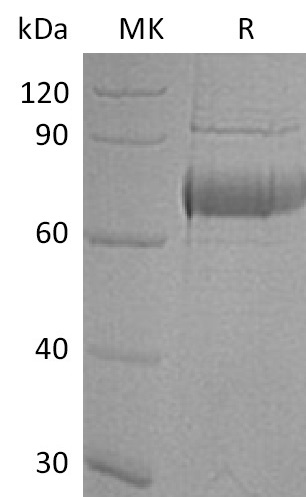 |
Greater than 80% as determined by reducing SDS-PAGE. |
靶点信息 Target Information
| 分子别名Alternative Names | Olfactomedin-4OLM4Antiapoptotic protein GW112G-CSF-stimulated clone 1 proteinhGC-1hOLfDOLFM4GW112 |
|---|---|
| 功能Function | May promote proliferation of pancreatic cancer cells by favoring the transition from the S to G2/M phase. In myeloid leukemic cell lines, inhibits cell growth and induces cell differentiation and apoptosis. May play a role in the inhibition of EIF4EBP1 phosphorylation/deactivation. Facilitates cell adhesion, most probably through interaction with cell surface lectins and cadherin. |
| 亚细胞定位Subcellular Location | Secreted, extracellular space. Mitochondrion. |
| 数据库链接Databases |
基因功能参考文献43 条
- Study results suggest that OLFM4, LY6D and S100A7 immunoreactivity are associated with an aggressive phenotype of estrogen receptor (ER)-positive breast carcinoma, and these are potent markers for distant metastasis of ER-positive breast cancer patients. PMID: 30137688 : 30137688
- these data propose that hCG is not a key regulator of cellular alterations within peripheral blood dendritic cells PMID: 29488661 : 29488661
- discovered that OLFM4, CD11b, and ITGA2 are proteins that are overexpressed in both primary colon tumors and liver metastasis. These are colon cancer biomarkers with autoantigenic properties. PMID: 28669815 : 28669815
- MiR-103 acts as an oncogene miRNA to promote triple-negative breast cancer cells migration and invasion through targeting OLFM4. PMID: 28320108 : 28320108
- OLFM4 has an important role in the regulation of intestinal inflammation and tumorigenesis, and could be a potential therapeutic target for intestinal malignant tumors. Unlike the human colonic epithelium, the mouse colonic epithelium does not express OLFM4, but nevertheless, systemic OLFM4 deletion promotes colon tumorigenesis and that loss from mucosal neutrophils may have a role to play. PMID: 26973250 : 26973250
- Olfactomedin-4 identifies a subpopulation of neutrophils in patients with septic shock, and those with a high percentage of olfactomedin-4+ neutrophils are at higher risk for greater organ failure burden and death. Olfactomedin-4 might serve as a marker of a pathogenic neutrophil subset in patients with septic shock PMID: 27635771 : 27635771
- OLFM4 is proved to as a functional target for miR-590. PMID: 28012926 : 28012926
- Olfactomedin 4 is a novel tumor marker for triple-negative breast cancer for predicting and prognosis. PMID: 27939521 : 27939521
- OLFM4 is downregulated by miR-486-5p, which contributes to ovarian cancer tumorigenesis. Conversely, estrogen receptor signaling downregulates miR-486-5p and upregulates OLFM4 expression, slowing the development and progression of ovarian cancer. PMID: 26871282 : 26871282
- Data show that olfactomedin 4 (OLFM4) is highly expressed in proliferating benign epithelial cells and in some carcinoma cells. PMID: 26416558 : 26416558
- olfactomedin 4 appears to play a critical role in regulating progression of prostate cancer, and has potential as a new biomarker for prostate cancer. PMID: 26581960 : 26581960
- Study demonstrates that epigenetic silencing of OLFM4 enhances gastric cancer cell invasion via activation of FAK signaling. PMID: 26303970 : 26303970
- suppression of OLFM4 expression may be a promising strategy in the development of novel cancer therapeutic drugs PMID: 26398045 : 26398045
- Patients with an OLFM4 gene expression level above -7.5 were 6 times more likely to develop severe disease, after correction for age at hospitalization and gestational age. PMID: 26162090 : 26162090
- Using a human vaginal epithelial cell line, the expression of mucin 5 subtype B and olfactomedin-4 were down-regulated in response to N9, suggesting these markers could apply to humans PMID: 25333937 : 25333937
- findings suggest that OLFM4 is not only involved in early stages of gastric carcinogenesis but also a useful prognostic marker for advanced gastric cancer PMID: 26070873 : 26070873
- OLM4 expression is increased in the early stages of gastric, colorectal, and pancreatic cancer initiation. PMID: 25400027 : 25400027
- High expression of GW112 in colorectal cancer tissues and reduced expression of GRIM-19 in colorectal cancer tissues may be associated with abnormal proliferation of cancer cells. PMID: 26011333 : 26011333
- although low OLFM4 expression is not an independent prognostic biomarker, it might indicate worse prognosis for smoking patients with non-small cell lung cancer PMID: 25771901 : 25771901
- Impairment of ERalpha signal-mediated OLFM4 expression promoted the malignant progression of endometrioid adenocarcinoma. PMID: 24495253 : 24495253
- OLFM4 is a novel candidate tumor-suppressor gene for chromosome 13q and may shed new light on strategies that could be used for the diagnosis, prognosis, and treatment of prostate cancer patients. PMID: 24070418 : 24070418
- Reduced expression of olfactomedin 4 and ectopic expression of claudin-18 might be useful markers in the differential diagnosis of serrated polyps. PMID: 23570326 : 23570326
- OLFM4 is overexpressed in active IBD and secreted into mucus. OLFM4 seems to be of functional relevance in IBD as a mucus component, possibly by binding defensins. PMID: 22398066 : 22398066
- OLFM4 regulates host defense against a broad range of bacteria including Gram-positive Staphylococcus aureus and Gram-negative Escherichia coli in an OLFM4-deficient mouse model. PMID: 22844115 : 22844115
- depletion of OLFM4 significantly inhibits tumorigenicity of the gastric cancer SGC-7901 and MKN45 cells. Blocking OLFM4 expression can sensitize gastric cancer cells to H2O2 or TNF alpha treatment by increasing caspase-3 dependent apoptosis. PMID: 22471589 : 22471589
- Single nucleotide polymorphism in OLFM4 gene is associated with childhood obesity. PMID: 22484627 : 22484627
- OLFM4 identifies a subset of human neutrophils. PMID: 22187488 : 22187488
- Our results also indicate that OLFM4 is regulated by the Ras-NF-kappaB2 pathway, one of the main oncogenic pathways deregulated in colorectal tumors PMID: 21986994 : 21986994
- Results suggest that S100B, TM4SF3, and OLFM4 overexpression may affect metastatic behavior of tumor cells in Taiwanese colorectal cancer patients. PMID: 22011044 : 22011044
- The expression of OLFM4 mRNA or protein differed significantly among gastric tumor tissue, matched normal gastric mucosa, and lymph node metastases. PMID: 21904905 : 21904905
- OLFM4 expression and its biological significances in tumor differentiation and progression as well as the contributions of OLFM4 to tumorigenesis (Review) PMID: 21067260 : 21067260
- protection of AGT and resistance to nitrosamine-induced genotoxicity critically depends on GSNOR in hepatocytes PMID: 21470957 : 21470957
- miR-486 antioncogenic activity may involve the direct targeting and inhibition of OLFM4. PMID: 21415212 : 21415212
- Olfactomedin 4 expression has been associated with progression of cervical intraepithelial neoplasia and differentiation of cervical cancer. PMID: 21270618 : 21270618
- Results show that cross-talk between estrogen and EGF signaling regulates OLFM-4 expression in human endometrium. PMID: 21048224 : 21048224
- Review critically evaluates recent advances in understanding of the transcriptional regulation of OLFM4 and its upstream signalling pathways with special emphasis on carcinogenesis and outline future perspectives in the field PMID: 20878207 : 20878207
- OLFM4 plays an important role in myeloid leukemia cellular functions PMID: 20724538 : 20724538
- Data show that granulocyte colony stimulating factor stimulated clone-1, an extracellular matrix glycoprotein, facilitates cell adhesion. PMID: 16566923 : 16566923
- The expression pattern of hGC-1 protein in 173 cases of gastric carcinoma was investigated and a striking correlation was demonstrated between hGC-1 expression and histological type and differentiation of gastric carcinoma. PMID: 17650212 : 17650212
- hGC-1 may be a useful marker for tumor differentiation and progression of human colon carcinoma. PMID: 18281536 : 18281536
- We generated human monoclonal antibodies against 2 potential tumor targets, NGAL and GW112, and we proved their selective expression in cancer colon and not or barely in healthy tissues. PMID: 18798264 : 18798264
- OLFM4 is a robust marker for stem cells in human intestine and marks a subset of colorectal cancer cells. PMID: 19450592 : 19450592
- High serum olfactomedin 4 is associated with gastric cancer. PMID: 19670418 : 19670418
蛋白复溶体积计算器缓冲液体积 = 蛋白质量 ÷ 蛋白浓度
输入任意两项,第三项自动计算 |
蛋白浓度稀释计算器初浓度 × 初体积 = 终浓度 × 终体积
输入任意三项,第四项自动计算 |



