


| 纯度Purity | Greater than 95% as determined by reducing SDS-PAGE. |
|---|---|
| 内毒素Endotoxin | Please contact with the lab for this information |
| 蛋白构建Protein Construction |
【Gln24-Gln100】序列区间
|
| Accession | P02652 |
| 表达宿主Expression Host | 293F |
| 种属Species | Homo sapiens (Human) |
| 预测分子量Predicted MW | 10.3 kDa |
| 制剂Formulation | Lyophilized from a 0.2 μm filtered solution of PBS, pH7.4, containing 0.01% SKL, 1mM DTT, 5% Trehalose and Proclin300. |
| 运输方式Shipping | The product is shipped with ice bag. Upon receipt, store it immediately at the temperature listed below. |
| 稳定性&储存Stability & Storage | 12 months at -20°C to -80°C in lyophilized state.6 months at -20°C to -80°C under sterile conditions after reconstitution.7-10 days at 2°C to 8°C under sterile conditions after reconstitution.Please minimize freeze-thaw cycles. |
| 复溶Reconstitution | Reconstitute in 10mM PBS (pH7.4) to a concentration of 0.1-1.0 mg/mL. Do not vortex. |
 |
Greater than 95% as determined by reducing SDS-PAGE. |
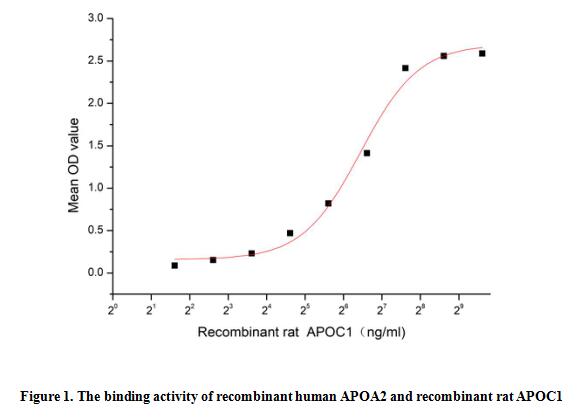 |
Apolipoprotein A2 (APOA2) is a major protein component of serum HDL. It is produced by the liver and is involved in cholesteryl ester formation and cholesterol transport from tissues to the liver. Polymorphisms of APOA2 are associated with disorders of cholesterol and fatty acid metabolism. APOA2 can form disulfide-linked 17 kDa homodimers and heterodimers with other apolipoproteins. Mature human APOA2 shares 96% aa sequence identity with chimpanzee APOA2 and 48% - 66% aa sequence identity with bovine, equine, mouse and rat APOA2. A functional ELISA assay was conducted to detect the interaction of recombinant human APOA2 and recombinant rat APOC1. Briefly, APOC1 was diluted serially in PBS with 0.01% BSA (pH 7.4). Duplicate samples of 100 μl were then transferred to APOA2-coated (1ug/ml, 100 ul/well) microtiter wells and incubated for 1h at 37℃. Wells were washed with PBST and incubated for 1h with anti-APOC1 pAb, then aspirated and washed 3 times. After incubation with HRP labelled secondary antibody for 1h at 37℃, wells were aspirated and washed 5 times. With the addition of substrate solution, wells were incubated 15-25 minutes at 37℃. Finally, add 50 µL stop solution to the wells and read at 450/630nm immediately. The binding activity of recombinant human APOA2 and recombinant rat APOC1 was shown in Figure 1, the concentration of APOC1 that produces 50% optimal binding response is found to be approximately 87.2 ng/mL. |
| 分子别名Alternative Names | Apo-A2Apolipoprotein A-IIProapoA-IITruncated apolipoprotein A-II |
|---|---|
| 背景介绍Background | May stabilize HDL (high density lipoprotein) structure by its association with lipids, and affect the HDL metabolism. |
| 功能Function | May stabilize HDL (high density lipoprotein) structure by its association with lipids, and affect the HDL metabolism. |
| 亚细胞定位Subcellular Location | Secreted. |
| 数据库链接Databases |
基因功能参考文献50 条
- Weight loss resulted from a reduction of HDL in both APOE-II genotypes. However, in C homozygote carriers, it was shown that HDL3 reduced significantly and leads to a general shift toward larger size HDL subfractions after intervention, while in T allele carriers HDL2 decreased significantly and weight loss leads to shift toward smaller size HDL subfractions. PMID: 28545455 : 28545455
- There was a statistically significant interaction between APOA2 polymorphism and dietary fatty acids intake on oxidative stress n patients with type 2 diabetes PMID: 27271094 : 27271094
- This study detected a reduced level of heterodimer apoA2-ATQ/AT and a specific apoA2 isoform hypo-processing pattern in the sera of autoimmune pancreatitis patients. PMID: 29481802 : 29481802
- In type 2 diabetes mellitus patients, the dietary intake of antiinflammatory fatty acids, such as omega-3 PUFAs and MUFAs, could reduce the inflammatory effects associated with the Apolipoprotein A2 CC genotype. In addition, proinflammatory fatty acids, such as SFAs, could overcome the antiinflammatory effect of the T-allele. PMID: 28359369 : 28359369
- data support an SR-B1 nibbling mechanism that is similar to that of streptococcal serum opacity factor, which also selectively removes CE and releases apoAI, leaving an apoAII-rich remnant. PMID: 28373285 : 28373285
- A new missense mutation in an Iranian population has a significant association with high-density lipoprotein cholesterol levels. PMID: 26590203 : 26590203
- ApoAII-ATQ/AT not only distinguished the early stages of pancreatic cancer from healthy controls but also identified patients at high risk for pancreatic malignancy. PMID: 26549697 : 26549697
- Plasma apoB pool size of VLDL containing apoA-II is much smaller than that of VLDL without apoA-II, and this was caused by a very low rate of secretion of this VLDL type into plasma. PMID: 26071654 : 26071654
- APOA-II polymorphism and oxidative stress is associated with poor prognosis in patients with type 2 diabetes. PMID: 26104730 : 26104730
- Apolipoprotein AII was detected as a protein associated with the urinary protein/urinary creatinine levels in pediatric idiopathic steroid-sensitive nephrotic syndrome PMID: 24633472 : 24633472
- Apolipoprotein A-II/B significantly improves risk prediction of overall survival, also in carotid surgery patients with lower LDL levels PMID: 25953375 : 25953375
- Apolipoprotein A-II and the regulation of high density lipoproteins in cardiovascular disease. [Review] PMID: 24012775 : 24012775
- We have cloned the cDNA encoding human ApoA-II and achieved its high-level secreting expression with a yield of 65 mg/L of yeast culture PMID: 24116940 : 24116940
- identified a statistically significant interaction between the APOA2 -265T > C variant and higher-fat dairy food intake in the Boston Puerto Ricans and replicated this relation in the GOLDN study PMID: 24108135 : 24108135
- Clinical studies demonstrate that apoA-II is a strong predictor of risk for CVD. There is no evidence, however, that selective therapeutic modification of apoA-II impacts on atherosclerosis and clinical outcomes.[review] PMID: 21501035 : 21501035
- These data suggest Apo-AII-containing high-density lipoproteins (HDL) formed intrahepatically are likely cholesterol-rich compared to the smaller intracellular lipid-poor Apo A-I HDL. PMID: 23025327 : 23025327
- Enrichment of apo A-II in high-density lipoprotein particles has atheroprotective effects and apo A-II may become a target for the treatment of atherosclerosis. PMID: 23241412 : 23241412
- We conclude that apoA-II plays a significant role in apoE-associated risk of incident CVD in women with high levels of HDL-C and CRP. PMID: 22723940 : 22723940
- APOA2 m265 genotype may be associated with eating behaviours and dietary modulation of plasma ghrelin. PMID: 21386805 : 21386805
- a gene-diet interaction involving the APOA2 -265T>C SNP and saturated fat intake determines body weight in a Mediterranean and an Asian populations PMID: 20975728 : 20975728
- Human apolipoprotein A-II inhibits the production of interferon-gamma by concanavalin A-stimulated mouse and human CD4-positive T cells. PMID: 21300819 : 21300819
- Low apolipoprotein-A2 is associated with metastatic renal cell cancer. PMID: 20022911 : 20022911
- ApoA-II plays a crucial role in triglyceride catabolism by regulating lipoprotein lipase activity, at least in part, through HDL proteome modulation. PMID: 19910634 : 19910634
- The serum apoA-II concentrations confer risk for MetS and diabetes and exhibit evidence of anti-inflammatory properties among Turks. PMID: 19817643 : 19817643
- In metabolic syndrome, fenofibrate, but not atorvastatin, influences high density lipoprotein metabolism by increasing the transport of APOA2 particles. PMID: 19651918 : 19651918
- when expressed in transgenic mice, HDL shows antioxidant properties PMID: 11971944 : 11971944
- Overexpression in transgenic mice does not increase their susceptibility to insulin resistance and obesity PMID: 12032642 : 12032642
- Evaluated as a positional candidate gene for familial Type II diabetes, altered lipid concentrations, and insulin resistance PMID: 12136402 : 12136402
- Crystallographic studies of apo A-II and its complex with lipid surrogate beta-octyl glucoside show that disulfide-linked dimers of apo A-II form amphipathic alpha-helices which aggregate into tetramers. PMID: 12269810 : 12269810
- Carriers of a novel splice-site mutation in the LDL-receptor gene were simultaneously homozygous for the -265C variant of apoA-II thus concluding that one variant of the apoA-II gene was associated with reduced plasma LDL cholesterol in FH patients PMID: 12522687 : 12522687
- This protein inhibits high density lipoprotein remodeling and lipid-poor apolipoprotein A-I formation PMID: 12690114 : 12690114
- Genetic association of plasma apolipoprotein A-II levels with familial combined hyperlipidemia. PMID: 12738753 : 12738753
- Analysis of trancription factors that bind response elements in the apoA-II promotor and modulate transcription. PMID: 12959642 : 12959642
- apoA-II affects both the structure and the dynamic behavior of HDL particles and selectively modifies lipid metabolism PMID: 14967812 : 14967812
- In transgenic mice overexpressing the human apoA-II gene, plasma human apoA-II concentration was positively correlated with blood glucose levels. PMID: 14988251 : 14988251
- this protein-exonic splicing enhancer interaction is able to promote the incorporation of exon 3 in mRNA and suggest that they can rescue the splicing despite the noncanonical 3' splice site. PMID: 15247216 : 15247216
- Overexpressed human apoA-II in mice impairs HDL protection of apoB-lipoproteins from oxidation. Displacement of PON1 by apoA-II may explain why PON1 is found in HDL particles with apoA-I, not apoA-II, & apo-A-II-rich HDL's poor antiatherogenic properties. PMID: 15388641 : 15388641
- results indicate a significant association between the T265C APOA-II polymorphism and levels of visceral adipose tissue in premenopausal women present in white but not African-American women PMID: 15833935 : 15833935
- Characterization of regulatory elements found in the apoA-II exon 3 and its flanking introns that are involved in the control of apoA-II exon 3 splicing. PMID: 16254078 : 16254078
- the association of apoA-II with triglyceride-rich lipoproteins occurs in the circulation and induces postprandial hypertriglyceridemia PMID: 16990646 : 16990646
- ApoA-II adopts a beltlike structure in which the protein helices wrap around the lipid- bilayer reconstituted high density lipoprotein (rHDL) disc. PMID: 17264082 : 17264082
- ApoAII is efficiently reabsorbed in kidney proximal tubules in relation to its plasma concentration PMID: 17652309 : 17652309
- carriers of the minor allele for Apo A-II -265T/C (CC/TC) have a lower postprandial response compared with TT homozygotes PMID: 17709437 : 17709437
- ApoA-II is associated with a decreased risk of future coronary artery disease in apparently healthy people, implying that apoA-II itself exerts effects on specific antiatherogenic pathways. PMID: 17923573 : 17923573
- APOAII rs5082 polymorphism may have a role in reducing risk of coronary artery disease in an Australian male population PMID: 18179799 : 18179799
- results for dimeric apolipoprotein AII are similar to those we have reported for the monomeric apolipoprotein CI, which has a similar secondary structure but a different peptide sequence and net charge PMID: 18652418 : 18652418
- procoagulant activities of plasma factor VIIc and factor Xc are positively and independently associated with concentrations of the high-density lipoprotein apolipoprotein, apo A-II PMID: 18766253 : 18766253
- small sizes (i. e., number of kringle-4 repeats in the gene) of apolipoprotein (a) are risk factors for the development of atherothrombosis. (review) PMID: 19069164 : 19069164
- Results indicate that CETP inhibition increases plasma concentrations of apoA-II by delaying HDL apoA-II catabolism and significantly alters the remodeling of apoA-II-containing HDL subpopulations. PMID: 19193611 : 19193611
- The available data does not support a role for common variants in APOA2 on type 2 diabetes susceptibility or related quantitative traits in Northern Europeans PMID: 19216768 : 19216768
蛋白复溶体积计算器缓冲液体积 = 蛋白质量 ÷ 蛋白浓度
输入任意两项,第三项自动计算 |
蛋白浓度稀释计算器初浓度 × 初体积 = 终浓度 × 终体积
输入任意三项,第四项自动计算 |



