


| 纯度Purity | Greater than 95% as determined by reducing SDS-PAGE. |
|---|---|
| 内毒素Endotoxin | Please contact with the lab for this information |
| 蛋白构建Protein Construction |
【Val24-Pro402】序列区间
|
| Accession | P05121 |
| 表达宿主Expression Host | 293F |
| 种属Species | Homo sapiens (Human) |
| 预测分子量Predicted MW | 44.4 kDa |
| 制剂Formulation | Lyophilized from a 0.2 μm filtered solution of PBS, pH7.4, containing 0.01% SKL, 1mM DTT, 5% Trehalose and Proclin300. |
| 运输方式Shipping | The product is shipped with ice bag. Upon receipt, store it immediately at the temperature listed below. |
| 稳定性&储存Stability & Storage | 12 months at -20°C to -80°C in lyophilized state.6 months at -20°C to -80°C under sterile conditions after reconstitution.7-10 days at 2°C to 8°C under sterile conditions after reconstitution.Please minimize freeze-thaw cycles. |
| 复溶Reconstitution | Reconstitute in 10mM PBS (pH7.4) to a concentration of 0.1-1.0 mg/mL. Do not vortex. |
 |
Greater than 95% as determined by reducing SDS-PAGE. |
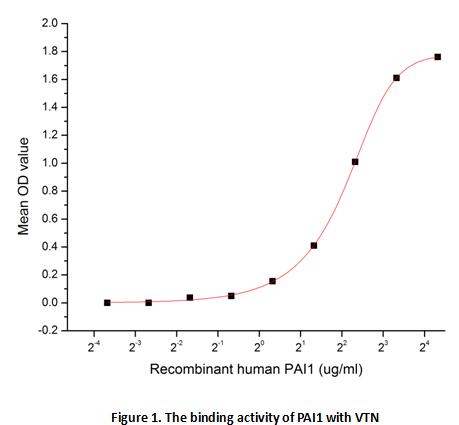 |
Plasminogen Activator Inhibitor 1 (PAI1) is a member of the Serpin superfamily of serine protease inhibitors, Serpin E1/PAI 1 is the principal inhibitor of urokinase type plasminogen activator (uPA) and tissue type PA. As important regulators of extracellular matrix remodeling, uPA and PAI 1 play a major role in many processes such as angiogenesis, tumor invasion and obesity. Besides, Vitronectin (VTN) has been identified as an interactor of PAI1, thus a binding ELISA assay was conducted to detect the interaction of recombinant human PAI1 and recombinant human VTN. Briefly, PAI1 were diluted serially in PBS, with 0.01% BSA (pH 7.4). Duplicate samples of 100 µl were then transferred to VTN-coated microtiter wells and incubated for 2h at 37℃. Wells were washed with PBST and incubated for 1h with anti-PAI1 pAb, then aspirated and washed 3 times. After incubation with HRP labelled secondary antibody, wells were aspirated and washed 3 times. With the addition of substrate solution, wells were incubated 15-25 minutes at 37℃. Finally, add 50µL stop solution to the wells and read at 450nm immediately. The binding activity of PAI1 and VTN was shown in Figure 1, and this effect was in a dose dependent manner, the EC50 was approximately 4.47 ug/mL. |
| 分子别名Alternative Names | SERPINE1PLANH1Serpin Peptidase Inhibitor Clade E Member 1Nexin,Plasminogen Activator Inhibitor Type 1 Serpin E1Endothelial plasminogen activator inhibitor |
|---|---|
| 背景介绍Background | Serine protease inhibitor. Inhibits TMPRSS7. Is a primary inhibitor of tissue-type plasminogen activator (PLAT) and urokinase-type plasminogen activator (PLAU). As PLAT inhibitor, it is required for fibrinolysis down-regulation and is responsible for the controlled degradation of blood clots. As PLAU inhibitor, it is involved in the regulation of cell adhesion and spreading. Acts as a regulator of cell migration, independently of its role as protease inhibitor. It is required for stimulation of keratinocyte migration during cutaneous injury repair. It is involved in cellular and replicative senescence. Plays a role in alveolar type 2 cells senescence in the lung. Is involved in the regulation of cementogenic differentiation of periodontal ligament stem cells, and regulates odontoblast differentiation and dentin formation during odontogenesis. |
| 功能Function | Serine protease inhibitor. Inhibits TMPRSS7. Is a primary inhibitor of tissue-type plasminogen activator (PLAT) and urokinase-type plasminogen activator (PLAU). As PLAT inhibitor, it is required for fibrinolysis down-regulation and is responsible for the controlled degradation of blood clots. As PLAU inhibitor, it is involved in the regulation of cell adhesion and spreading. Acts as a regulator of cell migration, independently of its role as protease inhibitor. It is required for stimulation of keratinocyte migration during cutaneous injury repair. It is involved in cellular and replicative senescence. Plays a role in alveolar type 2 cells senescence in the lung. Is involved in the regulation of cementogenic differentiation of periodontal ligament stem cells, and regulates odontoblast differentiation and dentin formation during odontogenesis. |
| 亚细胞定位Subcellular Location | Secreted. |
| 数据库链接Databases |
基因功能参考文献50 条
- results of study have not shown that individual genetic variation in PAI-1 is an independent variable that predispose same of children for renal scarring after first febrile urinary tract infection PMID: 29736094 : 29736094
- upregulation of PAI-1 may be a critical mechanism underlying insufficient neurotrophic support and increased neurodegeneration associated with AD. Thus, targeting BDNF maturation through pharmacological inhibition of PAI-1 might become a potential treatment for AD. PMID: 28132883 : 28132883
- CCL5, from endothelial cells, acts in a paracrine fashion on triple-negative breast cancer (TNBC) cells to enhance their migration, invasion, and metastasis. CCL5, in turn, accelerates TNBC cell secretion of PAI-1 and promotes TNBC cell metastasis, thus forming a positive feedback loop. Moreover, this enhanced metastatic ability is reversible and dependent on CCL5 signaling via the chemokine receptor, CCR5. PMID: 28899878 : 28899878
- The present study shows that mean serum TSH and PAI-1 levels were higher in MetS cases as compared to healthy controls and even higher in MetS cases with SCH as compared to MetS cases without SCH. Thus, it can be summarized that in MetS with the presence of thyroid dysfunction, adipocytes behave abnormally and secrete various adipokines such as PAI-1 which in future may lead to thrombotic complication PMID: 29261514 : 29261514
- Protease nexin-1 prevents growth of human B cell lymphoma via inhibition of sonic hedgehog signaling. PMID: 29483508 : 29483508
- PAI-1 gene polymorphisms have roles in atherosclerotic diseases [review] PMID: 29908999 : 29908999
- Decreased fibrinolytic activity increased, whereas PAI-1 4G/5G polymorphism did not influence venous thrombosis risk in this study. PMID: 28777103 : 28777103
- The G-4G-C/A-5G-G PAI-1 haplogenotype may be a genetic marker of susceptibility for obesity and hypertriglyceridemia in Mexican children PMID: 29938477 : 29938477
- The analysis of genotype coexistence revealed a higher incidence of the combination of the ACE II and the PAI-1 4G/4G genotypes in the control group (10.0 vs.5.9% in control group; p = 0.17). CONCLUSIONS: The obtained results suggest no apparent association between the ACE I/D, PAI-1 4G/5G polymorphisms and increased RM susceptibility in the analyzed Polish population. PMID: 27321098 : 27321098
- Serum PAI-1 level at the time of traumatic brain injury may serve as a predictive biomarker of late pituitary dysfunction in mild traumatic brain injury patients. PMID: 28931364 : 28931364
- The personalization of the patients' treatment using uPA/PAI-1 tumor levels allows the reversion of the well-known poor prognostic impact of high uPA/PAI-1 levels and strongly supports the use of this biomarker in clinical practice. PMID: 28685212 : 28685212
- Data show that plasminogen activator inhibitor-1 (PAI-1) and chemokine CCL5 (CCL5) overexpression promoted cell proliferation and migration in breast cancer cells. PMID: 29601121 : 29601121
- Multiple sclerosis patients were categorized as not cognitively impaired (NCI) and cognitively impaired (CI). The NCI group had a higher percentage of heterozygous subjects but no statistical differences were found between the CI and NCI group. Neuropsychological functioning did not correlate with plasma levels of PAI-1 or its genetic polymorphism. PAI-1 plasma levels were related to neurological impairment. PMID: 29111023 : 29111023
- Results demonstrated that EMT could promote the secretion of PAI-1 in the triple negative breast cancer (TNBC) cells. TNBC-secreted PAI-1 could increase cell growth, migration and invasion, and the expression of EMT markers in the TNBC cell lines and xenograft mice model. Most importantly, PAI-1 expression is significantly elevated in the breast cancer tissues and associated with prognosis of patients with TNBC. PMID: 29802992 : 29802992
- Plasma PAI-1 levels may be determined by the degree of obesity and triglyceride metabolic disorders. These factors correlate with a decreased LDL-particle size, increasing the risk of atherosclerosis. PMID: 28692480 : 28692480
- In this meta-analysis, it was determined that PAI-1 polymorphism confers a genetic contribution to the development of recurrent spontaneous abortion. PMID: 28395596 : 28395596
- The A allele and AA genotype of rs6092 in SERPINE 1 may protect against T2 diabetes, and have a protective effect on waist circumference, but a negative effect on Triglycerides in men, while may contribute to a lower HbA1c level in women. PMID: 29627522 : 29627522
- Adjuvant chemotherapy was 9% less likely to be recommended by a multidisciplinary board when using the current criteria compared with using a combination of the St. Gallen criteria and Ki67 and uPA/PAI-1 status (P = 0.03). Taken together, our data show discordance among markers in identifying the risk of recurrence, even though each marker may prove to be independently valid. PMID: 28954632 : 28954632
- Study shows that hyperglycaemia-induced repression of miR-30c increases PAI-1 expression and thrombus formation in type 2 diabetic mellitus. PMID: 27819307 : 27819307
- human plasma protects against endothelial cell apoptosis through sustained BAD phosphorylation, which is achieved by, at least in part, a novel interaction between PP1 with PAI1. PMID: 28296156 : 28296156
- Statistically significant association was not found between 4G/4G genotype and CVT risk. PAI-1 4G/4G is a strong risk factor for venous thrombosis in Indian patients and should be included in laboratory testing panel of thrombophil. PMID: 28561456 : 28561456
- PAI-1 -675 4G/5G polymorphism was not associated with type 2 diabetes mellitus risk in this population. PMID: 28838342 : 28838342
- the association of a gain-of-function polymorphism in the PAI-1 promoter region, rs2227631, with lung function is modified by asthma status. The polymorphism is associated with decreased FEV1/FVC ratio and increased prevalence of airway obstruction in Latino and African American subjects with asthma, but it has no effect in healthy controls. PMID: 28543872 : 28543872
- Plasminogen activator inhibitor-1 has a role in determining leukocyte telomere length in American Indians PMID: 28378522 : 28378522
- we have identified a detailed molecular mechanism in which p53 acts in partnership with Smad to selectively enhance PAI-1 transcription. PMID: 27759037 : 27759037
- PAI-1 is implicated in the pathophysiology of depression. PMID: 27456456 : 27456456
- Plasminogen activator inhibitor 1 (PAI-1) is associated with the risk of Alzheimer's disease (AD) in Tunisian patients. PMID: 28466654 : 28466654
- PAI-1 levels are increased in patients with recurrent pregnancy losses (RPL), preeclampsia, intrauterine growth restriction (IUGR), gestational diabetes mellitus (GDM) in the previous pregnancy, endometriosis and polycystic ovary syndrome (PCOS). In general, an increased expression of PAI-1 in the blood is associated with an increased risk for infertility and a worse pregnancy outcome. PMID: 28758928 : 28758928
- PAI-1/tPA ratio may be an important parameter to monitor the progression of OSMF, and normalizing this ratio to 1:1 may reinstate the normal healing pattern in OSMF cases PMID: 27212010 : 27212010
- uPA, uPAR, and PAI-1 expression was up-regulated in the epidermis of psoriatic skin and in tumor cells in basal cell carcinomas. PMID: 28429105 : 28429105
- evidence for the significant association of PAI-1 4G/5G polymorphism with an increased risk of adult but not pediatric ischemic stroke (Meta-Analysis) PMID: 26742513 : 26742513
- Review/Meta-analysis: indicates a causal effect of elevated PAI-1 level on coronary heart disease risk, which may be mediated by glucose dysfunction. PMID: 28550093 : 28550093
- Case Report: mutation in a highly conserved glycine residue in strand 5B of plasminogen activator inhibitor 1 causes polymerization and PAI-1 deficiency. PMID: 28229167 : 28229167
- PAI-1 and TGF-beta1 promote non-small cell lung cancer tumor cells and tumor-associated macrophages and might be valuable targets for cancer immunosuppression. PMID: 29253845 : 29253845
- This study suggests that PAI-1 is an independent predictor of impaired insulin sensitivity among chronic HIV-infected individuals. PMID: 28322572 : 28322572
- Our study suggested that SERPINE1 may be a promising therapeutic target for chemoresistance. PMID: 28975405 : 28975405
- PAI-1 mRNA expression is significantly increased in cutaneous lesions of patients with livedoid vasculopathy lesions. PMID: 28186689 : 28186689
- We show that the tumor-suppressive actions of MEPs are mediated by PAI-1, uPA and its receptor, uPAR, and are sustained even in the presence of the CAFs, which themselves enhance DCIS tumorigenesis via IL-6 signaling. PMID: 28506312 : 28506312
- The concentration of tPA/PAI-1 complex is an independent predictor of mortality from all causes and from cardiovascular causes in patients with heart failure and preserved ejection fraction. PMID: 27975104 : 27975104
- tPA:Ag and PAI-1:Ag concentration analysis in diabetic foot syndrome depending on age, gender and BMI did not show any significant differences PMID: 28193577 : 28193577
- The homozygous variant 4G/4G also was found to be associated with the higher PAI-1 levels (0.005). The variant allele 4G of PAI-1 4G/5G polymorphism and higher plasma PAI-1 levels were found to be significantly associated with IS in young Asian Indians. PMID: 28460568 : 28460568
- uPA/uPAR and SERPINE1 have roles in in head and neck cancer tumor resistance, metastasis, prognosis and therapy [review] PMID: 27385000 : 27385000
- High PAI-1 expression is associated radioresistance and aggressiveness of non-small cell lung cancer. PMID: 27004408 : 27004408
- The PAI-1 4G/5G genotype was not a relevant predictor of persistent residual venous occlusion after idiopathic deep vein thrombosis, which however was associated with age. PMID: 28347810 : 28347810
- data suggest that even an isocaloric exchange of macronutrients - for example, a switch to a fat-rich diet - affects PAI-1 concentrations in humans and that this is highly heritable. PMID: 28633683 : 28633683
- The current study revealed a significant increase level of TAFI and PAI-1, coupled with a decrease in PAI-2 in women with severe preeclampsia in comparison with the control group. PMID: 27598010 : 27598010
- The abundance of free PAI-1 and TAFI in the plaque may inhibit plasmin generation and thereby counteract plaque destabilization by fibrinolysis, cell migration and inflammation PMID: 28135035 : 28135035
- Genotype PAI 4G/4G is significantly more common in patients with allergic rhinitis (28.1% vs. 16.1%; P = 0.017) compared to the genotype 5G/5G. The results suggest that the carriers of at least one 4G allele are at a higher risk for developing symptoms of allergic rhinitis in asthma. PMID: 28258374 : 28258374
- Genetic polymorphism in the promoter region of the PAI-1 gene was associated with early onset coronary artery disease. PMID: 27805237 : 27805237
- MetS prevalence in the Ghanaian population studied was comparable to that of the industrialized West. PAI-1 may serve as a key link between MetS, as currently defined, and the endpoints with which it is associated. PMID: 27697752 : 27697752
蛋白复溶体积计算器缓冲液体积 = 蛋白质量 ÷ 蛋白浓度
输入任意两项,第三项自动计算 |
蛋白浓度稀释计算器初浓度 × 初体积 = 终浓度 × 终体积
输入任意三项,第四项自动计算 |



