


| 纯度Purity | Greater than 90% as determined by reducing SDS-PAGE. |
|---|---|
| 内毒素Endotoxin | Please contact with the lab for this information |
| 蛋白构建Protein Construction |
【Asp25-Gln267】序列区间
|
| Accession | P02647 |
| 表达宿主Expression Host | 293F |
| 种属Species | Homo sapiens (Human) |
| 预测分子量Predicted MW | 29.6 kDa |
| 制剂Formulation | Lyophilized from a 0.2 μm filtered solution of PBS, pH7.4, containing 0.01% SKL, 1mM DTT, 5% Trehalose and Proclin300. |
| 运输方式Shipping | The product is shipped with ice bag. Upon receipt, store it immediately at the temperature listed below. |
| 稳定性&储存Stability & Storage | 12 months at -20°C to -80°C in lyophilized state.6 months at -20°C to -80°C under sterile conditions after reconstitution.7-10 days at 2°C to 8°C under sterile conditions after reconstitution.Please minimize freeze-thaw cycles. |
| 复溶Reconstitution | Reconstitute in 10mM PBS (pH7.4) to a concentration of 0.1-1.0 mg/mL. Do not vortex. |
 |
Greater than 90% as determined by reducing SDS-PAGE. |
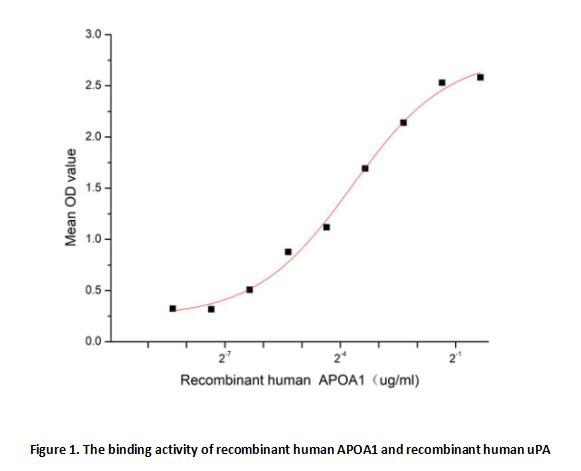 |
Apolipoprotein A1 (APOA1) is the major protein component of HDL particles in plasma. It is a cofactor for lecithin cholesterolacyltransferase (LCAT) which is responsible for the formation of most plasma cholesteryl esters. ApoA1 was also isolated as a prostacyclin (PGI2) stabilizing factor, and thus may have an anticlotting effect. ApoA1 is often used as a biomarker for prediction of cardiovascular diseases. Besides, Plasminogen Activator, Urokinase (uPA) has been identified as an interactor of APOA1, thus a functional binding ELISA assay was conducted to detect the interaction of recombinant human APOA1 and recombinant human uPA. Briefly, biotin-linked APOA1 were diluted serially in PBS, with 0.01% BSA (pH 7.4). Duplicate samples of 100 ul were then transferred to uPA-coated microtiter wells and incubated for 1h at 37℃. Wells were washed with PBST 3 times and incubation with Streptavidin-HRP for 30min, then wells were aspirated and washed 5 times. With the addition of substrate solution, wells were incubated 15-25 minutes at 37℃. Finally, add 50 µl stop solution to the wells and read at 450/630 nm immediately. The binding activity of recombinant human uPA and recombinant human APOA1 was shown in Figure 1, the EC50 for this effect is 0.08 ug/mL. |
| 分子别名Alternative Names | Apo-A1ApoA-1 MilanoProapoA-IProapolipoprotein A-ITruncated apolipoprotein A-I |
|---|---|
| 背景介绍Background | Participates in the reverse transport of cholesterol from tissues to the liver for excretion by promoting cholesterol efflux from tissues and by acting as a cofactor for the lecithin cholesterol acyltransferase (LCAT). As part of the SPAP complex, activates spermatozoa motility. |
| 功能Function | Participates in the reverse transport of cholesterol from tissues to the liver for excretion by promoting cholesterol efflux from tissues and by acting as a cofactor for the lecithin cholesterol acyltransferase (LCAT). As part of the SPAP complex, activates spermatozoa motility. |
| 亚细胞定位Subcellular Location | Secreted. |
| 数据库链接Databases |
基因功能参考文献50 条
- Plasma apoA-I proteolysis is augmented in aortic valve stenosis and cathepsin S exerts the most deleterious effects on apoA-I integrity in humans. PMID: 29915952 : 29915952
- This study explores how the high-density lipoproteins lipid composition influences amyloid deposition by apoA-I and related proteins. PMID: 27768903 : 27768903
- Site-specific, covalent modifications of apoA-I (lysines or arginines) led to altered protein structure, reduced lipid binding capability and a reduced ability to catalyze cholesterol efflux from macrophages, partly in a modification-specific manner. PMID: 29802959 : 29802959
- assessing the quality of ApoA1 and, in turn, that of HDL in circulating blood can serve as an early diagnostic tool for cardiovascular diseases (CVDs). In this study, we developed monoclonal antibodies (mAbs) specific to modified ApoA1 with its tyrosine residue at the 166th position nitrated to 3-nitrotyrosine PMID: 30132720 : 30132720
- Vitreous levels of APOA1 and RBP4 in human rhegmatogenous retinal detachment associated with choroidal detachment reflects the severity of disease. PMID: 29618920 : 29618920
- The objective of this study was to evaluate whether apolipoprotein gene polymorphisms confer susceptibility to osteonecrosis of the femoral head. PMID: 30119683 : 30119683
- Case Report: recurrence of non-familial hereditary apolipoprotein A-I amyloidosis in Japanese transplant recipient with two novel APOA1 mutations. PMID: 29968409 : 29968409
- TNFalpha differently regulated the levels of PPARalpha, LXRalpha, and LXRbeta binding to the apoA-I gene promoter in THP-1 cells. Obtained results suggest a novel tissue-specific mechanism of the TNFalpha-mediated regulation of apoA-I gene in monocytes and macrophages and show that endogenous ApoA-I might be positively regulated in macrophage during inflammation. PMID: 29442267 : 29442267
- An increased apo B/apo A1 ratio was independently associated with all-cause mortality and cardiovascular events in peritoneal dialysis patients. PMID: 29776362 : 29776362
- he present study reveals that there may be a racial/ethnic- and/or gender-specific association between the APOA1 rs964184 SNP and serum lipid parameters in our study populations PMID: 29747660 : 29747660
- In this study the APOA1 (rs670) gene showed important effects on body weight, adiposity, LDL-cholesterol levels and insulin resistance after 12weeks of the dietary intervention PMID: 29859275 : 29859275
- Residues 26-43 of one APOA1 in the smaller particle form a hinge on the disc edge, which displaces the C-terminal domain of the other APOA1 to the phospholipid surface PMID: 29712830 : 29712830
- H1 receptor signaling is a novel pathway of apo A1 gene expression PMID: 29378195 : 29378195
- genetic polymorphisms of ApoA1 rs5070 A/G may play a role in the susceptibility to large artery atherosclerosis among male diabetic patients. PMID: 28238629 : 28238629
- Single Nucleotide Polymorphism in APOA1 gene is associated with dyslipidemia. PMID: 29758034 : 29758034
- rs670, rs2854116, and rs662799 single nucleotide polymorphisms of the APOA1-C3-A5 cluster are associated with ischemic stroke in the northern Chinese Han population. PMID: 28635360 : 28635360
- Higher levels of TG, LPO (P<0.0001), nonHDL/HDL and ApoB/ApoA1 (P<0.001, 0.05, respectively), and lower levels of HDL-c, ApoA1, and PON1 (P<0.0001) were observed in T2DM subjects than in controls. PMID: 29626583 : 29626583
- Data suggest that N(epsilon)-(carboxyethyl)lysine (CEL) modification of ApoA1 is up-regulated in serum from patients with Alzheimer's disease (AD); CEL-ApoA1 is a kind of advanced glycation end product; this leads to up-regulation of anti-CEL-ApoA1 IgM in early disease. Both CEL and anti-CEL IgM may serve as AD biomarkers. PMID: 29680706 : 29680706
- The osteonecrosis of the femoral head patients had higher A/A genotype proportions on the apolipoprotein A1 gene 75bp, compared to the control group, while the G/A genotype frequency was lower in the affected patients. This suggests that the G/A mutation on Apo A1 promoter might be one of the predisposing factors for osteonecrosis of the femoral head. PMID: 28770971 : 28770971
- Independent evidence indicated LpAI:A-II has a diameter 20% smaller than LpAI, consistent with a model having two apoA-I and one apoA-II PMID: 27526664 : 27526664
- ApoA1 combined with 9alpha,11ss-PGF2 represents a useful composite biomarker of anaphylaxis, achieving superior diagnostic power over either factor alone. PMID: 28378321 : 28378321
- Low-dose lipid-free apoA-I treatment in atherosclerotic mice preserves and restores collecting lymphatic vessels function by direct and indirect mechanisms. PMID: 28939717 : 28939717
- APOA1 gene may be associated with low HDL-cholesterol disease in the pastoral area of northwest China. PMID: 28969676 : 28969676
- Our results strongly suggest that plasma concentrations of EPA and DHA influence aspirin effects on lipid mediators of CVD event risk where their concentrations are most beneficial when moderate, not high or low. These effects on HDL-C cholesterol and apoA-I exchange are novel. PMID: 29031392 : 29031392
- A multidisciplinary approach, including circular dichroism, dynamic light scattering, spectrofluorometric and atomic force microscopy analyses, monitored the effect of target cells on the conformation and fibrillogenic pathway of the two AApoAI amyloidogenic variants AApoAI(L75P) and AApoAI(L174S). Specific cell milieus selectively affect conformation, aggregation propensity and fibrillogenesis of these variants. PMID: 29174954 : 29174954
- we demonstrated a 21.6% decrease in serum ApoA-I in FA patients compared with non-affected controls PMID: 29447225 : 29447225
- Smaller apolipoprotein(a) isoform size and increased lipoprotein(a) concentration are independent and causal risk factors for coronary heart disease. PMID: 28408323 : 28408323
- In conclusion, decreasing levels of apolipoproteins B and A1 were associated with increased risk of venous thrombosis. PMID: 28540474 : 28540474
- Serum ApoA-I level was negatively correlated with the formation of vocal fold polyps, suggesting ApoA-I may reduce the risk of vocal fold polyps. PMID: 27816355 : 27816355
- data indicate that low apoA1 levels are an independent predictor of the poor clinical outcomes in invasive ductal carcinoma patients. PMID: 28595037 : 28595037
- Data suggest that Apolipoprotein A1 (ApoA-1) might be a promising therapeutic target to reduce recurrence and metastasis for hepatocellular carcinoma (HCC) patients after resection. PMID: 27683106 : 27683106
- The generated structures provide evidence for the discoidal, antiparallel arrangement of apoA-I in nascent HDL, and propose two preferred conformations of the flexible N-termini PMID: 28754383 : 28754383
- identified that apolipoprotein-A1 and haptoglobin had significant predictive values for the prediction of recovery at 12 weeks in DILI, enabling the construction of a new prognostic panel, the DILI-ActiTest, which needs to be independently validated PMID: 29287080 : 29287080
- ApoA1 is associated with neurite outgrowth after mechanical injury by mediating polymerisation of actin and restricting inflammatory responses after injury which are deleterious to healing. PMID: 27100352 : 27100352
- A retractable lid in lecithin:cholesterol acyltransferase provides a structural mechanism for activation by apolipoprotein A-I PMID: 29030428 : 29030428
- Lower ApoA1 improves the risk prediction of new type 2 diabetes PMID: 28502492 : 28502492
- Following ETC-216 administration to normal human volunteers, an initial dose-dependent HDL-C elevation was observed. Thereafter, subjects transiently acquired a lipoprotein profile similar to that of AIM carriers, including reduced HDL-C and mild hypertriglyceridemia. PMID: 27155060 : 27155060
- The different anti-inflammatory mechanisms of the ApoA-I cysteine mutants might be associated with the regulation of ATF3 level. PMID: 28093456 : 28093456
- Anti-apoA-1 IgG are independent predictors of nonfatal incident coronary artery disease in the general population. The strength of this association is dependent on a functional polymorphism of the CD14 receptor gene, a finding suggesting a gene-autoantibody interaction for the development of CAD. PMID: 29074586 : 29074586
- In vitro proteolysis of the apoA-I-Cy5.5 probe by a variety of proteases including serine, cysteine, and metalloproteases resulted in an up to 11-fold increase in fluorescence, allowing for quantification of apolipoprotein A-I proteolytic degradation. PMID: 28167355 : 28167355
- Using atomic force microscopy, detail the ring-shaped coarse structure, and the three detailed structures of apoA-I directly derived from spherical HDL through NP-40-induced lipid depletion. PMID: 28279834 : 28279834
- These data suggest that high doses of insulin downregulate apoA-I gene expression in HepG2 cells through redistribution of FOXO1/LXRbeta complex, FOXA2, and LXRalpha on hepatic enhancer of apoA-I gene. PMID: 27404023 : 27404023
- Our findings suggest that serum ApoA-I level should be evaluated as a predictor of survival in patients with esophageal squamous cell carcinoma PMID: 27444612 : 27444612
- Inflammatory markers modify the risk of recurrent coronary events associated with apolipoprotein A-I in postinfarction patients PMID: 28391888 : 28391888
- Serum Apo-A1 was significantly lower in term SGA newborns compared to control term newborns. PMID: 28304324 : 28304324
- This study showed that the predictive value of apolipoprotein B/A-I ratio for coronary artery calcification may differ according to kidney function. PMID: 28957410 : 28957410
- Findings suggest that the ABCG1-mediated efflux of cholesterol, but not of 7-ketocholesterol, shows specificity for structural domains of apoA-I bound to reconstituted HDL. Although the mid region alone of apoA-I associated to rHDL can promote ABCG1-mediated cholesterol efflux, deletion of carboxyl-terminal region 185-243 from full-length apoA-I diminishes ABCG1-mediated cholesterol efflux. PMID: 23826352 : 23826352
- Low APOA1 expression is associated with coronary artery disease severity. PMID: 28038449 : 28038449
- Data suggest that activation of SR-BI by APOAI down-regulates sphingosine 1-phosphate/S1PR2-mediated inflammation in vascular endothelial cells by activating the PI3K/Akt signaling pathway; oxidized-LDL does the opposite. (APOA1 = apolipoprotein A-I; SR-BI/SCARB1 = scavenger receptor class B type I; S1PR2 = sphingosine 1-phosphate receptor 2; PI3K = phosphatidylinositol 3-kinase; Akt = proto-oncogene c-akt) PMID: 28181168 : 28181168
- The minor alleles of rs662799 (APOA5) and rs5072 (APOA1) modulate TG levels in Mexican children PMID: 27171122 : 27171122
蛋白复溶体积计算器缓冲液体积 = 蛋白质量 ÷ 蛋白浓度
输入任意两项,第三项自动计算 |
蛋白浓度稀释计算器初浓度 × 初体积 = 终浓度 × 终体积
输入任意三项,第四项自动计算 |



