


| 纯度Purity | Greater than 95% as determined by reducing SDS-PAGE |
|---|---|
| 内毒素Endotoxin | <0.01 EU/µg as determined by LAL test. |
| 蛋白构建Protein Construction |
【Pro19-Pro261】序列区间-6HisC 端标签
|
| Accession | P20151 |
| 表达宿主Expression Host | HEK293 |
| 种属Species | Human |
| 预测分子量Predicted MW | 27.9 kDa |
| 制剂Formulation | Lyophilized From a 0.2 μm filtered solution of 20mM Acetate, 250mM Trehalose, 0.02% Tween 80, pH5.0. |
| 运输方式Shipping | The product is shipped with ice bag. Upon receipt, store it immediately at the temperature listed below. |
| 稳定性&储存Stability & Storage | 12 months at -20°C to -80°C in lyophilized state.6 months at -20°C to -80°C under sterile conditions after reconstitution.7-10 days at 2°C to 8°C under sterile conditions after reconstitution.Please minimize freeze-thaw cycles. |
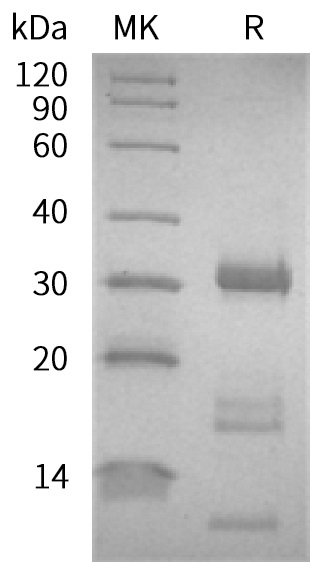 |
Greater than 95% as determined by reducing SDS-PAGE. |
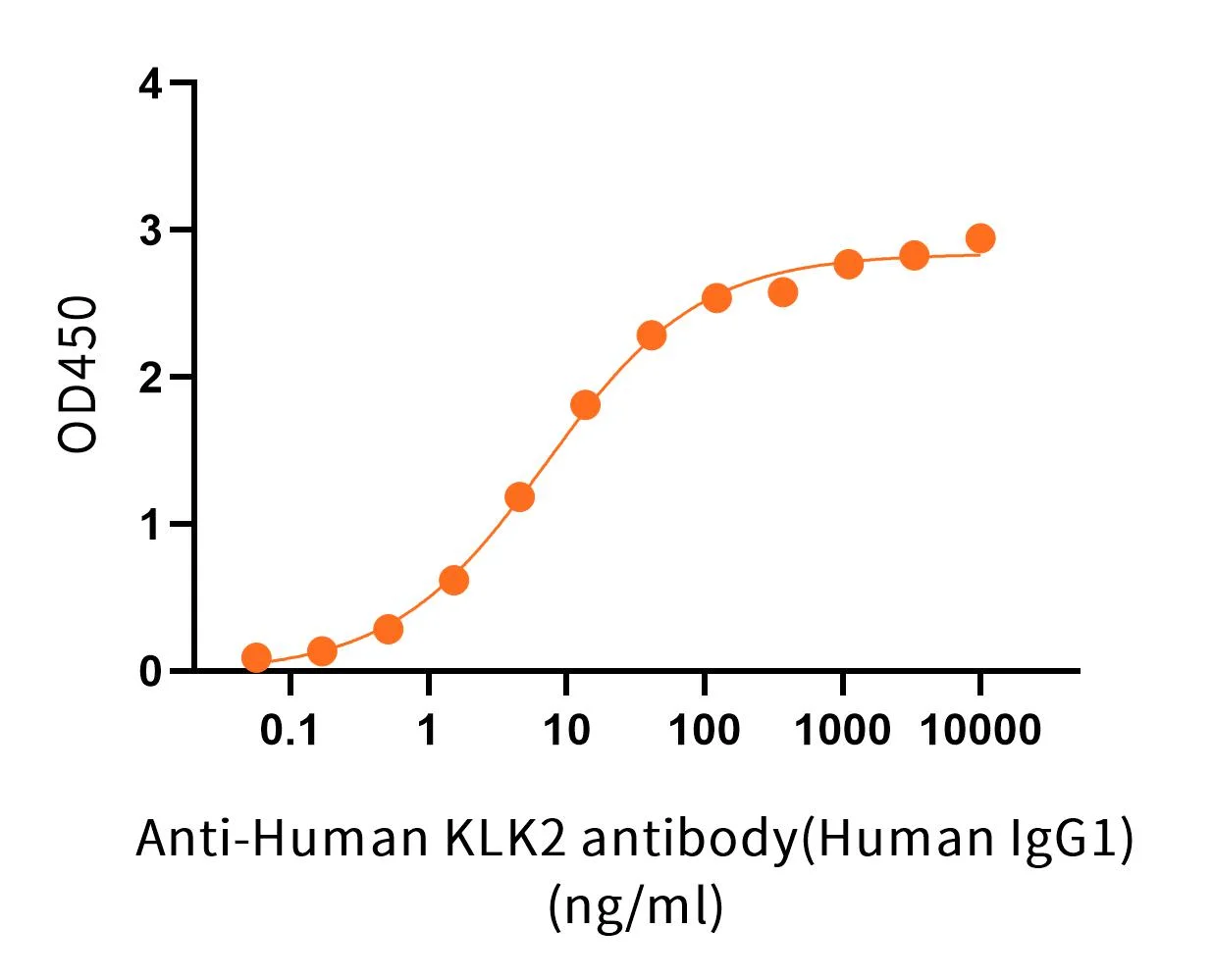 |
Immobilized Recombinant Human KLK2 (C-6His) at 1μg/ml (100 μl/well) can bind Anti-Human KLK2 antibody(Human IgG1). The ED50 of Anti-Human KLK2 antibody(Human IgG1) is 7.06 ng/ml.(Regularly tested) |
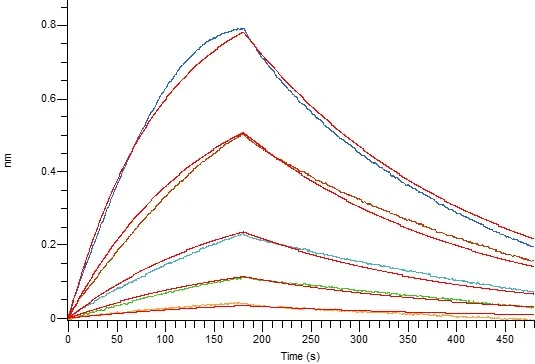 |
Loaded Anti-Human KLK2 antibody on Pro-A Biosensor, can bind Recombinant Human KLK2 with an affinity constant of 34.4 nM as determined in BLI assay. (Regularly tested) |
| 分子别名Alternative Names | Kallikrein-2Glandular Kallikrein-1hGK-1Tissue Kallikrein-2KLK2 |
|---|---|
| 功能Function | Glandular kallikreins cleave Met-Lys and Arg-Ser bonds in kininogen to release Lys-bradykinin. |
| 数据库链接Databases |
基因功能参考文献29 条
- glycosylation changes the enzymatic activity of KLK2 in a drastically substrate-dependent manner. PMID: 26582203 : 26582203
- The results indicated that W-hK2 had a defect in cellular trafficking due to its misfolding and that it activated the unfolded protein response, suggesting a mechanism to explain the association of the T allele with higher prostate cancer risk. PMID: 25847286 : 25847286
- miR-378 was predicted to target both KLK2 and KLK4 and downregulated levels detected in prostate cancer patients. PMID: 25153390 : 25153390
- The differential regulation of alternative transcripts (using KLK2, KLK3 and KLK4 as models) by androgens and anti-androgens as an indicator of prostate cancers, was investigated. PMID: 25153393 : 25153393
- Structure-function analyses of KLK2 establish the 99-loop as master regulator of its activity. PMID: 25326387 : 25326387
- Predictions based on levels of four kallikrein markers, including KLK2, in blood distinguish between pathologically insignificant and aggressive disease after radical prostatectomy with good accuracy. PMID: 23683475 : 23683475
- Alteration of cellular junctions in benign prostatic hyperplasia could contribute to the presence of luminal epithelial secreted proteins prostate specific antigen (PSA)2 and and KLK2 in the stromal compartment. PMID: 24711254 : 24711254
- we present the first evidence that KLK2 can also function as an androgen receptor modulator that may modulate cell growth after the development of castration-resistant prostate cancer PMID: 24122203 : 24122203
- Associations observed in young, healthy men between the seminal plasma and serum concentrations of hK2 and PSA and several genetic variants in KLK2 and KLK3 could be useful to refine models of PSA cutoff values in prostate cancer testing. PMID: 24270797 : 24270797
- Genetic variants at ATF7IP and KLK2 contribute to the variance of %fPSA. PMID: 23359319 : 23359319
- Two SNPs, in beta-microseminoprotein at and in kallikrein-related peptidase 2 at, are associated with PCA3 score at genome-wide significance level PMID: 23555189 : 23555189
- TK promotes vessel growth by increasing the number of EPCs and enhancing their functional properties through the kinin B(2) receptor-Akt signaling pathway. PMID: 22435954 : 22435954
- An exploratory study of a KLK2 polymorphism as a prognostic marker in prostate cancer was found to be less likely associated with low Gleason score morphology. PMID: 21178268 : 21178268
- we identifiedand genotyped novel single-nucleotide polymorphisms in cancer cases and controls which verified prior associations in KLK2 and in MSMB (but not in KLK3) with prostate cancer PMID: 20424135 : 20424135
- Data show six non-synonymous amino acid or frame shift changes in the KLK3 gene and three changes in each of the neighboring genes, KLK15 and KLK2. PMID: 19823874 : 19823874
- The identification of unusual mRNA splice variants of the KLK2 and KLK3 genes that result from inclusion of intronic sequences adjacent to the first exon. PMID: 11834722 : 11834722
- Characterization of androgen receptor and nuclear receptor co-regulator expression in human breast cancer cell lines exhibiting differential regulation of kallikreins 2 and 3. PMID: 12124798 : 12124798
- kallikrein expression in nipple aspirate fluid- ethnic variation PMID: 12209605 : 12209605
- Measurements of free prostate specific antigen and hK2 improve on our ability to counsel patients prior to treatment as to their risk of biochemical recurrence PMID: 16152616 : 16152616
- An additional serum marker for the detection of prostatic cancer. PMID: 16388506 : 16388506
- a role for the KLK2 gene in prostate cancer susceptibility PMID: 17085659 : 17085659
- results imply that prostate cancer risk is associated with androgen receptor(AR)-CAG repeat and kallikrein-2 polymorphisms in Indian population but no unambiguous association was observed with PSA and AR-GGN repeat polymorphism PMID: 17257635 : 17257635
- role of kallikrein gene 2 and 3 variant SNPs in the etiology of prostate cancer among men of European ancestry PMID: 17593395 : 17593395
- %fPSA and hK2 add important predictive value in older men and much closer to diagnosis PMID: 17657743 : 17657743
- The two novel ETV4 fusion partners possess as predominant common characteristics androgen-induction and prostate-specific expression. PMID: 18451133 : 18451133
- Recombinant hK2 activates ERK1/2 signaling of prostate cancer cell lines, which express both PAR1 and PAR2. PMID: 18567807 : 18567807
- adding free PSA and human kallikrein 2 to standard pretreatment risk-assessment models to predict biochemical recurrence after radical prostatectomy for prostate cancer enhanced the AUC PMID: 19003994 : 19003994
- PSA and kallikrein 2 transcripts in the peripheral blood of prostate cancer patients during barchytherapy could serve as a predictor of biochemiacl outcome. PMID: 19434652 : 19434652
- Observational study of gene-disease association, gene-gene interaction, and genetic testing. (HuGE Navigator) PMID: 19223501 : 19223501
蛋白复溶体积计算器缓冲液体积 = 蛋白质量 ÷ 蛋白浓度
输入任意两项,第三项自动计算 |
蛋白浓度稀释计算器初浓度 × 初体积 = 终浓度 × 终体积
输入任意三项,第四项自动计算 |



